There comes a point in any genealogical research where we finish examining the “basic” record sets. To the Greek genealogist, these are:
We have extracted relevant data, entered information into our research databases, saved original images (digitizing any paper copies) and written exact source citations. After evaluating what was found, we decide if we want to go further. Most of us do, but we don’t know how to proceed.
- What additional records are available?
- Where are they kept?
- How can we access them?
To add to our confusion and frustration, we face the language issue. Old documents are generally handwritten and even our familiar surnames can be difficult to decipher. See this 1844 Voter List for my great-grandfather, Andreas Kostakos / Ανδρέας Κωστάκος: [click on any images in this post to make them larger]

1844 Election Register, Line 1205; Andreas Kostakos, age 35
The first name looks like “Μαθ” not “Ανδ”. The first two and last two letters of the surname, “Κω” and “ος” are easy to read, but I struggled to decipher “στακ” in the middle.
Despite this somewhat daunting scenario of finding and reading records, there is hope! Last month, Gregory Kontos, established a name-searchable website, GreekAncestry.net. His goal is to preserve and make accessible records from Greece. I went to the search page, clicked on Lakonia, and began entering surnames in English. (Searches are bi-lingual and can be done in Greek or English).
In July 2017, I had found the marriage record of my 2nd great-grandmother, Eleni G. Dimitrakakis, at the Metropolis of Sparta, which named her father as Giannakis from Mystras.

Mitropolis of Sparta, Marriage Index Book
Book: Sparta, 1852-1859
Entry #524
License Date: February 13, 1859
Marriage Date: not given
Groom: Panagiotis Lerikos, no father listed; residence: Agios Ioannis
Bride: Eleni Dimitrakakis, father: Giannakis; residence: Mystras
Church: Agios Georgios
First marriage for both bride and groom
Image DSC_0182
Photographed by Carol Kostakos Petranek, July 2017
I wondered if there could be any records for that family, so I typed Dimitrakakis (Δημητρακάκης) and the following results appeared:
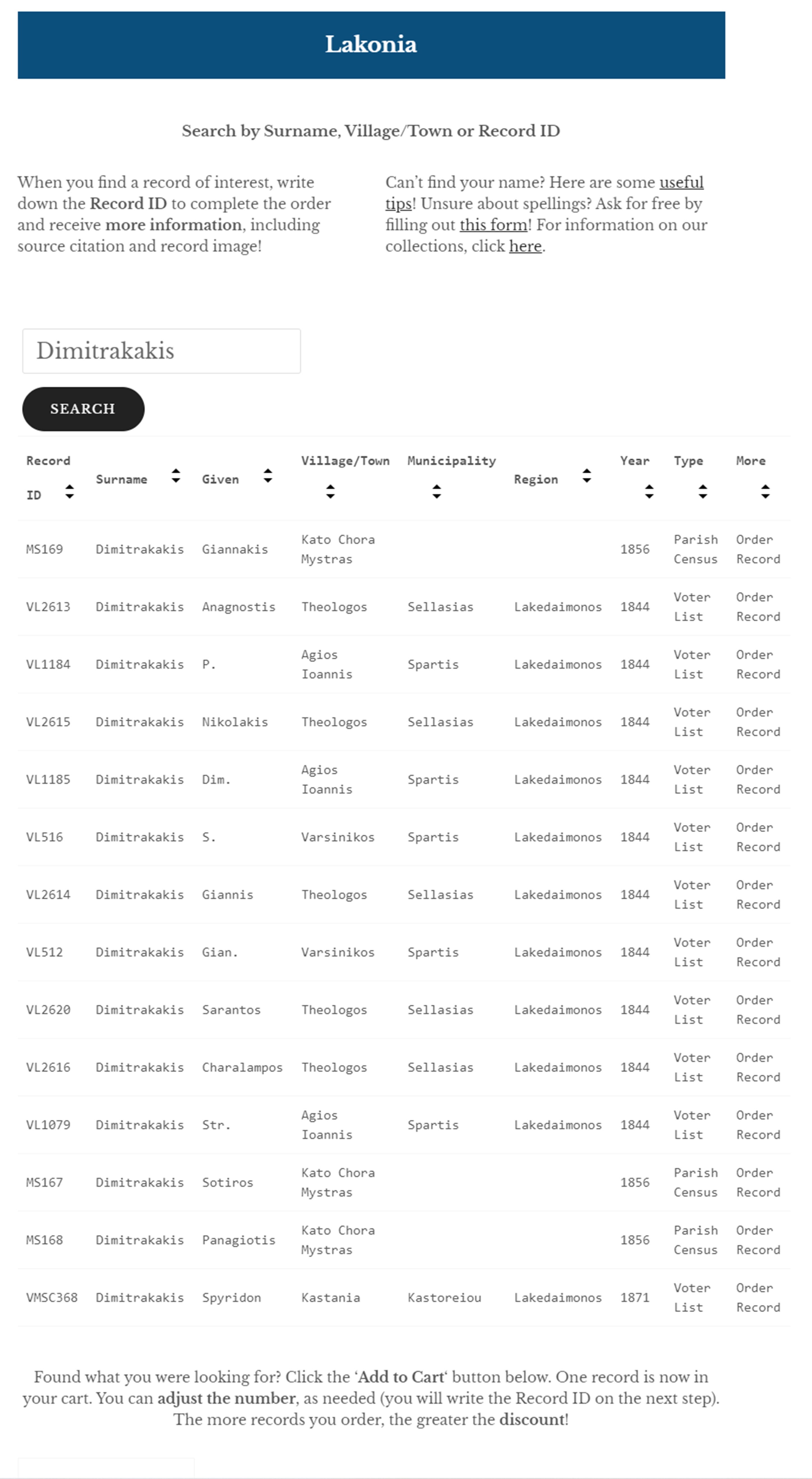
Dimitrakakis surname in Lakonia, GreekAncestry.net
The right hand columns give the record collection name and date. Besides the 1844 and 1871 Voter List, there is an 1856 Parish Census. The first entry is for Giannakis Dimitrakakis, my 3rd great-grandfather and his wife, Politimi!
I ordered the record and received the following original image and translation with full source citation. Giannakis Dimitrakakis is on line 67:
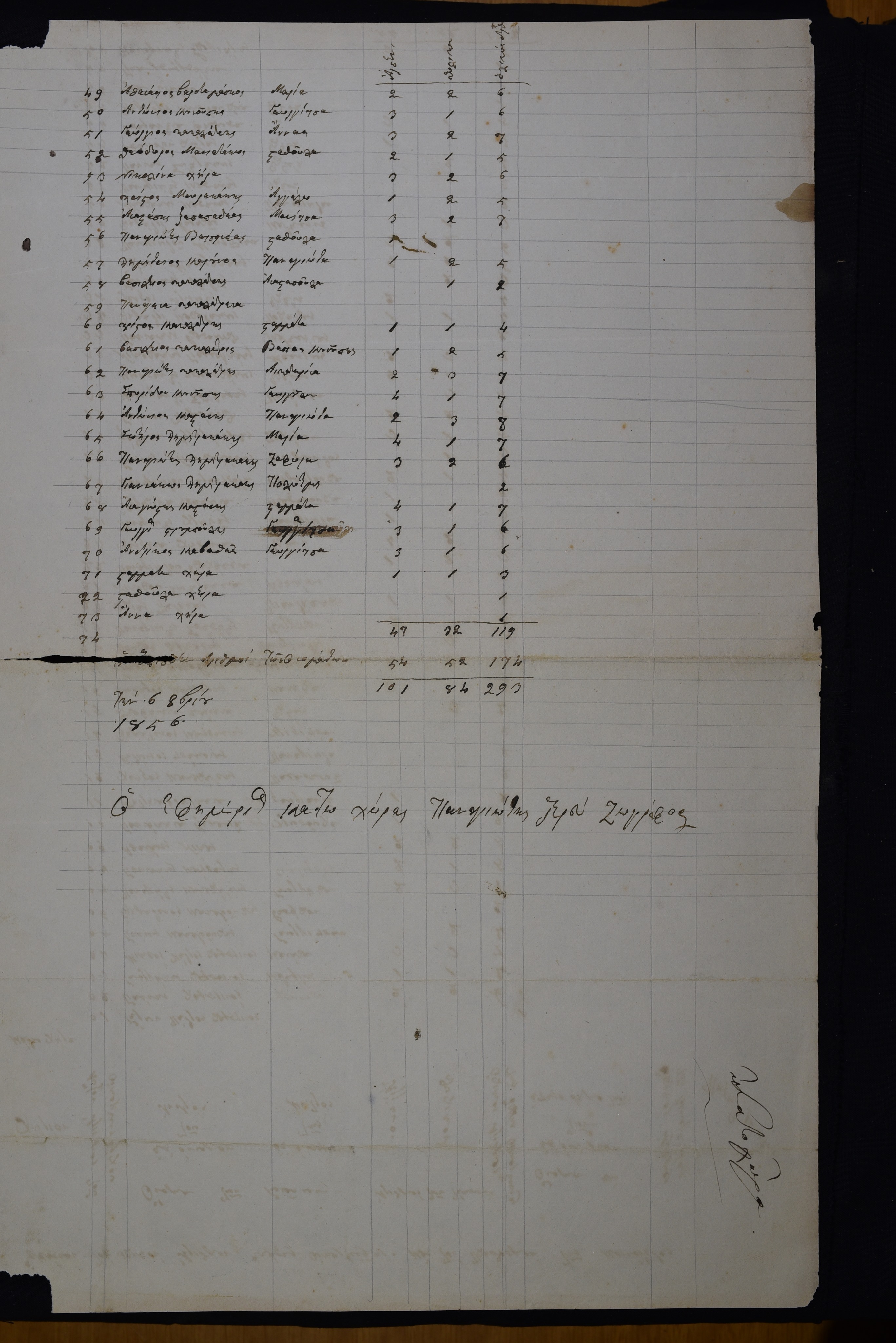
1856 Parish Census, Mystras / Kato Chora
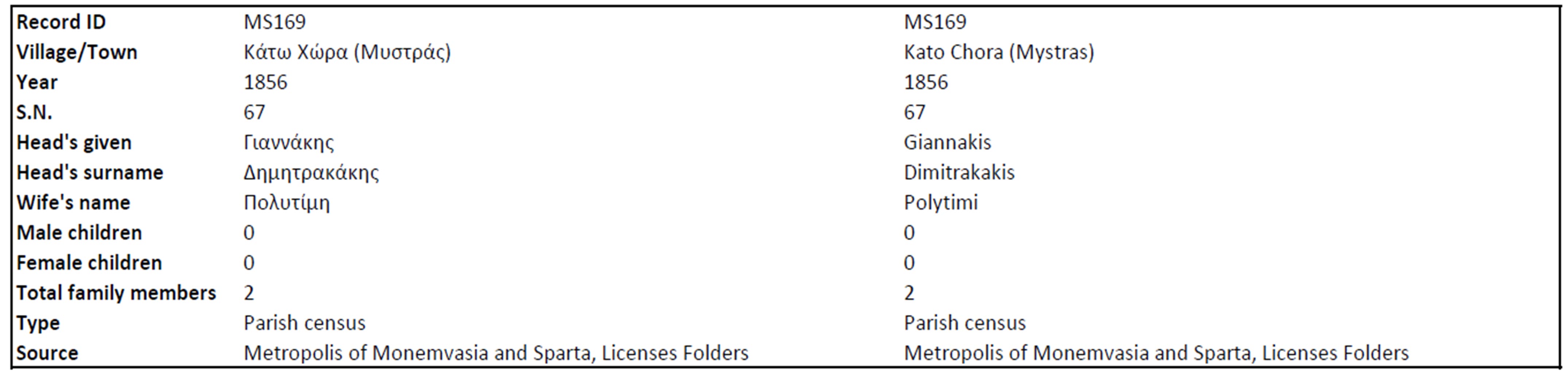
1856 Kato Chora Parish Census Transcription
I am so grateful to have this translation! Although the priest’s writing is neat, it is still a challenge to read and I may not have been able to identify my Dimitrakakis name.
Clicking on the “Collections” page of GreekAncestry provides information about this record set (available for the villages of Kato Chora-Mystras, Parori, and Oitylo) and other collections available on the website:
Parish censuses were censuses of all the families of a parish conducted by the local priest. They were important for church organization reasons. A parish census includes the name of the head of the family (which, in some cases, were widows), his wife’s name, as well as the number of their children, male and female.
It’s hard to describe my excitement at learning the name of my 3rd-great grandmother, Politimi, in this document! Finding the names of women in Greek records is especially challenging, which is why this collection is especially important. To learn more, see “Women in Greek Archives – Missing Half of Us.”
I will be sharing any additional “beyond the basics” information that I become aware of through GreekAncestry and other sources. Stay tuned and stay hopeful–our research can and will move forward!


 Spartan Roots (Σπαρτιατικές Ρίζες)