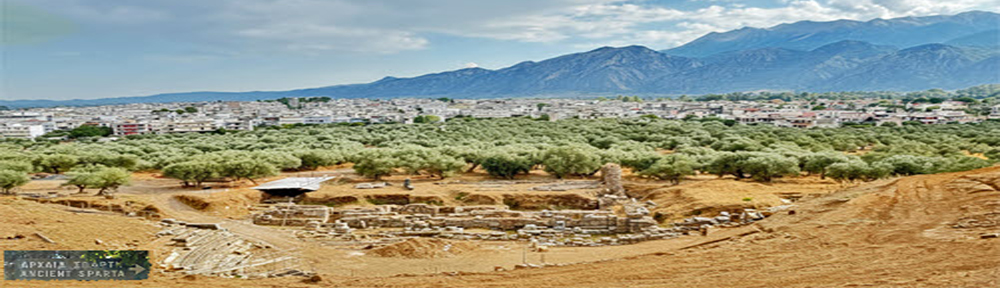
Eftaxias / Eftaxas in Laconia

Searching my Eftaxias family in Laconia is yielding some exciting results. My great-great grandfather, Ioannis Eftaxias1, was born in 1809 in Mystras. As far as can be determined, he is the oldest Eftaxias in Mystras. He had two sons listed in the 1872/1873 Election Rolls: my great-grandfather, Konstandinos2, (born 1840) and Georgios(born 1848).

Dimitrios Eftaxias4, born 1846 in Mystras, is also found in these Election Lists; however, his father is not named. It is very likely that Ioannis is his father, because Ioannis is the only male Eftaxias in Mystras who is of the age to be a father during that time period. I am hoping that the staff at the Archives office in Sparta will be able to resolve this by finding Dimitrios in the Male Register, which will list his father.

My friend, historian and teacher, Giannis Michalakakos, has found the name in two areas in Laconia: Mystras and Lagia (Mani). He said this name is rare and may be Byzantine in origin. It is likely that all Eftaxias from Laconia are blood-related. Giannis surmises that members of the Eftaxias family moved from Lagia north to Mystra after the 1821 Revolution, as this was a time of widespread migration throughout southern Greece. When the Ottoman occupation ended, families were free to move about, unmolested and unafraid. It was common for families to leave their hiding places in the forbidding mountains to find work in cities and farming opportunities in the fertile plains of Laconia.

A newly-found Eftaxias relative was told by his father that his family originated in Kalamata. Corroborating this, the map below reveals the route from Lagia through Kalamata to Mystras. Understanding migration patterns helps us move back through time.
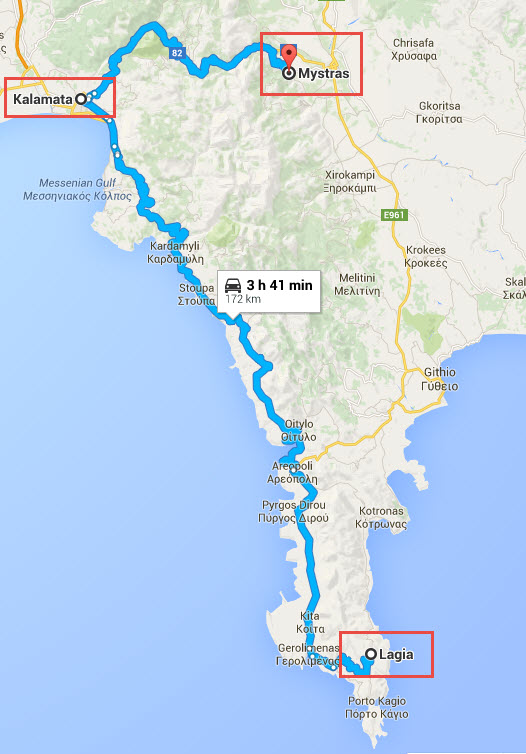
Lagia-Kalamata-SpartaGiannis determined that the oldest Eftaxias in the village of Lagia is Mihalis Eftaxias, born about 1800. He fought in the 1821 Revolution. Mihalis had a son named Vrettos, and Vrettos had two sons: Michalis5 (born 1826) and Panagiotis6 (born in 1832).

The Eftaxias name is found in Atatka, the first Modern Greek dictionary! The Atatka was compiled by Adamantios Korais, a Greek humanist scholar who played an influential role in the Greek Enlightenment, the 1821 Revolution, and in particular the development of the “purist” Greek language, Katharevousa. His monumental work, Atatka, is comprised of 17 volumes and was published in France in 1832.

Recently Giannis sent me an entry from page 147 of Volume One of Atakta, where the name “Eftaxias” appears.
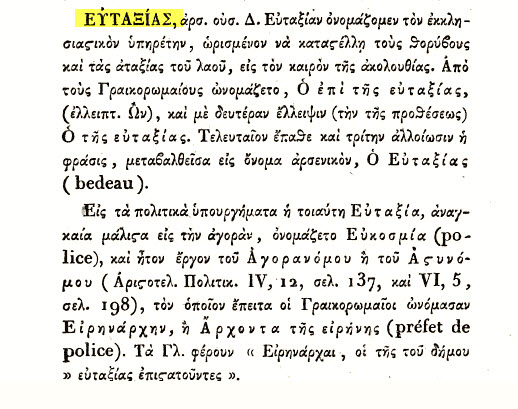
Page 147, "Eftaxias"

Page 147, “Eftaxias”

A rough translation reveals that Eftaxias is an ecclesiastical servant; one who keeps the order of the church. [From Gregory Kontos: Ευταξίας: good=ευ, order=τάξη]. He is the one that ensures there is orderliness among the people by preventing disorderly conduct, noise and mischief. There is reference in this document that Eftaxias was named “the Lord of peace.” This description gives me a most interesting insight into my ancestor who was first given (or adopted) this name.

Some families spell the name without an “i”:  Eftaxas. Giannis explained that in the Maniate language, the name is pronounced Eftaxeas (accent on the 2nd e, and pronounced as a long e). The family is part of a Maniat clan (blood related families with different names) named Ksifomaheridianoi. Other branches of families from this clan are Kassimis, Royssakos, and Kapylorihos, all of whom remained in Lagia.

Along with clan affiliations, name changes pose real challenges. Most occur from either παρατσούκλι (paratsoúkli) which is a nickname; or creating a surname from a given name —  males taking the given names of their fathers and adding -akos to indicate “son of.” Example: my surname, Kostakos, means “son of Kostas.” Thus, the original surname is lost. Reading through Election Rolls, I see this phenomenon on almost every page in Mani records. With the Eftaxias name having a distinct definition, there is no name change. Tracking down the “first” Eftaxias would be a fabulous find!

Sources:

1General Archives of Greece, Election Lists, 1843-44
File 22, Image 62, Line 239, Mystras
Ioannis Eftaxias, age 35, owns property; gardener; no father listed

2General Archives of Greece, Election Lists, 1872
File 25, Image 404, Line 573, Mystras
Konstandinos Eftaxias, age 32, shepherd; father: Ioannis

3General Archives of Greece, Election Lists, 1875
1872: File 25, Image 402, Line 480, Sparta-Mystras
Line 480 : Georgios Eftaxias, age 24, b.1848; occupation: student; father: not named

4General Archives of Greece, Election Lists, 1872
1872: File 25, Image 403, Line 506, Sparta-Mystras
Line 506: Dimitrios Eftaxias, age 26, occupation: shepherd; father: not named

5 General Archives of Greece, Election Lists, 1875
File 9, Image 99, Line 188, Lagia
Mihalis Eftaxias, age 49, farmer, father: Vrettos,

6 General Archives of Greece, Election Lists, 1875
File 9, Image 100, Line 237, Lagia
Panagiotis Eftaxias, age 43, farmer; father: Vrettos


Research and Remembrances, Part 6

On to Mani!

How can I describe Mani? It is beautiful yet forbidding, spectacular yet humble, historical yet contemporary. It is an amalgam of opposites; a study in contradictions. It is part of my heritage. I am trying to determine which lines in my family migrated from Mani into Sparta. I’ve done a search in Election Rolls, looking for my surnames in areas in Mani. There are many, and unfortunately without corroborating evidence, I can’t determine which people are my direct lines. Church records are such a vital key, but they did not open to me during this trip. Next time!

Gregory and I met our friend, Giannis Michalakakos, in Areopoli where our adventure began. Giannis is from the village of Nifi, and he is an expert on all-things Mani. Giannis keeps a blog, Maniatika, where he chronicles history, genealogy, and culture.

My dear friends, Giannis Michalakakos (left) and Gregory Kontos (right).

My dear friends, Giannis Michalakakos (left) and Gregory Kontos (right).

Areopoli is an amazing town! It’s name means “the city of Ares” who was the god of war. It was here that, on March 17, 1821, Petrobey Mavromichalis united many clans of Mani and began a movement that resulted in the Greek War of Independence from Turkish rule.

Statue of Petrobey Mavromichalis, in the Aeropoli town square

Statue of Petrobey Mavromichalis, in the Aeropoli town square

I have never seen anything like Areopoli — ever! The “tower” architecture of Mani is built into every building: rectangular with thin and narrow windows, always constructed of stone.

This post will be mostly photographs with captions, as one picture is truly worth 1,000 words!

Aeropoli

Courtyard in Areopoli

Alley in Aeropoli

Alley in Areopoli

Dining tables are found outside every cafe and restaurant

Dining tables are found outside every cafe and restaurant

Even Churches have the tower architecture

Even Churches have the tower architecture

This building was erected in 1818, three years before the Greek Independence Revolution began with uprisings in Aeropoli

This building was erected in 1818, three years before the Greek Independence Revolution began with Petrobey Mavromichalis from Areopoli

This is a restaurant , such a perfect mix of old and new.

This restaurant  is a perfect blend of old and new.

Mani-Aeropoli (32)

Trees and flowers add splashes of color to this courtyard in Aeropoli

I’ve never seen a bookstore quite like the one below! It has everything from old newspapers to history books to tourist souvenirs. Giannis knows the owner, who welcomed us warmly and gave me a CD of a helicopter ride over Mani.

 'Adouloti Mani' Bookshop owned by Georgios Dimakogiannis

‘Adouloti Mani’ Bookshop owned by Georgios Dimakogiannis

We spent the night in the Hotel “Areospolis” – charming, quaint and very comfortable.

Hotel Aeropolis

Hotel Areospolis

The next morning we embarked on a road trip unlike any I have ever undertaken — through the narrow, switchback roads that wind around the mountains and through villages. There are times I couldn’t believe that we were actually on a road!

Carol in car

The homes in Mani are stark, isolated and impenetrable. Many are carved into the rugged hillsides, which led me to wonder how they ever were built.

Houses and villages

Houses and villages reveal that people have tamed the forbidding countryside

Our southernmost destination on this trip was Vathia, which Giannis promised was one of the most beautiful places in Mani. He was right! As we drove the winding road into the town, we saw a produce truck. Fruits and vegetables were protected from the blazing sun by a white tarp, and the all-important scale swung back and forth as the truck made its way through the villages.

Produce truck making its rounds through the villages of southern Mani

Produce truck making its rounds through the villages of southern Mani. We drove the same road into Vathia.

Entering Vathia

Entering Vathia

Vathia is

Vathia overlooks the sea, and vegetation punctuates the rocky hillsides.

Vathia tower houses

Vathia tower houses have a seaside view

Our ride out of Vathia towards Kotrona provided us with incredible views of the sea.The aquamarine blue provides a stark contrast to the barren hillsides.

Leaving Vathia, headed towards Kotrona

Leaving Vathia, headed towards Kotrona

Churches are everywhere, both large and small. We had to stoop to enter this one, which was constructed by a family for personal use only.

Interior of a tiny church

Interior of a tiny family church

Of course, what is a trip to Greece without donkeys and goats?

Donkey and goats abound!

Donkey and goats abound!

Gregory and I left Giannis at his home in Nyfi and headed north, up the east coast of

Mani. Kotronas was a beautiful place to stop for lunch.

Kotronas, an idyllic village by the sea

Kotronas, an idyllic village by the sea

A cemetery in the countryside

A cemetery in the countryside

As we drove into the lush farmland of the Spartan plains, I felt as if I had traveled from one distinct world into another. Such variety of places, people and scenery in a one-day car ride!

View of the plains of Sparta from the mountain village of Anavriti

View of the plains of Sparta from the mountain village of Anavriti

This first visit to Mani has left me with a deep-seated desire to return. There is so much to explore and experience! I can now understand why the Turks and Nazis could never overtake this area of Greece. The resilience and resistance of the people who adapted to this harshly beautiful land was no match for the greatest armies of our times. I am so deeply proud to be a descendant of Maniates!

If you would like to read more about this amazing area, this brief essay, “The Deep Mani,” written by Diana Farr Louis, combines history and photos.

Mani: My Grandparents’ Ancestral Homeland

Lately, I have been reading about the history of Mani, an area in the far southern Peloponnese now shared by Laconia and Messinia. The Maniates were known to be strong, resilient, clan-oriented people, indomitable in war and ferocious in defending family honor. When I was last in Greece, at the Archives in Sparta, I asked an archivist about the origins of my four grandparents’ surnames: Kostakos, Papagiannakos, Aridas (possibly Mihalakakos) and Eftaxias. He responded that those names most likely originated in Mani, and he proceeded to explain the reputation and temperament of the Maniates.

A chord of pride struck my soul — these are my people! This is the blood that flows in my genes. I, too, can face life’s challenges and overcome obstacles. I am a Maniate.

Reading this book, Mani and the Maniates by Dimos N. Mexis, has led me to further research on the internet. A friend referred me to the blog, Maniatika, hosted by Giannis Mihalakakos and George Athanasakos. This is an outstanding source of history, genealogy, village information and current news. These men are devoted to keeping  alive the traditions of their ancestors and the spirit of their land. They are passionate about this mission and it is evident in the time they devote to their blog and their interest in helping others.

I am so impressed with the commitment of these young men, as well as my friend, Gregory Kontos  (http://gkfamilytrees.wordpress.com/). Their generation will ensure that the glory of Greece is not only remembered, but carried forth.