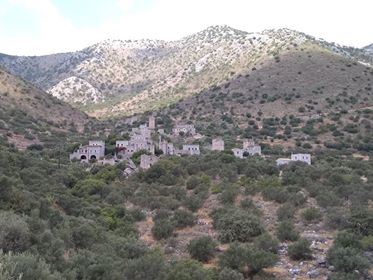
Pirates and invaders. Warring clans. Fortified towers. The legends of Vathia are captivating and plunge you into an era of the past. Vathia was built as a fortress to protect its families from hostile attacks. A sign in the midst of this “ghost village” alludes to its history:

My first introduction to the tower villages of Mani was in 2014 when Giannis Michalakakos took Gregory Kontos and me to Vathia. My fascination has not waned, but accelerated. It’s not only the architecture, but also the stories, myths, customs, and traditions of this land that captivate my imagination.
My ancestors were from Mani, as reflected in their surnames and in family stories. Their genesis in this region and their migration north began before the revolution of 1821, as they are in Agios Ioannis, Sparta in the 1844 Election Registers. Because records prior to the Revolution do not exist in the modern Greek state, I cannot trace where, in Mani, they originated. However, every time I come to this region, I feel a metaphysical connection to this land and to them.
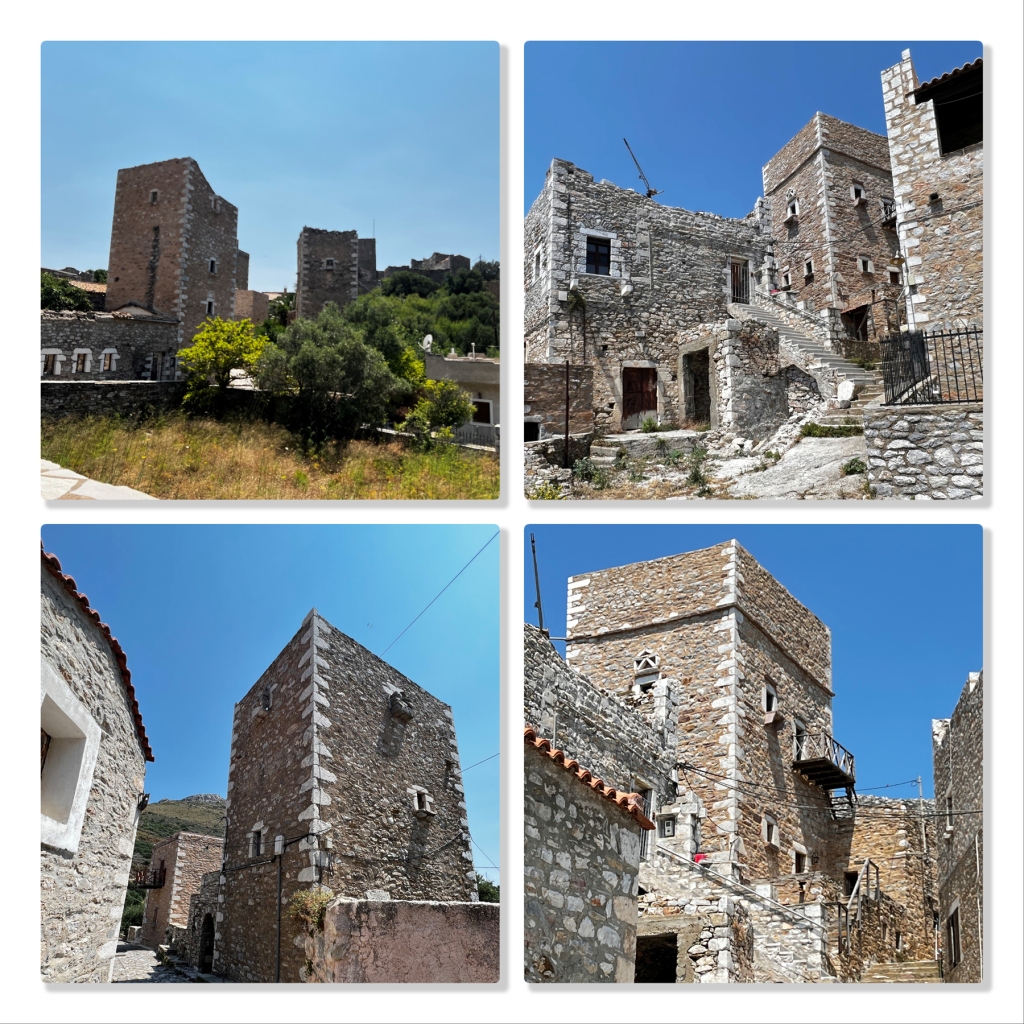
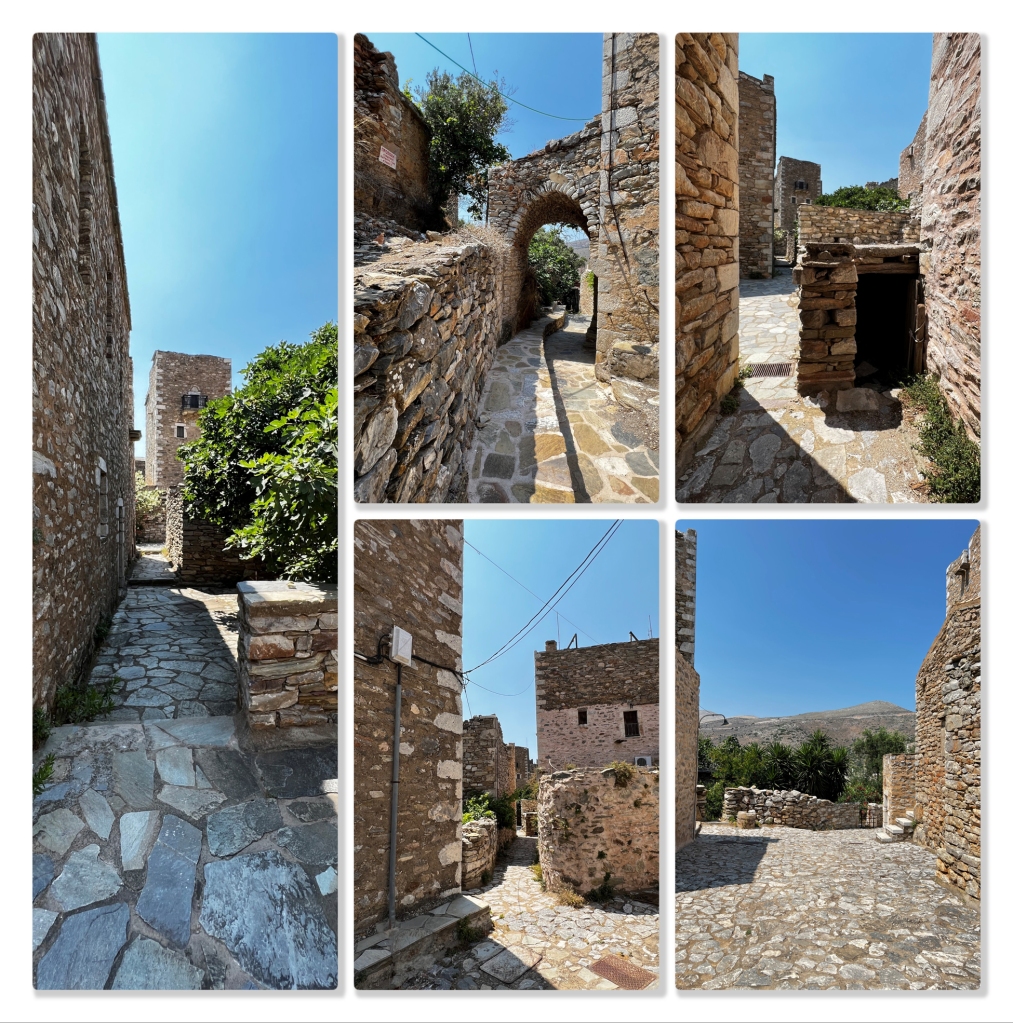
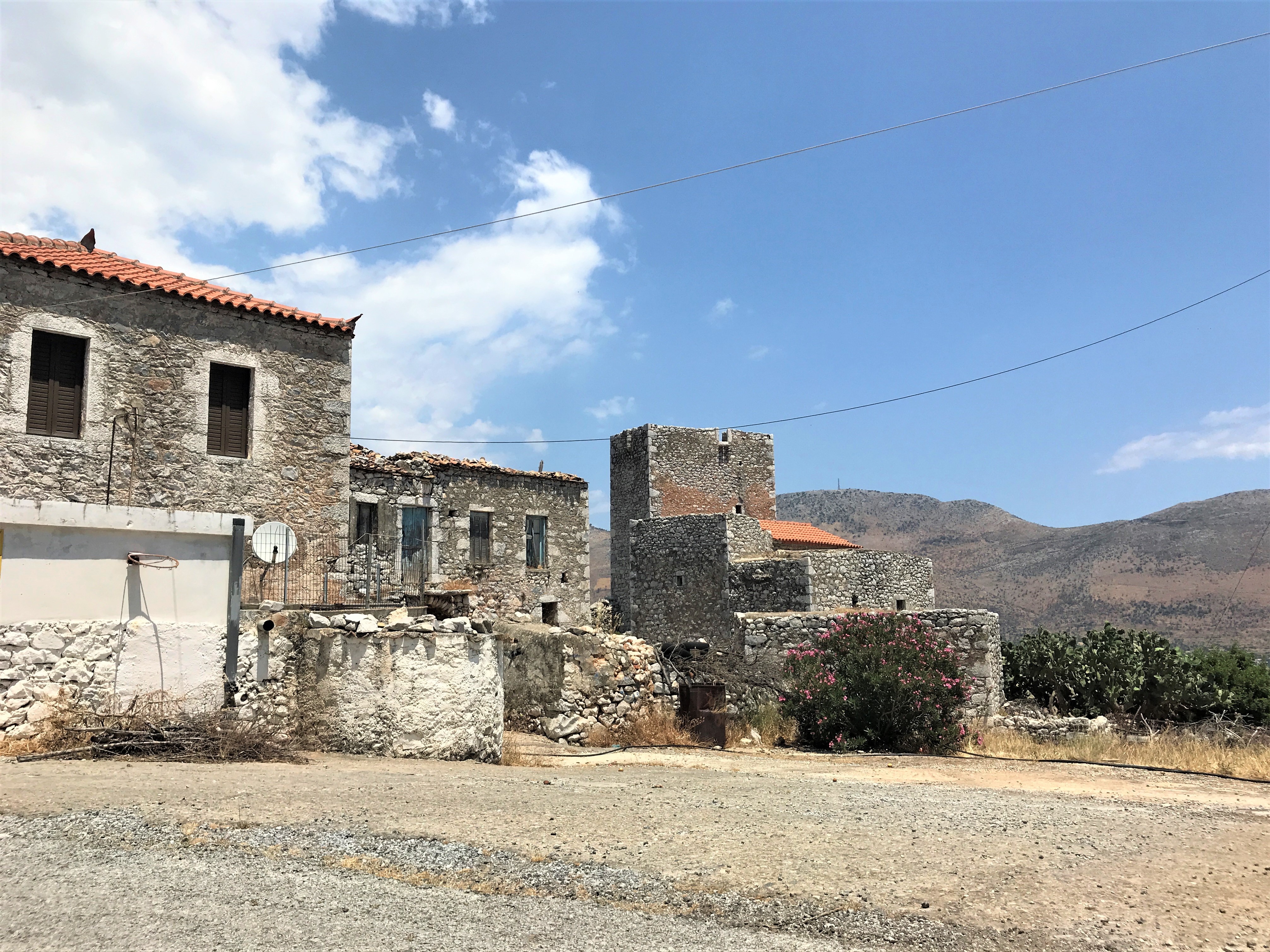
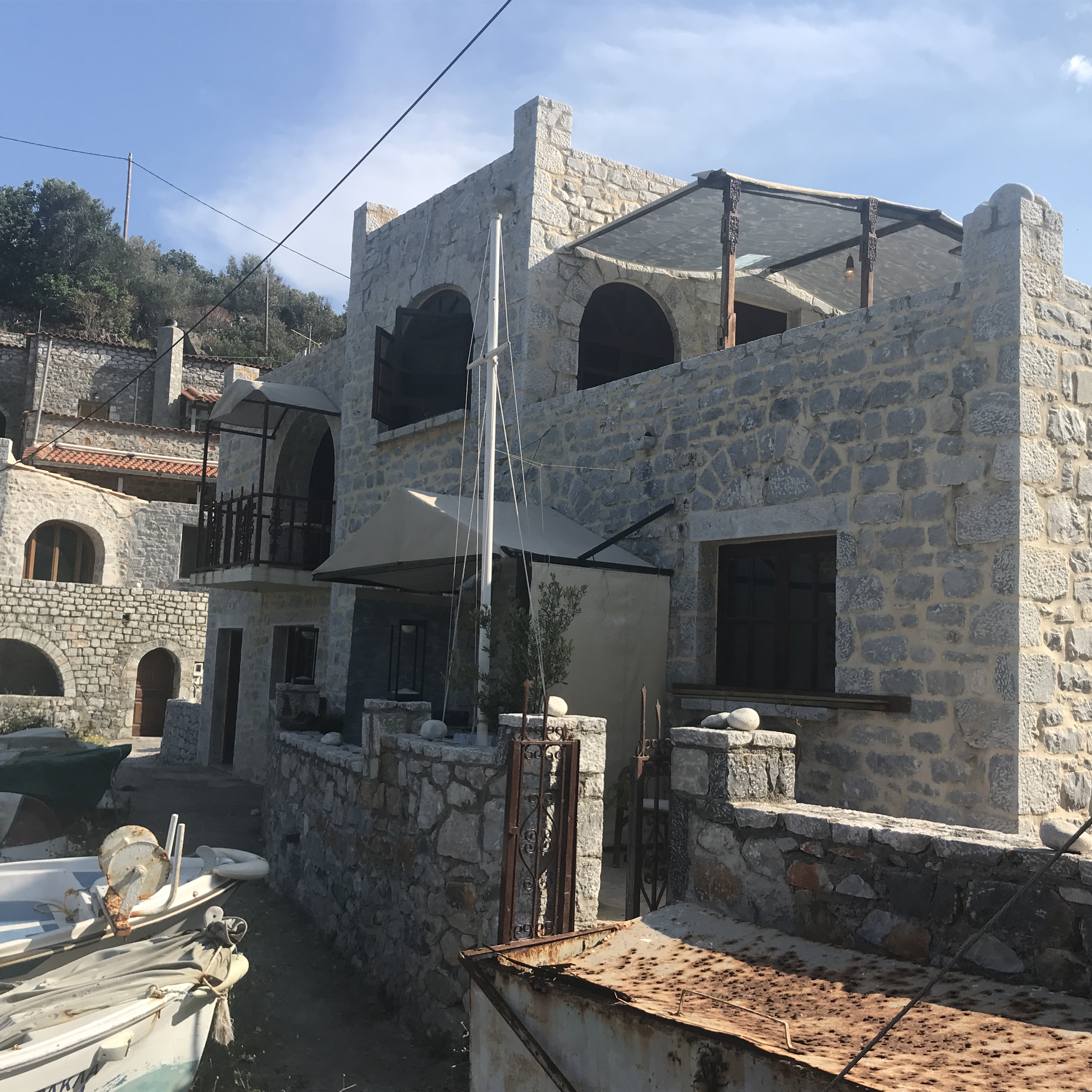
These tower houses are owned by families. The size of the tower demonstrated the family’s wealth and standing in the community. They are built close to each other, with small alleys as separations. Most of them are square with two or three floors. The windows are just large enough for guns and armaments to protrude outwards in times of defense. The inhabitants of Mani are legendary for fiercely resisting foreign invasions. They maintained their independence for centuries.
During the Ottoman period, Maniots continued to resist Ottoman rule. They preserved a degree of autonomy and the Ottoman beys (rulers) let them be. Maniots were known for their military acumen and martial skills, and their resistance played a significant role in the 1821 War of Independence. As with all Greek villages, monuments to the fallen are found in the plateia, across from the church.


Names on the War Monument
Top:
Georgakakos, Antonios
Georgakakos, Petros
Exarchakos, Panagiotis
Laos, Panagiotis
Kallidonis, Petros
Lagoudakos, Nikolaos
Feidopiastis, Fotios
Gerakakos, Stavros
Gerakakos, Nikolaos
Lagoudakos, Panagiotis
Syggikos, Petros
Bottom:
Anaroutsakos, Spyros
Mitsakos, Ioannis
Stravokefalos, Michail
Andreakos, Nikolaos
Xypolitos, Michail
Xypolitos, Panagiotis
Kallidonis, Leonidas
Aggelakos, Aristeidis
Xypolitos, Vasileios
Giannakakos, Panagiotis
Koutrigaros, Antonios
Maniot families evolved from clans which controlled various regions. There are many stories written about the loyalty and protection that clans provided for their families. Conflicts between clans were common, and some clan wars continued for years. This article provides historical background and names of the clans of Vathia.
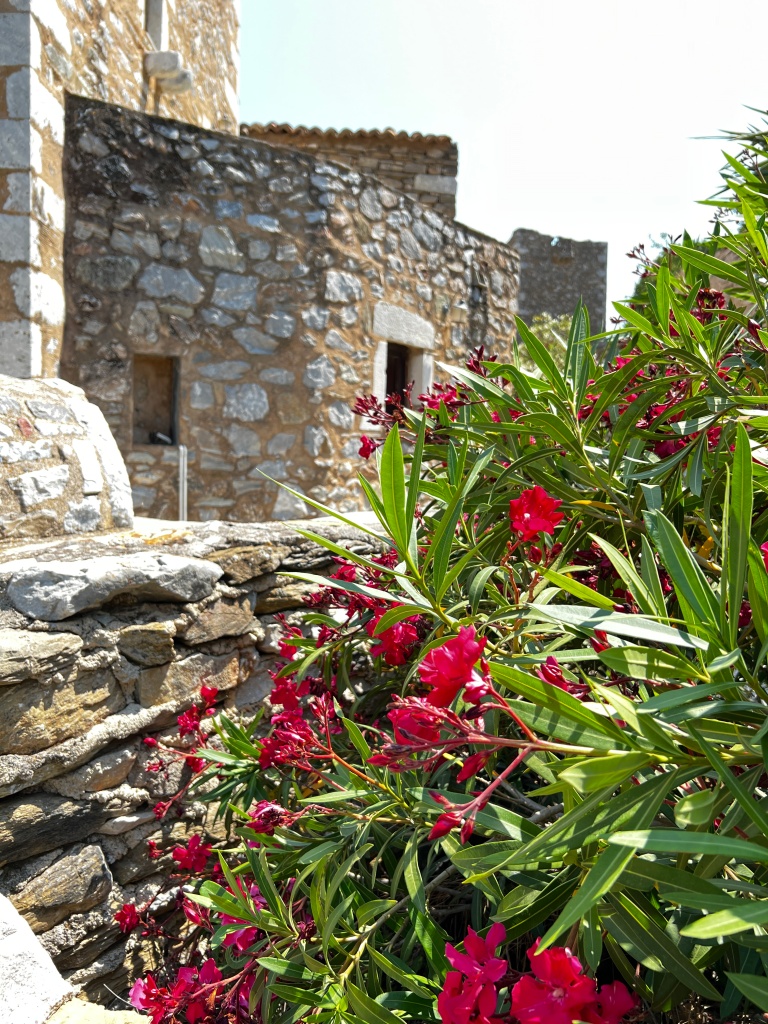
After Greece gained independence from the Ottomans in 1830, Vathia, like other parts of Mani, experienced a decline in its strategic importance. The tower houses gradually lost their defensive purpose and many fell into disrepair. Around 1950, after World War II and the Greek Civil War, families left rural areas to reestablish themselves in urban areas where economic opportunities existed. People abadoned their tower homes for Kalamata, Sparta, and Piraeus. By 1960-1970, the village was deserted.
I asked my friend, Giannis Michalakakos, local historian and author of the Maniatika blog, if the tower houses would ever be restored, especially with the current surge in tourism that Mani is experiencing. His answers helped me understand both the complexities of this issue and the culture of the society.
Homes are primarily abandoned because of financial considerations:
• It was common for many members of a family (cousins) to have partial ownership in a tower; sometimes as many as 40!
• If many parties had an interest in a house, and one person wanted to be the sole owner, he would have to have enough money to buy out all the other parties.
• If a person wanted to restore an abandoned home, he may have to buy out others who would have to agree to sell it, AND spend a lot of money to refurbish the home. Therefore, if financial matters were a concern, it is easier to just abandon a home than to deal with ownership and renovation issues.
• To sell a house to an outsider of the family, a title is needed. Years ago, oral agreements were made within and among families when buying, selling or partitioning a house. In times past, a man’s word was his honor and official documents were not required, nor were they needed. Such transactions occurred in the local cafenion (coffee house), where witnesses would attest to the validity of the agreement and be called upon if there was ever a conflict.
• There may have been a past agreement, still in full force, that a house would never be sold.
• If a house was renovated strictly for tourism, that season is short and the family would need other sources of income. In the area of Vathia, that does not currently exist.
This explanation made sense, but it also made me sad. Such an area, so rich in history and so incredibly wild and beautiful, should be renovated and preserved. The complications above make this difficult now, but in the future there may be resolutions that are not currently available. It is my hope that this will be.























 Spartan Roots (Σπαρτιατικές Ρίζες)