Visiting the Villages: Theologos and the Zacharakis Reunion

The road leading to Theologos winds around a verdant mountain, filled with thousands of olive trees. “The trees on this mountain belong to the families of the village,” my cousin, Nikos explains. “Years ago [around the early 1900s], just a few families owned all of these trees. Now, every family has an olive grove.” I stared out the car window, looking for a some type of sign or marker to delineate one owner’s property from another. I saw none. So I asked, “How do the families know which trees are theirs?” Nikos smiled. “Every family known how many trees they have, and exactly where they are.”

At one time, there were two olive processing plants in this small village. In recent years when stricter safety regulations were passed, the facilities closed and people now take their harvest to Sparta.

Left: a former oil processing plant in Theologos; upper right: mountainside with the olive groves of Theologos; center: Dimos Οinountos, Theologou; bottom right: stone used in olive press

The homes of the families are constructed of stone, and they are literally built into the mountainside. Houses remain in families for generations. They are beautifully maintained and constantly being updated with modern conveniences. Living on a mountain means that there are steps everywhere, and they are steep! You can’t leave your house, or enter another, without walking up a flight. The village roads are precipitous and narrow, yet people are adept at maneuvering and parking their cars and trucks. The plateia appears to have the only flat surface in the village.

Houses, steps, and the flat plateia

The village priest, “Papa” Panagiotis Kotsos, presides over the church of Agios Ioannis Theologos. It is incredibly beautiful and filled with historic icons. I was honored to be shown several holy relics, too sacred to photograph. It’s amazing that a small village church at the top of a mountain would have such treasures.

The Church of Agios Ioannis Theologos and its priest, “Papa” Panagiotis Kotsos

What I love most about returning to the village is to gather with my cousins of the Zacharakis family. My great-grandmother, Stathoula Zacharakis, was born in Theologos1. As I researched her lineage, I created a family tree which documents the various branches of the family. Whenever I visit, I bring the “updated” Zacharakis tree which is spread out along the benches at the perimeter of the plateia. People add and correct information, and we enjoy an evening of reunion and reminiscing. It has become a joyful tradition.

Checking out the family tree! June 23, 2023
Back left-right: Antonios Karagiannis, Aggelos Sarantakis, Niki Zacharakis Sarantakis, Asimina Zacharakis, Pepi Vartsaki Zacharakis, Nikos Zacharakis, Panagiota Zacharakis. Front left-right: Ioanna Karagiannis, Panagiotis Karagiannis, Argyro Bebetsos, Anthi Karagiannis, Lygeri Zacharakis Zacharakis, Anastasia Kantzioris, Rozi Kritsepis Zacharakis, John Rakis, Carol Kostakos Petranek, Alexandra Rakis, Konstantina Dariotis Zacharakis, Roula Zacharakis, Pavlos Zacharakis, Amalia Iliopoulos Zacharakis

I love these dear people and am so very grateful for their kinship and friendship. Being together in an ancestral village brings a feeling of generational connectedness. Our ancestors walked these streets, built the churches, and gathered in the plateia. Now it is our turn.


1Previous Spartan Roots posts about the Zacharakis family:
Stories from the Village: Theologos
Putting Together the Zacharakis Family Tree
The Zacharakis Family of Theologos
Greece 2017. Part Six: Theologos
Ioannis Zacharakis, Hero from Theologos

Visiting the Villages: Vathia

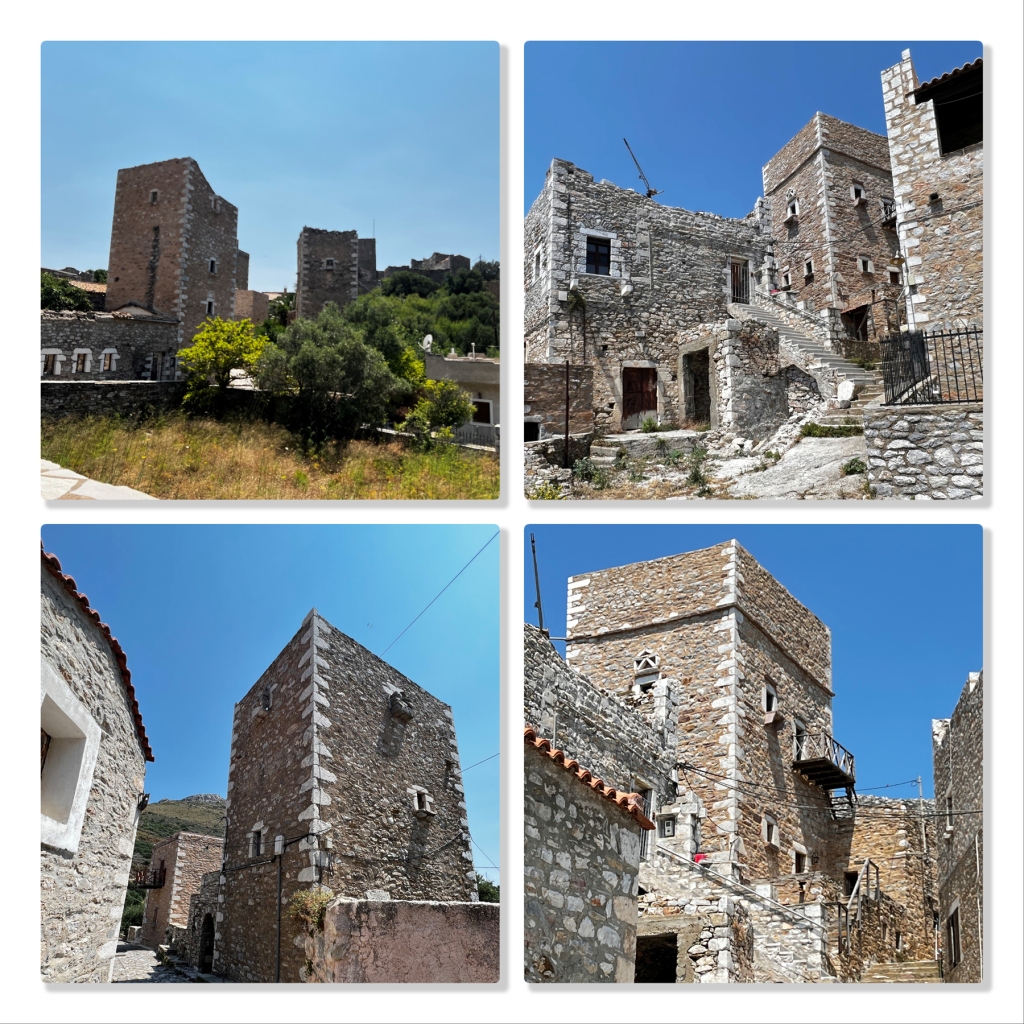
Pirates and invaders. Warring clans. Fortified towers. The legends of Vathia are captivating and plunge you into an era of the past. Vathia was built as a fortress to protect its families from hostile attacks. A sign in the midst of this “ghost village” alludes to its history:

My first introduction to the tower villages of Mani was in 2014 when Giannis Michalakakos took Gregory Kontos and me to Vathia. My fascination has not waned, but accelerated. It’s not only the architecture, but also the stories, myths, customs, and traditions of this land that captivate my imagination.

My ancestors were from Mani, as reflected in their surnames and in family stories. Their genesis in this region and their migration north began before the revolution of 1821, as they are in Agios Ioannis, Sparta in the 1844 Election Registers. Because records prior to the Revolution do not exist in the modern Greek state, I cannot trace where, in Mani, they originated. However, every time I come to this region, I feel a metaphysical connection to this land and to them.

The tower houses of Vathia are classic Maniot fortification architecture

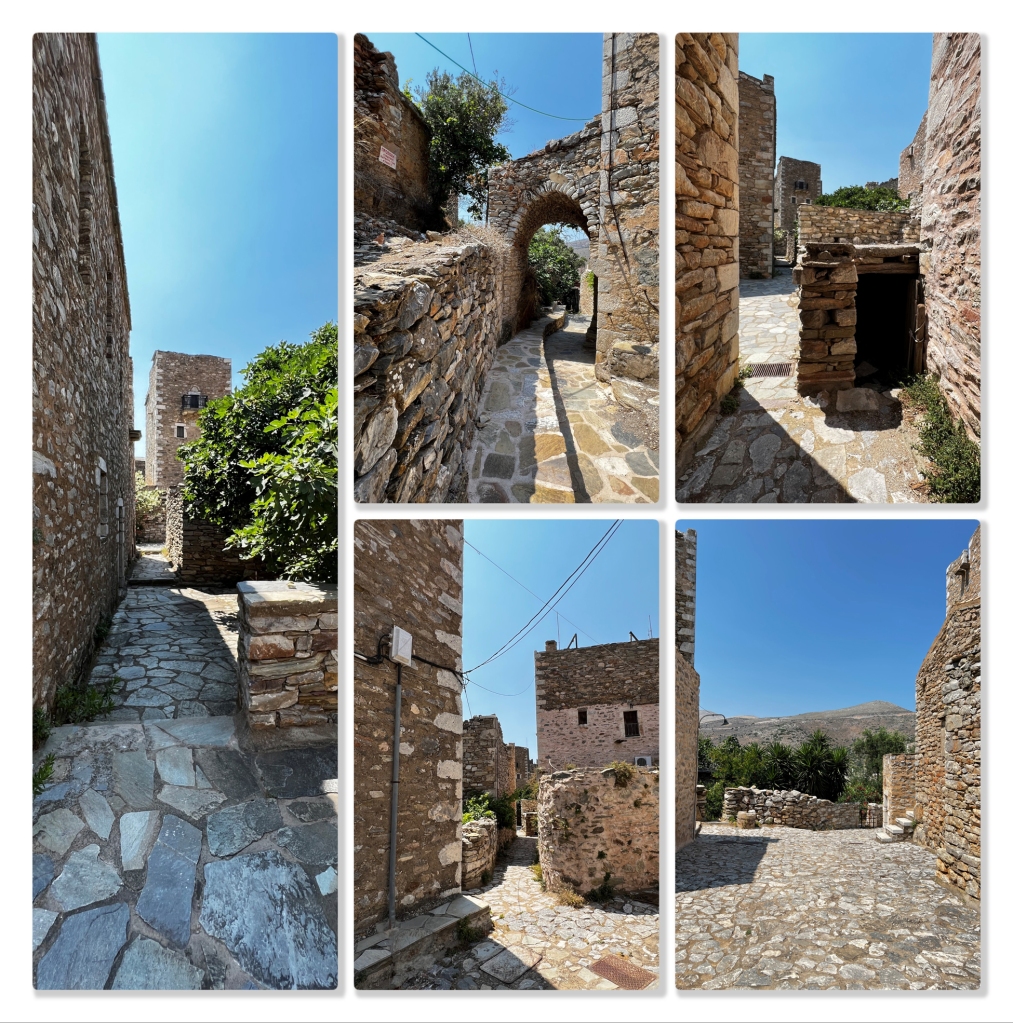
These tower houses are owned by families. The size of the tower demonstrated the family’s wealth and standing in the community. They are built close to each other, with small alleys as separations. Most of them are square with two or three floors. The windows are just large enough for guns and armaments to protrude outwards in times of defense. The inhabitants of Mani are legendary for fiercely resisting foreign invasions. They maintained their independence for centuries.

The alleyways of Vathia

During the Ottoman period, Maniots continued to resist Ottoman rule. They preserved a degree of autonomy and the Ottoman beys (rulers) let them be. Maniots were known for their military acumen and martial skills, and their resistance played a significant role in the 1821 War of Independence. As with all Greek villages, monuments to the fallen are found in the plateia, across from the church.

Monument photos courtesy of Nick Santas, whose great-grandfather, Panagiotis Laos, is listed

Names on the War Monument
Top:
Georgakakos, Antonios
Georgakakos, Petros
Exarchakos, Panagiotis
Laos, Panagiotis
Kallidonis, Petros
Lagoudakos, Nikolaos
Feidopiastis, Fotios
Gerakakos, Stavros
Gerakakos, Nikolaos
Lagoudakos, Panagiotis
Syggikos, Petros
Bottom:
Anaroutsakos, Spyros
Mitsakos, Ioannis
Stravokefalos, Michail
Andreakos, Nikolaos
Xypolitos, Michail
Xypolitos, Panagiotis
Kallidonis, Leonidas
Aggelakos, Aristeidis
Xypolitos, Vasileios
Giannakakos, Panagiotis
Koutrigaros, Antonios

Maniot families evolved from clans which controlled various regions. There are many stories written about the loyalty and protection that clans provided for their families. Conflicts between clans were common, and some clan wars continued for years. This article provides historical background and names of the clans of Vathia.

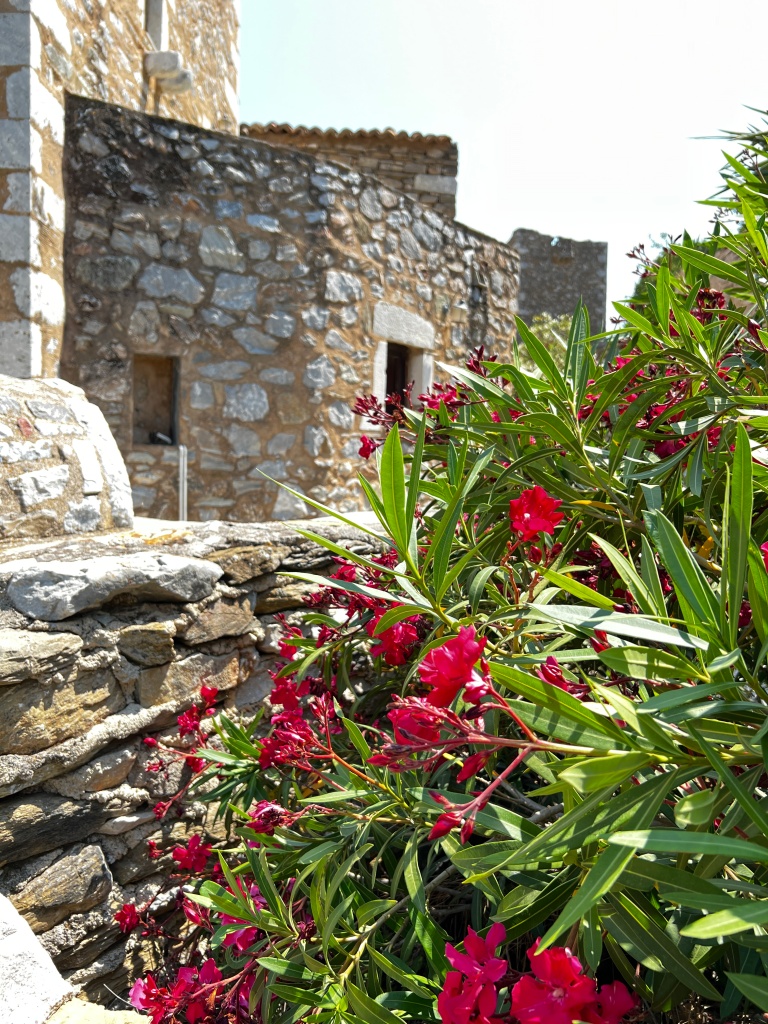
Bright spots of color amidst the stone towers

After Greece gained independence from the Ottomans in 1830, Vathia, like other parts of Mani, experienced a decline in its strategic importance. The tower houses gradually lost their defensive purpose and many fell into disrepair. Around 1950, after World War II and the Greek Civil War, families left rural areas to reestablish themselves in urban areas where economic opportunities existed. People abadoned their tower homes for Kalamata, Sparta, and Piraeus. By 1960-1970, the village was deserted.

I asked my friend, Giannis Michalakakos, local historian and author of the Maniatika blog, if the tower houses would ever be restored, especially with the current surge in tourism that Mani is experiencing. His answers helped me understand both the complexities of this issue and the culture of the society.

Homes are primarily abandoned because of financial considerations:
• It was common for many members of a family (cousins) to have partial ownership in a tower; sometimes as many as 40!
• If many parties had an interest in a house, and one person wanted to be the sole owner, he would have to have enough money to buy out all the other parties.
• If a person wanted to restore an abandoned home, he may have to buy out others who would have to agree to sell it, AND spend a lot of money to refurbish the home. Therefore, if financial matters were a concern, it is easier to just abandon a home than to deal with ownership and renovation issues.
• To sell a house to an outsider of the family, a title is needed. Years ago, oral agreements were made within and among families when buying, selling or partitioning a house. In times past, a man’s word was his honor and official documents were not required, nor were they needed. Such transactions occurred in the local cafenion (coffee house), where witnesses would attest to the validity of the agreement and be called upon if there was ever a conflict.
• There may have been a past agreement, still in full force, that a house would never be sold.
• If a house was renovated strictly for tourism, that season is short and the family would need other sources of income. In the area of Vathia, that does not currently exist.

This explanation made sense, but it also made me sad. Such an area, so rich in history and so incredibly wild and beautiful, should be renovated and preserved. The complications above make this difficult now, but in the future there may be resolutions that are not currently available. It is my hope that this will be.


Visiting the Villages: Koumousta

Going back in my family research always leads to the mountains. The Spartan villages of my four grandparents, Agios Ioannis and Mystras, were nestled in the valley beneath the Taygetos range. This was the agricultural center of the region—fertile plains filled with citrus and olive trees, fruit and vegetable gardens. As I wrote previously, villages in the valleys became repopulated after the Ottomans were expelled in 1830 and people descended from the mountain tops to start a new life. Among them were my grandparents’ ancestors.

Prior to the Revolution of 1821, Koumousta was the populated village; Xirokampi was a small settlement with just a few families. In the book, Koumousta of Lacedaimonos, Theodore Katsoulakos and Panagiotis X. Stoumbos meticulously describe life in Koumousta prior to the residents’ leaving. Among them was the Christakos family, ancestors of my paternal great-grandmother, Politimi Christakos, who married Andreas Kostakos. Her father, Nikolaos, and her grandfather, Dimitrios, are named in this book. Finding this information was an enormous and important breakthrough in my research.

Koumousta of Lakedaimonos, Theodore S. Katsoulakos and Panagiotis X. Stoumbos, published 2012

The book describes the villagers: “Koumousta, from old times and until its desertion, was a very hospitable village. Everyone of Koumousta considered it an honor and pleasure to have someone under his roof. Work was stopped to settle the foreigners. Many people back then came to Koumousta from the plains and from surrounding villages. Relatives and friends were everywhere…Every Koumoustioti’s door was open to any foreigner that would knock on his door. The man who asked for hospitality was considered a “holy” [highly respected] person who should be treated with all arrangements of good relations. This treatment was highly characteristic and very good. Every good thing that there was in the house was offered with love and selflessness, and above all, food: cheese, bread, pork, eggs were the necessary and basic foods. Women put their hands deep into the barrels because there was where the best portions of pork meat lay after it was boiled. But it was not only the visitor that had to be treated well; even his mule had to be treated well. They took care to give the mule water and food, like their own animals.”1

This intrigued me. People would climb a steep mule trail to visit a village at the crest of a mountain? The villagers were known for their hospitality, despite living in an isolated area? I knew that Koumousta was situated on a high peak and that its access road was narrow and treacherous. But my ancestors were those described in the book, and I just had to go!

Leaving Xirokampi on the road to Koumousta

The journey seemed inoccuous at first. The road was paved, and a low stone wall provided a comforting border between the road and the ravine below. I felt reassured. But after a mile, the wall disappeared and the ravine’s treetops lined the side of the road. They were my guardrails throughout the four mile ascent.

The treetops on the left appear to be bushes, indicating the depth of the ravine.
The face of this mountain is particularly scary!

Partway up the mountain, I saw what appeared to be a lake on the right side of the road. But this is a man-made, rectangular basin. There are no structures adjacent to it, and I cannot imagine its purpose.

A pool of some type, constructed mid-mountain
The scenery is lovely, with bright spots of color accenting the rocks and greenery.

The road was extremely steep, and despite my growing fears, I had to keep my foot on the accelerator to keep the car moving upwards. Parts of the pavement were washed out, with evidence of small rockslides.

Seeing an isolated house, I wondered who would construct it mid-way up a mountain? It appeared to be abandoned, but at some point it was a home. How could one live so alone?

This house, although close to the road, was built in an isolated spot

The phrase, “are we there yet?” kept running through my mind. I knew that the closer I got to the top, the worse the road conditions would become. I felt relief when I came across this sign.

Koumousta 500 metres – almost there!

Rounding a curve, my breath stopped when I saw the village: perched on the mountains were beautiful stone houses with red tile roofs. This appeared to be a viable village; I had expected crumbling vestiges of bygone years.

Homes in beautiful condition, cut into the mountain

Driving onto the stone pavement of the plateia, I could not believe the scene before me. Koumousta was not a village in ruins. It was beautifully restored and utterly charming. I parked the car and in the town square; a black and white dog greeted and walked with me. The peace and beauty were almost magical.

The lovely plateia, impeccably clean and perfectly maintained
Pure mountain water gushes from the fountain and is channeled
The houses are traditional and charming. All appear to be renovated and in excellent condition.
One couple lives in Koumousta year-round; others come for holidays and vacations.
The inscription on the plaque mentions the restoration of the plateia in October 2000.

I can understand why my 3rd great-grandfather, Dimitrios, left and resettled in Xirokampi in the mid-1800s. I would bet, however, that if he were alive today, he would find a way to keep his mountain home. Although winter weather would make the road impassible and the cold intolerable (altitude of 2200 feet), this village remains a pristine oasis and a welcomed haven from contemporary life. Today, the village of Koumousta is also known as Pentavli.


1Koumousta of Lacedaimonos, page 213; translation by Giannis Michalakakos.

Visiting the Villages: Zarafona

When a family moves from one village to another, the natives of their new “horio” may refer to them as the people from [name of their former village]. That is exactly what happened to my third great-grandfather, Panagiotis Zarafonitis. Sometime in the mid-1800s, he left his mountain village of Zarafona and settled in the fertile plains of Sparta, specifically the village of Sklavochori (now part of Amykles).

One of several mountain paths that the Zarafonitis family could have walked to settle in the valley.

He became known as Zarafonitis, the man from Zarafona. His original surname is unknown. The Zarafonitis family of Amykles claims that there were two Zarafona families who settled in Amykles: Mazis and Tountas. Another comment was that the Maltezos family of Zarafona also came to Amykles. Because the migration most likely occurred after the Revolution of 1821 ended, around 1830–before records were created by the modern Greek state–the name will have to remain a mystery.

The village of Zarafona

Zarafona, also known as Kallithea, is most likely ancient and surely pre-dates Byzantium. Its church, Enniamera tis Panagias / Εννιάμερα της Παναγίας (Nine Days of the Virgin Mary) was built in the 10th century.

The Byzantine Church of Zarafona

The village has a castle which towers at the top of a mountain. “According to an inscription found on the west external wall, the castle was constructed in the period that the Despotate of Moreas was governed by Theodoros II Paleologos (1407-1448). Therefore it was a construction of the first half of the 15th century, part of the effort of the Byzantines to confront the Ottoman threat.”1 The short video below shows both the castle and the surrounding countryside.

Castle of Zarafona; photo from Kastrologos

With the castle as a fortress, one can conclude that the Zarafonites were activey engaged in thwarting the Ottoman incursion into their territory. It’s rather thrilling to imagine Panagiotis Zarafonitis and others in active opposition to this threat, and their jubilation when the Ottomans were defeated.

It makes sense that, after their freedom was secured, Panagiotis did exactly as so many others — go down from the mountain to settle in the fertile valley.2 I know he was there by 1849, the approximate year of the birth of my second great grandmother, Giannoula, in Sklavochori.3

Park adjacent to the plateia

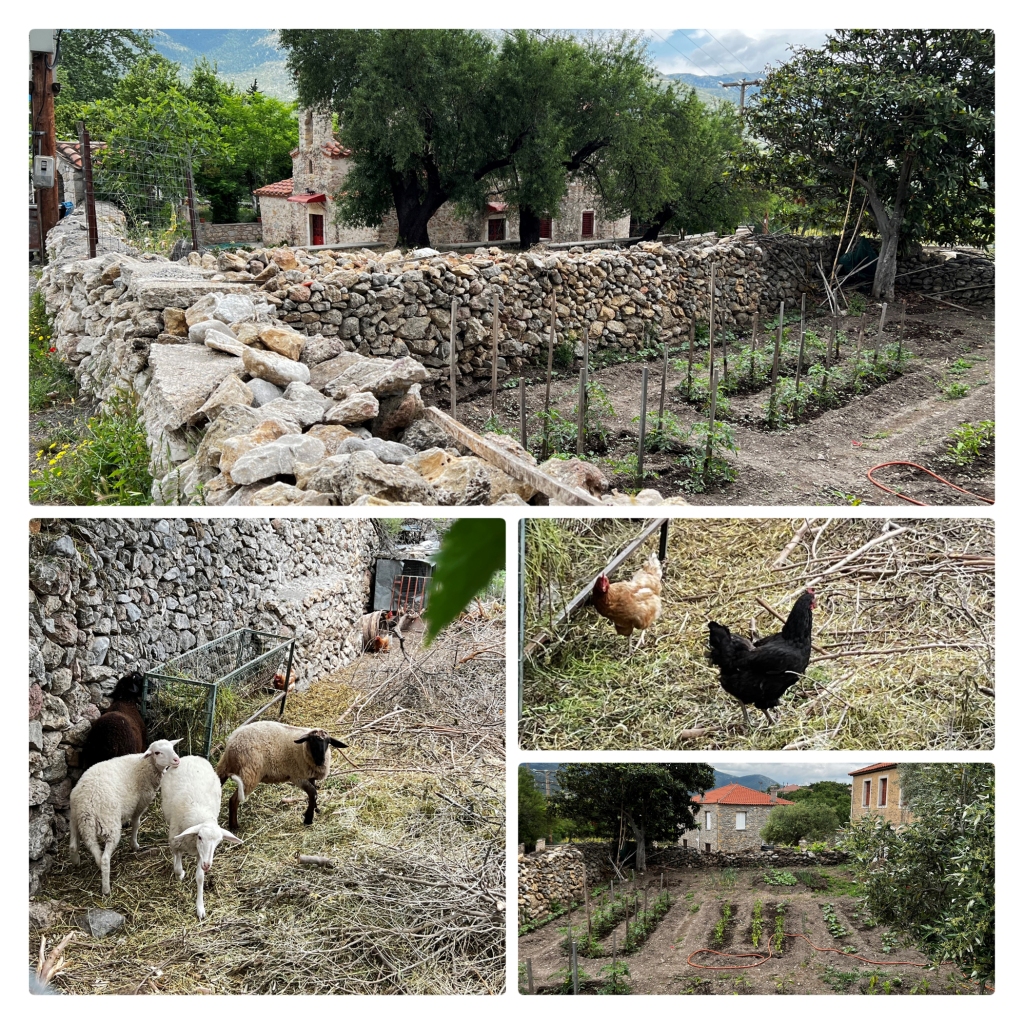
Zarafona is an agricultural community. Crops such as olives, citrus fruits, vegetables, and grapes are cultivated. The region has a long history of wine production. The village is peaceful and the neat gardens and livestock give it a homey atmosphere.

Sheep, chickens and gardens make Zarafona feel comfortable and homey
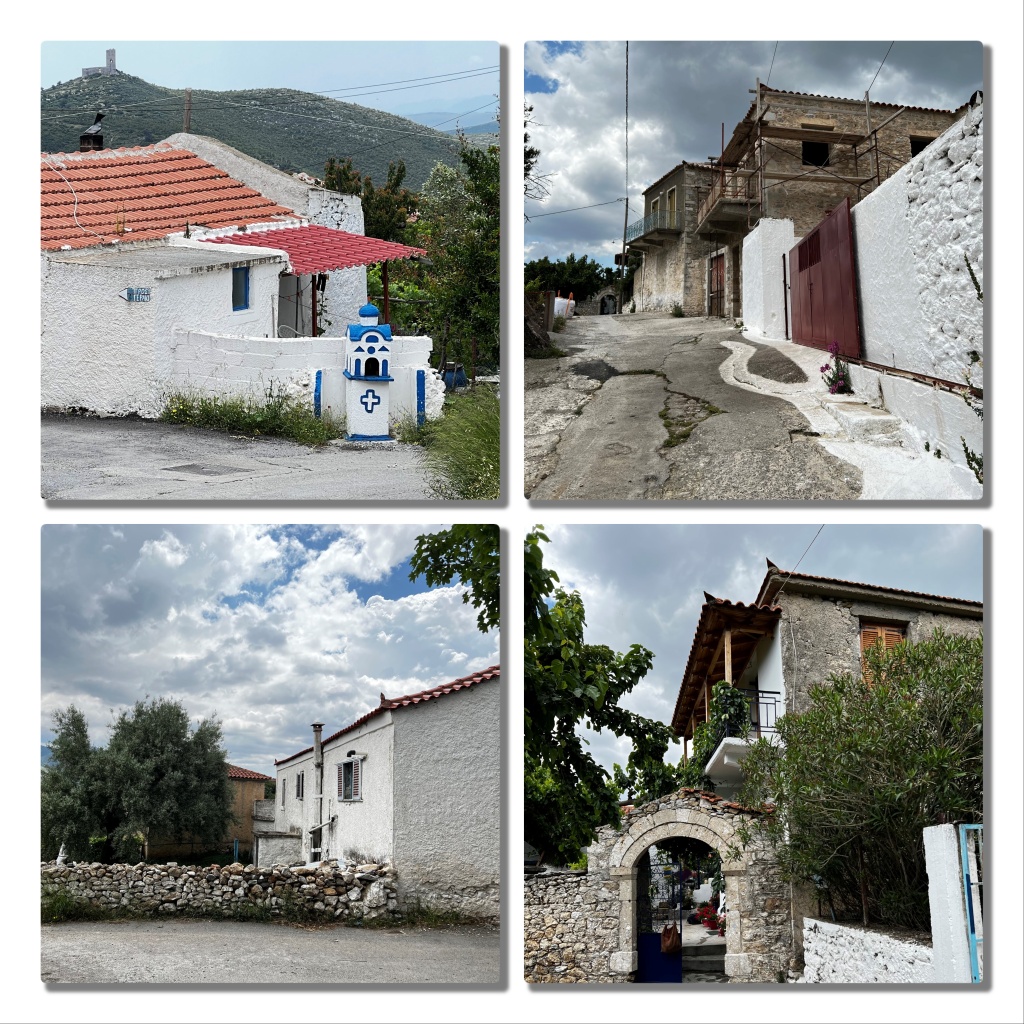
Traditional stone houses; some whitewashed and some natural stone. All neatly maintained
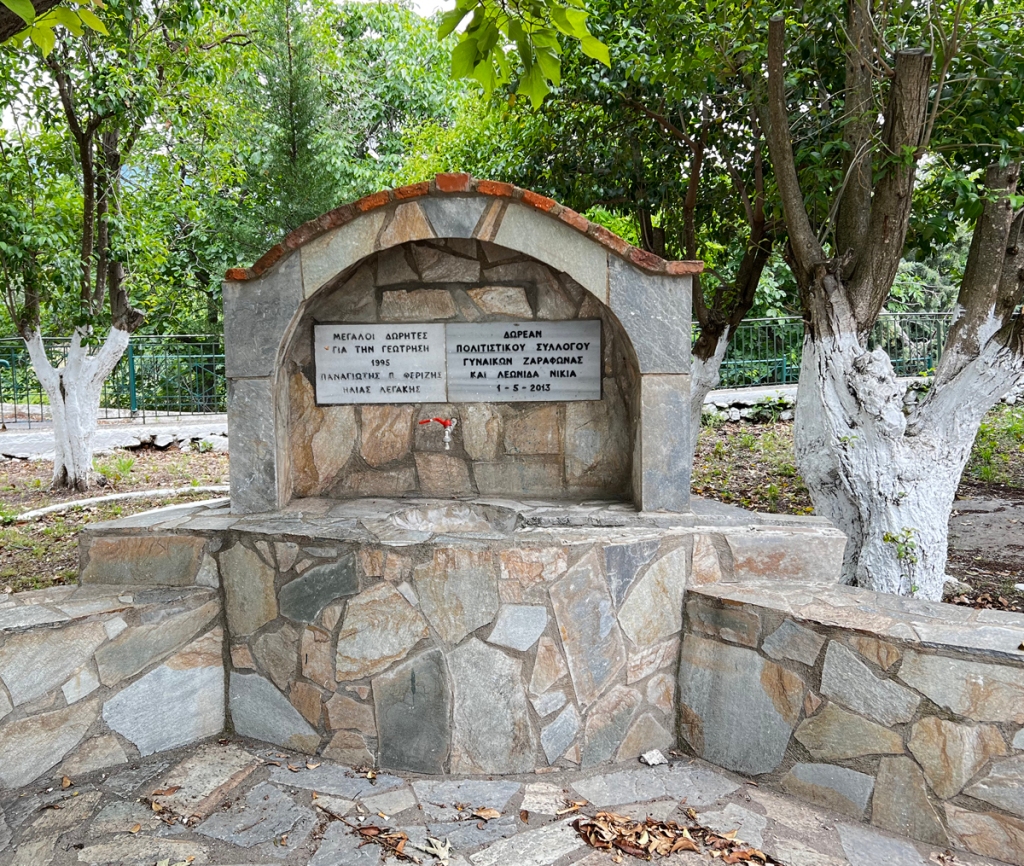
There are two signs on this well.
Left: Major donors for drilling, 1995; Panagiotis P. Ferizis; Ilias Legakis
Right: Gift from the Zarafona Women’s Syllogos and Leonida Nikia, 1-5-2013
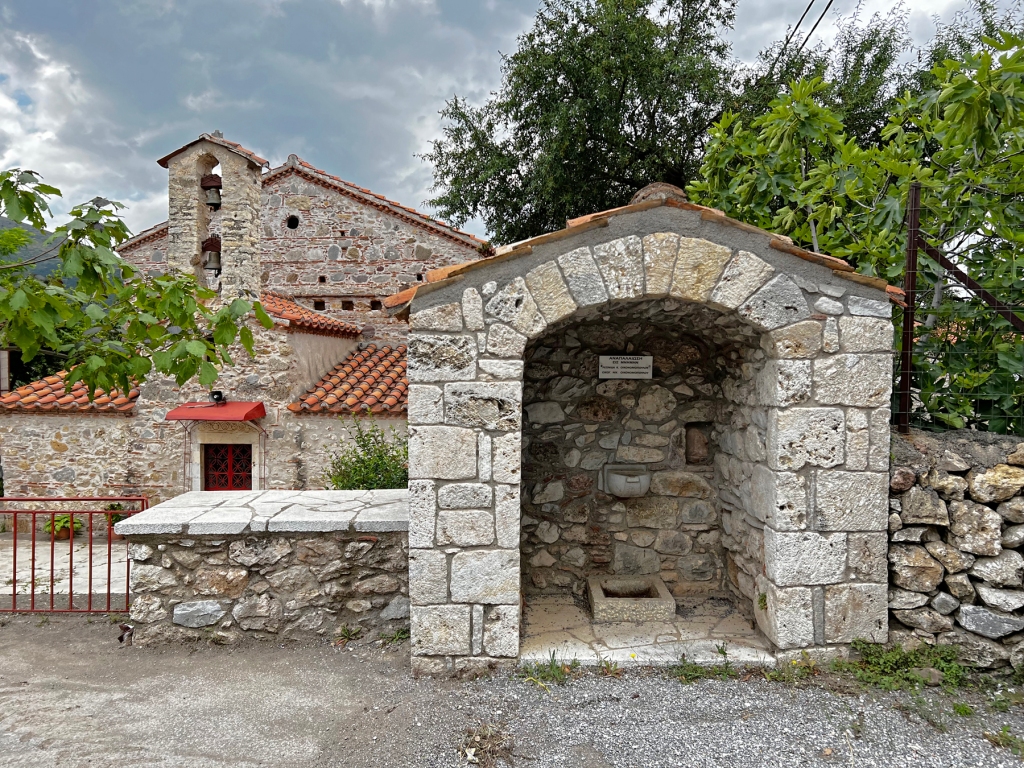
Another well, adjacent to the church, in memory of Leonida K. and [?] Nik. Oikonomopoulos
War Memorial
1912-1940: S.K. Voudouris; P I. Ferizis ;I. D. Chrysikos; I. V. Maltezos; P. G. Maltezos; G. N. Voudouris; I. P. Giakas; P. Ch. Farlekas; K. D. Stamatopoulos; N. Th. Oikonomopoulos; I. H. Douvris; Ef. Lochagos; N. G. Ferizis; S. P. Maltezos; P. V. Flogos; I. P. Manousopoulos
1940-1949: P. D. Karakitsos; G. I. Plagakis; Chr. P. Katranis; D. I. Nikias; E. P. Oikonomopoulos; P. G. Danas; I. G. Koumoutzis; G. Th. Vlachos; I. P. Oikonomakis; H. I. Danas

I thank Yanni Lambrinakos for taking me to see this village. His knowledge of the area and its people have helped me better understand this branch of my ancestral roots.


1Source: Kastrologos
2For migration patterns after the Revolution, see this post.
3Giannoula’s marriage record to Dimitrios Nikolaos Zacharakis on April 18, 1869 states her residence as Sklavochori. I estimate her birth at 20 years prior to marriage.
Metropolis of Sparta, Marriage Index Book
Book: Sparta, 1866-1872; Year: 1869; Entries: 88-94
Entry  #89
License Date: April 18, 1869
Marriage Date: not given
Groom:  Dimitrios Zacharakis, no father listed; residence: Theologos
Bride:  Giannoula Zarafonitou; father: P., residence: Sklavochori
Church Name:  not given
First marriage for both bride and groom
Photographed at the Metropolis of Sparta in Sparta, Greece by Carol Kostakos Petranek, July 2017