Greece 2019 – Saturday in Mani

Digitizing the village church books of Laconia is both a privilege and a huge task. Having time on weekends to enjoy the sun and beauty of the land is both a delight and a necessity.  Yesterday, I drove to the port town of Gytheio, 45 minutes south of Sparta, to visit friends, Dina and Christina.

Along the waterfront of Gytheio

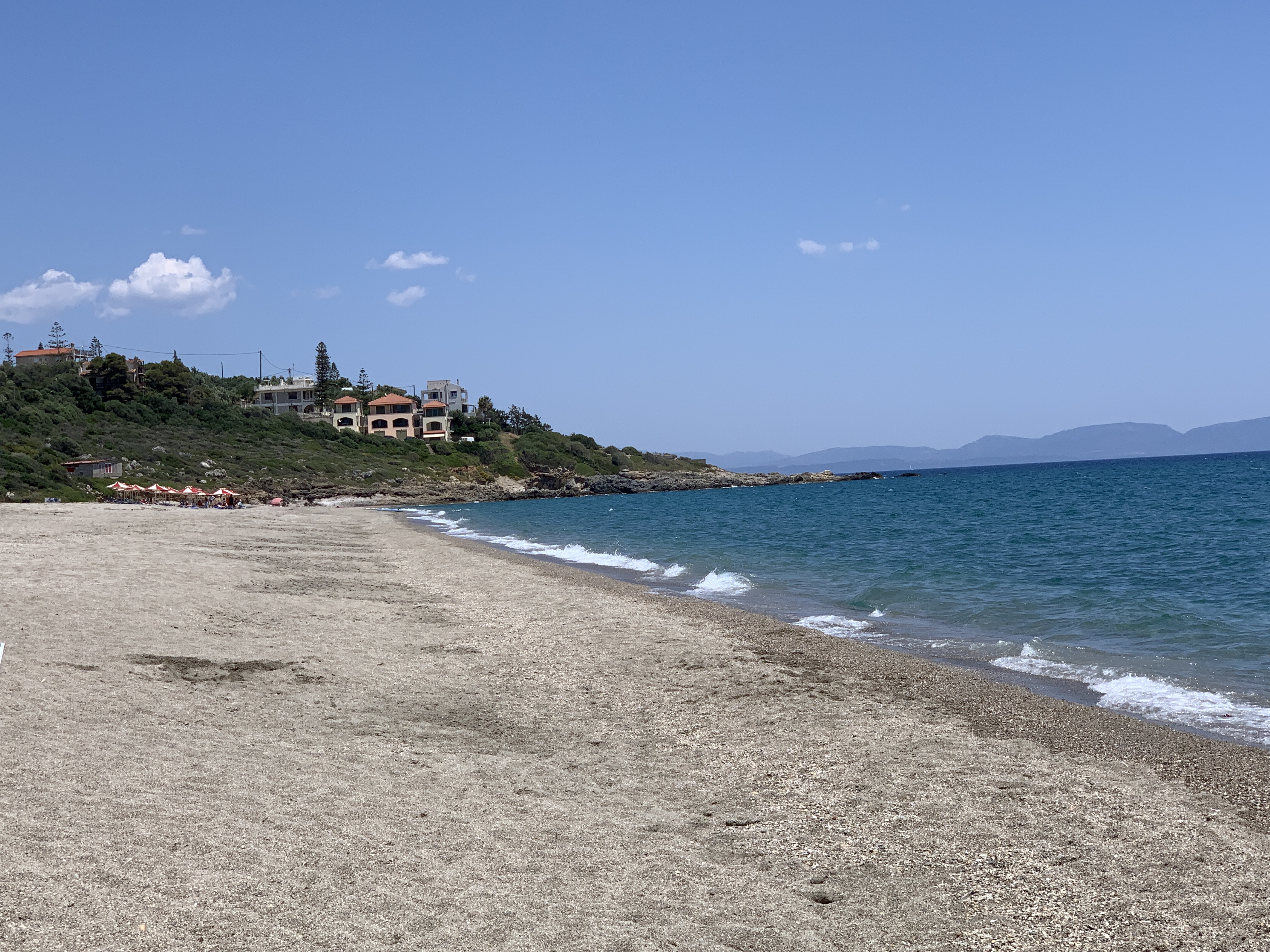
Mavrovouni Beach is adjacent to the town where locals and tourists can relax. There are many cottages, guest houses and hotels. The aquamarine water is perfectly clear.  I came here several times last year, as well, just to unwind and breathe clear air.

Mavrovouni Beach

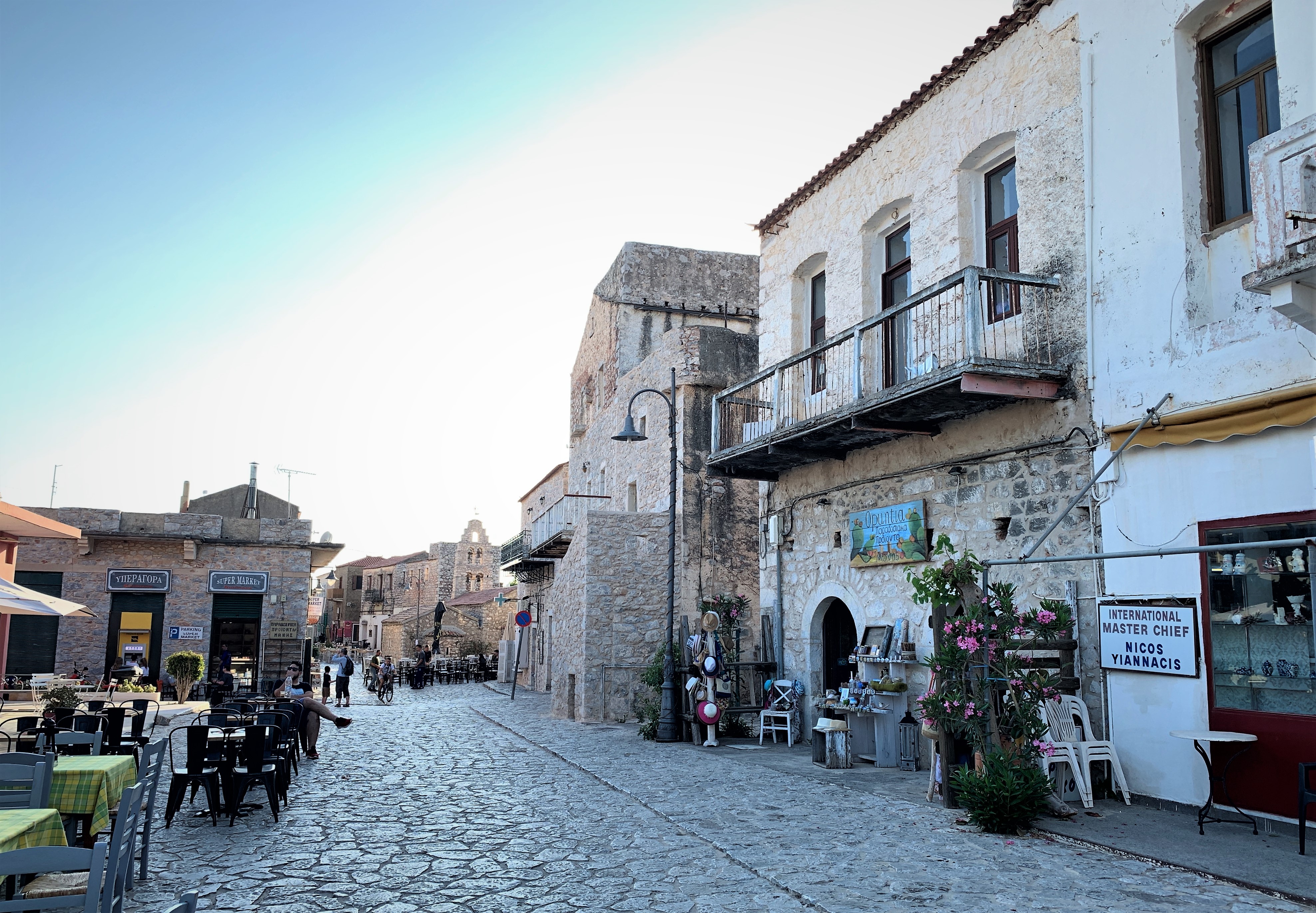
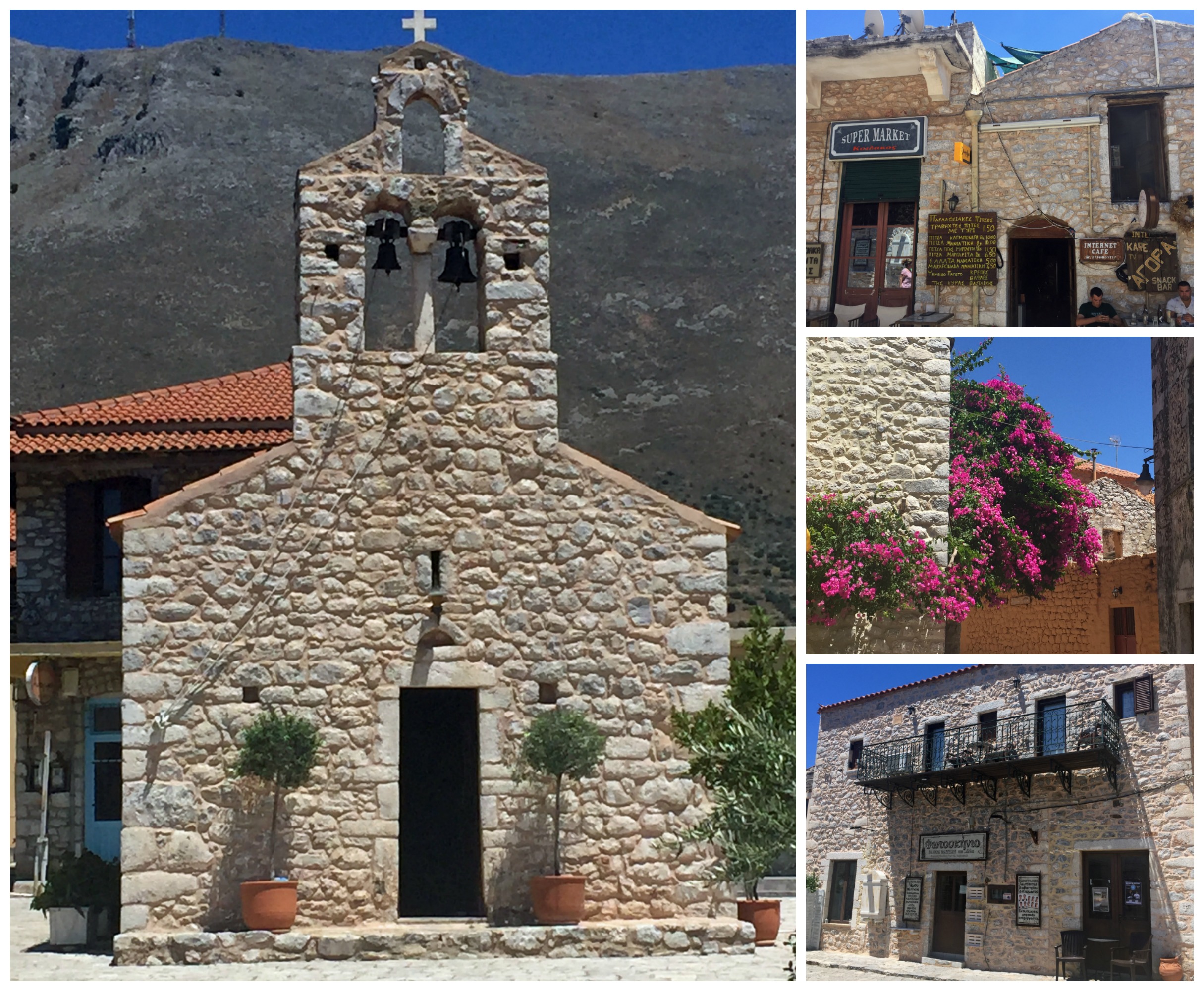
After a relaxing afternoon, the three of us drove to Aeropoli and Limeni in the Mani region of southern Laconia. There is no place like Aeropoli, a village of stone, with its distinctive Maniate tower architecture and gloried history. The Greek Independence Revolution began here on March 17, 1821. Today, it lures people with its unique character and charm. For me, it is a must to spend time here every summer.

A street in Aeropoli, Mani

Storefront on the main street, Aeropoli, Mani

Market in Aeropoli, Mani

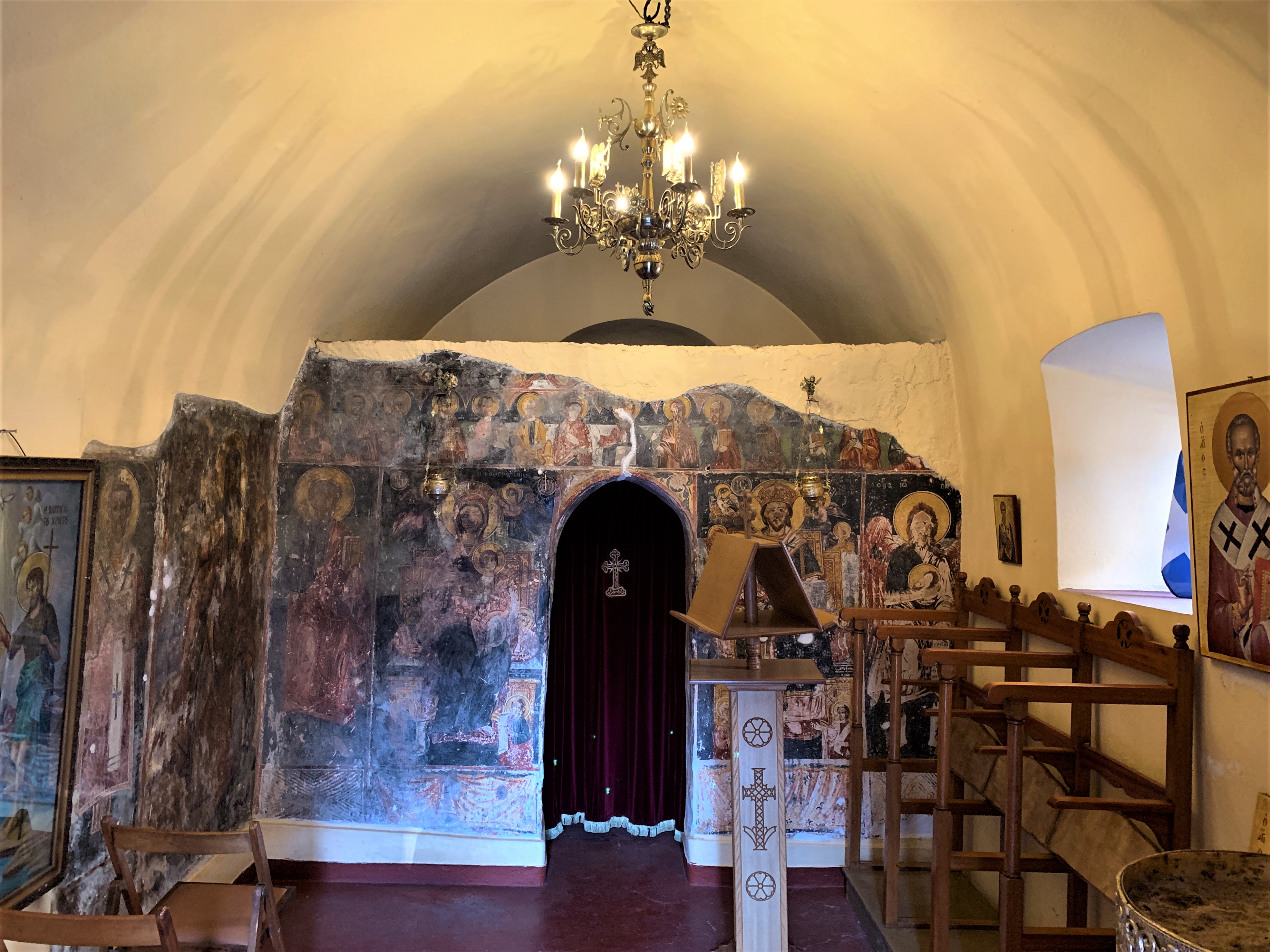
Frescoe inside one of the oldest churches in Aeropoli

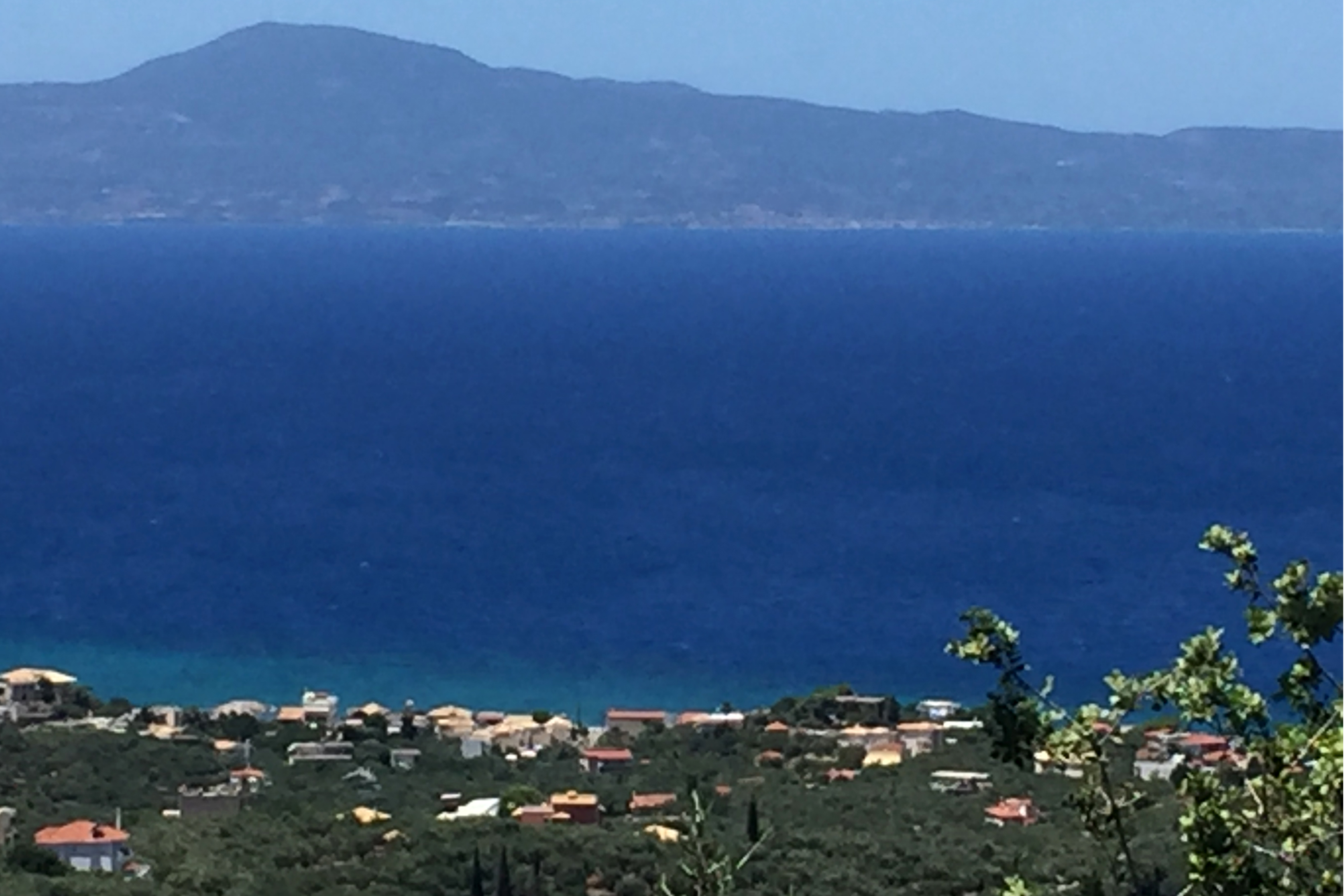
The drive from Aeropoli to Limeni is less than 10 minutes. The winding road around the mountains provides spectacular views of the sea below.

The road to Limeni

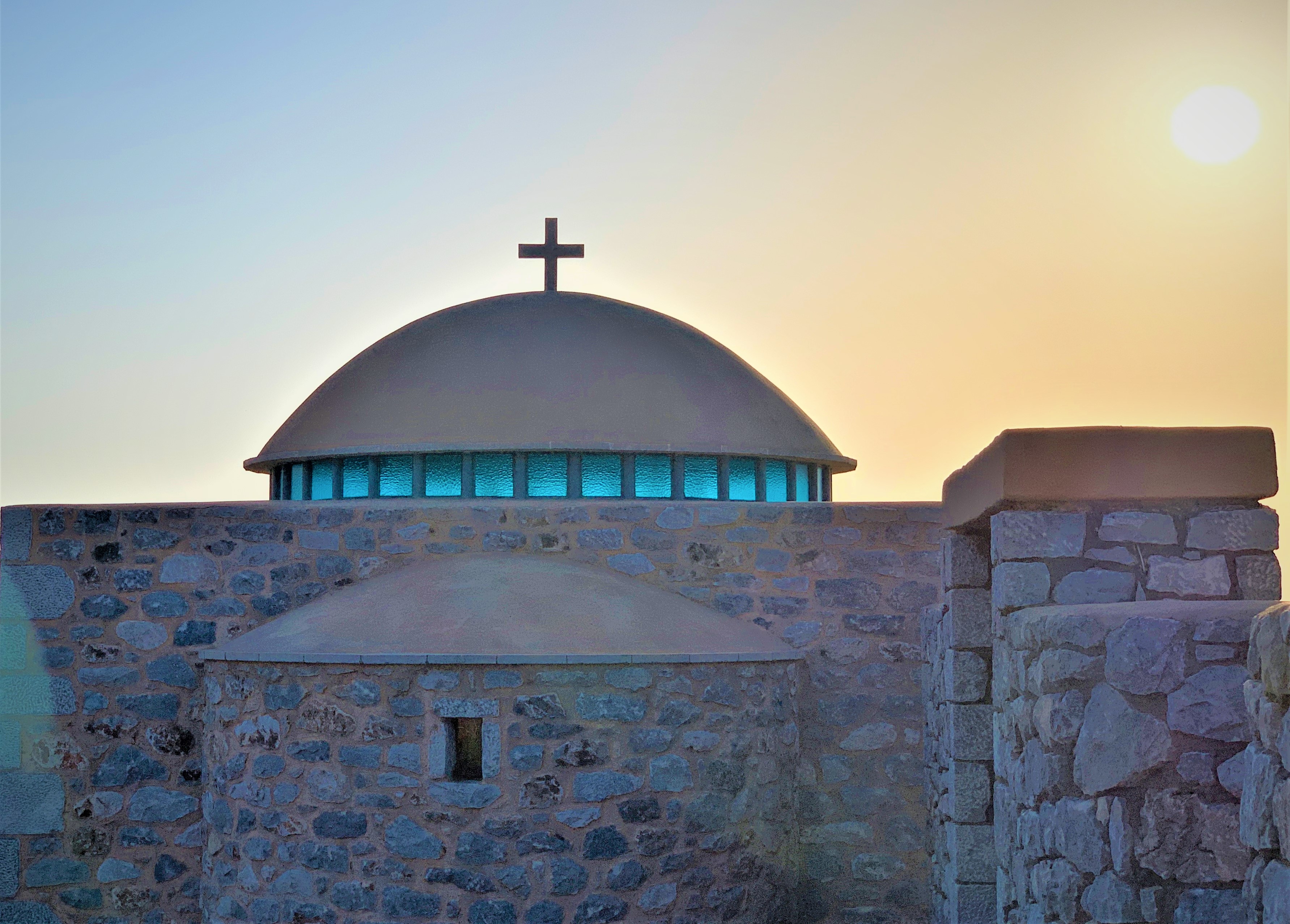
This church is a point of interest on the road, but last night the slant of the sun was low and for the first time, I noticed that the windows around the dome are blue! This illumination produced an ethereal light in the sacred building.

The fading sun illuminates the blue windows and creates an ethereal and heavenly light around the dome

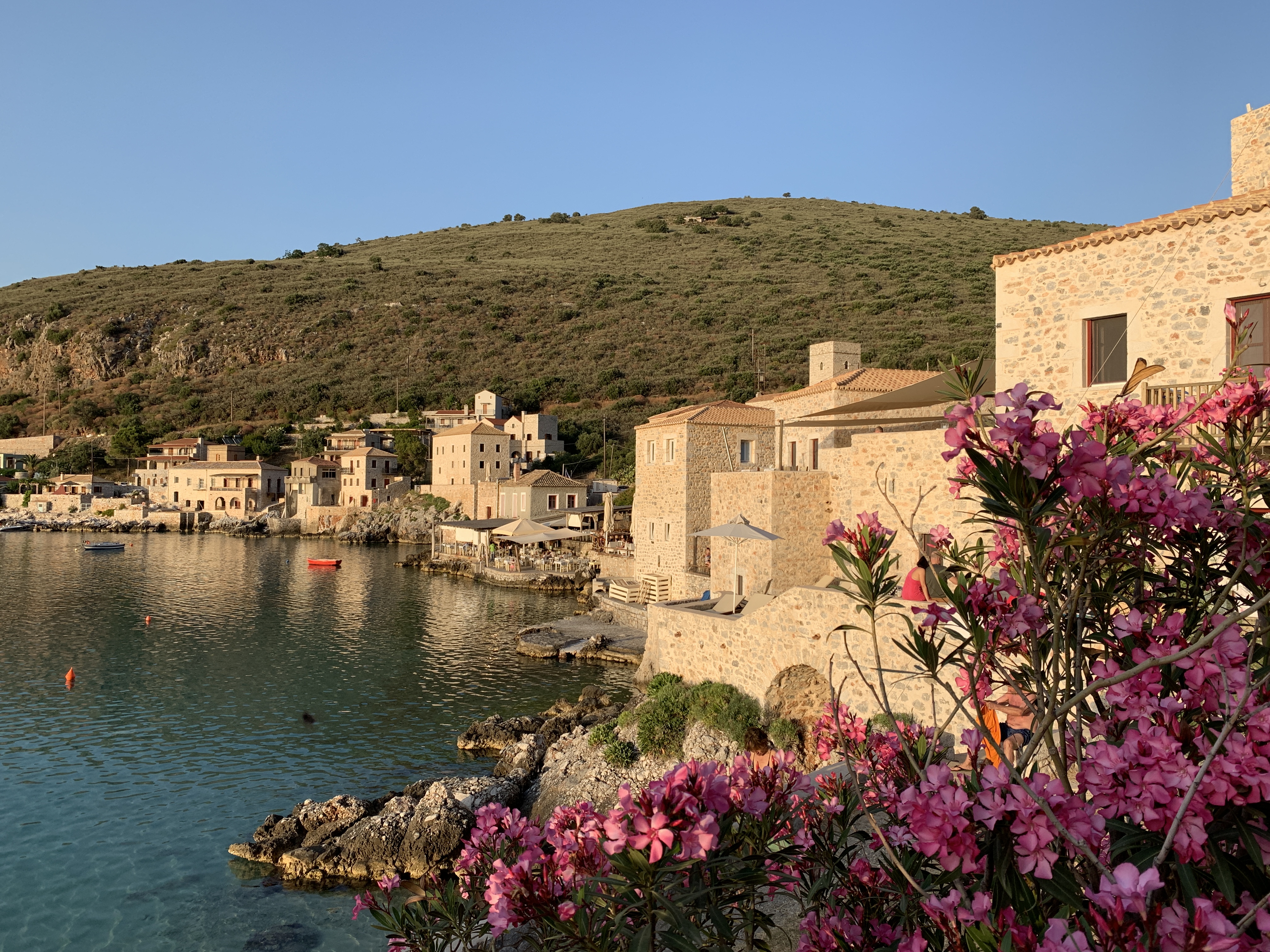
We reached Limeni at sunset. This is one of the loveliest places in Mani at anytime of day, but especially so when night is about to fall. The glow of the fading sun casts a golden light upon the stone buildings, producing a glow which is breathtaking.

Entering Limeni

Evening in Limeni

Homes nestled around the harbor

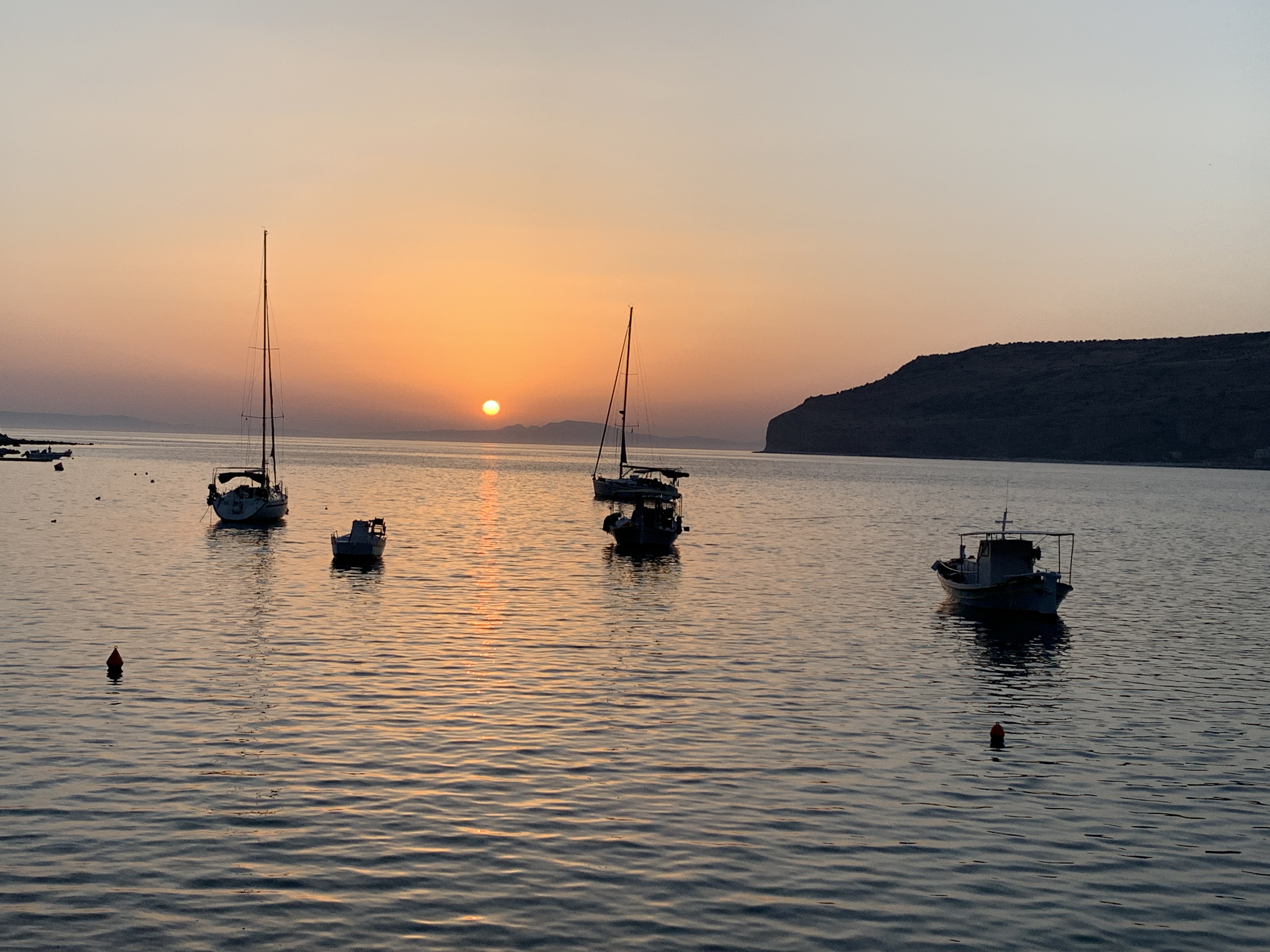
The rugged precipices of Mani are counterbalanced by the softness of sunset. The mountains and seas are enveloped in gold as another day passes and the beauty of the land waits to be rediscovered tomorrow.

Goodnight, Limeni

Return to Greece, 2016. Part 8: Meandering in Mani

This is the eighth post in a series about my trip to Greece, June 30-July 20, 2016 — an amazing journey of history, family and discovery. Previous posts can be found here.

Mani. There’s something about this land that speaks to my soul. From the moment I left two years ago, I couldn’t wait to return. The forbidding mountains, expansive plains, and impenetrable stone structures exemplify resilience, fortitude, and never giving up. It is the land of some of my ancestral families. On my first trip to Greece years ago, a man at the Archives looked at my surnames and exclaimed, “Oh, your families are from Mani!” Then he looked at my husband and said without any humor, “Watch out! She’s a Maniot. She  comes from tough people.”

Since then, I have learned so much about these “tough people.” There’s a reason they are so strong and self-reliant. They have weathered the elements and tamed the forbidding soil. They repelled any potential invaders by using rustic, yet effective methods. The Turks never penetrated or conquered the Mani. Neither did the Nazis. The people hid in caves in the hills until danger passed, then returned to their villages and their simple lives. Although the spirit of independence from Ottoman rule had been simmering for years throughout Greece, the spark that ignited the Revolution was in Mani on March 17, 1821.

By al-Qamar - File:Peloponnese relief map-blank.svg, GFDL, https://commons.wikimedia.org/w/index.php?curid=36370154

By al-Qamar – File:Peloponnese relief map-blank.svg, GFDL, https://commons.wikimedia.org/w/index.php?curid=36370154

There are three regions in Mani:  “exo” or outer; “kato” or lower; “mesa” or inner. As the map clearly shows, the entire region is mountainous and sustains little vegetation except wild olive trees, cactus, and brush. Goats scrape by on the sparse grasses, and an occasional flat valley may support orange trees. Wild herbs such as sage and oregano fill the air with a tantalizing scent. Even during hot summers, cool breezes sweep the mountains.

I fulfilled a dream by driving the beautiful, winding road from Kalamata to Areopoli. My GPS estimated the driving time at 1-1/2 hours, but it took me seven. All I did was stop, take photos, and savor every unique site and beautiful view. Being alone, I was able to absorb the atmosphere and revel in the rugged beauty of the land. I felt so peaceful and happy as I drove. I feel like I belong here.

Driving from Kalamata to Areopoli; the mountains, July 2016

Driving from Kalamata to Areopoli – the mountains. July 2016


kalamata-to-aeropoli-9-07-16

Driving from Kalamata to Areopoli – the sea. July 2016


Kalamats to Areopoli - the buildings. July 2016

Kalamats to Areopoli – the buildings. July 2016

A major item on my Plan A was to visit the village of Pyrgos Lefktro in Messinia. I had been told by an elderly aunt that my great-grandfather, Andreas Kostakos, may have come to Sparta from “Pyrgos over the mountains.” This particular Pyrgos seems to be the most logical place. The village is literally at the top of the mountain. When the mountain road ended, I had to park my car and walk because the village “road” was actually a narrow cobblestone winding path, lined with what seemed like ancient stone homes. It was mid-afternoon when I arrived, so of course, not a soul was to be seen except a stray cat. I wandered all around the town, taking many pictures. I found the church, the cemetery, and even went into the osteofilakio (οστεοφυλάκιο), the ossuary building, and looked at the names on the boxes. I did not see anything that could possibly be Kostakos, but my great-grandfather would have left in the middle 1800’s. If he did come from here, there are no descendants remaining.

At the front of the village was a sign on a tree that read “500 years old”. It would have been in full leaf during my great-grandfather’s time.

500 year old tree, Pyrgos, Messinia. July 2016
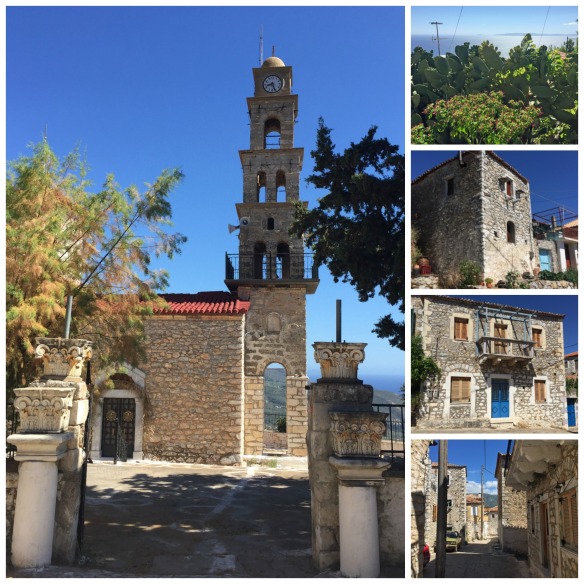
500 year old tree, Pyrgos, Messinia. July 2016


Buildings in Pyrgos, which overlooks the sea. July 2016

Buildings in Pyrgos, which overlooks the sea. July 2016

There is a very old museum which was locked; there was no sign as to when it opens. I peered in the windows and was taken aback at the life-size figures in full costume, standing watch over the treasures of the village.

Museum in Pyrgos, Messinia. July 2016

Museum in Pyrgos, Messinia. July 2016

As I was leaving, I did see two elderly women sitting on a veranda. They beckoned me to join them. I asked if they had ever heard the Kostakos name in the village, but their answer was no. I wanted to ask what type of life they had led; what type of work their husbands did; how often they left the village to “go to town” (wherever that was, somewhere down the mountain). They had a hard time hearing me and my vocabulary is limited, so the conversation was limited to pleasantries. One of them blew me a kiss as I said goodbye.
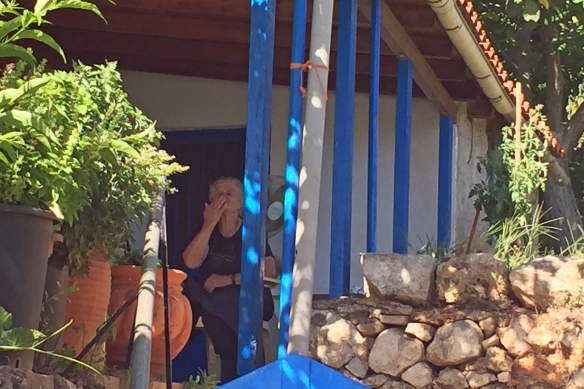
Saying goodbye; Pyrgos, Messinia, July 2016

Saying goodbye; Pyrgos, Messinia, July 2016

Driving back down the mountain, I wondered if I may have come — literally — to the end of the road in trying to learn more about the origins of Andreas Kostakos. But I resolutely pushed that thought from my mind. I guess it’s the fighting Spartan and tough Maniot in me that just refuses to give up!

Continuing on the road to Areopoli, I found a settlement, Tzokeika, that is being reconstructed to portray a traditional Maniot village, including a tower, a church, individual homes and an olive press. How fascinating to walk through the buildings that are under construction! This is a living settlement, with people occupying houses. I spoke with a man who had moved in last year, and he was very enthusiastic about his new home, the beauty of the scenery, and the pleasures of living in a closely knit community.

The settlement of Tza

The settlement of Tzokeika, Messinia, July 2016


Tz

Tzokeika settlement, Messinia, July 2016

I was in Areopoli, the capital of Mani, by 7:00 p.m. It was Saturday evening and the town was filled to capacity with both locals and tourists. When I went to dinner at 11:00 p.m., I could not find an empty table. I love this village! It eneaeropoli-07-16rgizes me. The ambiance is lively, the buildings are beautifully maintained, and it is the home of a favorite bookstore, Adouloti (owned by Georgios Dimakogiannis). There are dozens of tavernas and cafes, and many unique shops. As are most Maniot villages, Areopoli is pure stone — buildings, roads, walkways. The starkness of the rock is punctuated by brilliantly colored flowers. It is a beautiful study in contrasts. Perched at the edge of the sea, the picturesque town is a visual and sensory delight.

Approaching Areopoli, a village by the sea. July 2016

Approaching Areopoli, a village by the sea. July 2016


Adouloti Mani Bookstore, Areopoli, July 2016

Adouloti Mani Bookstore, Areopoli, July 2016


Areopoli, July 2016

Areopoli, Laconia, July 2016
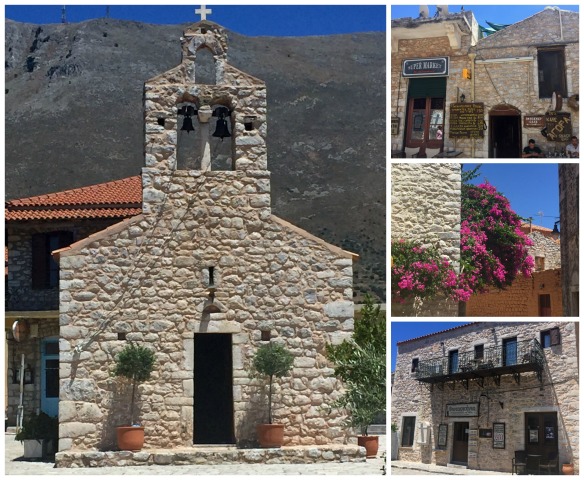

Areopoli, Laconia, July 2016

Areopoli, Laconia, July 2016

On the way back to Sparta, I stopped at Karavelas to see my friend, Margarita Thomakou, and visit her adopted village. Margarita and I had a delightful visit and a delicious lunch, made by her friend, Pietro. Pietro showed me a book about the history of the village. It is heartwarming to see that many villages in Laconia, even some of the smallest, have these wonderful histories.

Karvelas, Laconia, with Margarita Thomakou and Pietro, July 2016

Karvelas, Laconia, with Margarita Thomakou and Pietro, July 2016

My meanderings in Mani were almost over. The road to Sparta threaded through fertile plains, filled with orange and olive groves. Wild and lovely; fruitful and plentiful, this region of Laconia is truly the breadbasket of Greece.

On the road to Sparta, July 2016
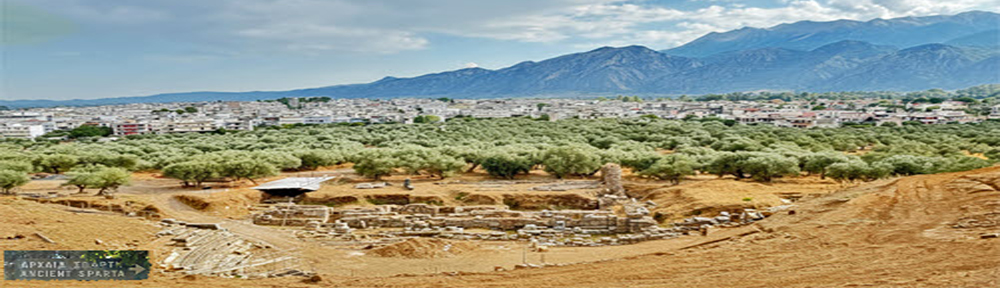
On the road to Sparta, July 2016


Research and Remembrances, Part 6

On to Mani!

How can I describe Mani? It is beautiful yet forbidding, spectacular yet humble, historical yet contemporary. It is an amalgam of opposites; a study in contradictions. It is part of my heritage. I am trying to determine which lines in my family migrated from Mani into Sparta. I’ve done a search in Election Rolls, looking for my surnames in areas in Mani. There are many, and unfortunately without corroborating evidence, I can’t determine which people are my direct lines. Church records are such a vital key, but they did not open to me during this trip. Next time!

Gregory and I met our friend, Giannis Michalakakos, in Areopoli where our adventure began. Giannis is from the village of Nifi, and he is an expert on all-things Mani. Giannis keeps a blog, Maniatika, where he chronicles history, genealogy, and culture.

My dear friends, Giannis Michalakakos (left) and Gregory Kontos (right).

My dear friends, Giannis Michalakakos (left) and Gregory Kontos (right).

Areopoli is an amazing town! It’s name means “the city of Ares” who was the god of war. It was here that, on March 17, 1821, Petrobey Mavromichalis united many clans of Mani and began a movement that resulted in the Greek War of Independence from Turkish rule.

Statue of Petrobey Mavromichalis, in the Aeropoli town square

Statue of Petrobey Mavromichalis, in the Aeropoli town square

I have never seen anything like Areopoli — ever! The “tower” architecture of Mani is built into every building: rectangular with thin and narrow windows, always constructed of stone.

This post will be mostly photographs with captions, as one picture is truly worth 1,000 words!

Aeropoli

Courtyard in Areopoli

Alley in Aeropoli

Alley in Areopoli

Dining tables are found outside every cafe and restaurant

Dining tables are found outside every cafe and restaurant

Even Churches have the tower architecture

Even Churches have the tower architecture

This building was erected in 1818, three years before the Greek Independence Revolution began with uprisings in Aeropoli

This building was erected in 1818, three years before the Greek Independence Revolution began with Petrobey Mavromichalis from Areopoli

This is a restaurant , such a perfect mix of old and new.

This restaurant  is a perfect blend of old and new.

Mani-Aeropoli (32)

Trees and flowers add splashes of color to this courtyard in Aeropoli

I’ve never seen a bookstore quite like the one below! It has everything from old newspapers to history books to tourist souvenirs. Giannis knows the owner, who welcomed us warmly and gave me a CD of a helicopter ride over Mani.

 'Adouloti Mani' Bookshop owned by Georgios Dimakogiannis

‘Adouloti Mani’ Bookshop owned by Georgios Dimakogiannis

We spent the night in the Hotel “Areospolis” – charming, quaint and very comfortable.

Hotel Aeropolis

Hotel Areospolis

The next morning we embarked on a road trip unlike any I have ever undertaken — through the narrow, switchback roads that wind around the mountains and through villages. There are times I couldn’t believe that we were actually on a road!

Carol in car

The homes in Mani are stark, isolated and impenetrable. Many are carved into the rugged hillsides, which led me to wonder how they ever were built.

Houses and villages

Houses and villages reveal that people have tamed the forbidding countryside

Our southernmost destination on this trip was Vathia, which Giannis promised was one of the most beautiful places in Mani. He was right! As we drove the winding road into the town, we saw a produce truck. Fruits and vegetables were protected from the blazing sun by a white tarp, and the all-important scale swung back and forth as the truck made its way through the villages.

Produce truck making its rounds through the villages of southern Mani

Produce truck making its rounds through the villages of southern Mani. We drove the same road into Vathia.

Entering Vathia

Entering Vathia

Vathia is

Vathia overlooks the sea, and vegetation punctuates the rocky hillsides.

Vathia tower houses

Vathia tower houses have a seaside view

Our ride out of Vathia towards Kotrona provided us with incredible views of the sea.The aquamarine blue provides a stark contrast to the barren hillsides.

Leaving Vathia, headed towards Kotrona

Leaving Vathia, headed towards Kotrona

Churches are everywhere, both large and small. We had to stoop to enter this one, which was constructed by a family for personal use only.

Interior of a tiny church

Interior of a tiny family church

Of course, what is a trip to Greece without donkeys and goats?

Donkey and goats abound!

Donkey and goats abound!

Gregory and I left Giannis at his home in Nyfi and headed north, up the east coast of

Mani. Kotronas was a beautiful place to stop for lunch.

Kotronas, an idyllic village by the sea

Kotronas, an idyllic village by the sea

A cemetery in the countryside

A cemetery in the countryside

As we drove into the lush farmland of the Spartan plains, I felt as if I had traveled from one distinct world into another. Such variety of places, people and scenery in a one-day car ride!

View of the plains of Sparta from the mountain village of Anavriti

View of the plains of Sparta from the mountain village of Anavriti

This first visit to Mani has left me with a deep-seated desire to return. There is so much to explore and experience! I can now understand why the Turks and Nazis could never overtake this area of Greece. The resilience and resistance of the people who adapted to this harshly beautiful land was no match for the greatest armies of our times. I am so deeply proud to be a descendant of Maniates!

If you would like to read more about this amazing area, this brief essay, “The Deep Mani,” written by Diana Farr Louis, combines history and photos.