First broadcast: Wednesday, February 14 at 12:00 noon Eastern Time (9AM PT)
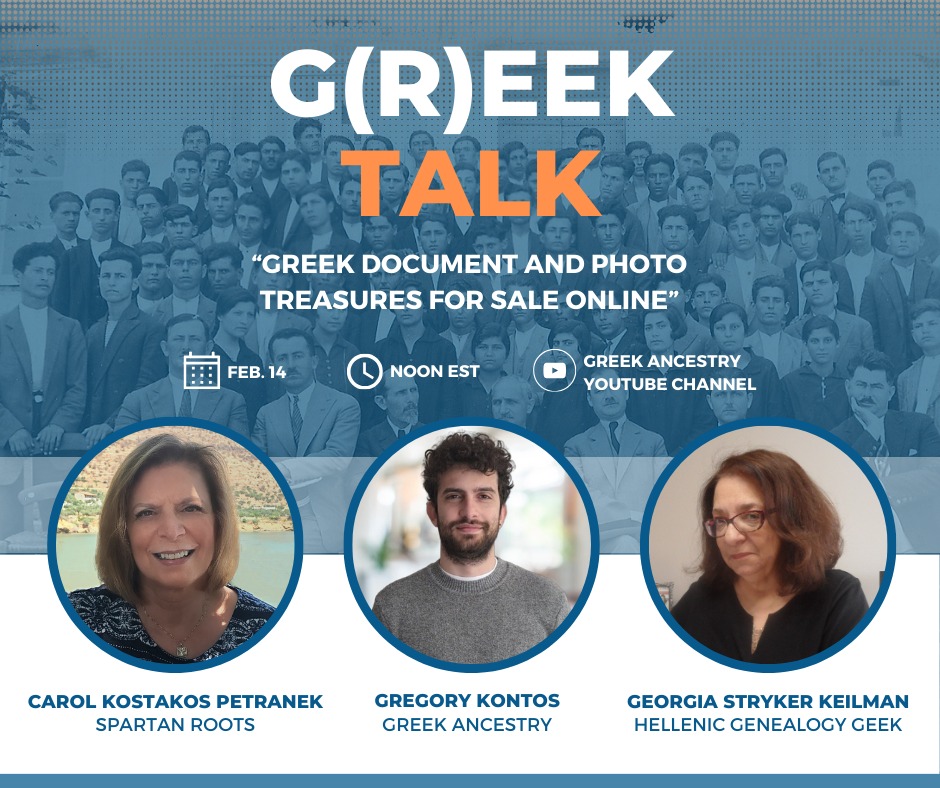
Greek Ancestry founder, Gregory Kontos, unveils an exciting new venture for the Greek genealogy community – G(r)eek Talk. This biweekly vidcast (video podcast) will be a dynamic and relevant platform for all things related to Greek family history research. It will offer insightful discussions, featured guests, and the latest news pertinent to the community.
G(r)eek Talk will be hosted by Gregory Kontos and cohosted by Georgia Stryker Keilman of the Hellenic Genealogy Geek website and Facebook group, and Carol Kostakos Petranek of the Spartan Roots website. Each episode will kick off with updates in the field, then move on to spotlight a specific theme. The group will dive into topics ranging from tracing ancestral roots to delving into less known aspects of Greek history and archival heritage. Guest speakers will bring viewers a wealth of varied perspectives and insights, expanding their knowledge and broadening their understanding of the lives and times of their ancestors.
Gregory Kontos expresses his excitement about the launch, stating, “Through our vidcast discussions, Carol, Georgia and I are looking forward to sharing knowledge, opinions and questions about all things Greek genealogy and family history, enhancing our field like never before and strengthening our community bonds.”
The inaugural episode of G(r)eek Talk will air on Wednesday, February 14 at 12:00 noon Eastern Time (9AM PT). Each episode will be live-streamed and recorded on the Greek Ancestry YouTube channel; and available for viewing on demand. The schedule for the first three vidcasts is:
2/14: “Greek Document and Photo Treasures for Sale Online” 2/28: “The Diary of Pantelis Karatasakis” (guest: Alec P. Karys) 3/13: “Memorable Ancestral Research Trips”
Tune in to G(r)eek Talk to join us, and other Greek genealogy enthusiasts, as we take this next step together in learning about our Greek ancestry!
Among the oldest records of genealogical value in the modern Greek state are the Election Registers of 1844 and 1872, which are lists of men eligible to vote. These records are now name indexed and available online (1844 at GreekAncestry.net; 1872-3 at MyHeritage). These Registers are critical for identifying which families resided in specific villages at specific points in time. In 2012, long before these records were name indexed and posted online, Georgia Stryker Keilman undertook the task of translating these registers from many villages in the Peloponnese, and her work can be found here.
I have Eftaxias ancestors from Mystras, which sent me to the 1872 Election Registers for that village. Mystras had been the seat of Byzantium in the Peloponnese until overtaken by Ottoman Rule. After the Greek Revolution for Independence, the population of Mystras began to decline as people descended from the castle area on the mountain top. Some formed the village of Mystras in the valley while others relocated to the emerging city of modern Sparta.
Mystras, Looking Towards Sparta, ca. 1890-1910. Library of Congress
When the Election Registers of 1872 were created, a man had to be at least 21 years old to vote. The number of men in Mystras on the election list was 268 and their average age was 38 years.
The “new” village of Mystras needed a mix of tradesmen, laborers, landowners and professionals to meet the needs of its population. The chart below, which lists the occupations of the voters, reveals that the village had the requisite composition to support its residents.
occupation
number
Baker
7
Bailiff
17
Bricklayer
1
Butcher
4
Clerk
3
Coachman/driver
1
Cobbler
4
Coffee seller
2
Court official
1
Doctor
2
Farmer
27
Farrier
1
Gardener
10
Gendarme
4
Grocer
12
Laborer
30
Landowner
53
Lawyer
1
Magistrate
2
Mason
2
Mayor
1
Merchant
3
Mule driver
7
Unemployed
2
Official / Clerk
3
Pharmacist
1
Police Inspector
1
Quilt Maker
1
Rag Seller
2
Retailer
1
Sandal Maker
3
Servant
7
Shepherd
23
Shoemaker
1
Soldier
7
Student
10
Superintendent
1
Surgeon
1
Tailor
4
Trader
1
Veteran
1
Wine Sales
2
Which families are found in the village during this time? This chart lists the names of the voters, their ages and occupations in alphabetical order. Some surnames have “disappeared” over time, but many are found in Mystras today.
This is the Register in Greek.
My great-grandfather, Konstantinos Eftaxias, is found on line 573. This Register gave me his father’s name, Ioannis, and his occupation as a shepherd. Also listed are Georgios, who were identified in the 1873 Election Register as being the son of Ioannis.
1873: Line 537, Georg. Eftaxias, age 25, father: Ioannis; occupation: student1873: Line 597, Dimitr. Eftaxias, age 27, no father listed; occupation: shepherd
Although the father of Dimitrios is not listed, further research indicated that there was only one Eftaxias family in Mystras during this period.These Eftaxias examples show the importance of trying to find your ancestors in every available record.
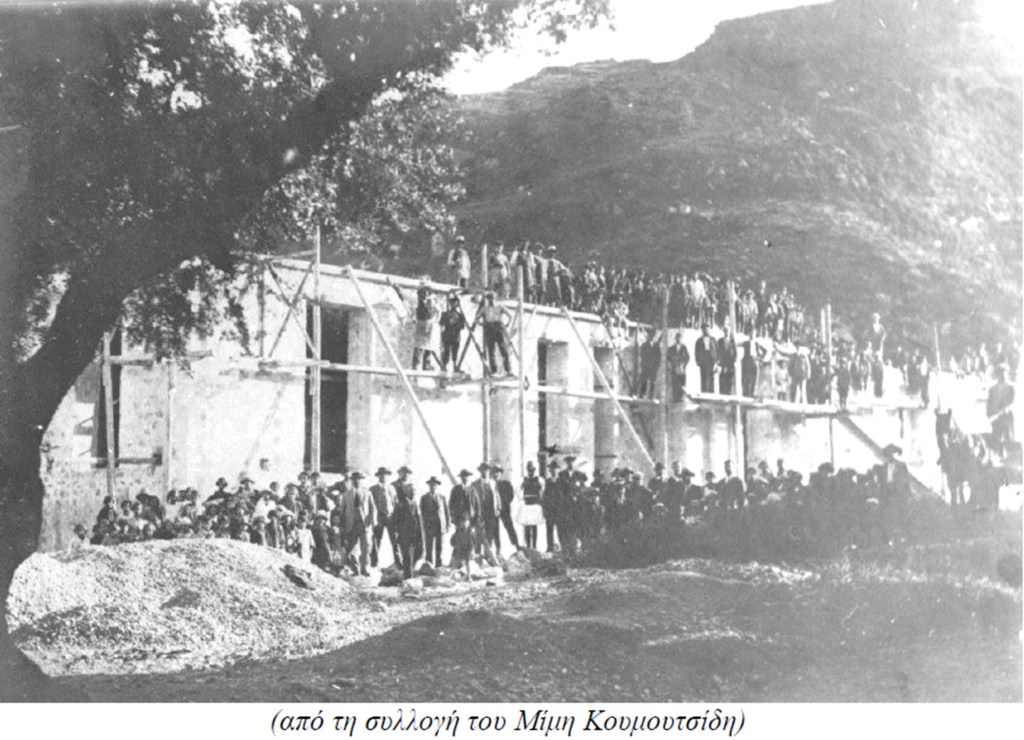
With the occasion of an old photograph I recently saw from the construction of the School Building in Xirokampi in 1927, I had some thoughts and observations as an engineer. At the same time, I remembered that until the 1970s in our villages (and not only), those who had built a house said the phrase of the title in every instance.
In the photograph, a crowd of people is depicted on the walls of the half-constructed building up to the first floor. They seem to celebrate the progress of the construction by wearing their best attire or even foustanellas. Some hold their tools and wear workers’ aprons. Everyone poses. Around the school, there is wood scaffolding. Piles of gravel and a few stones are scattered everywhere, but there is no lift [elevator] or machinery anywhere. Only a cart pulled by a horse. Obviously, the day of putting the concrete base of the first floor of the school will follow.
I thought about what would happen that day! Like every such day, many eyewitnesses remember that putting a cement building slab (also) in our villages, before the 1970s, required the mobilization of many artisans and workers. The whole village. It also required the coordination of many technical and manual tasks, culminating in a laborious and noisy effort (or celebration) for a day, with almost no mechanical support.
Each time, the processes of arranging the space preceded the placement of the concrete base, always done by hand using common tools, measurements with the paseto, [a folded wooden measuring stick], wooden supports, and moldings nailed with hammers. Molds to make metal rods [to reinforce the concrete] were created with concrete sticks that were cut and shaped on the spot by the craftsmen.
On the day of the slab casting, a crowd of workers with shovels made the mixture from cement and sand. Another larger group of workers carried “on their shoulders” bins of mud, climbing up to the level of the slab through narrow and shaky improvised stairs and scaffolding that slipped through the mud. Others smoothed the fluid mud with straight boards. Time was critical for the cement to set. So, with shouts coordinated by the elders, they created a feverish enthusiasm that encouraged the carriers to move quickly without stopping.
In contrast, today the same process is carried out quickly and nonstop by many mechanical means, with hoists, cranes, and tools operated by a few operators. However, it lacks the excitement and enthusiasm of the old “tilers.” Besides, in the past, the casting of the slab was boosted and completed soon by the anticipation of an informal, standing feast that followed, with dozens of herrings and countless jugs of wine passed from mouth to mouth. I think that what was happening then compared to what is happening today is a typical example of a “paradigm” shift for technology.
Returning to the photo, which was the trigger for this note, I remind you that the construction of the School Building in Xirokampi (1927-1929) was the fulfillment of a “vow” made by our compatriots who had fought in Asia Minor between 1918 and 1922 and returned alive.
I (Carol Kostakos Petranek) am honored to receive permission from the Katsoulakos family to translate and share articles from The Faris. Translation verification and corrections have been made by GreekAncestry.net. This is the thirteenth article of the ongoing series. Previous articles can be viewed here.
Family challenges often lead to difficult decisions. Among the most heart rending are those involving minor children. Parents die or become indigent, leaving their most vulnerable loved ones to be cared for by others–perhaps family members, perhaps not.
My mother shared such a story about her Uncle Kolokota and his wife, Katina (whom mom called Thea Kolokotou). “They never had children of their own,” she said. “Instead, they raised their niece. Thea Kolokotou’s sister and her husband had nine children, born two years apart. They couldn’t take care of them all, so Theo and Thea took in one of the daughters and raised her as their own.” I remember being mildly surprised, yet reassured, that this couple would open their home and hearts to help one of Katina’s children. This was my first introduction to ψυχοπαίδια (psychopedia), known in Greece as “soul children1.”
Konstantinos Kolokotas naturalization photo, 1937
My grandfather, John Andrew Kostakos, was the youngest of eleven children. When he was about one year old, his mother died. I learned stories of him being nursed and cared for by women in the village while his father worked in his fields. Then John’s father died when he was eight years old, and John was taken in and raised by his half-brother, Gregory, who had five children of his own. At age 14, John left Gregory’s home to work for a wealthy man in Mystras, who funded John’s voyage to America.
John Andrew Kostakos naturalization photo, 1931
The concept of an orphaned child being raised by family members is repeated in countless families.
The concept of a child whose parents are unable to care for him/her, then is raised by family members, is less common.
What is rare, but not uncommon in rural Greece, is the concept of an orphaned or destitute child who is not formally adopted, but is brought as a “soul child” into the home of an unrelated family.
I found such a case this week, as I was adding marriage records into the family tree I am creating for the village of Agios Ioannis, Sparta.2
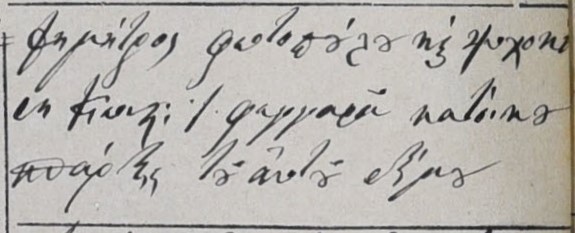
Metropolis of Sparta, Marriage Index Book: Sparta 1873-1879; Year: 1875, Entries: 205-216 Entry #209
I began entering information for entry #209: Marriage License Date: August 24, 1875 Groom: Nikolaos Voulgaris of Agios Ioannis
I then saw an unusual entry in the bride’s column. Normally, the entry would give the name of the bride, her father’s name, and residence. But this entry reads: Dimitro Fotopoulou, psychokori Konst. I. Feggara, residence, Sparta.
I was stumped as to why Dimitro’s father’s name was not recorded in her marriage record. And who was Konstantinos Feggaras? I sent the image above to my colleague, Gregory Kontos, owner of GreekAncestry. He responded that Fotopoulos was her biological father’s surname, and that Konstantinos I. Feggaras had “adopted” her. Greg reminded me that Greek Ancestry had published this article, “Soul-children” (Ψυχοπαίδια) earlier this year.
An excerpt from the article: The term “soul – child” describes an institution already existing in Byzantine customary law. According to this, the “soul – son” or the “soul – daughter” are granted to the “soul – parent”, who in exchange for the child’s labor undertakes the obligation to ensure his professional development or endow her until she reaches the age of marriage. In comparison to an ordinary adoption, the tradition of the “soul – children” was accompanied by a less formal legal relationship, and by a strong ethical character, which is also reflected by the first part [“ψυχή” (soul)] of this Greek compound word [“ψυχή” + “παιδί” (soul + child)]: this signifies the moral and religious attitude of the father, who aims not only at his inner atonement but also at the devotion of the adopted child to him during the last years of his life. The benefits from the offered labor usually were not important.
Reading this description, we see that ψυχοπαιδία/psychopedia connotes a deep and loving relationship–one that would rival, if not equal, that of biological parents and children. A legal adoption may have been difficult, and honestly, not necessary, in rural Greece. That this practice was brought to America and followed by the Kolokotas’ and other families gives us a heartwarming insight into those who welcomed children of need into their homes.
1For a detailed historical description and case study of this topic, see “Soul-Children (Ψυχοπαίδια)” published by GreekAncestry on March 14, 2023. 2MyHeritage has a collection titled, Sparta Marriages, 1835-1935, which I digitized at the Metropolis of Sparta. This collection has both the marriage index books and accompanying marriage licenses for thousands of families.
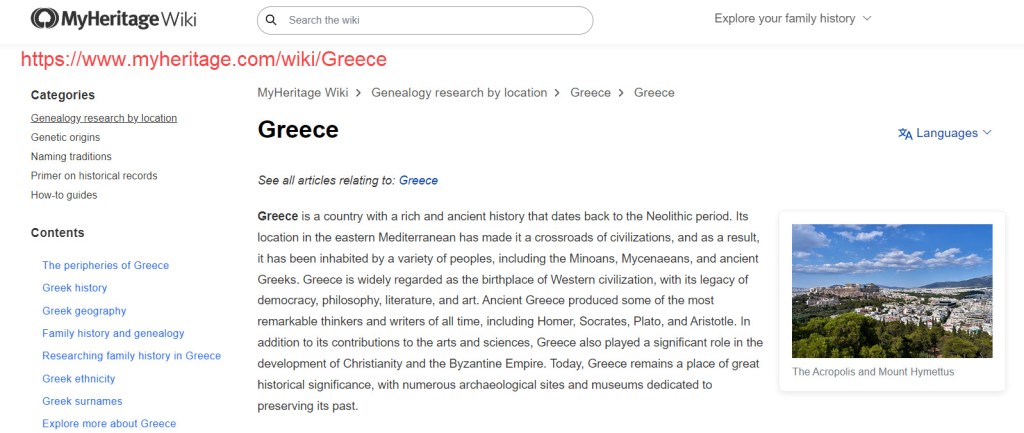
For several months, my colleagues (Gregory Kontos, Georgia Stryker Keilman) and I have been developing articles to help people with their family history research in Greece. These articles are now published on a new wiki page online at MyHeritage.com.











 Spartan Roots (Σπαρτιατικές Ρίζες)