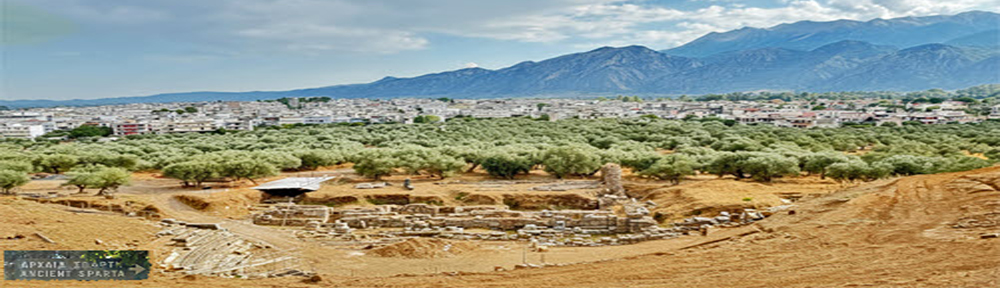
On Tuesday, September 3 at 6:00 p.m., I have been invited to give a presentation in Sparta, Greece on “Genealogy Tourism” (see news article here). My cousin, Georgios Kostakos, recently organized Sparta.Komvos, a group that hosts a variety of speakers and events that both educate and interest youth and modern Spartans.
Georgios asked if I could talk about the work I have been doing for many years with Spartan genealogy research. As I considered what could be of interest for this audience, I decided to help them understand the concept of Heritage Travel, or Diaspora Travel, or Genealogy Tourism — whichever term is used — and the opportunities it can bring. Businesses, artisans, shop owners and the hospitality industry could reap significant benefits by welcoming family historians.
We are a niche group with specific needs and expectations when we travel to visit our ancestral land. We want to find living cousins, go to the archives and research, understand our heritage, immerse ourselves in culture, and “walk where our ancestors walked.” Going to the beach and touring ancient ruins is a side note, not the purpose of our visit. I think it would be helpful for the Spartan community understand this type of tourism, and how they can prepare to help us researchers when we visit. The benefits that will come to them could be significant.
If you have suggestions to share with me that I can share with this group, I would love to hear from you. Please, send me a message and I will pass along your thoughts.
I’ll let you know how the event is received. Wish me luck! 🙂
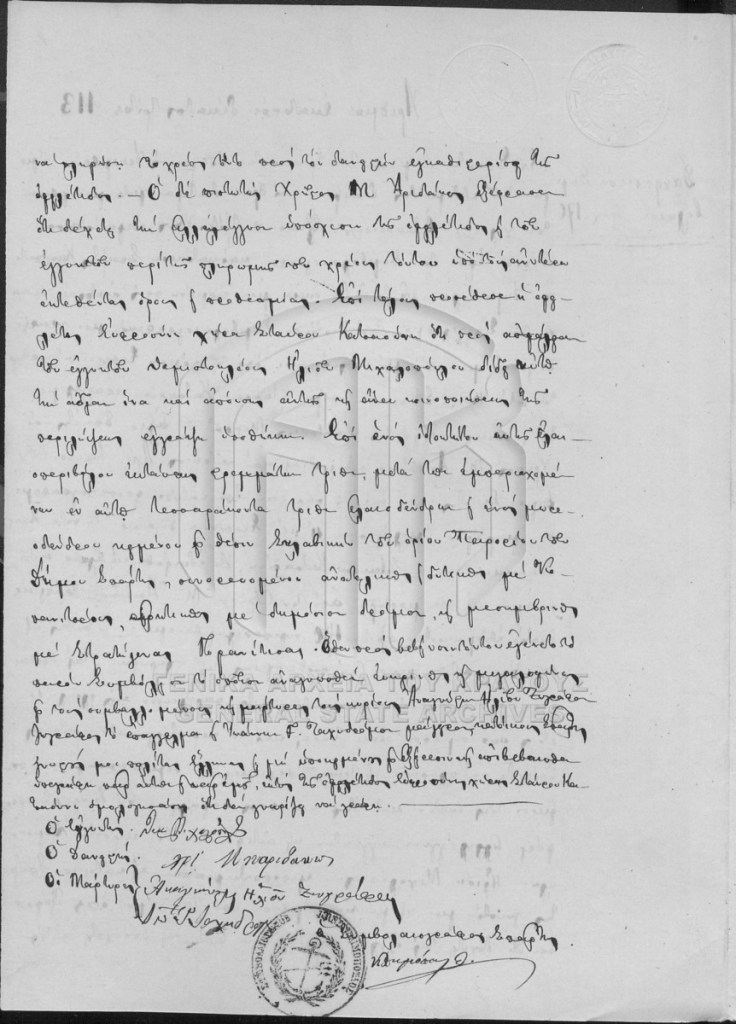
Notary files in archive offices contain gems of information about families, businsess dealings, and traditions. People who entered into contracts–whether for dowries, businesses, or loans–ensured that the contract was legally binding by signing before a notary and witnesses. At the Sparta, Lakonia office of the General State Archives of Greece, Gregory Kontos and I found several notary files of great interest to me which documented transations by my ancestral family.
This is one of those notary documents. My great-grand uncle, Christos Aridakos (Aridas) entered into a contract to loan money to Ephrosyni Stasinakis. The document is dated December 30, 1863. The details are fascinating! This translation was done by Gregory Kontos.
Lending contract between Christos Aridakos and Ephrosyni Stasinakis, 12/30/1863
page 1
(page 1) In Sparta, today, on the 30th of month December, day Monday, and at 2pm, of year 1863, Ephrosyni, daughter of the late Konstantinos Stasinakis and widow of Stavros Katsaounis, housekeeper and resident of Mystras of the Municipality of Sparta, and Christos M. Aridakos, landowner and resident of Agios Ioannis of the Municipality of Sparta, both known to me and legal people, appeared before me, notary and resident of Sparta, Konstantinos Dimopoulos, at my notarial office, located at my house which is at the east of the Church of the Annunciation of Theotokos. In the presence of the witnesses signing below they stated the following: Ephrosyni, daughter of the late Konstantinos Stasinakis and widow of Stavros Katsaounis, declared that she borrowed and got, before me and the witnesses, 170 drachmas from Christos M. Aridakos, including their interest until the expiration of the payment, and promises to return this money to him after the lapse of one whole year from this day without any interest. In case of a deferred payment, she promises to pay an agreed interest of 20% per year; and in order for the lender to be secure, she adds Themistocles Ilia Michalopoulos, merchant-landowner and resident of Sparta, present, known to me and legal, as a joint and several guarantor. He (Themistocles) stated that he accepts this guarantee of the debtor and promised
page 2
(page 2) to pay this debt to the lender. On the other hand, the creditor, Christos M. Aridakos, declared that he accepts the promises of the debtor and the guarantor to pay this debt under the above mentioned terms and deadlines. Lastly, the debtor, Ephrosyni, widow of Stavros Katsaounis, added that in order for the guarantor, Themistocles Ilia Michalopoulos, to be secure she gives him the permission to mortgage an olive grove of herself, 3 acres big, together with the 43 olive trees in it and a […]tree, located at the place “Sklaviki” at the borders of Parori of the Municipality of Sparta; on the east and west side the field is adjacent to the Koumanitoros family, on the north side to a public road and on the south side to Stratigena Goranitissa. And as an indication was the present agreement contract created, which, after being read sufficiently and loudly before the stipulators and the witnesses, Mr. Anagnostis Ilia Zografos, painter, and Ioannis G. Tahydromos, cook, residents of Sparta and Greek citizens known to me, and after being confirmed, was signed by them and by me, except for the debtor, Ephrosyni, widow of Stavros Katsaounis, who claimed she’s illiterate.
The guarantor, Them. Michalopoulos The lender, Chri. M. Aridakos The witnesses: Anagnostis Ilia Zografos; Io. G. Tahydromos The notary of Sparta, K. Dimopoulos
page 3
(page 3) […] It is requested from every bailiff to execute the present contract, and from every attorney to do his duty, and from all the judges and public officials to help, if they’re legally asked to.
[…] In Sparta, July 7th 1866. The notary of Sparta, K. Dimopoulos
Source: General Archives of Greece, GAK Lakonia, Sparta Office Notary: Konstandinos Dimopoulos, Volume: 12.1.1 Contract Reference Number: 113/31.12.1863 (Contract #113; date: 31 December 1863) Accessed July 2014; Carol Kostakos Petranek & Gregory Kontos
My colleague, Georgia Stryker Keilman of Hellenic Genealogy Geek and I have embarked on a new venture: a series of short videos to address the most common research questions that people ask. Each video will address a specific topic and have an accompanying handout.
Our first videos are available now. The first is “Tips about Names and Villages” with information that we wish we had known when we started our research.
The second is “How to Find Your Grandfather’s Greek Name” which shows a wide variety of records that will give you this information. Trying to find ancestors in Greece without the original Greek surname is virtually impossible.
The third is “How to Find Your Ancestor’s Village of Birth.” This can be tricky, as many people gave just a county (prefecture) or the nearest city, rather than their exact village.
Be sure to download the handout for each video, which can be found in the Description area below the video.
We will be announcing more recordings over the next few weeks. We hope they will be helpful to you!
The market of our village [Xirokampi, Lakonia] is, for me, the most familiar and beloved part of the village after my paternal home. In the summers, in fact, it is the “center of the world.” Everything happens in the market (or the square, as we also call it). The meetings with acquaintances and friends, the new acquaintances, the company, the discussions, the walks, the celebrations and the feasts… There, under the three plane trees and the bitter orange trees, next to the sweet acacia tree in the center, around the welcoming tables of the cafes… from morning until late in the evening… or even at night.
The Plateia of Xirokampi; Photos by Carol Kostakos Petranek
The market does not seem to change in character in terms of the people who frequent it. However, it has changed form since it was created until today, with cement pavements, stone pavements, tree planting, lighting… Mainly, however, its character has changed in terms of the composition of the shops and the commercial activities of the residents and visitors in the wider area.
According to a note published continually, in the first issues of our newspaper [the Faris](from the first to the fifth issues of the years 1966-70), in the wider area of the market, there were operating then: many cafes and restaurants or taverns, wine shops that were also wineries (in basements), a kiosk (always), a market for agricultural products and animals (once a week), a pharmacy (always), doctor’s offices, law offices, post office and telephone office, a bank (formerly), a closed cinema venue, a dance school, a bookstore, a photo studio, barbershops, hair salons, grocery stores, cheese shops, coffee shops, agricultural drug stores, a dried fig station, fabric and clothing stores, tailors, shoemaking and shoe stores, a bicycle repair shop and a traffic light shop, blacksmiths, carpenters and cabinet makers, a tannery, …
Commercial activities in retail stores selling goods and services, as well as the shops themselves, have drastically decreased today, while production activities and manufacturing workshops have disappeared.
A typical example is the shoe stores that were once also cobbler shops, the well-known “tsagkarika” that mainly repaired or even custom-made shoes “on order” and “to the measure” of the customer. The usually large families of the area, most of them agricultural or working-class, provided and maintained a clientele for many cobblers, with their low prices. The requirement for durability was the main concern, while design options were limited compared to today.
A second typical example is the wineries in addition to the wine shops. In many basements, there were barrels (or vats) for the “boiling” of the grape must, which was done with the guidance of a winemaker of Sparta or empirical recipes. Wine was usually sold on the ground floor or bought by enthusiastic neighbors or even compatriots in Athens if it arrived there in good condition.
I (Carol Kostakos Petranek) am honored to receive permission from the Katsoulakos family to translate and share articles from The Faris. Translation verification and corrections have been made by GreekAncestry.net. This is the eighteenth article of the ongoing series. Previous articles can be viewed here.
At the end of the fourth decade of the 20th century, marriages were mainly arranged by matchmaking. The role of the matchmaker was undertaken by a female relative, a neighbor, or even a stranger. The matchmaker was responsible for bringing together the two families concerned, informing them about the “situation,” meaning the financial requirements. At a festival, celebration, or a relative’s house, the parents or close relatives would meet. If they agreed to the terms, the groom and the bride would go to this meeting: there they would finalize the arrangement.
Engagement usually followed shortly after. On the designated Sunday, after church, the betrothal ceremony took place. There was a feast with meat, plenty of wine, and the celebration included dancing, many jokes, and well-wishes.
Then, the wedding preparations followed. The bride and groom’s clothes had to be bought, sweets prepared, and rings purchased. The economic conditions of the time did not allow for the purchase of other jewelry as gifts for the bride. In the meantime, they took care of adding anything missing from the dowry, such as pillows, wool blankets, quilts, and embroidery or woven cloths.
When everything was ready on both the bride’s and groom’s sides, the wedding date was set. Weddings always took place on Sundays, never on Saturdays, as Sunday was dedicated to God, and the couple was not allowed to be together on Saturday night.
Παραδοσική γαμίλια πομπή στην Αταλάντη – Traditional wedding procession in Atalanti Photo credit: el.wikipedia, accessed May 26, 2024
The relatives, the “psiki” (the celebration procession) accompanied the bride and the groom to the church on decorated horses. However, many people stayed at home and did not attend the ceremony, to help prepare for the feast that would follow. The meat for the feast was prepared from Saturday. Usually, the wedding table included meat with potatoes in the oven or pot roasted. The meat was roasted in large pans. The pasta was boiled in tin-plated pots. Once the pasta was cooked and sprinkled with cheese, it was placed on platters from which everyone ate in turn with the same fork. The celebration included dancing and singing many songs a cappella, as the economic situation of the time did not allow for hiring musicians. They danced syrtos, tsamikos, as well as the Charleston and foxtrot. The celebration was filled with jokes and well-wishes for the couple. In the meantime, a man would serve wine from a bottle, and everyone drank from the same glass. The celebration lasted until dawn. There were also many sweets, usually kourabiedes but also koulouria, baked in the oven and decorated. The bride would throw the koulouria into the air for the unmarried women to catch. It was believed that whoever caught a koulouri would marry soon.
After the party, the newlyweds went to the groom’s house or stayed a few days at a hotel in Sparta or sometimes in Tripoli. Then they went to the in-laws’ house, where relatives gathered to verify the bride’s “honor.” They cheered and fired shots in joy.
If the bride was not a virgin, she was either sent away or additional dowry was demanded if the groom agreed.
A decade later, the improvement in economic conditions led to a differentiation, but not in the essence, of marriage customs. Once the betrothal was fixed, the dowry agreement was sometimes written at the bride’s house and paid with her money. At the engagement, the bride received not only the ring but also additional jewelry, if possible. The groom and the bride were accompanied by professional musicians, who were hired by both sides, and they remained for the celebration, as noted by the couple Vasiliki and Yiannis Poulakos from Mousga*. The groom’s procession had 98 horses. Guests no longer brought only animals to the newlyweds but also household items – glassware, plates, glasses.
The better economic situation, however, did not eliminate superstitions and preserved beautiful and interesting wedding customs of previous decades. The bride had to go to the fountain to fetch water, accompanied by a small child whose both parents were alive and who had to throw silver coins to the fountain. This custom is probably related to fertility and childbearing. The bride went to the church, having the church key and a black-handled knife at her waist to protect her from spells. When she would go to the groom’s house, she had to lie down with a small boy to have healthy children. At the entrance door, she had to eat honey given by her mother-in-law for a sweet life. Also, they poured honey on the door three times, and the couple entered the house covered with a handkerchief.
A song that was sung when the bride was about to be get married:
“Come away, bride, come away from your parents’ Where are you going, little bride, to your in-laws Stand like a cypress, root like a tree Bloom like an apple tree, bear fruit, Make nine sons and one daughter.”
Testimonies: Eugenia Konidi, 87 years old. She finished elementary school and 2 classes of Greek school. She married on 22/10/1939. Vasiliki Ioan. Poulakou. Born on 20/7/1922. She finished elementary school. She married on 21/8/1949.
The Dowry Agreement
In the name of the Father and the Son and Saint Prokopios Amen. I, Georgios Ath. Rigakos from Gorani, give my daughter for marriage, Vasiliki Georg. Rigakos to Ioannis Pan. Poulakos from Mousga, endowing her with the following items:
* Their wedding was the last in the area where guests arrived riding horses and mules.
I (Carol Kostakos Petranek) am honored to receive permission from the Katsoulakos family to translate and share articles from The Faris. Translation verification and corrections have been made by GreekAncestry.net. This is the seventeenth article of the ongoing series. Previous articles can be viewed here.




 Spartan Roots (Σπαρτιατικές Ρίζες)