My colleague, Georgia Stryker Keilman of Hellenic Genealogy Geek and I have thoroughly enjoyed creating the video series, “Bite-Sized Greek Genealogy.” These short presentations are our way of sharing what we have learned in researching our Greek family history. We also hope these videos will help others avoid making the same mistakes as we did, and to avoid the myriad of pitfalls that we encountered.
Education for any topic is critical for success! Therefore, we are taking this series one step further.
With the videos now complete, we embarked on writing a booklet to capture the notes and talking points that accompanied our slide presentations. This booklet is now complete and is available as a free download at this link.
The booklet is structured according to the contents of each video. Each chapter contains links to the relevant videos and additional references and website links which correlate to the topic.
SECTION I: Episode 1: Tips about Names and Villages, page 3
SECTION II: SEARCHING IN U.S. RECORDS, pages 7-11 Episode 2: How to Find Your Grandfather’s Greek Name Episode 3: How to Find Your Ancestor’s Village of Origin Episode 4: How to Find Your Grandmother’s Greek Maiden Name
SECTION III: RESEARCHING IN GREEK RECORDS, pages 12-40 Episode 5: How to Find Birth Information in Greece (3 videos) Episode 6: How to Find Marriage Information in Greece Episode 7: How to Find Death Information in Greece
SECTION IV: APPENDIX Greek Document Locator, Parts 1 &2 Greek Word List
The plateia is the heart and soul of every Greek village. Anchored by its peoples’ beloved Greek Church, amply shaded a huge plane tree, proudly displaying the marble War Memorial honoring its dead and surrounded by businesses and cafes, it is the central gathering point of the village. In the beautiful mountain village of Theologos, Lakonia, the plateia is very special to me as it is where members of my Zacharakis family meet for summer reunions.
Zacharakis reunion at the plateia in Theologos, July 2017
During my last visit in 2023, I noticed with sadness that some buildings on the plateia were abandoned and in serious disrepair. Gone were places to gather indoors on a rainy or wintry day, to celebrate a baptism or mourn a death, to hold a bazaar or community event, or to house the Women’s Association of St. John Theologian1. The empty buildings made it seem as if the plateia had lost part of its soul.
Imagine my surprise—and my delight—when I received a message from my cousin, Georgia Zacharaki1, stating that a large building on the plateia had been donated from the city to the village, but it was in need of major renovations. “It is a wonderful venue and the location is perfect,” wrote Georgia, who is President of the Women’s Association. She and the Association members organized an initiative to raise funds and repair the building.
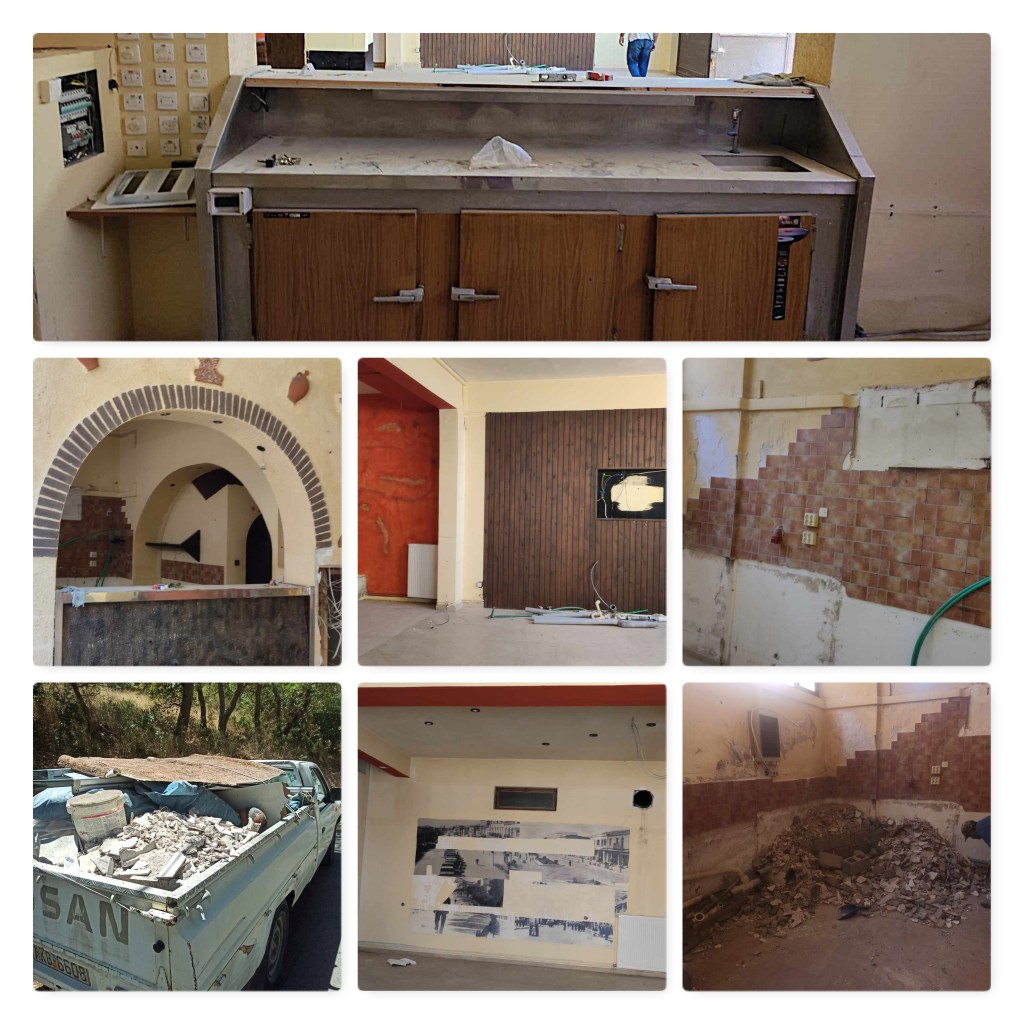
These photos show the interior during demolition. Truckloads of debris were removed.
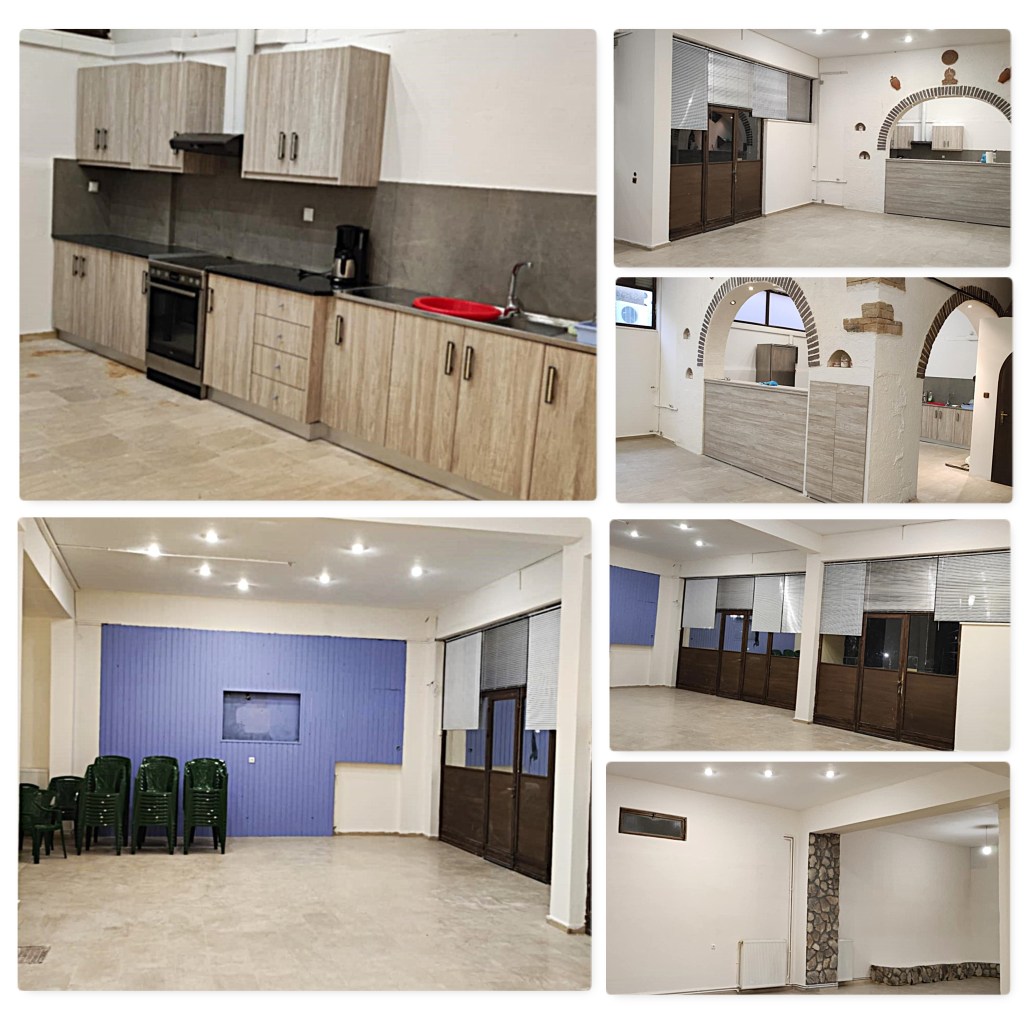
Much work needed to be done: interior walls, electrical work, and a complete overhaul of the kitchen area. When Georgia and I met in Sparta in early September, renovations were well underway. By late October, the project was near completion. So much work was done so quickly! The rooms are sparkling, bright, and beautiful.
The beautifully renovated venue
Donations of money, large and small, came from people in Greece and America. There were also many contributions of needed items such as appliances, kitchen utensils, blinds, glasses, coffee cups, etc. “If we had to pay for everything and did not have volunteer work and donations in money and materials, the cost to us would have been close to $10,000,” Georgia noted. Thus, every euro and every item was gratefully received and sincerely appreciated.
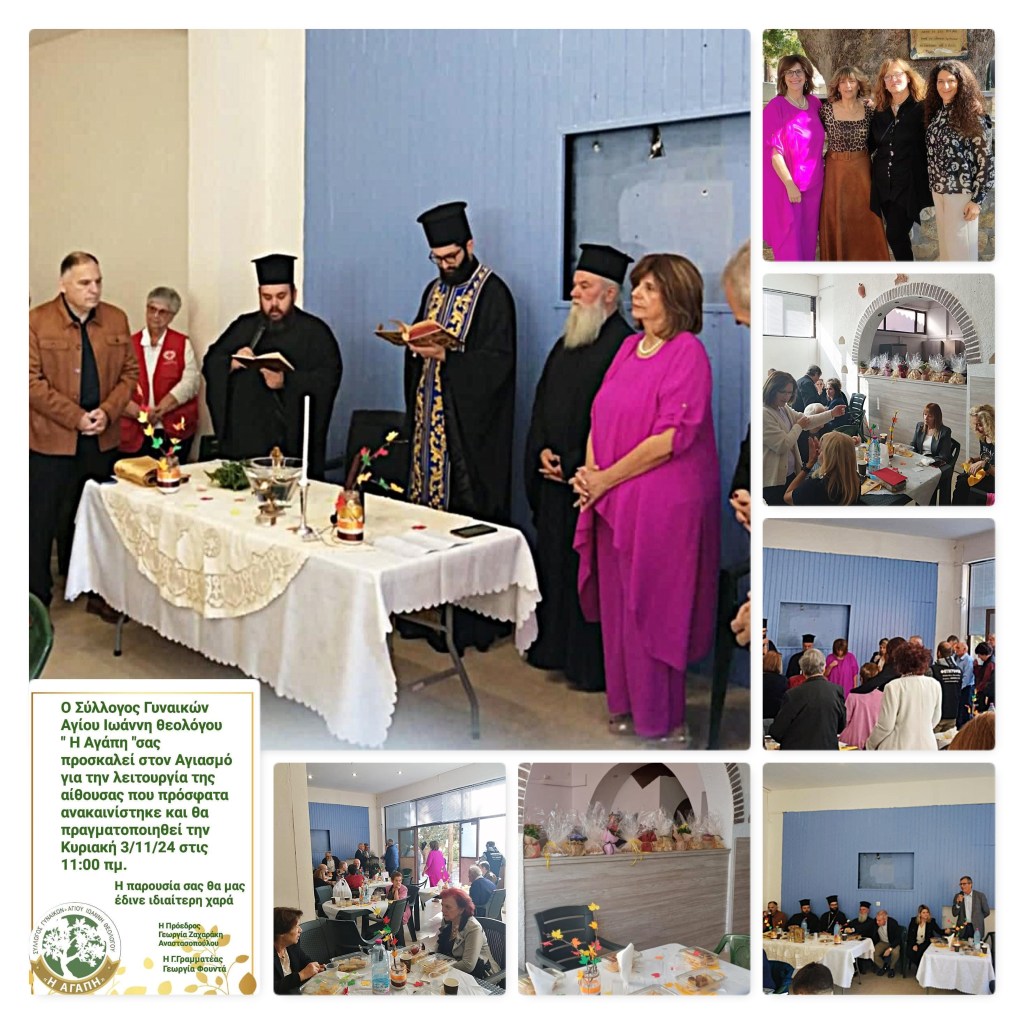
By the first of November, the venue was ready for use. A dedication ceremony was scheduled for Sunday, November 3. Women of the Association gathered happily in the new kitchen to prepare for the event by baking traditional Greek sweets such as diples and baklava.
Baking in the new kitchen to prepare for the dedication. Delicious homemade sweets were lovingly made and beautifully packaged for those at the dedicationThe room was gaily decorated for the dedication
The dedication on November 3, 2024, was joyfully attended by over 120 people throughout the area. The blessing on the venue was offered by the beloved village priest, Father Panagiotis Kotsios (below, left). He was joined by Archimandrite Ierotheos Varvitsiotis of the Monastery of Panagia Faneromeni of Anavryri (below, right) and Archimandrite Rafael Tsaltas of the Monastery of Panagia Koubari of Paleopanagia (below center; also representative of His Eminence Bishop Efstathios of the Metropolis of Monemvasia and Sparta).
Additional noted guests were three members of Parliament; two Deputy Mayors of Sparta; the representative of the Mayor, Deputy Mayor Mr. Antonakos; the former Mayor of Sparta, Mr. Valioti; and the Board of Directors of the Daughters of Penelope Sparta2.
The attendance of so many local dignitaries indicated that the strength, resourcefulness and abilities of the Women’s Association merited their support and recognition.
Although the main renovations are completed, additional work is required. Money is needed to install a heating system and to fix a water pipe. At the dedication, 20 trays of homemade sweets were raffled off and additional fundraising will occur. With cold, mountain winter months now arriving, a heating system is a necessity for the 300 permanent residents to gather indoors.
I am saddened that so many charming villages in Greece are abandoned and neglected as residents leave for employment in cities. However, I am relieved and elated that the soul of beautiful Theologos has been revived.
If you desire to make a donation to help towards purchasing a heating system, please contact me at: spartanroots1@gmail.com. Any amount will be gratefully accepted by our friends–and my family–in beautiful Theologos.
Theologos, a charming village at 1,860 feet at the top of the Mt. Parnon range, has about 300 permanent residents. Many with roots in the village now live in Sparta and surrounding areas.
1Georgia Zacharaki is a founding member of the Women’s Association of Agios Ioannis Theologos, and a former Deputy Mayor of Sparta. 2“The women’s association is named Γυναικών Αγ.Ιωάννη θεολόγου Ηαγάπη — in English: the Women’s Association of Agios Ioannis Theologos Agapi (love). Because the village is named after the Apostle John Theologos who was Christ’s beloved as He appointed him as Virgin Mary’s son after Jis crucifixion and he preached Jesus’ word which that of LOVE, we named our association LOVE. The association was formed in 2017.” Georgia Zacharaki to Carol Kostakos Petranek, October 22, 2024. 3The Daughters of Penelope is a worldwide association formed in 1929 to promote Hellenism, Education, Civic Responsiblity, Philanthropy, and Family & Individual Excellence.
Women of all ages wore headscarves on their heads. Elderly and middle-aged women wore brown headscarves, young women wore white or floral scarves, and those in mourning wore black ones.
At church or other formal occasions, they usually didn’t wear headscarves, but styled their hair, which was primarily long. They braided it into plaits or buns. The headscarf was tied in front under the chin or in back or made into a “duvali” – meaning they crossed the two ends behind, brought it forward and tied it slightly to the side.
Men and women wear traditional dress and head coverings as they dance at the village “panegyri” Amykles, Lakonia, July 2019; photo by Carol Kostakos Petranek
There were also scissors, which they put in the fire and heated. These were passed through the hair to curl it, making it wavy.
If a young woman fell into moral disgrace and was discovered, her hair was cut. Also, when two young women harbored hatred for each other, one would hide and suddenly cut off the other’s braids with scissors for revenge. This was a crime and, if it went to court, the punishment was severe.
Men wore various kinds of hats. Students had caps. These were made of black or blue fabric and had a symbol in front made with gold thread, depicting an owl. Older men wore a type of hat called “kouko,” which they used in winter. In summer they wore straw hats for festive days and wide-brimmed hats for working in the sun.
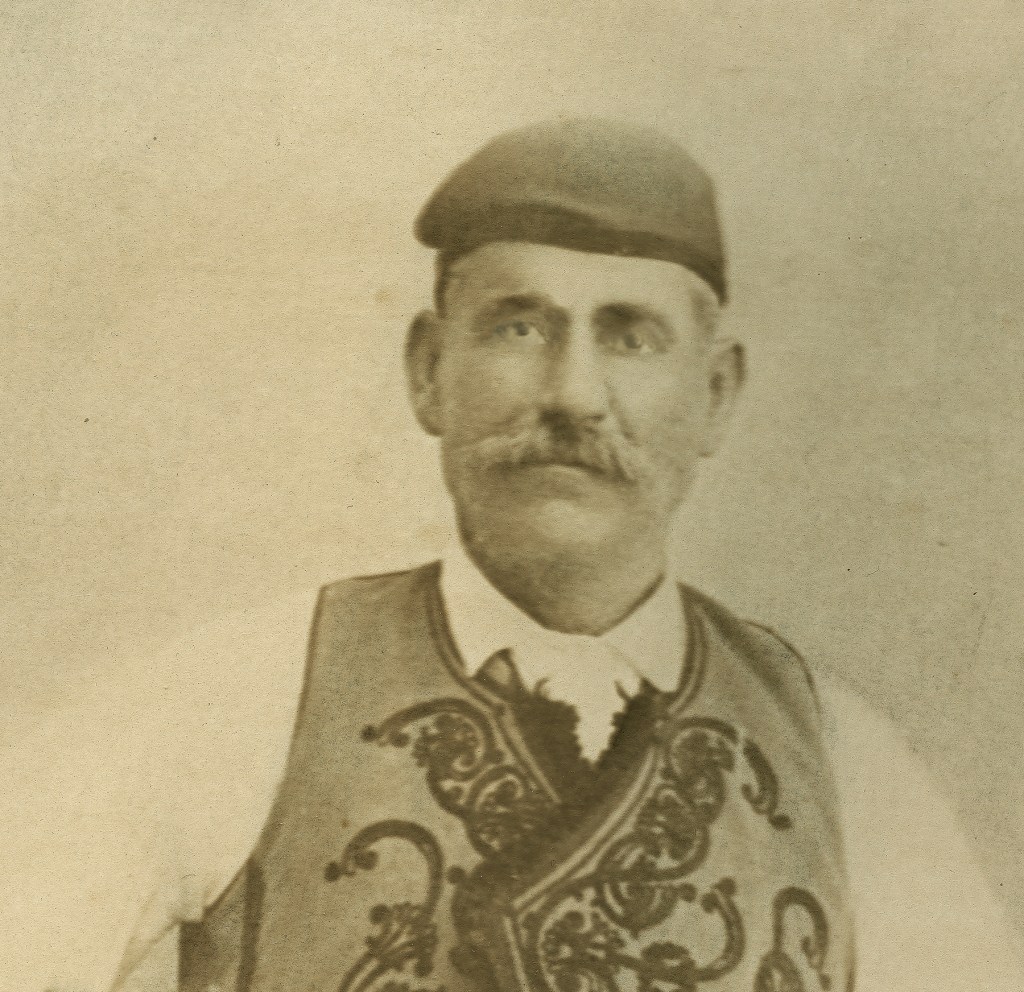
Georgios Stratigopoulos/Stratigakos of Agios Ioannis, Sparta, born abt 1849, wears a traditional cap. He is the great-grandfather of Georgia Stryker Keilman, founder of Hellenic Genealogy Geek
Regarding women’s grooming, the possibilities were limited and usually concerned wealthier women. The cosmetics used were powder and rouge. For eyebrows, they used charcoal to emphasize them. There were colognes and gold jewelry, such as pins, earrings, necklaces and rings. Usually, however, poor women had nothing more than their wedding ring.
I (Carol Kostakos Petranek) am honored to receive permission from the Katsoulakos family to translate and share articles from The Faris. Translation verification and corrections have been made by GreekAncestry.net. This is the nineteenth article of the ongoing series. Previous articles can be viewed here.
Primary source materials are the essence of historical research. Distinguished historians, linguists, scientists, archaeologists and cultural specialists of Sparta have written extensively about the historical evolution of our region and the lives of our people.
Now, their work is accessible to researchers worldwide at the Library of Congress (“Library”). This morning, I was both thrilled and honored to deliver to Nevila Pahumi, Ph.D.1 twelve of the twenty-three journals published by the Society of Lakonia Studies (“Society”). Next summer, I will bring her the remaining volumes and supplements.
Nevila Pahumi, Ph.D., enthusiastically accepts Lakonia Studies Volumes 1-12 Library of Congress, Washington, D.C. October 25, 2024
I first met Dr. Pahumi in February, 2022, when Gregory Kontos of GreekAncestry and I visited the Library to examine their collection of Directories for Cyprus. It was during our discussion that I became aware of the Library’s eagerness to access primary source materials. During my yearly visits to Sparta, I continue to look for books and other manuscripts that are locally sourced and written, and which would meet the interests of the Library’s researchers. In 2023, I brought Dr. Pahumi all published issues of the Faris (Φαρις) newsletter of Xirokampi, which are filled with recollections of villagers, research by historians, and local poems, stories and anecdotes.
I have long known of the mission and publications of the Society of Lakonia Studies through my historian colleagues and friends, Dimitris Katsoulakos and Giannis Michalakakos. But it was not until last summer, when I spent one month working at the Central Library of Sparta and reviewing the Lakonia Studies journals, that I thought of bringing them to the Library of Congress. My deepest gratitude to Dimitris and Giannis for helping to make this concept a reality!
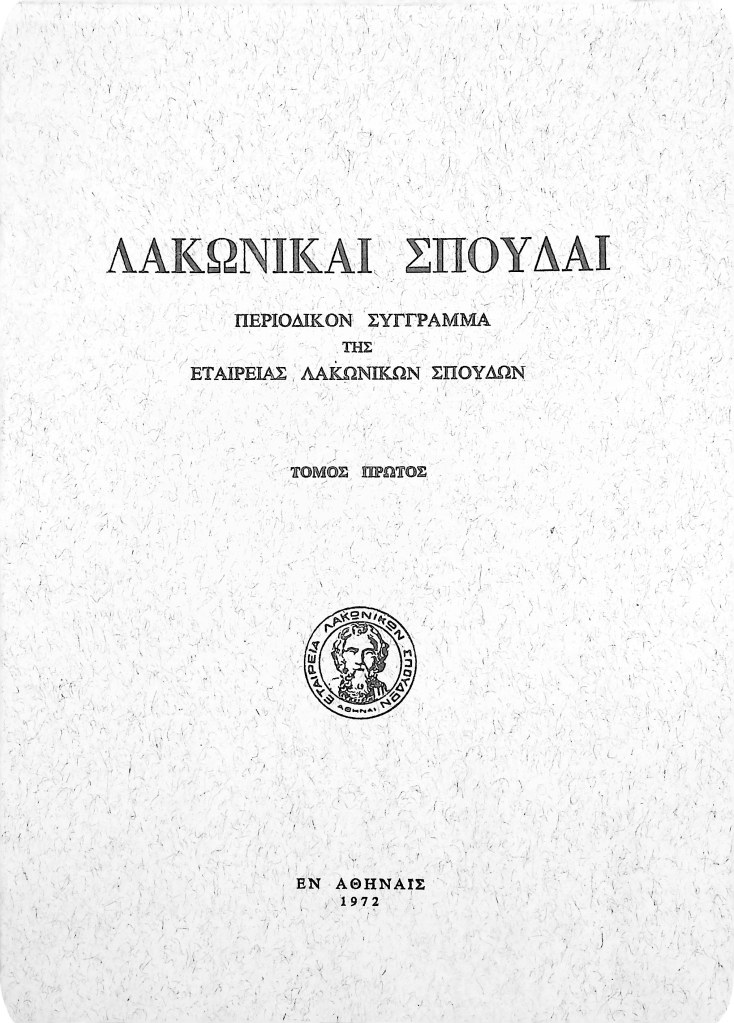
The Society of Lakonia Studies has a 58-year history. It was organized in 1966 in Athens under the initiative of Dikaios V. Vagiakakos with the mission of developing and promoting scientific research about Lakonia. Topics focus on: history, archaeology, linguistics, folklore, philosophy, law, portraiture, anthropology, painting, architecture. Authors present their scholarly work at the Society’s yearly conferences held in Athens. Their writings are subsequently published in the journal Λακωνικαί Σπουδαί or Lakonian Studies. Clicking on the title of each volume will reveal its Table of Contents. These articles are historically important, meticulously researched, and truly fascinating to read.
Volume 1, published 1972 in Athens
The Society is housed in Athens at 63 Charilaou Trikoupi, 4th floor. Office hours are Monday – Wednesday – Friday from 11:30 am – 1:00 pm; phone: 210-3304422; email: etlasp@gmail.com. Its library is accessible to anyone interested.
Lakonia Studies Office, Athens
This announcement is on the Lakonia Studies website:
Thursday, September 26, 2024 SIXTH CONFERENCE OF THE SOCIETY OF LACONIAN STUDIES The Society of Laconian Studies will organize in November 2025 in Sparta (the exact date will be announced in the near future) the 6th Congress of Laconia Studies on the subject: Laconia 330 AD. – 1830. We ask those interested in participating to send a summary (up to 300 words) of their presentations by March 1, 2025 to the email address: etlasp@gmail.com. More information about the conference will be posted on the website of the Society of Laconic Studies http://www.etlasp.gr/ The organizing committee: Sokratis Kougeas & Dimitris Katsoulakos
1Dr. Pahumi is the Reference Librarian for Latin American, Caribbean, and European Division at the Library of Congress in Washington, D.C.,
On Tuesday, September 3 at 6:00 p.m., I have been invited to give a presentation in Sparta, Greece on “Genealogy Tourism” (see news article here). My cousin, Georgios Kostakos, recently organized Sparta.Komvos, a group that hosts a variety of speakers and events that both educate and interest youth and modern Spartans.
Georgios asked if I could talk about the work I have been doing for many years with Spartan genealogy research. As I considered what could be of interest for this audience, I decided to help them understand the concept of Heritage Travel, or Diaspora Travel, or Genealogy Tourism — whichever term is used — and the opportunities it can bring. Businesses, artisans, shop owners and the hospitality industry could reap significant benefits by welcoming family historians.
We are a niche group with specific needs and expectations when we travel to visit our ancestral land. We want to find living cousins, go to the archives and research, understand our heritage, immerse ourselves in culture, and “walk where our ancestors walked.” Going to the beach and touring ancient ruins is a side note, not the purpose of our visit. I think it would be helpful for the Spartan community understand this type of tourism, and how they can prepare to help us researchers when we visit. The benefits that will come to them could be significant.
If you have suggestions to share with me that I can share with this group, I would love to hear from you. Please, send me a message and I will pass along your thoughts.
I’ll let you know how the event is received. Wish me luck! 🙂