The Rescue of the Kamchi Family from Athens

published in The Faris Newsletter Issue 74,  July 2021,  Page 4
by: Panagiota (Pitsa) S. Katsoulakou (Part I) and
Gerasimos (Makis) St. Katsoulakos  (Part II)

[Note by Carol Kostakos Petranek:  Stories of the German occupation of Greece abide in our families and in our history. The narratives are harrowing, but there are stories, such as this one, which reveal the altruism of humanity. Although there are many accounts of those bravely who sheltered Jews, Dimitris Katsoukakos told me that his family had done so, and that the story was published in Φαρις. It is translated here to acknowledge, with great respect, those who risked their lives to save others.]

Part I:

From the pre-war years [World War II], my uncle Petros Katsoulakos son of Ilias, first cousin of my father, and his wife Eleni Demonti from Smyrna, lived in Athens. They had rented their house in Katsoulaiika of Xirokampi, which was across from ours. Whenever they came to the village, they stayed in our house. Uncle Petros had a brotherly relationship with my father.

Uncle Petros had a good friend in Athens, Victor Kamchi, Jewish by religion. When in autumn of 1943 things became very difficult for the Jewish populations of Greece, Uncle Petros smuggled the Kamchi family out of Athens. He brought them to our house. I was nine years old then. We children did not know who they were or that they were Jewish. I remember they had Christian names. Apparently, they had changed them for safety. We knew they were visitors from Athens, friends of Uncle Petros. My siblings and I gave up our beds to accommodate the visitors. Besides, Uncle Petros often brought guests from Athens to our house.

They stayed in our house for several days; I don’t remember for exactly how long. One day, there came to our house two siblings, Agisilaos and Rosalia Koutsoulieris, our relatives from Kotronas, Mani, the village of our family’s distant origin. The next morning, Uncle Petros, my father, and the two Koutsoulieris siblings took the Kamchi family to the Lykopanagou Inn.1 Their belongings were loaded onto two mules, ours and Uncle Petros’. From the Lykopanagou Inn, the Koutsoulieris with the Kamchis would leave by truck for Kotrona.

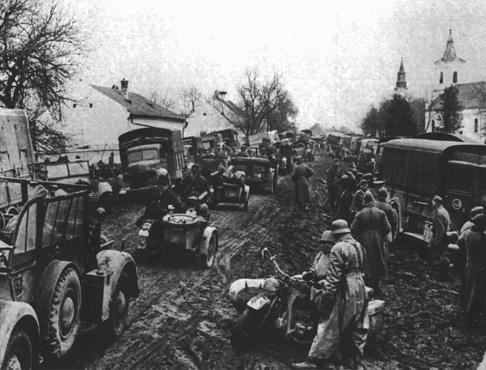
SS troops advance during the invasion of Greece.
National Archives and Records Administration, College Park, MD; US Holocaust Museum – https://encyclopedia.ushmm.org/content/en/photo/invasion-of-greece

Part II:

The Kamchi family came to our house introduced as the Papadopoulos family. I don’t remember how many days they stayed. Besides, a house in the countryside did not face serious food problems, as happened in cities then. However, the issue of security was paramount. The fear of the Germans was pervasive. I remember that our parents sometimes sent me and Nikos, my older brother, to Ai-Lias of Kamini, a hill of the neighboring village, to observe if there were any German movements in the plain. After some days, the Kamchi family left for Kotrona to stay in the house of our relatives Koutsoulieris for better safety.

The Germans left and the war ended. The Kamchi family survived and returned to Athens. After the war, I also lived in Athens for several years. Together with my aunt Lela (my uncle Petros was no longer alive, as he was executed in the December Events), I visited the Kamchi family several times at their house in Patisia on Drosopoulou Street.

___

1An inn of that time on the western side of the national road from Sparta to Gytheio. Today in this space there is a gas station slightly south of KEEM camp.


I (Carol Kostakos Petranek) am honored to receive permission from the Katsoulakos family to translate and share articles from The Faris. Translation verification and corrections have been made by GreekAncestry.net. This is the sixteenth article of the ongoing series. Previous articles can be viewed here.

Memory Eternal: Georgia Stryker Keilman

My dear friend and Greek genealogy colleague, Georgia Stryker Keilman, left earth suddenly and unexpectedly on January 5, 2025. Over the past fifteen years, we have collaborated and planned and worked together on many projects and initiatives to benefit our worldwide Hellenic genealogy community. We encouraged each other to keep moving forward on both our personal research, and on our individual and joint efforts to help people of Greek descent learn how to find their ancestral families. Words cannot describe my intense feelings of loss.

Georgia was a pioneer in the Greek genealogy community. On April 16, 2010, when Facebook was in its infancy, she conceptualized a group with a two-fold mission: a place where she could share information about Greek genealogy, and a forum where Greeks worldwide could help each other with their genealogy research. Her Hellenic Genealogy Geek Facebook group is now the meeting place for our community with an astounding 45,800 members (as of this date)!

But Georgia did not stop there. She created a companion Hellenic Genealogy Geek Blog which gave her a narrative format to write about print, photographic and online resources. In 2012, Georgia discovered that Election Registers for the years 1872-1873 were online at the General State Archives of Greece website. She downloaded hundreds of pages and began transcribing the names from Greek into English. She published these lists on her blog and printed them in books, thus creating what most likely is the first online-accessible indexed records of Greek names on both the internet and in print.

The community’s enthusiastic response to Georgia’s work encouraged her to keep going. Her number of translated lists grew rapidly.

Georgia continued this work for several years, completing translations for the astounding number of 253 villages! She reluctantly “retired” from this project only when our friend, Gregory Kontos founded GreekAncestry.net. Georgia’s lists are still in use and remain online here. Their organization by village makes them especially useful, allowing researchers to easily identify family surnames specific to each village.

In 2021, Georgia felt it would be helpful for the community to have a website of Greek research links–a “one stop shop” of sorts, where people interested in a specific topic could find information without having to spend hours surfing the web. That’s when Hellenic Genealogy Geek Research Links was created. Our conversations for weeks centered on this project. Georgia spent countless hours combing through both the web and her personal data collections to compile and organize thousands of online links.

In addition to the Facebook group and her two websites, Georgia helped organize the first-ever in-person Greek genealogy conferences in the United States: April 2015 at Holy Trinity Cathedral Ballroom in New York City with Ilias Katsos and the Education and Culture Committee of the Hellenic American Chamber of Commerce; and September 2015 at the Hellenic Memorial Building at Holy Trinity Cathedral in Salt Lake City with the Hellenic Cultural Association and the Ethnic and Mining Museum of Magna, Utah. She and I worked together and rejoiced together at these historic events which enabled diaspora Greeks to meet, learn and share their passion for genealogy.

Georgia’s friendship with Gregory Kontos of Greek Ancestry was priceless–filled with humor, mutual appreciation and respect. She so enjoyed working with him to plan and organize Greek genealogy conferences and webinars; and to coordinate the first-ever podcast for Greek genealogy, “G(r)eek Talk.” Georgia’s analytical mind always predominated in these planning sessions, and we were confident that she would find any “hole” or missing piece in whatever was being considered. And she always did!

The most recent initiative that Georgia and I completed together was the video series, “Bite-Sized Greek Genealogy.” We noticed that new members of HGG were asking the same questions and decided that brief recordings would be an effective way to provide answers. We brainstormed topics and ideas, found relevant materials, and had many laughs in creating the series. When it was finished, Georgia suggested that we create a companion booklet which would contain the talking points of our videos as well as additional information and online links. She was always seeking ways to make something good even better.

These initiatives were on top of Georgia’s daily tasks: to administer the ever-growing HGG Facebook group, to continue to locate and publish information for her websites, and to work on her own personal research. The project of most importance to her personally was “Your Greek Roots,” a family history book she wrote in 2019. Dedicated to her nieces and nephews, it represents Georgia’s desire to ensure that her closest family members understand their heritage and never forget their roots. I can testify that compiling this book and contemplating its importance to her family brought Georgia immense joy.

“Excellence is never an accident. It is always the result of high intention, sincere effort, and intelligent execution; it represents the wise choice of many alternatives – choice, not chance, determines your destiny.” ~ Aristotle [Nicomachean Ethics]

Georgia’s intentions, efforts and choices led to her to devote this stage of her life to helping others. This is her legacy and for it, she will remain highly respected, deeply loved and forever missed.

Please see this wonderful article about Georgia which was published in NeosKosmos on February 26, 2018.

OBITUARY

Georgia Stryker Keilman, aged 74, passed away peacefully at her home on January 5, 2025, in Mount Prospect, Illinois. She is survived by her brothers, Tom and Peter, as well as her adult nieces and nephews: Alexandra (Daniel), Christine, Christopher (Lindsey), Steven (Kellie), George, Michael, Katherine (Zar), and Sergio. Georgia was also a devoted great-aunt to her beloved grand-nephews and nieces: Elijah, Isaac, Maddie, Evelyn, Jack, and Nina.

Born as Georgia Ann Stryker, she was the eldest daughter of Ann and George Stryker of Chicago, Illinois. Georgia’s warm personality and adventurous spirit shaped her remarkable life. She pursued a successful career as Director of International Marketing in the medical device industry, which afforded her opportunities to travel extensively. During her career, she lived in Boston, Massachusetts; Sydney, Australia; and Athens, Greece, before ultimately returning to the Chicago area to be near her family.

Georgia had a deep love for her family, a keen talent for research, and a genuine curiosity that inspired her to embark on a meticulous investigation into her family’s Greek genealogy. In 2009, she founded the online community “Hellenic Genealogy Geek,” a platform dedicated to sharing and exploring Greek ancestry. This community, which began as a passion project, eventually grew to include over 45,000 members from around the world. Georgia found immense joy and purpose in connecting Greeks in the diaspora with their familial heritage and ancestral roots.

Her contributions to the Hellenic Genealogy community are considered her life’s work. Georgia’s dedication to assisting people worldwide in uncovering and cherishing their family legacies is a lasting testament to her generous and inquisitive spirit.

Georgia will be deeply missed and lovingly remembered by her friends, family, and the global community she nurtured. A private family gathering will be held in her honor. Additionally, condolences and prayers from her online community will be shared at a memorial event hosted virtually.

For those wishing to make a donation in Georgia’s memory, contributions can be made to support the archives of rural Greek villages via the following link: https://www.facebook.com/100001113949069/posts/8921917944521915/.

To learn more about the Hellenic Genealogy Geek community, please visit:

Mills – Mylovagena (Μυλοβάγενα)

by Charilaou N. Stavrogianni
published in The Faris Newsletter Issue 74, July 2021, pages 8-9

The area around Konstantinos Plainos’s house down to the Rasina river was called Mylovagena because of the pre-existing watermill there.

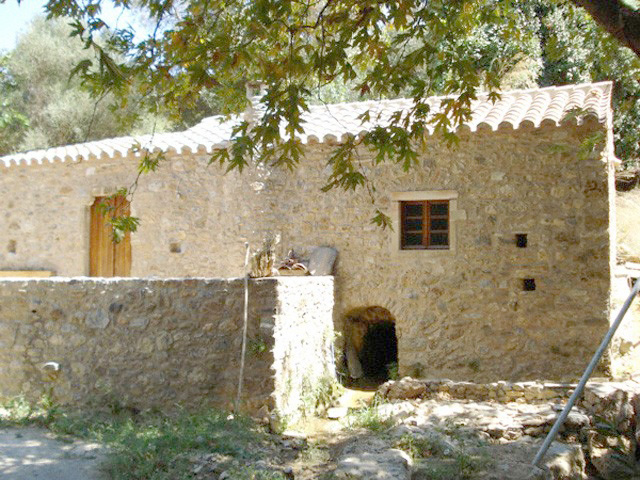
Flour Mill in Talanta (Monemvasia), Lakonia, Greece
Source: Lakonika.gr

Many times I think of a visit with my mother to get our flour from the mill when I was a small child. Arriving there I heard a loud noice which came from the waterfall through the basins. This made me afraid. Entering into a low-ceilinged, dimly lit room and seeing white dust floating, I became even more afraid, culminating with the appearance of a human shadow full of flour dust. Finally this human shadow came and stood beside me and began to stroke the hair on my head. As he spoke to me, I realized it was my grandfather, the miller of the watermill, who had rented the mill from the monastery of Zerbitsa. Then he loaded our flour onto our animal, which we had tied outside the watermill to a thick wooden post placed there for this purpose, lifted me onto the animal’s saddle between the two sacks of flour, and my mother and I took the road back, which made me feel great relief from the fear that had overtaken me inside the mill.

Later, when I was a much older child, I would ask my grandfather to explain to me the the entire process and operation of the mill. He told me that the miller’s biggest problem was the water, which was the driving force for the mill to work. The water came to the mill through a large earthen channel, called the milavlako. It started just under the arch of the Greek Bridge. That is where the dam was.

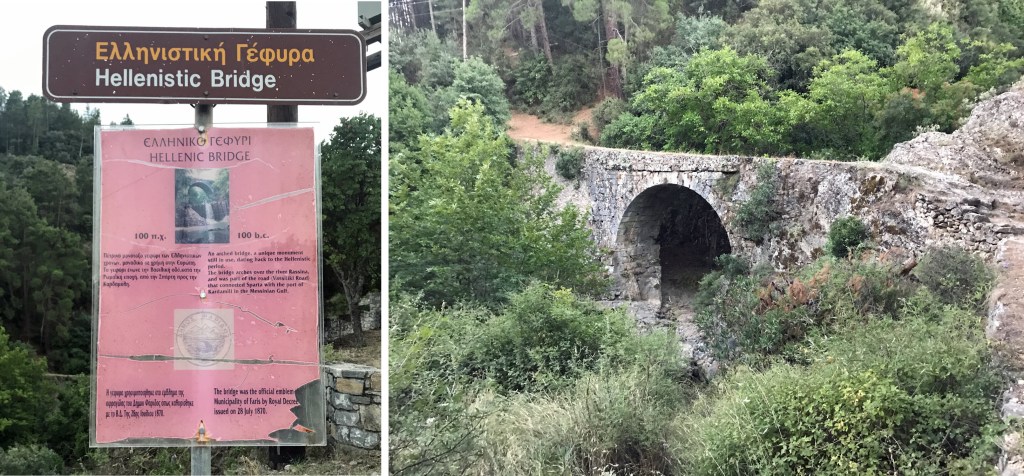
Hellenic Bridge, Xirokampi; Photos by Carol Kostakos Petranek

He would also tell me: To divert the water, I would climb on the rocks and cut branches of mastic and holly trees and place them in the river water, weigh them down with large stones, and pray to God, making my cross, that the river wouldn’t regularly flood and wash away my dam and I would have to start all over again. This must be how the saying arose “Everyone cries about their pain and the miller about his ditch.”

The milavlako with its abundant water passed over a concrete bridge exactly before and above the mill, so that the road would not be closed and and to form the appropriate height. In the past, before cement, the bridge was constructed with thick boards. On the bridge somewhere in the middle there was a divider for the miller to distribute the water as he wished, before it fell into the barrels. The vats had large, tall openings and were made of thick sheet metal with many external metal rings to withstand the water pressure. From these came the name Mylovagena. The water fell with great pressure and force through the vat onto the wheel, which was a propeller of thick pine boards, which the miller obtained from the woodcutters of Koumusta. The powerful fall of water continuously rotated the wheel, whose axle turned the upper horizontal cylindrical millstone. The bottom stone remained stationary. The miller would pour the wheat through a hole in the center of the upper rotating millstone. With this motion the wheat would break, being crushed between the two millstones and become flour. The producer paid the miller a fee of 8-10% on the quantity of flour, exactly as is done in today’s olive mills.

Millstone from Talanta (Monemvasia), Lakonia, Greece
Source: Δ. Αβούρης, Lakonika.gr

The watermill area was sold shortly after 1950 by the abbess of the Nymphodora monastery, in order to build the building that housed the looms and is today the monastery’s guest house. The mill with all the surrounding area was bought by Stratigis Solomos. Perhaps the mill worked a little longer. After all, the new owner had his own flour mill. Shortly before 1980 the mill was sold again by G. Venetsakos, a primary school teacher from Potamia, who had received the mill from Solomos as dowry.

Today in area around the mill and on both sides of the road, there are two houses. In less than thirty years the mill changed hands four times. Outside the mill there was also the most beautiful well of Xirokampi. Its external appearance was square with beautifully carved pistachio colored stones. Today it does not exist. It seems we did not like the tradition. The only thing that has remained from Mylovagena is the stone staircase, which went down to the mill and the well.

On the Greek islands, where there was not plenty of water but there was plenty of but strong air, the so-called windmills operated. Some are still in operation today.

In almost all the villages of our region there were also household hand mills. These were two horizontal cylindrical millstones, naturally small in size and weight so they could be moved easily. The bottom millstone always remained stationary and at the edge of the top there was a small hole, where a wooden handle was placed, hence the hand mill. In the middle there was a larger hole, where they would drop the wheat. As the top millstone rotated, the wheat was coarsely ground, exactly as they wanted to make sweet couscous and then in the winter the delicious pumpkin pies in the wood-fired oven of the house. The hand mill was a miniature of the watermill and, instead of water as a driving force, it had the power of a human woman’s hand.

It would be an omission to forget the coffee mills. Many times I remember the grandmothers, who with a metal device, the so-called mill, would grind coffee beans in the evenings in the fireplace of their house and the whole neighborhood would smell of coffee beans. To increase the quantity of coffee and for health reasons they would also throw chickpea seeds into the roaster. Today the mills that once ground coffee decorate a shelf or other place in the house as antique souveniers.

Tradition tells many stories and tales about millers and watermills. Also many proverbs, such as: “Everyone cries about their pain and the miller about his channel”, “Without water the mill does not turn”, “A good mill grinds everything.”

Writing the last proverb, I remembered what my grandfather would tell me: During the difficult and poor years of the Occupation and the subsequentl civil strife, in order to survive the watermills had to grind not only wheat and corn, but even barley, lupines and acorns, after drying the latter in the oven. The last three types, without mixing wheat flour and wheat-corn flour, produced very bad black and bitter bread. During the latter part of my life I had heard many times the phrase: “I ate or have eaten the bitter bread of Occupation.”

NOTE: Additional information about the mills of Talanta (Monemvasia), Lakonia can be found in this article at Lakonikos.gr.
__

I (Carol Kostakos Petranek) am honored to receive permission from the Katsoulakos family to translate and share articles from The Faris. Translation verification and corrections have been made by GreekAncestry.net. This is the twentieth article of the ongoing series. Previous articles can be viewed here.
Greek Genealogy and Spartan Roots Radio Interview, WNTN Boston

On November 25, 2024, Meletios Pouliopoulos of Greek Cultural Resources interviewed me on his weekly radio program at Grecian Echoes, WNTN Boston. A kind and gracious host, he wrote to his audience: I had the pleasure of interviewing a Greek genealogy expert, who is doing remarkable work. If there are any Greek heritage awards to be given, she and her colleagues should be at the top of the list.

We had a delightful and productive half-hour discussing civil and church records access in Greece; the Bite-Sized Greek Genealogy video series and its companion handbook, the work being done here at Spartan Roots and my village history project at Agios Ioannis, Sparta. We talked about online Greek record resources at Greek Ancestry.net and Hellenic Genealogy Geek website and Facebook page.

The segment is now available on Youtube.

Meletios is a man who is laser-focused on preserving Greek-American music and culture. For years, he has single-handedly collected recordings of Greek music, manuscripts, and films as well as newspapers, books and other publications. This provides a unique resource to musicians, teachers and the public. Read more about Meletios and his non-profit organization, Greek Cultural Resources, here.

Thank you, Meletios, for the opportunity to discuss our shared passion for Greek heritage preservation. I wish you every success in your most important work!

Adding to the Family Tree: Mt. Olivet Cemetery

In late October, my husband, Gary, and I took a road trip to Mt. Olivet Cemetery in Maspeth, Queens, New York. A huge cemetery, it commands a stunning view of the midtown Manhattan skyline.

The influx of emigrants at the turn of the 20th century from Spartan villages to the New York City area is legendary and well documented in Michael Contopoulos’ The Greek Community of New York City: Early Years to 1910. Among them were my four grandparents with many of their siblings, cousins and villagers. Studying their migration and resettlement is fascinating–in essence, they recreated their village in Brooklyn. And that means that I have hundreds of relatives who lived there.

As a child, I ran around my grandparents’ house with my cousins, oblivious to the assortment of “old folks” who would visit on Sunday afternoons. But today, they visit in heaven, and I run around connecting the dots of their relationships.

In preparation for this cemetery trip, I spent days online looking for family death records in the outstanding collection on MyHeritage: New York City Deaths, 1866-1948. Navigating through the corrupted spelling of Greek surnames, I was nevertheless successful in finding dozens of my parents’ cousins and their spouses. These death certificates include the deceased’s burial place at the bottom of page one.

Pappas, George James: infant son of James Papagiannakos and Athanasia Morfogen, died 1917
This baby is my first cousin once removed

I found people buried in several New York cemeteries, but I focused on Mt. Olivet. I created an Excel spreadsheet with 75 names and emailed the cemetery office to request a lookup of those plot numbers. Although many were buried in family plots, there were still a lot of names for the staff to search. (We gave a monetary donation and brought candy to the staff to show our appreciation.)

Gary downloaded a map of the cemetery from their website and marked how many people were buried in each section. We felt well prepared as we headed north from our home in the Washington, D.C. suburbs.

Left: My maternal grandparents, Louis Papagianakos and Angelina Eftaxias
Right: My paternal grandparents, John Kostakos, Harikleia Aridas, their daughter, Alice
and John’s brother, William

For two days, we walked and searched, finding headstones for many but surprisingly, not all. Several people whose death certificates listed Mt. Olivet as the burial place were not in the cemetery records. The office staff explained that in such cases, the family chose a different cemetery if there was a plot elsewhere owned by a relative. For those without headstones, we learned that many immigrant families did not have money for both a burial and a monument. The empty spaces in many lots are unmarked resting places.

The West Lawn section of Mt. Olivet. Cemetery records indicate that this lot is full, despite empty spaces. Several members of my family rest here, without headstones or markers.

By far, however, the ultimate heartbreak was learning that 13 infants in my family are at Mt. Olivet, and not one has a headstone. Among them are my mother’s baby brother, Peter Pappas, who died of pneumonia at 4 months, 10 days. I have now ordered a monument so he will not be forgotten. All of these babies were born to immigrant parents who suffered their losses in a strange land far from their immediate families. (See list below.*)

My mother’s brother, Peter, who died at 4 months.

Sometimes it’s hard to find a marker even with the plot number; the dizzying number of granite monoliths can be disorienting. To help others locate our relatives, Gary had a plan to create a map for each burial place. We took a photo of every family headstone and used our phones to pinpoint its GPS coordinates. For those with no headstone, we photographed the general area and created a virtual marker to memorialize who was buried there.

Gary at work
Top: one of Gary’s maps, pinpointing a Papagianakos headstone
Bottom: although the Stavracos’ did not have a headstone, we created a virtual marker

As we walked the grounds, I recognized so many surnames and knew exactly from which Spartan village these people had come. Some of the earliest headstones had the name of the village inscribed–a point of Spartan pride in his/her χωριό.

Apostolos Boritsos of Agios Ioannis, Sparta 1891-1940

Upon arriving home, the “real work” began: names and data had to be entered into my genealogy database; FindAGrave pages were created for each person with both the headstone and the map; everything was uploaded into family trees on FamilySearch, MyHeritage and Ancestry. The more information that I entered into these genealogy websites, the more “hints” popped up which expanded the profile of each individual and added new members to his/her family. To discover more about married couples, I turned to the MyHeritage collection of New York City Marriages, 1866-1949, a phenomenal resource which has images of marriage licenses and certificates. What makes this collection so valuable is its inclusion of the original Affidavit for License to Marry, which is in the handwriting of the prospective groom and bride. This proves the spellings of the Greek surnames as used by the individuals, thus eliminating the “wonky indexing” done by those who do not know our names. Also, these records include the mothers’ maiden names.

Marriage of my parents, Andrew Kostakos and Catherine Pappas
license handwritten and typed, and marriage certificate

Now that we have a workable system for cemetery research, we will return to Mt. Olivet and other cemeteries in the New York area to continue this work. It’s important to that all information is put on FindAGrave as well as online family trees, so as to enable our ever-expanding web of descendants to have success in finding connections to their families.

*Memory Eternal: babies of my relatives at Mt. Olivet who died without markers

  • Aridas, George Christos 1923-1926, son of Christos Aridas & Stella Lambrianakos
  • Aridas, Louis Basil 1918 (4 months), son of Basil George Aridas and Politime Adamakos
  • Catsores, Bessie 1917-1930, daughter of John Anthony Catsores and Eleni Papagiannakos
  • Catsores, Pota 1909-1910, daughter of John Anthony Catsores and Eleni Papagiannakos
  • Catsores, Theodoros 1918 (4 days), son of John Anthony Catsores and Eleni Papagiannakos
  • Georgas, Christine 1925-1926, daughter of George Georgas and Panagiota Lerikos
  • Londis, Constantina 1919 (7 days), daughter of James John Londis and Pauline Chrisomalis
  • Markopoulos, Konstantine James 1905-1906, son of James Nikolaos Markopoulos and Mary Christakos
  • Moundas, Peter Harry 1922-1924, son of Harry Moundas and Mary Neckles
  • Pappas, George James 1916-1917, son of James P. Pappas (Papagiannakos) and Athanasia Morfogen
  • Pappas, Mimi 1914-1918, daughter of James P. Pappas (Papagiannakos) and Athanasia Morfogen
  • Pappas, Peter Louis 1915-1916, son of Louis Peter Pappas (Papagiannakos) and Angelina Eftaxias
  • Tactikos, Stella 1924 (1 month), daughter of Georgios Nikolaos Tactikos and Katherine Patsakis