Once a year on August 15–and only on that day–the doors of the historic church of Agios Ioannis, Sparta, Koimisi tis Theotokou, are opened to commemorate the Dormition of Theotokos. Second only to Easter in the Orthodox Church, this national and religious holiday is a time of joy, not mourning, as it marks the “falling asleep” and taking into heaven of Mary, the mother of Jesus Christ.1
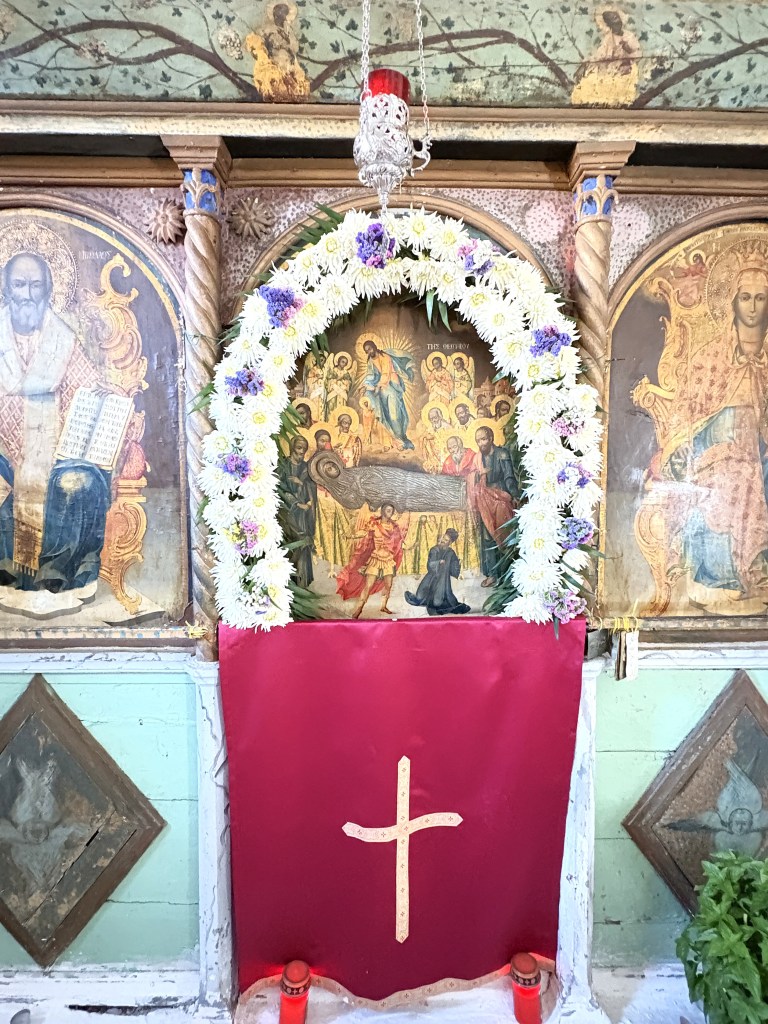
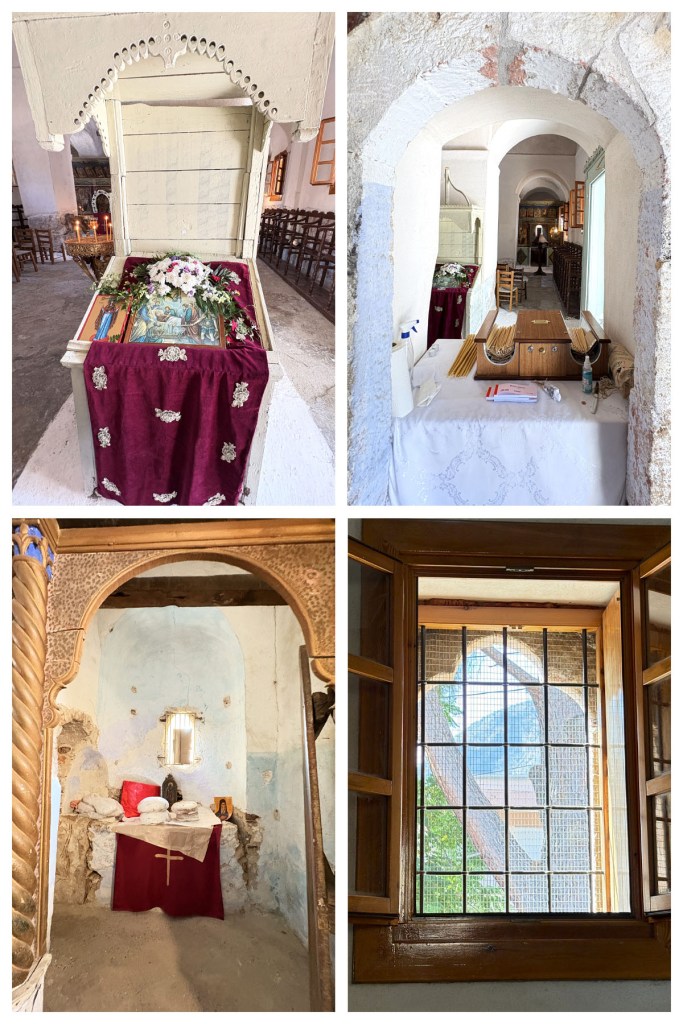
Icon depicting the Dormition of Theotokou. Note the flowers around the perimeter, the red cloth indicating it is the focus of the service, and the candles on the floor.
Known as Dekapentavgoustos (the literal translation is 15 of August), priests conclude two weeks of fasting by conducting a special service. In churches that are named Koimisi tis Theotokou (or Church of the Assumption), the liturgy is conducted there which makes this worship especially meaningful.
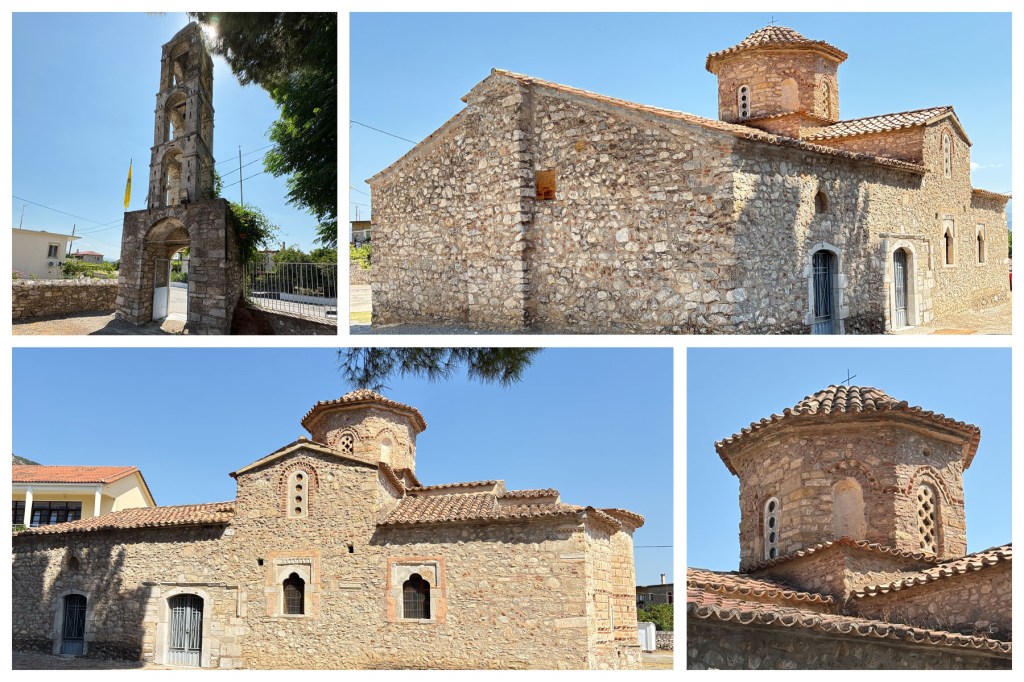
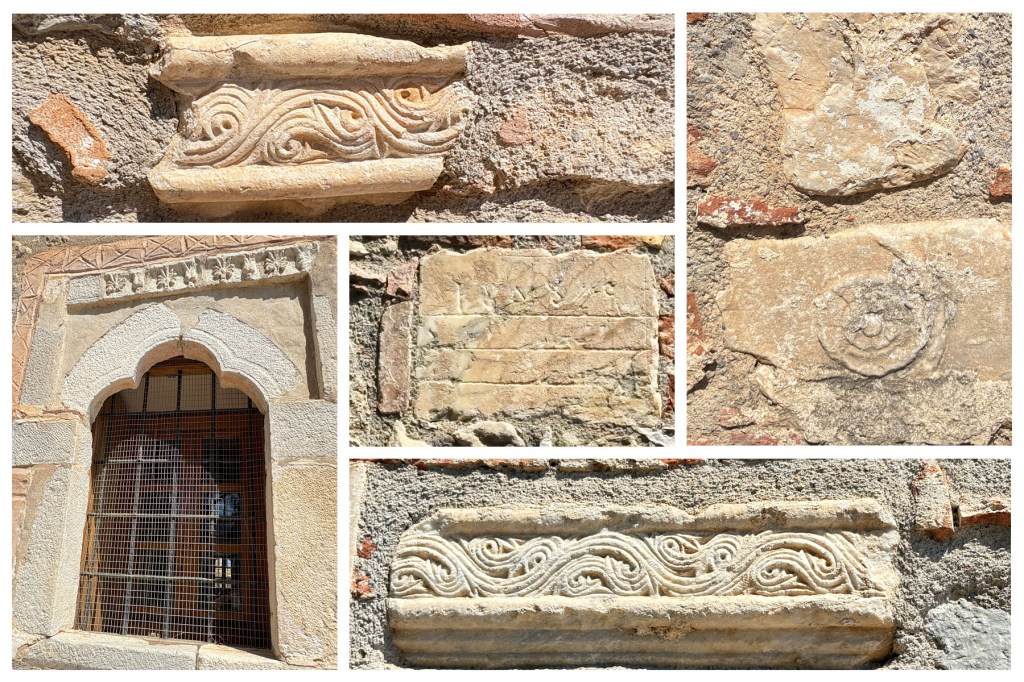
Koimisi tis Theotokou of Agios Ioannis with bell tower (upper left)Note the ancient stones and pillar fragments that were incorporated into the exterior stonework of the church. The small frieze over the window was carefully placed to accentuate its opening.
Marriage and baptism records prove that Koimsis tis Theotokou was the early church of our village, hosting joyous celebrations of life and sorrowful goodbys. It was the center of our ancestors’ world. For many years, I desired to see the inside of this church in Agios Ioannis. This year, that wish came true.
Interior with its whitewashed walls
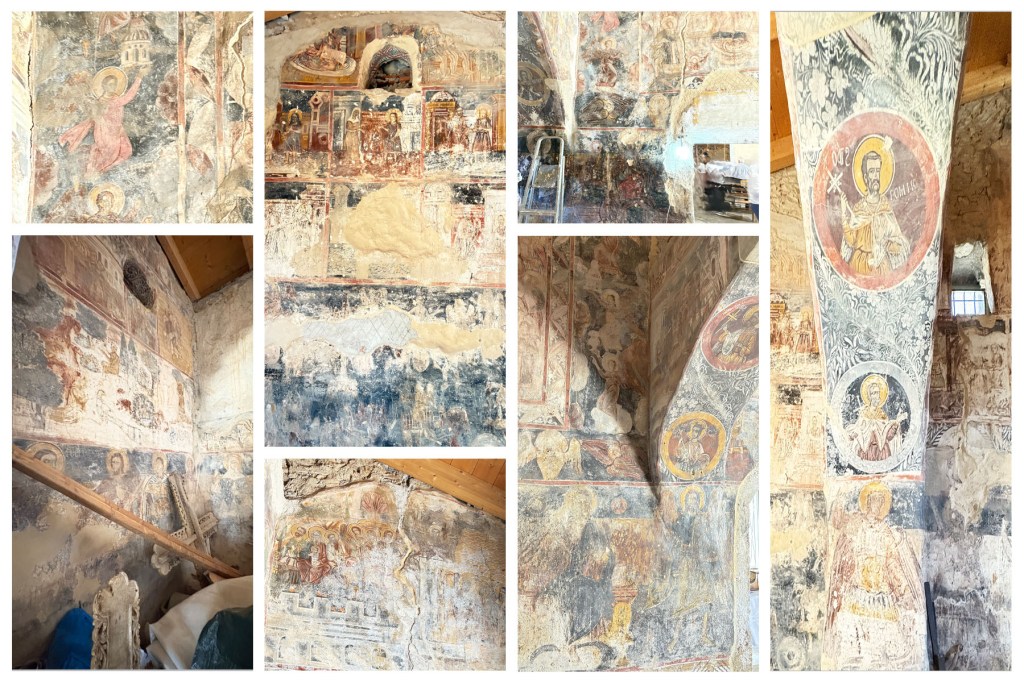
My family had told me that many years ago, the inside of the church was whitewashed, thus covering the historic frescoes. However, a small antechamber at the back remained untouched which enabled us to see the types of images that had once adorned the walls of the church.
Looking into the antechamber with its frescoes from the main hall of the church
It is my hope that these photos will enable you to picture your predecessors gathering for Sunday liturgies and rites of passage. There was a distinctive spirit present as I gratefully celebrated this special holiday in this special church.
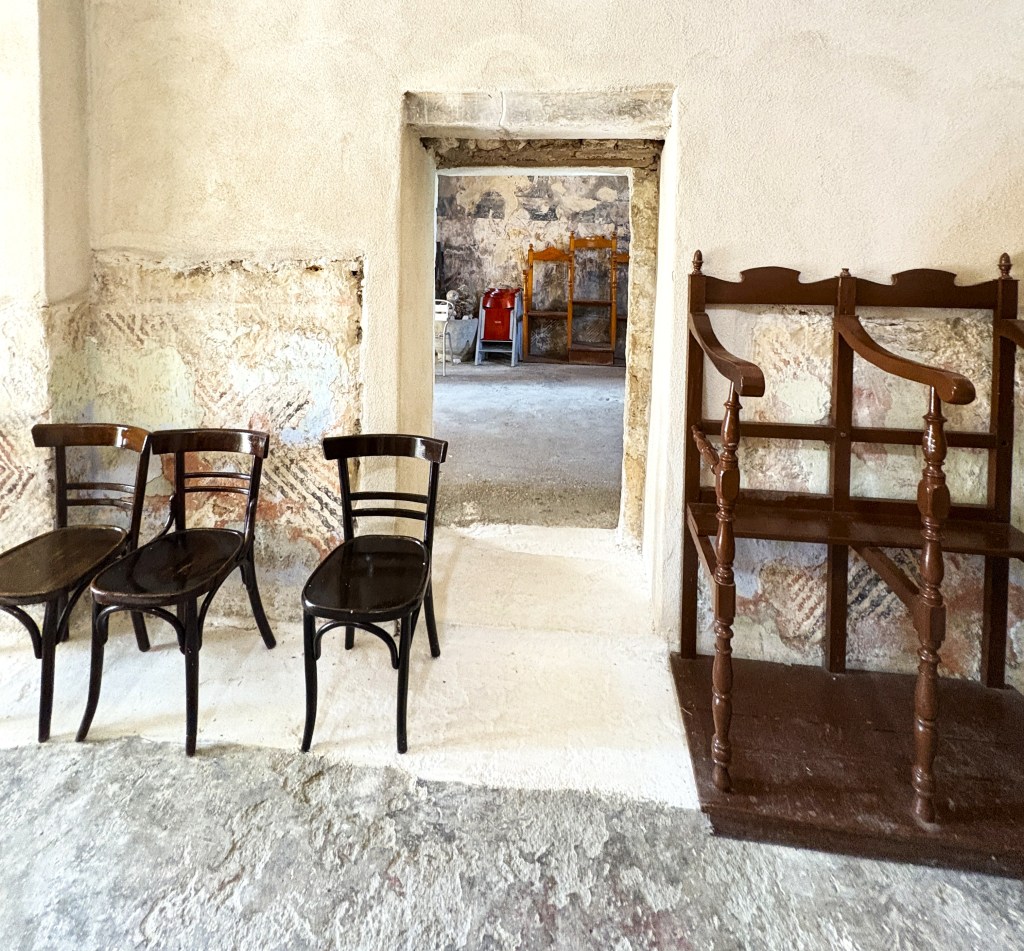
Looking into the church from the antechamber
Although the interior walls are whitewashed, the iconostasis retains its spectacular icons which serve as the focal point of the interior.
IconostasisThe icons across the topCloser view of the larger iconsViews of the interior
Looking from the church into the antechamber at the back, we see the frescoes that remained untouched.
Looking into the antechamberThe amazing and historic frescoes in the antechamber
For those of you who may not be able to go to a Byzantine church in Greece for an August 15 holiday, I hope these photos will enable you to feel the essence of this holy house.
by Tasou D. Volti published in the Faris Newsletter No. 66, July 2017, page 11 Author Note: In issue 64, there is an interesting retrospective on the old means of road transportation. There, testimonies and memories are mentioned concerning the appearance of the first automobiles in our village, Xirokampi. To this valuable account and presentation by Stratis S. Solomos, I will add some of my own references with supplementary details on this fascinating topic of that era.
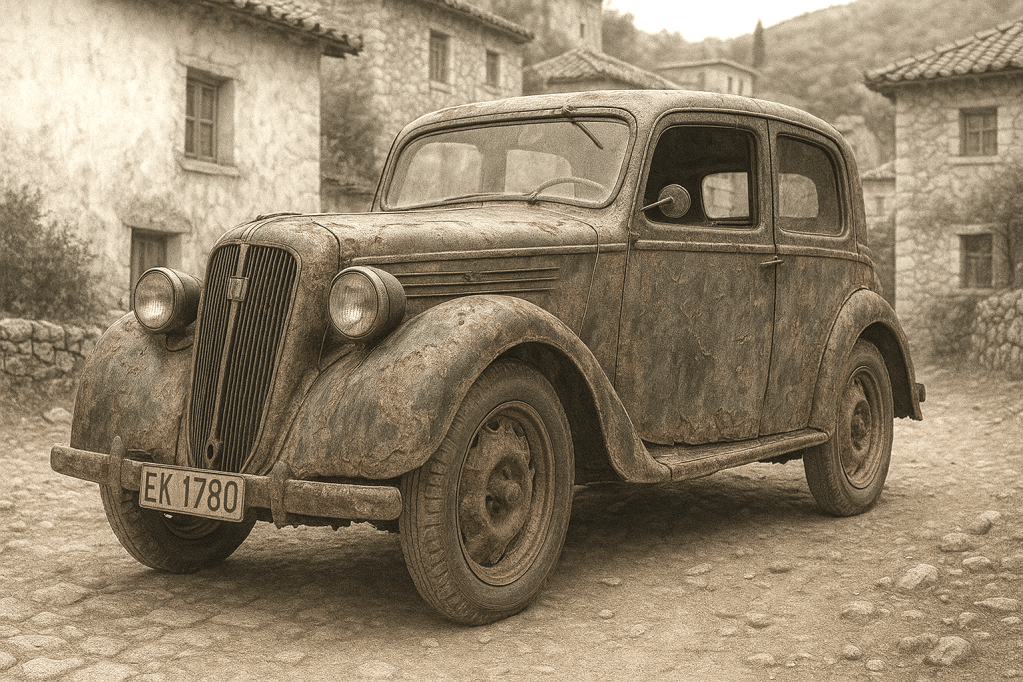
The late Vasileios Kountouris, a remarkable and restless individual with an entrepreneurial spirit, was among the first motorists of the 1930s and 1940s. He had bought the first small passenger car of the FIAT brand.
Fiat, circa 1930, image generated by ChatGPT
I remember my late uncle, Lampros Sakellariadis, who later became a judge at the Supreme Court (Areios Pagos), recounting an incident involving that car. Kountouris had driven the FIAT up to the village cistern to wash it. With him were my uncle Lampros—then a teenager—and Kountouris’ son Kostas, who was younger. During the washing, the handbrake came loose, and the vehicle rolled off the edge of the rock and plunged into the ravine, above the path leading to the Rasina bridge. It suffered severe, irreparable damage. After the difficult recovery, it remained in a corner of the large sandlot at the village square, the “Chortarakia,” just below the barbershop of Yiannis Sykiotis. The famous “Chortarakia” was our exclusive play area. And here the saying “nothing is more permanent than the temporary” held true, as the car—according to its owner—was to remain there for possible repair. But it became permanently immobile. Kountouris’ repeated efforts and shouted threats failed to deter us or drive us away from the car, which we had now turned into one of our favorite playgrounds. Uncle Vasilis eventually gave up trying to remove us. And then, our destructive tendencies—more so driven by curiosity—gradually left only the skeleton of the FIAT!
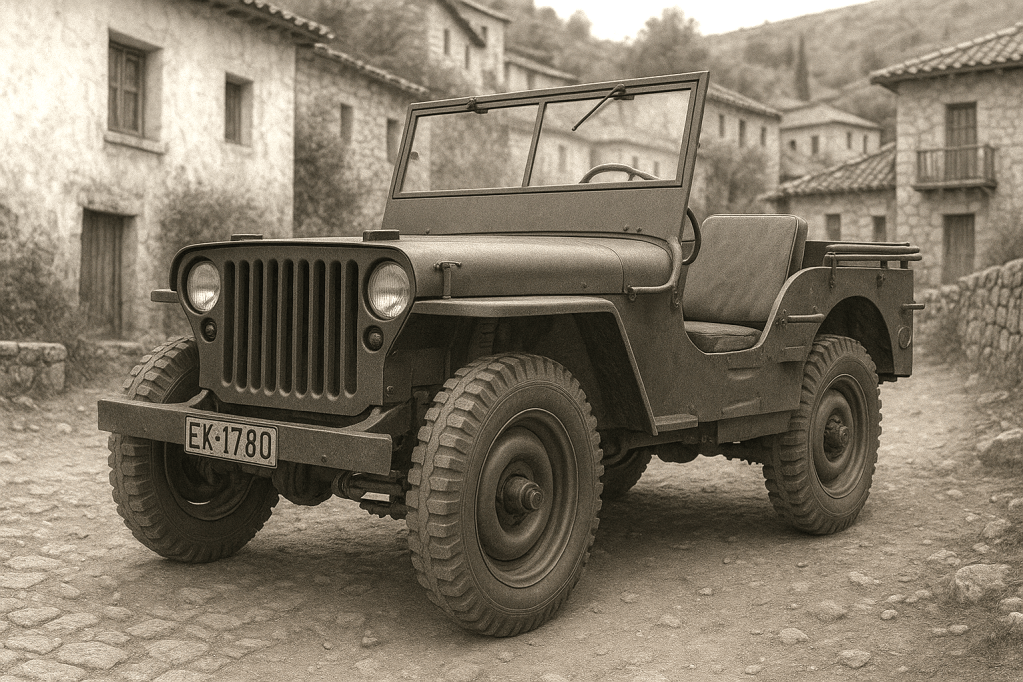
Kountouris later brought another small car—a kind of jeep—which had the starter button on the floor. It was always parked outside the gate of his house, next to the notary office of my grandfather Kostis Sakellariadis. That jeep aroused our curiosity and, approaching it cautiously, we would press the starter with our hand—resulting in, to our great satisfaction, the jeep making little hops, as the gear lever was jammed. No matter how much Uncle Vasilis threatened us, we had fun.
Jeep, circa 1940s. Image generated by ChatGPT
I remember one time Uncle Vasilis stopped me on the road—strangely, he wasn’t angry—and, with fluent expression in his Katharevousa eloquence, he told me something I still remember today: “Even though you are the son of a professor, you are no different from the other street urchins by taking part in such acts of mischief. A pity!” It has stayed in my memory—as if I can still hear him. I was ashamed and never again tried to go near the car.
Here I will also mention the small car of Kostas Feggaras, which ran the route: Xirokampi – Kaminia – Potamia – Goranous. The older folks will remember the unfortunate incident when a drunk passenger, standing and holding onto the door, fell out and died on the road to Kaminia. That incident brought serious troubles for Kostas.
I also remember the small truck of Gavvaris, which we children admired so much when he first brought it to the village. His son Vasilis, who later became a professor of literature—one of the finest in our region—asked his father, I recall, and received permission for us to climb into the truck bed for a ride to Agios Vasileios. Holding on to the truck’s railings, we jumped with joy. And I remember a phrase from Vasilis, who, excited by the speed of his father’s new vehicle, shouted: “It flies—it’s flying! These little cars fly!”
As for the large truck of Giannis Kakagiannis, we were so full of admiration that we opened our eyes wide and stood still watching… its ten wheels—tires that seemed to us something completely new and unimaginable.
All this may seem… funny to today’s youth. But to us children of that era, when transportation was a novelty, everything was magical. No matter how insurmountable the difficulties were, we loved everything that amazed us, even if it seems so distant today. Those were our most important years—and so they remain in our memories, despite the passage of time.
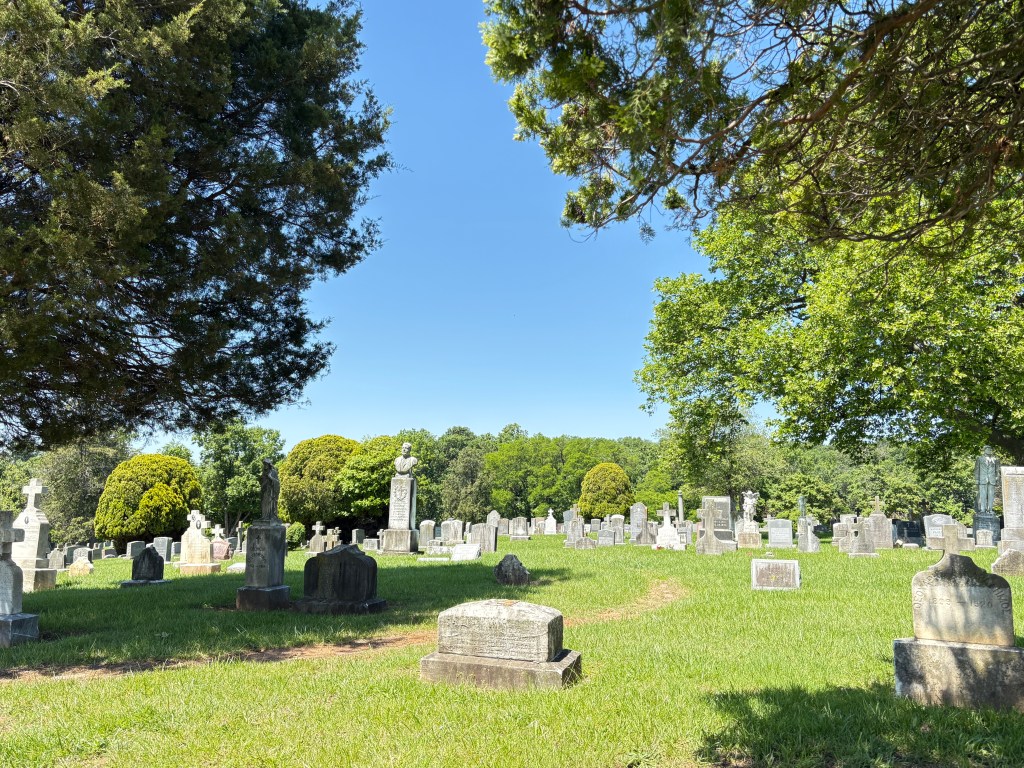
On a clear and lovely day this June, Nicholas Prevas took me to the sacred and historic resting place of the earliest Greek immigrants in Baltimore, Maryland. We were welcomed by flocks of geese as we drove the gently winding road past a rippling lake to the “Greek Circle,” situated at the pinnacle of Woodlawn Cemetery. So named because the 1,000 square foot parcel of land is in the shape of a circle, this hallowed ground holds the stories of families who left their rural villages and thrived in the teeming city of Baltimore in the early 1900s.
The Greek Circle, June 2, 2025. Note the bricks nestled in the ground, marking the circle.
Nick is the Parish Historian of the Greek Orthodox Cathedral of the Annunciation which owns the Greek Circle. The parishioners of the Church, which was established in 1906, secured this plot in January 1912. The Greek Circle was the first of four parcels (collectively known as the Greek Section) purchased by the Church in the North Avon area of Woodlawn.
page v, Gone But Not Forgotten, A Definitive History of the Greek Section of Woodlawn Cemetery by Nicholas M. Prevas, Parish Historian, Greek Orthodox Cathedral of the Annunciation, 2001
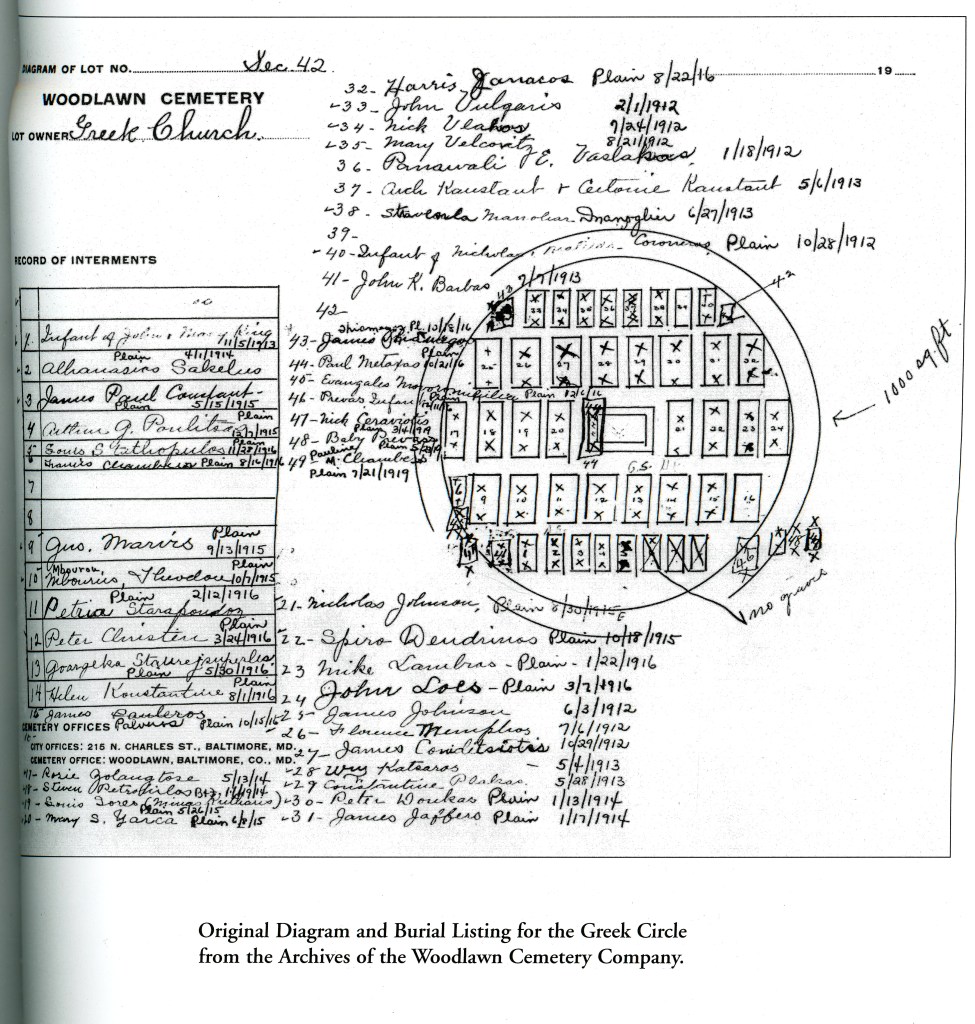
The Greek Circle is arranged in rows of five. This fascinating diagram of burials is from the Archives of the Woodlawn Cemetery Company.
page 119, Gone But Not Forgotten, A Definitive History of the Greek Section of Woodlawn Cemetery by Nicholas M. Prevas, Parish Historian, Greek Orthodox Cathedral of the Annunciation, 2001
As we stood before each headstone, Nick told me the stories of the families. All were immigrants, many from Lakonian villages. They were pillars of the community, forming the backbone of the Cathedral of the Annunciation and making significant contributions to their Baltimore neighborhoods. Despite their successes and prosperities in their new homeland, they were not immune to the vicissitudes and tragedies of mortality: accidents, drownings, and infant deaths permeated their lives. The Greek Circle holds 45 interments; of those, 25 are children under the age of 18. I could sense the spirits of these people and almost feel sorrows of their families as I stood before each grave. It was a holy moment for me.
In honor of the lives and in memory of those at rest in the Greek Circle, their names, ages, and dates of interment are listed below.
Row 1: Kerasiotis, Nicholas, age 3 days – March 4, 1919 Barbas, John K., age 9 months – July 7, 1913 Kousouris [King], Christopher J., stillborn – November 5, 1913 Sakelos, Athanasios, age 11 mos., 29 days – April 1, 1914 Constant, James B., age 9 months – May 15, 1915 Poulitsas, Athanasios G., age 8 months – December 7, 1915 Stathopoulos, Leonidas H., age 2-1/2 months – May 28, 1916 Prevas, Infant, stillborn – December 11, 1916 Prevas, Infant, age 2 days – May 23, 1919 Chambers, Pauline Mary, age 3 days – July 21, 1919
Row 2: Chambers, Frances, age 12 days – August 16, 1916 Mavromihalis, Evangelos, age 1 year – December 6, 1916 Mavris, Constantine, age 46 – September 13, 1915 Mbourzos, Theodore, age 29 – October 7, 1915 Stavropoulos, Patra, age 30 – February 12, 1916 Christen, Peter, age 70 – March 24, 1916 Stavropoulos, Georgia, age 65 – May 30, 1916 Konstantopoulou, Eleni K., age 37 – August 1, 1916 Pavleros, Dimitrios, age 15 – October 15, 1916
Row 3: Zogalsin, Rose, age 20 – May 13, 1914 Petrohilos, Stylianos, age 39 – November 19, 1914 Kritharis, Minas, age 21 – May 26, 1915 Yarca, Marie S., age 45 – June 8, 1915 Metaxas, Paul, age 55 – October 21, 1916 Johnson, Nicholas, age 52 – August 30, 1916 Dendrinos, Spiros, age 35 – October 18, 1915 Lambros, Michael, age 17 – January 22, 1916 Leos, John, age 23 – March 7, 1916
Row 4: Mamais, Dimitrios, age 72 – June 3, 1912 Nifakos, Efrosene S., age 16 – July 8, 1912 Koniditsiotis, Dimitrios, age 60 – October 29, 1912 Katsaros, Vasilios P., age 23 – May 4, 1913 Plakas, Constantine, age 38 – May 28, 1913 Doukas, Petros K., age 14-1/2 – January 13, 1914 Kouroupis, Michael, age 35 – October 16, 1929 Zafirakis, Dimitrios, age 29 – January 17, 1914 Gianakis, Harry, age 31 – August 22, 1916
Row 5: Thiamengos, Dimitrios E., age 4 years – October 18, 1916 Vulgaris, John J., age 1 year – February 1, 1912 Vlahos, Nicholas, age 1 year – July 24, 1912 Velcovitz, Maria, age 3 months – August 21, 1912 Vasilakos, Epaminondas E., age 2 – January 18, 1912 (1st burial in Greek Circle) Konstantopoulos, Antonia, age 1 day – May 6, 1913 Konstantopoulos, Areti, age 22 days – May 6, 1913 Manolias, Stavroula G., age 4 months – June 27, 1913 Coroneos, Infant, stillborn – October 28, 1912
A Note of Appreciation: Nicholas Prevas, the Parish Historian of the Greek Orthodox Cathedral of the Annunication, has selflessly dedicated years of his life to documenting and preserving the history of the Church and its members. He has authored three comprehensive volumes: History of the Greek Orthodox Cathedral of the Annunciation (1982), House of God…Gateway to Heaven (2007), and Gone But Not Forgotten, A Definitive History of the Greek Section of Woodlawn Cemetery (2001) which has been referenced in this post.
In this book, Nicholas has meticulously written the history of the Greek Circle and the entire Greek Section at Woodlawn Cemetery. Every burial is recorded with notations from both parish and cemetery records. He has included biographical sketches and photos of many families whose members are interred in the cemetery. These photos are of the earliest immigrant families, making them both rare and precious. Nick’s work is historically significant and genealogically vital. The Baltimore Greek community is blessed to have Nick in its “circle,” and I am blessed to have him as a cherished friend. Copies of Nick’s books can be purchased through the author.
Nicholas Prevas stands at the commemorative plaque of the Greek Circle, June 2, 2025
by Stavros Theof. Kalkanis published in The Faris Newsletter No 68, July 2018
NOTE: In Greek villages, empirical (self-taught) or folk doctors treated all types of medical conditions during the 1800’s up to modern times. Doctors passed down their remedies to other practitioners and members of their families. Many cures are still practiced in rural homes. The author is from a family of physicians which stretch back to his 3rd great-grandfather who was a folk doctor during the Greek Revolution of 1821.
Our family’s oral tradition also refers to empirical (self-taught) doctors among its members, both before and during the Revolution of 1821. Vasileios (Vasos) Nikitas Kalkanis (1903–1983) passed on to my father and brother the information that our great-great-great-grandfather Georgios Kalkanis, who was the elder if Gorani during the Revolution, took care of the wounds of his fellow villagers using empirical knowledge and practices he had learned from his father. A century later, in the villages of Kato Riza, his namesake and my grandfather, Georgios Christofilou Kalkanis (1858–1950), served as a graduate of the University of Athens School of Medicine.
George Kalkanis signs as community elder of Gorani and Liantina, with all the distinguished community elders and other residents of the villages of Kato Riza and Vardinochori of Lacedaemon”, in Arna in 1835, a “plea” to the Holy Synod “to act for the preservation of the Holy Monastery of Gola which we have as an asylum and refuge in times of need and sorrow” (from the General State Archives)
The actions of the empirical doctor G. Kalkanis appear to have been particularly notable during the battles of our compatriots (in the period 1825–1826) against Ibrahim’s army, which was operating in Taygetos to destroy our villages and subjugate their inhabitants in his effort to reach Mani. It is recorded that Ibrahim “burned to the ground” all the homes in Goranous, Kourtsouna, and Koumousta (as well as in other villages), forcing the residents of the whole region to take refuge in the mountains of Taygetos.
At that time, wounded fighters, residents of our villages who supported our villages and protected their inhabitants and civilians, needed immediate care for their injuries from sharp weapons, firearms, and even cannons.
Of course, in our villages,– but also more widely in southern Lakedaimona and even throughout the southern Peloponnese—five brothers of the Giatrakos family were particularly active and known as empirical doctors (in addition to being warriors and chieftains). Descendants of the Italian Medici family who initially settled in Mani, they Hellenized their surname and, with towers in their possession immediately after the declaration of the Revolution, played a significant role in revolutionary and post-revolutionary Greece. Their ability to provide medical surgical care to the wounded led many warriors to join their ranks. In nearly every Greek camp set up near a battle zone, the Giatrakos brothers would organize a makeshift “hospital.”
From their archives – their records – it appears that they “treated” many wounded with severe injuries and amputations for many weeks, removing fragmented bones from their wounds. Panagiotis Giatrakos had even traveled to Italy a few years before the Revolution and brought with him knowledge from the University of Padua, as well as medical supplies and techniques, anticipating that they would be needed in the impending revolution. Later, his brother Ilias created a Medical School and Hospital in Mystras.
At the same time, many empirical doctors throughout the revolutionary country were trying with minimal means to care for the wounded and provide therapeutic care in houses and monasteries, or onsite, in the countryside. In the area of Mystras, even two Muslim empirical doctors, Hasanakos and Drizakos Gioupis, who remained in the country, participated in the effort. Of course, most of the empirical doctors did not have degrees, except for a few who were trained mainly in Italian universities. Many empirical doctors who did not have degrees were provided after the Revolution with licenses from the Prefectures of the newly established State (since 1835 with royal decrees) to “practice minor surgery.”
But with what tools, practices, or materials did these empirical doctors/surgeons provide care to the wounded of the Struggle before the groundbreaking discoveries and changes that took place in the second half of the 19th century and defined modern medical science? I have often wondered about this because of the tradition that includes practical doctors in my family and because I am a doctor. In this essay, I will focus on injuries and not the milder ailments treated by these doctors or by the mothers and grandmothers of every family. The most common of these illnesses were pustules, fevers, runny noses, moles, obstructions, pimples, calluses, sores, abdominal pains and even evil eye.
Common treatments for these ailments included rubs or antisepsis with raki, wine, and vinegar (which contain alcohol); warming drinks like “kaftoura” (made of red wine, peppers, and cinnamon); dry or wet cupping; bloodletting or leech therapy; enemas; opium (from poppies); moldy bread; poultices from flaxseed—and also censing with flowers from the Epitaph, lighting the Easter candle, sprinkling with Holy Water… In our villages, cleaning earwax was done with a wise and simple method: one end of a horsehair was placed in the ear, and drops of hot wax were dripped along the length of the hair. When the wax hardened inside the ear and stuck to the wax plug, they pulled the hair along with the wax and the ear plug.
Injuries or wounds from swords and scimitars or bullets that tore the soft tissues of the body seem to have been treated at the time of ’21—and before or shortly after—with poultices or “blastria” (plasters). These were therapeutic dressings made of cloth or unwashed sheep wool soaked with ointments (balms) made from everyday easily available materials, that had been recognized through centuries of experience—even by Hippocrates. It is characteristic that in texts of the “Hippocratic Collection” “many dirty wounds mixed with wine and oil” are recommended (!) The fatty coating of the “dirty” sheep’s hair seems to replace the lanolin of modern medical science and pharmaceutical technology.
The basic materials used in the plasters were wine or raki and vinegar, oil, and egg white. The first were used to clean/wash the wound and to stop bleeding. In more serious cases, they cauterized it with a red-hot iron or hot tar. They filled the wound with ointments from the above materials or soaked cotton, cloth, or linen threads with them to form the wax, which they used for the bandages. The wax was also smeared with melted wax, which is why they often spoke of “cerates” (wax ointments). Wax ointments are mentioned in many “giatrosofia” (written instructions from experienced doctors) and of course refer to the “waxed plasters” of the Hippocratic texts and to the Italian word “tsiroto” which is a reborrowing.
The wounds were not sewn up so that the pus could drain, but they were cleaned daily and the plaster changed. The above antiseptic and healing materials were found in homes or monasteries, but the healing of the wounds required weeks or even months of care. It is noted that often, due to lack of dressings, or following ancient Greek medical practices, the empirical doctors and the companions of the wounded put herbs or grasses (the so-called “flesh herbs”) on the wounds. These herbs, known from tradition for their anti-hemorrhagic, analgesic and healing properties, were referred to by Homer as “odynifata” or “pain-killing roots”, and were described in detail by Hippocrates and Dioscorides.
But wounds caused by scimitars, hatchets or axes usually involved bone fractures in the skull, limbs, or the chest. Many wounds, especially in the limbs, resulted in amputation followed by cauterization. The horror is described by the fighter and historian Fotakos, who shudders even at the memory of the “shattering” and the “grinding of bones” in the battles and amputations.
In these cases, crushed tile or crushed marble, and even ash, were added to the ingredients of the ointments, perhaps to create a cohesive material between the broken bones, while the limbs – arms or legs – were also immobilized with reeds and boards. During healing, empirical surgeons often remove small, shattered bones from the wound, during the long rehabilitation of fractures and the closure of wounds. Of course, they continued to use mainly unwashed sheep’s hair as bandages.
Τhe ingredients in the ointments included crushed ceramic or marble—and even ash—perhaps to create a cohesive material between broken bones. Immobilization of limbs—arms or legs—was done using reeds and planks. During healing, empirical surgeons often remove small shattered bones from the wound, during the long recovery of fractures and wound closure. Of course, they continued to use unwashed sheep wool as bandages.
Great contributions to the medical aid and nursing care of the wounded residents and fighters in our region—both during the Struggle and in the time of the “klephts” (after the Orlov Revolt)—were provided by the Monastery of Golas, despite the hardships and destructions—even the desolation—that it suffered through the years. In its centuries-old tradition, the Monastery of Golas—when it had not suffered destructions by the Turks—offered solace, assistance, and care, because besides its facilities and necessary materials for treating injuries (lacking in the poor homes and inaccessible to the “klephts”), it also had a monk with empirical medical knowledge and knowledge of healing herbs. It should be noted that the in the Monastery of the Zoodochos Pigi Kastriou, near Kastori, there was—and has been preserved—a special “Recipe Book” with recipes for prescriptions/formulas for remedies and healing herbs.
In conclusion and with due respect, I note that the experienced doctors/surgeons of the Struggle of 1821, in our region and throughout the then revolutionary country, though overlooked by historiography, are acknowledged by history. They applied life-saving medical methods still unknown to the science of Medicine, contributing to the care and survival of thousands of wounded.
I (Carol Kostakos Petranek) am honored to receive permission from the Katsoulakos family to translate and share articles from The Faris. Translation verification and corrections have been made by GreekAncestry.net. This is the twenty-third article of the ongoing series. Previous articles can be viewed here.
The conquest of the Peloponnese by the Venetians (in 1685/87) had very serious consequences for its inhabitants, both for Christians and for Muslims. One of these was the Christianization of about 4,000 Muslims, mainly in the regions of Gastouni and Mystras, where the presence of the Turkish-Muslim element was more intense than in any other region of the Peloponnese, during the period of the first Turkish rule. The Venetian officials in their reports do not agree among themselves on the assessment of the causes that led to these mass conversions to Christianity: some, such as the ledger keepers Griti and Mikiel, argue that those who became Christians had Christian ancestors, who had previously converted to Islam and found the opportunity, after the expulsion of the Turks, to return to their previous faith or to the faith of their ancestors, while others, such as the Proveditor Fr. Grimani, believe that the motives that drove these individuals to become Christians were fear for their lives and self-interest. Undoubtedly, both views have a dose of truth. However, the absence of testimonies from Ottoman sources (which either have been destroyed or still remain unpublished) does not allow us to see exactly what extent individual or mass conversions to Islam had taken in the Peloponnese during the first Turkish rule, so that we can speak with more certainty about the possible relationship between these two opposite religious conversions (Islamization and Christianization).¹
For the Christianizations in Mystras and in villages of this kaza, we are given information by documents from Venetian archives that were published two decades ago², as well as others that remain unpublished. Specifically, according to this important archival evidence, Christianizations are recorded in Mystras and in the villages of Agios Ioannis, Sklavochori, Arkasas, L(i)opesi, Floka, Kastri and Voaria (?). According to this source, in the settlement of Arkasas or Arkasades, which is known from Byzantine and post-Byzantine sources, ³ the following seven families were Christianized at the beginning of the Venetian conquest:
Village of Arkasa
Michalakis Messinakis, 30 years old his wife, Dimitris his son, Georgoula his sister-in-law.
Panagiotis Gorianitis, 30 years old, his wife Stathou, his mother, a son, 6 months old, Dimitrios, his adopted son.
Panagiota Safitsa daughter of Kanella, Dimitris, her adopted son
Nikolaos Silikanos 25 years old, his wife Gkolfo, his mother.
Thodorakis Karfopoulos 30 years old, from Rizia (?), his wife, Ilias his father, Panagiota, his daughter.
Pieros Maniatis from Kastania 22 years old, his wife, Nikolaos his son, Maroula, his adopted daughter.
Panagiotis Tzourakis, Panagiota Flokiotissa his wife, Dimitris, his son.⁴
Specifically, 25 people were Christianized (13 men and 12 women), who, as we see, are mentioned by name, and with their exact family relationship, some even with their age. Although we do not know the population of this settlement before 1685, we can, judging by the data from the Venetian census of 1700 (38 families/145 people) ⁵, conclude that a significant number of inhabitants converted to Christianity. It appears, in fact, that two of these families had recently or previously settled in Arkasa: Panagiotis Gorianitis from Goranous, and Pieros Maniatis from Kastania of Mani. This record, which is important from the perspective of the composition and size of the families of this settlement in a period where such information is scarce, shows, indirectly, that in this village – as in other neighboring villages – several Muslims lived before 1685. However, since, as we said, we do not have at our disposal reliable testimonies from Ottoman archives, we cannot determine with certainty whether they were genuine Turks – Muslims or Islamized Christians, as is suggested in other sources.
The historian Peter Topping argued that the fact that the individuals who were Christianized then in the Peloponnese bore Greek surnames (as here) shows that they had Greek ancestors, a hypothesis that is repeated by other historians. This argument is very strong, but not absolutely certain. Perhaps these individuals changed, with their Christianization, not only their baptismal name, but simultaneously also their family name, something which happened in certain cases, as other Venetian sources inform us. Unfortunately, the type of records does not help us to give a more certain answer to this very important question. Only the systematic research of the unpublished documents that contain other names of Christianized people from Laconia, with more data, will better illuminate this issue. This is at least what our studies show for other regions of the Peloponnese, regarding the above topic. Moreover, this brief record does not help us at all to answer with certainty whether these individuals were Christianized by baptism – a fact that would lead us to the conclusion that they were genuine Turks/Muslims, given that, according to the sacred canons of the Orthodox Church, baptism is a non-repeatable sacrament – or if they simply received the holy unction as was done then in similar cases, precisely because they were Christians who had converted to Islam and returned to their original faith.
Whatever happened, one thing is certain. These people who lived during the brief period of Venetian rule (1685/87-1715) as Christians, found themselves in a difficult position in 1715, with the reconquest of the Peloponnese by the Ottoman Turks. According to completely reliable testimonies, all the Christianized people of the region of Mystras – in contrast to those of the region of Gastouni – were executed because they were considered murtads, which means, deniers of their faith. They had committed, that is, the gravest sin, according to Islamic law⁶. Thus, would close, at least for some of these individuals, the cycle of successive conversions from the last decades of the 17th century until 1715, which passed through the following phases: original Christian descent – Islamization – conversion to Christianity and again Islamization at the beginning of the second Ottoman rule.
___
¹ See on this issue Georgios V. Nikolaou, Islamizations in the Peloponnese from the middle of the 17th century until 1821, ed. Herodotos, Athens 2006, p. 37-42, where the relevant sources and bibliography.
² Konstantinos Mertzios – Thomas Papadopoulos, “Mystras and its region in the Archives of Venice during the Venetocracy (1687-1715)”, Lakonian Studies, vol. 19th (1988), p. 271-275, document from Mystras dated September 20, 1689.
³ See Theodoros S. Katsoulakos, “Sales documents of the 18th century”, Faris, issue 14 (1996), p. 5, Dimitrios K. Giannakopoulos, “The travels of the Italian Ciriaco de Pizzicoli in late Byzantine Laconia”, Faris, issue 32 (2002), p. 13, where this settlement is identified with the ancient Pharida.
⁴ K. Mertzios – Th. Papadopoulos, op. cit., p. 274.
⁵ Vasilis Panagiotopoulos, Population and settlements of the Peloponnese, 13th-18th Centuries, Athens 1985, p. 284.
⁶See G.V. Nikolaou, op. cit., p. 49-52.
I (Carol Kostakos Petranek) am honored to receive permission from the Katsoulakos family to translate and share articles from The Faris. Translation verification and corrections have been made by GreekAncestry.net. This is the twenty-first article of the ongoing series. Previous articles can be viewed here.








 Spartan Roots (Σπαρτιατικές Ρίζες)