An Unusual Town Register

Town Registers (Dimotologion Koinointos) are among the most important documents we can find for our families. A Dimotologion lists the parents and children in a family and includes for each person: birthdate and birthplace, permanent residence, occupation, religion, citizenship status and municipal registration. In villages surrounding Sparta, these Town Registers were compiled in 1955. Details can be found at this post.

As exciting as it is to find a Dimotologion, we have to remember that it may be incomplete. And never forget that any record can be inaccurate.

The example below is the Town Register for my great-grandparents, Georgios Michail Aridas and his wife, Afroditi Lerikou, of Agios Ioannis, Sparta. They had five children: Aspasia born 1886; Dimitra born 1891; Harikleia (my grandmother) born 1893; Michail born 1894; Aristedes born 1905. However, only Dimitra appears in this record.

Family of Georgios & Afroditi Aridas of Agios Ioannis; of five children born, only Dimitra is recorded

Why are the other children not listed? In 1955, Aristedes appears in the Dimotologion with his own family, so he is not shown with his parents. All of the others had emigrated to America long before 1955. There are many entries which retain the names of children living in Canada, the U.S., and other countries. So the answer is: there is no logical explanation as to why only Dimitra appears on this record. But the more important point is that this record is not complete.

I recently found a different example of an incomplete Dimotologion record. It does not include the names of the parents! The Town Register below lists five sons of Efstratios Goranitis from the village of Parori, Lakonia: Ilias born 1911, Damaskinos born 1912, Georgios born 1914, Christos born 1916, Nikolaos born 1919. No parents. No sisters.

Goranitis sons listed without parents’ names

I sent this to Gregory Kontos of GreekAncestry who confirmed they would be brothers. I inquired if perhaps both parents were deceased by 1955 which is why they were not listed, but we don’t know for sure. Gregory related that some older municipal registers simply listed the people, often siblings only.

Another fact which intrigued me was that no daughters of Efstratios were listed. Perhaps the record is incomplete; or, there were no daughters in the family; or if there were, the daughters had married and were living in other households. However, there are Dimotologion entries which list daughters in the family and provide the household registry number where they were living at the time the Dimotologion was compiled. So again, the answer is: there is no logical explanation as to why the record is incomplete.

These examples show the importance of researching every available record for your family so you can correlate information. That includes finding records for the children and siblings.

  • In the Sparta Archives is the Male Register for Parori. I found Efstratios, the father of the five boys: Efstratios Ilias Goranitis born 1875 in Parori.
  • The Sparta Marriage collection on MyHeritage has the marriage record of Efstratios:
    Metropolis of Sparta, Marriage Index
    Book: Sparta, 1907-1921; Page:  16; Year: 1908, Entries: 363-385
    Entry  #384
    License Date: November 8, 1908
    Marriage Date: November 9, 1908
    Groom:  Efstratios Goranitis of Parori
    Bride:  Aikaterini Mavroukakis of Kato Chora [Mystras], father: Georgios, Priest
    Church Name:  Agios Dimitrios
    First marriage for both bride and groom

Interestingly, the Goranitis boys’ maternal grandfather, Georgios Mavroukakis, was a priest in Kato Chora (Mystras) and both Damaskinos and Christos also became priests.

I will expand my research of the Goranitis family of Parori, because Efstratos’ father, Ilias Stratigis Goranitis, married my great grandaunt, Panagiota Papagiannakos.

Two Marriages, or One?

What are the chances that there are two men named Ioannis Konstantinos Laliotis living in Magoula, both of whom married women named Georgitsa Giannakopooulos (father Paraskevas) living in Theologos? Although this seems improbable, the documents should answer the question. But in this case, it wasn’t that easy.

Let’s dig in.

In the Metropolis of Sparta Marriage Index Books, we find that a marriage license was issued on June 28,1898: Entry #237, Ioannis K. Laliotis of Magoula, Sparta; his first marriage (A) & Georgitsa Par. N. Giannakopoulos of Theologos, Sellasia; her first marriage (A).

Metropolis of Sparta Marriage Index Book 1894-1899; Page: 150; Year:1898, Entries: 234-246
Available on MyHeritage at this link.

There is additional documentation in the form of the priest’s letter to the bishop, requesting permission for the marriage. In this document, we see the groom was age 22 and the bride was age 19.

1898 Priest’s letter requesting permission for marriage; same URL as above

In books where both the license date and the marriage date are given, there is usually just a one or two day difference between the date the license was issued and the date of the marriage. In this case, there is no marriage date given. Possible reasons: (1) early books do not have a column for a marriage date to be written; (2) the bishop’s letter agreeing to the marriage, and the priest’s response giving the date of the ceremony have not survived; (3) the marriage never took place. In this last scenario, it is quite unusual for a license to be issued and a marriage not to occur.

Let’s look at the second set of documents. In the Metropolis of Sparta Marriage Index Books, we find that a marriage license was issued on April 20, 1900; Entry #105, Ioannis Laliotis of Magoula, Sparta, (no father given); his first marriage (A) & Georgitsa Par. Giannakopoulou of Theologos, Sellasia; her first marriage (A).

Metropolis of Sparta, Marriage Index Book: Sparta, Oct. 1899-Sept. 1907;  Year: 1900, Entries: 85-108
Available on MyHeritage at this link.

There is additional documentation in the form of the priest’s letter to the bishop, requesting permission for the marriage. In this document, we see the groom was age 25 and the bride was age 22. HOWEVER, there is an indexing error in this record on MyHeritage: Giannakopoulou was transcribed as Giannopoulou.

Priest’s letter dated April 16, 1900, requesting permission for marriage; same URL as above

Looking at the “bare bones” information in these documents, we can easily discern that:

  • The 1898 index book entry gives Ioannis’ father’s initial (K), and a fuller description of Georgitsa’s father as Par. N. The 1900 index book entry does not give Ioannis’ father’s initial or the initial “N” for Georgitsa’s father. And, Giannakopoulou was transcribed incorrectly as Giannopoulou. Without their father’s names or initials, and with the transcription error, these could easily be two different couples.
  • The 1898 index book entry shows this is the first marriage for both the groom and the bride.
  • The 1898 priest’s letter gives the groom’s age as 22 and the bride’s age as 19.
  • The 1900 index book entry shows this is the first marriage for both the groom and the bride.
  • The 1900 priest’s letter gives the groom’s age as 25 and the bride’s age as 22.

Thus far, it appears that these are, indeed, two different couples. BUT, my suspicions were raised because the difference in ages corresponds to the difference in the two license dates; and I know the demographics of the families in these villages.

  • I have the Town Registers for both villages. In Magoula, there is only one Laliotis family and only one Ioannis, born 1876, who is the son of Konstantinos.
  • In Theologos, there are many Giannakopoulos families; however, there is only one Paraskevas Nikolaos Giannakopoulos and only one Georgitsa Par. N.
  • The Sparta Town Register, Family #245, recorded the family of Ioannis and Georgitsa, and provided the marriage date of April 20, 1900  in Theologos. There is no other Laliotis-Giannakopoulos family named.

So, how could there possibly be two marriages?

I believed the answer lay in the priest’s letters. I cannot read old Greek script so I asked Gregory Kontos of GreekAncestry.net to review them. He said that the the priest’s letter dated 1900 contains unusual language: “this will be the first (or the second) marriage for the couple.” That’s strange wording! Although a license was issued in 1898, that marriage did not occur. Greg gave possible scenarios such as: an issue with the dowry, or possible migration if the groom left the area temporarily, with the marriage postponed until he returned in 1900. Anything could have happened to delay the nuptials.

Analyzing this situation led me to several conclusions:

  1. A marriage license does not equate to a marriage occurring.
  2. The documents associated with the marriages are important! If you cannot read them, ask Greg at Greek Ancestry, or find someone who can decipher the handwriting.
  3. Even though I can’t read all the words in the handwritten document, I must study it anyway. When I saw the bride’s name indexed as “Giannopoulou,” I looked for the name in the document to verify the transcription. To me, it looked like “Giannakopoulou.” I was right!
  4. I must find, and correlate, any and all possible records that exist for a family. A Male Register records how many men of the same name lived in the village, and their years of birth. A Town Register provides the names of the father, mother, and children. If I have a marriage license, is the couple found in the Town Register? This depends on the timeframe of the marriage, as Town Registers were created in the mid-1950s in Sparta; however, there are many fathers and mothers born in the late 1800s that are listed.
  5. You have to know your village and its families. I knew there was only one Laliotis in Magoula, and that raised “red flags” when I found two licenses for Ioannis Konstantinos.

Expect the unexpected! That’s the challenge of research–especially in Greece.

Pillars in the Sky: Meteora

The monoliths jut forth from the earth as some type of interstellar phenomenon–sheer rock, gray, and utterly barren. Bereft of even a sliver of living greenery, it seems impossible that life could exist in this stone forest. But it does. Since the 11th century, Meteora has been a haven of monasteries, retreats and hermit caves for Orthodox monks.1 The name Metéora (Greek: Μετέωρα) can be translated as: “suspended rocks”, “suspended in the air” or “in the heavens above”. Built on the pinnacles of the pillars, Meteora draws people worldwide. Next to Athens, it is the second most visited site in Greece.

Panoramic view of Meteora from my hotel balcony in Kalambaka

Nestled in the plains of historic Thessaly, Meteora is a phenomenon of nature. The area is mentioned in the writings of Homer and other classical historians. “Fine mosaics, coins, inscriptions, vessels, sarcophagi and small works of art…dating from the Roman period have been found.”2

The plain of Thessaly as seen from the cliffs of Meteora

Monks built monasteries on top of the rock formations in order to be closer to God. The earliest monks lived as hermits in caves, which still are visible in the forbidding rock. How they ascended, descended and maintained life in that environment is one of the marvels of human determination.

Hermit caves appear as holes in the rocks

There are six monasteries that are active today and open to the public: The Transfiguration, St. Varlaam, Holy Trinity, St. Stephen the Protomartyr, St. Nicholas Anapafsas and Rousanou. Sixteen others are currently uninhabited and in partial ruins. I booked guided tours for Saturday evening and Sunday morning, visiting three monasteries during each excursion. These are beautiful complexes with gardens, churches and libraries. Although the tour bus drops us off at the entrance, there are long walks up steep paths and many steps to reach the front door of the monasteries–one had 115 steps and another had 325!

Monastery of St. Stephen, built in the year 1192
Holy Trinity Monastery, featured in the 1981 James Bond film,”For Your Eyes Only”

The first buildings in the monastery complexes were built at various times, from the 11th to the 15th centuries.3 As more monks came to Meteora monasteries, additional buildings were added to the complexes. To build the earliest churches, monks carried supplies on their backs while scaling the rocks. Our tour guide explained that one solitary monk carried materials on his back for 27 years!

Varlaam Monastery
The Great Meteoron Monastery. Notice the cable car in the middle of the rock

To haul materials, food, water and people, a system of pulleys and ropes was devised. Rope baskets, also known as net bags or “kouvouklia,” were the most efficient method of transporting necessities–and people–from the valley. Rickety wood ladders were also devised and used. Later, metal crates replaced the net bags. Today, goods are transported by vehicles.

Pulleys, ropes, baskets and crates enabled the monks to be supplied with necessities

The monasteries’ gardens were filled with brilliant flowers, beautiful horticultural designs and bounteous vegetables.

Gardens of St. Stephen (top) and St. Barbаra Roussanоu (bottom)

Meals were prepared in kitchens such as the one below in the Great Meteoron Monastery.

Utensils in the Great Meteoron Monastery kitchen

Each monastery is uniquely different in design, layout and topography. The exterior courtyards and alleys are meticulously maintained. There are cupolas and outdoor shrines. Splashes of color from flowerpots and paintings bring relief to the starkness of the stone buildings and backdrops.

Outdoor features add color to the stone backdrops
Each monastery is unique in form and design

The monk population has fluctuated over the past 100 years. Some monasteries have just a couple of monks in residence; others have more. Their living quarters are plain, and their earthly possessions few–limited to some clothing and books. I cracked open a door to snap these photos.

Typical Monk Bedroom; small and sparely furnished

Monastery complexes can have more than one church. The spectacular icons, murals and frescoes are vibrantly painted and depict scenes of Jesus Christ, His Apostles, events in their lives and in Christian history. The church interiors, whether large or small, are elaborate with sparkling, ornate crystal chandeliers and meticulously polished wood, gold, and brass.

Examples of some church interiors

At the Great Meteoron Monastery, I was thrilled to see an iconographer at work. His studio was small but well equipped. I was surprised that he had enough light with only one small window. Watching him craft the icons was fascinating.

An iconographer at his meticulous craft

Although all six monasteries had libraries, the Great Meteoron also housed a museum. Its historical codices, parchments and artifacts were breathtaking. They testify of the dedication of the monks in safeguarding items so precious to the Orthodox faith.

Photos surreptitiously taken; I simply could not resist!

Visiting the monasteries, exploring their libraries and museums, and learning of their histories enhanced my appreciation of those who have, and continue to, preserve the history of Orthodox Christianity. When I stepped inside these building that are hundreds of years old, a sense of permanence and timelessness swept over me. I understand how the faith of my ancestors kept them rooted and hopeful during their most difficult times. I am grateful they passed their faith in God to me.

If you get to Meteora, be sure to take the sunset tour. Seeing the monasteries silhouetted against the fading light will cement this experience into your soul. It will stay with you forever.


1A monk is a man who is a member of a religious order and voluntarily leaves a human community to lives in a monastery. There are some monasteries inhabited by females who are known as nuns.
2Provatakis, Theocharis M., Meteora, History of the Monasteries and Monasticism, page 10; Athens: Michalis Toubis Editions.
3Details about the six working monasteries can be found here.

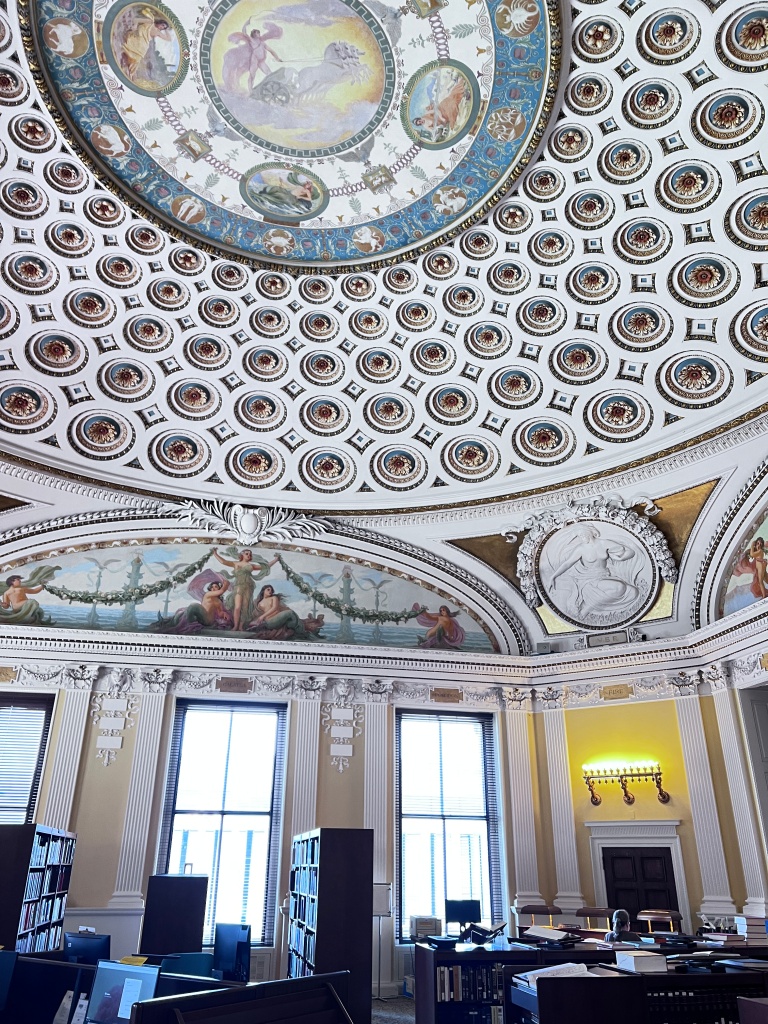
Faris at the Library of Congress

I am so pleased to share exciting news that the Faris (Φαρις) newsletter of Xirokampi, Lakonia, is now in the Library of Congress, Washington, D.C. Archivist Nevila Pahumi, who oversees the “Greece and Cyprus” collection in the European Reading Room, enthusiastically received the printed copies for the years 1979 to present. Earlier copies (1966-1977) which were published under the title Xirokampi, will be reprinted and donated at a later date.

Nevila Pahumi welcomes the donation of Faris, July 18, 2023

Last month in Athens, Dimitris Katsoulakos brought me forty-four years of printed editions of Faris. It was a thrilling experience to bring these back to the U.S. and donate them to the Library.  Ms. Pahumi explained that it is quite difficult for the Library to obtain printed copies of publications that are created at the local level, especially from rural villages. “We are very happy to have it in our collections, so that generations of future users can access it in both physical and digital form. The ability to service it to users in both formats increases the likelihood that they can work with the historical and more current issues. This kind of primary resource is invaluable, and I thank you for personally bringing it in all the way from Xirokampi.”

Faris is unique because its contents are not only empirical research, but also — and more importantly — it has captured oral histories and first-person accounts of village life and historic events. People who are conducting research about life in Greece will use Faris as a prototype of village life. It is exciting to think of our village of Xirokampi as being a primary source for academicians worldwide!

To access digital copies of Faris, click here. I am honored to have permission to translate and republish selected articles from Faris on an ongoing basis. These posts can be found here.

European Reading Room at the Library of Congress, Washington, D.C., July 18, 2023

If you know of other publications from Greece which could possibly be donated to the Library of Congress, please email me. Ms. Pahumi is seeking to expand the Greece collection.

While at the Library, I also brought copies of the family history books that I have written about my maternal and paternal grandparents. These were donated to the Local History and Genealogy Reading Room. Please note: the Library gratefully accepts ALL books which are biographical, family history or local history. They can be mailed to:

Library of Congress
U.S. Special Acquisitions Section – RG
101 Independence Avenue, SE
Washington, DC 20540-4275

The archivist suggests sending books via UPS or FedEx, not U.S. Mail, because the U.S. Post Office irradiates all incoming mail which could permanently damage or destroy books. If possible, also provide the carrier’s name and tracking number.

The Smells of Parcels from America

written and translated by Stratis A. Solomos
published in The Faris Newsletter, Issue 77, December 2022, page 6

During the 1950s and early 1960s, immigrants to America and Canada wanted to help Greece, which was poor at the time. They sent, especially to their relatives, parcels containing various useful items, generally clothes. It is not certain whether this aid was essential to the then rapidly economically developing petty-bourgeois society, but it was certainly welcomed by the poorest. These parcels mainly contained clothes and objects that had new and rather pleasant smells.

The strongest smell was that of clothes. The explanation for most was that they had been disinfected, which reassured those who feared germs. But the reality was that this smell was due to the synthetic fragrance of modern detergent powders, which had been used to wash them. They were still unknown in Greece. They did not arrive until the end of the 1950s. The first and most widespread was the American Tide. Along with this powdered “soap” also came the American “soap-opera,” a long-running sentimental radio and later TV series. The first such Greek soap opera was “Πικρή μικρή μου αγάπη” (My Bitter Little Love), the endless sentimental story of Alexis and Vana, played by Stefanos Linaios and Elli Fotiou.

The parcels were usually sent by relatives. In addition to clothing, they also contained other items, often unknown in the villages. Chewing gum with new flavors and aromas. Toothpastes which it is said that some people, who did not know their use, tried to eat!

My father and teacher Alexander Solomos, who also did educational research, received beautifully bound American elementary school books. With these books, he taught me my first English lessons. These books also had a particular smell, which has since remained an indelible and pleasant memory. I don’t know what caused that smell, perhaps the binding glue used. I rediscovered this smell in my teenage years when I frequented the American Library of Athens and later read American science books.

Sometimes there were also more valuable items like watches, which after consultation were carefully hidden in certain pockets, but most of the contents were clothes of all kinds. Taffeta ball gowns and hats for women. Suits for men. Colorful Hawaiian shirts and plaid pants. Belts with large cowboy buckles. Jackets that featured monstrous comic book characters on the back. With the exception of a few young people from the big cities, American fashion had not yet reached the conservative Greek society of these times. Few dared to wear them, except perhaps during Carnival. T-shirts with visible inscriptions and brands were only seen in the cinema. So it was very funny to see a Greek peasant picking olives wearing a Harvard University t-shirt.

The skillful seamstresses and several equally competent housewives did wonders to transform the eccentric American gowns into dresses compatible with the European fashions of the time propagated by the women’s magazines Ρομάντζο (Romance), Θησαυρός (Treasure) and Γυναίκα (Woman) . The men’s suits, those whose fabric was not too colorful, were transformed by our local Xirokambi tailor Charalambos Arabatzidis. These clothes weren’t worn very much. They were often new. But they were still deliberately wrinkled and a few buttons were removed to make them look second-hand. It seems that there were special customs exemptions for these aid parcels with used clothes. Later, when American jeans, jackets and cowboy boots became fashionable, some shrewd traders devised the ploy of passing off imported goods as packages of “gifts from America’s uncle “.

___

I (Carol Kostakos Petranek) am honored to receive permission from the Katsoulakos family to translate and share articles from The Faris. Translation verification and corrections have been made by GreekAncestry.net. This is the twelfth article of the ongoing series. Previous articles can be viewed here.