New to the Family: Fostered and Loved

Family challenges often lead to difficult decisions. Among the most heart rending are those involving minor children. Parents die or become indigent, leaving their most vulnerable loved ones to be cared for by others–perhaps family members, perhaps not.

My mother shared such a story about her Uncle Kolokota and his wife, Katina (whom mom called Thea Kolokotou). “They never had children of their own,” she said. “Instead, they raised their niece. Thea Kolokotou’s sister and her husband had nine children, born two years apart. They couldn’t take care of them all, so Theo and Thea took in one of the daughters and raised her as their own.” I remember being mildly surprised, yet reassured, that this couple would open their home and hearts to help one of Katina’s children. This was my first introduction to ψυχοπαίδια (psychopedia), known in Greece as “soul children1.”
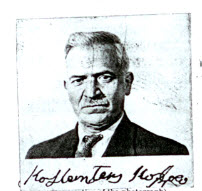
Konstantinos Kolokotas
naturalization photo, 1937

My grandfather, John Andrew Kostakos, was the youngest of eleven children. When he was about one year old, his mother died. I learned stories of him being nursed and cared for by women in the village while his father worked in his fields. Then John’s father died when he was eight years old, and John was taken in and raised by his half-brother, Gregory, who had five children of his own. At age 14, John left Gregory’s home to work for a wealthy man in Mystras, who funded John’s voyage to America.

John Andrew Kostakos
naturalization photo, 1931

The concept of an orphaned child being raised by family members is repeated in countless families.

The concept of a child whose parents are unable to care for him/her, then is raised by family members, is less common.

What is rare, but not uncommon in rural Greece, is the concept of an orphaned or destitute child who is not formally adopted, but is brought as a “soul child” into the home of an unrelated family.

I found such a case this week, as I was adding marriage records into the family tree I am creating for the village of Agios Ioannis, Sparta.2

Metropolis of Sparta, Marriage Index Book: Sparta  1873-1879;
Year: 1875, Entries: 205-216 Entry  #209

I began entering information for entry #209:
Marriage License Date: August 24, 1875
Groom:  Nikolaos Voulgaris of Agios Ioannis

I then saw an unusual entry in the bride’s column. Normally, the entry would give the name of the bride, her father’s name, and residence. But this entry reads: Dimitro Fotopoulou, psychokori Konst. I. Feggara, residence, Sparta.
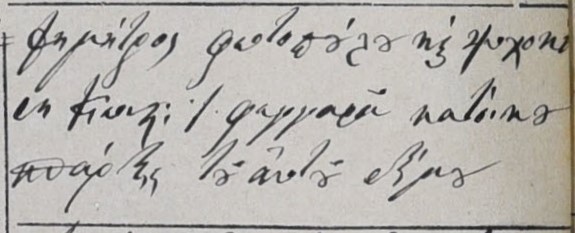
I was stumped as to why Dimitro’s father’s name was not recorded in her marriage record. And who was Konstantinos Feggaras? I sent the image above to my colleague, Gregory Kontos, owner of GreekAncestry. He responded that Fotopoulos was her biological father’s surname, and that Konstantinos I. Feggaras had “adopted” her. Greg reminded me that Greek Ancestry had published this article, “Soul-children” (Ψυχοπαίδια) earlier this year.

An excerpt from the article: The term “soul – child” describes an institution already existing in Byzantine customary law. According to this, the “soul – son” or the “soul – daughter” are granted to the “soul – parent”, who in exchange for the child’s labor undertakes the obligation to ensure his professional development or endow her until she reaches the age of marriage. In comparison to an ordinary adoption, the tradition of the “soul – children” was accompanied by a less formal legal relationship, and by a strong ethical character, which is also reflected by the first part [“ψυχή” (soul)] of this Greek compound word [“ψυχή” + “παιδί” (soul + child)]: this signifies the moral and religious attitude of the father, who aims not only at his inner atonement but also at the devotion of the adopted child to him during the last years of his life. The benefits from the offered labor usually were not important.

Reading this description, we see that ψυχοπαιδία/psychopedia connotes a deep and loving relationship–one that would rival, if not equal, that of biological parents and children. A legal adoption may have been difficult, and honestly, not necessary, in rural Greece. That this practice was brought to America and followed by the Kolokotas’ and other families gives us a heartwarming insight into those who welcomed children of need into their homes.


1For a detailed historical description and case study of this topic, see “Soul-Children (Ψυχοπαίδια)” published by GreekAncestry on March 14, 2023.
2MyHeritage has a collection titled, Sparta Marriages, 1835-1935, which I digitized at the Metropolis of Sparta. This collection has both the marriage index books and accompanying marriage licenses for thousands of families.

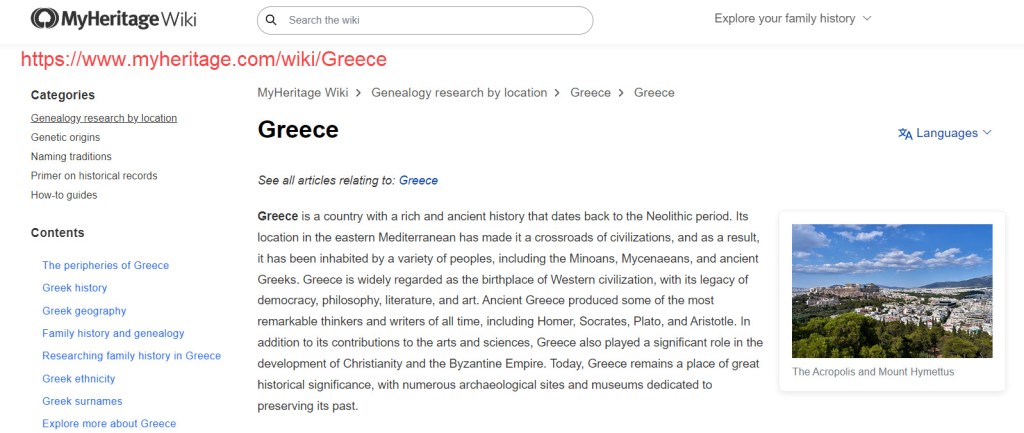
New! MyHeritage Wiki Page for Greek Research

For several months, my colleagues (Gregory Kontos, Georgia Stryker Keilman) and I have been developing articles to help people with their family history research in Greece. These articles are now published on a new wiki page online at MyHeritage.com.

The link to the Greek Research page is here: https://www.myheritage.com/wiki/Greece

Currently, the Greece Wiki Page is divided into these sections. As you click on each section, additional links and references can be found.

  1. The peripheries of Greece
  2. Greek history
  3. Greek geography
  4. Family history and genealogy
  5. Researching family history in Greece
  6. Greek ethnicity
  7. Greek surnames
  8. Explore more about Greece
  9. References

One of my contributions to the Wiki is this article, “How to Discover Your Greek Heritage” which has tips and resources to help people get started.

Additional articles on these topics will be published in the next few weeks, so please check back for new content:

  • Marriage records in Greece
  • Death records in Greece
  • Church records in Greece
  • Civil registrations in Greece

If you have ideas for additional resources or content information, please leave a comment and I will pass it on to the Wiki team. Thank you!

New Greek Records Online at MyHeritage & New Search Engine at Greek Ancestry

The MyHeritage website has added two new databases to its Greek collection, bringing the total to five. They can be found at this link.

The two newest additions are:

1856 Farmers’ Census – 99,800 records. “This collection contains census records of farmers from Greece in 1856. Records typically include the name of the individual, their year of birth, residence, and may include the name of the father.”

1901-1947 City Directories – 202,823 records. “This collection consists of city directories from Greece from the first half of the twentieth century. Records may contain the full name, residence, and occupation of the individual. Additionally, the year and name of the directory, and a comment may also be included. The individual’s residence normally contains the street name and number, the name of the town, and the prefecture. Information is given in Greek, and there is additionally a transliterated version of the information in Latin script.”

They are in addition to:

1856-1950 Electoral Rolls and Male Registers – 1,408,633 records. “This collection includes the election material of the Vlachogiannis Collection of the General State Archives of Greece. The collection consists of voter lists from 56 regions of Greece, and two male registers from another two regions. Most of the material covers the decades of 1860, 1870 and 1880, while the voter lists of Athens include records from the 1920s. The voter lists are sorted by province (επαρχία), municipality (δήμος) and town/village. Voter lists generally include: the voter’s given name and surname, father’s name, age and occupation.”

1835-1936 Sparta Marriages – 179,411 records. “This collection includes marriage records created by and kept at the Holy Metropolis of Monemvasia and Sparta from 1835 to 1935. As every marriage needed to be licensed and blessed by the area’s Metropolitan, the Metropolis kept systematic records of the marriages in its jurisdiction…both licenses and indexes.

1841-1932 Corfu Vital Records – 646,880 records. “This collection consists of birth, marriage, and death certificates from the entire island of Corfu, kept at the General State Archives of Corfu. As the vital records were created by the civil authorities, all of the island’s ethnic and religious groups are represented.”

The GreekAncestry.net website has a powerful new search engine, Zeus, which simplifies and enhances accurate search results. Try it here. The collections at Greek Ancestry continue to expand; descriptions are here.

Records at both MyHeritage and Greek Ancestry collections can be searched by name in either English and Greek.

My colleague, Gregory Kontos of Greek Ancestry, is the force behind these online collections at both Greek Ancestry and MyHeritage. His team is busy finding, digitizing and name-indexing records from all areas of Greece. People worldwide are now able to research their family history, beginning at home — a huge step forward for all with Hellenic roots!

Beyond the Basics: The EETAA Website – Nuggets of Important Information

Have you ever wondered why you cannot find your ancestor’s village on a Google map? Do you need to find the email or phone number of a community to request a record or ask for information? The EETAA website (Greek Society of Local Development and Self Government) has these answers. But, it takes some digging to find them. I hope this guide will help you.

NOTE: There are links to specific pages in this guide to help you navigate. It takes time to maneuver to the exact page you want. When you find your pages, bookmark them for easy access.

First and very important — if you do not read Greek, install a translate extension (such as Google Translate) which will enable you to click on “translate this page” so it can be read in English. As you explore this website, you will use this browser extension.  Note:  the example below is how it looks on Chrome, it will look different on other browsers i.e. Microsoft Edge, etc.

Second, understand the structure of Greece’s Levels of Administration (as organized under the Kallikratis Plan of 2011). Note that the designations of Nomos and Prefecture were eliminated under the Kallikratis Plan, but these terms continue to be used.

The “official” levels of administration:

Level 1:  7 Administrative Districts (Αποκεντρωμένη Διοίκηση).

Level 2:  13 Regional Units (Περιφέρεια)  

Level 3:  325 Municipalities (Dimos – Δήμος). These are further divided into municipal units (Δημοτική ενότητα). The municipal units are then divided into:  (1) municipal communities  (Δημοτική κοινότητα) and (2) local communities  (Τοπική κοινότητα).

The EETAA website is a gateway to contact information for these three levels.  

This is the homepage.

Remember, this is a government website with a myriad of information. To dig into what is needed by family historians, focus on the left column. Ignore the top of the column, and scroll down almost to the bottom where you will see the categories described below.  


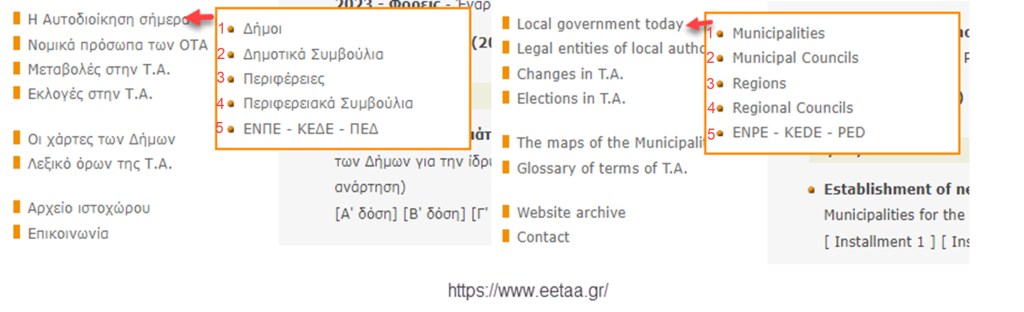
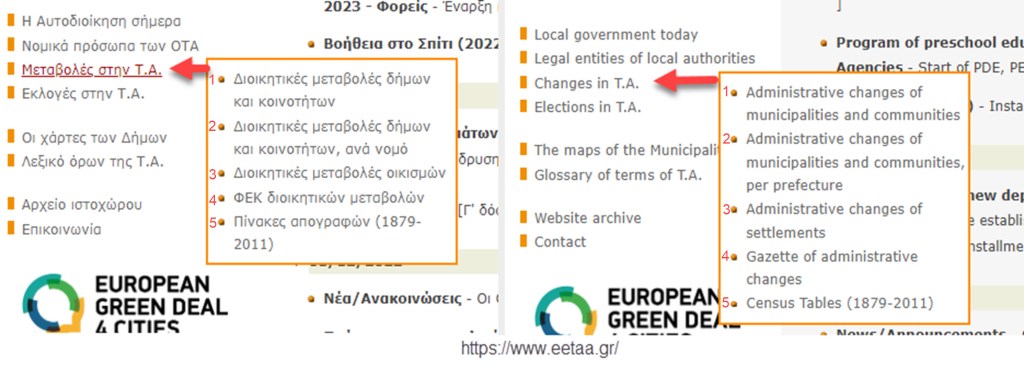
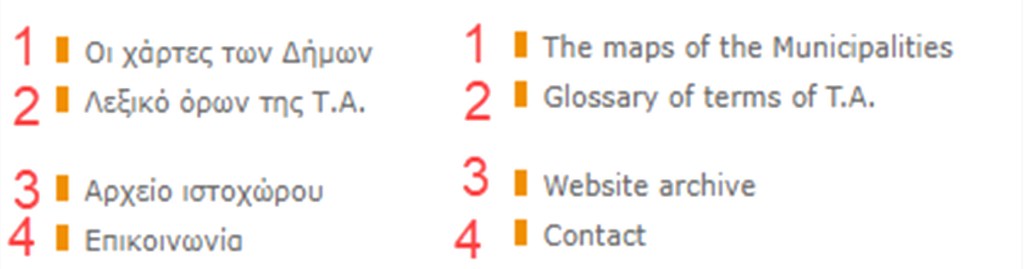
The images below show the categories as they appear in Greek (on the left). I have added the English translation (on the right). I have also inserted numbers which correspond to detailed information and links below the image.

The first category of interest is Local Government Today (Η Αυτοδιοίκηση Σήμερα). This is where you will find contact information for each administrative level.

#1: Dimos or Municipalities – contact info; emails, websites. Use page numbers at bottom to jump ahead: https://www.eetaa.gr/foreis/dhmoi.php

#2: Municipal Councils – click on the name of the municipality for names of mayor, deputy mayors, board members and municipal councilors. Use the alpha list at the top to find your area and page numbers at bottom to jump ahead: https://www.eetaa.gr/foreis/ds_select.php

#3: Regional Units – name of governor, address, phone number, email, website. Go to the regional website to drill down into municipal units:  https://www.eetaa.gr/foreis/perifereies.php

#4: Regional Councils – click on name of region for names of district governor, deputy governors, regional council members: https://www.eetaa.gr/foreis/ps_select.php

#5: Local government today / ENPE – KEDE – PED. Regions listed with contact information, website and email. Click on the region name for names of officials. https://www.eetaa.gr/foreis/enpe_kede_ped.php


The next links of interest are Changes in T.A.
These show the administrative changes of municipalities and their communities. This is where you can find the history of a municipality or a community, and you will learn what happened to the “old settlements” that no longer exist.

#1.  Administrative Changes of Municipalities and Communities: https://www.eetaa.gr/metaboles/dk_metaboles.php
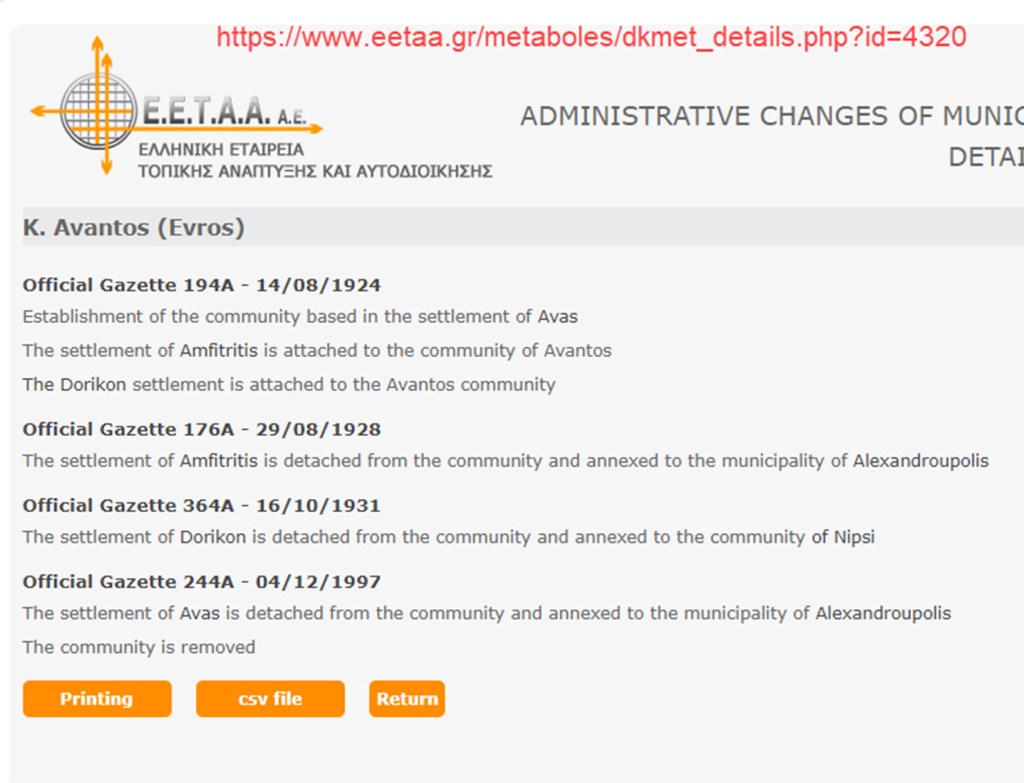
Every municipality and community is listed. Use the alpha list at the top to find your municipality and page numbers at bottom to jump ahead. Click on the name of the municipality or community to see its history. There is a link to the issue of the ΦΕΚ which decreed the change. Click on the ΦΕΚ line to see a digital issue of the newspaper.

Example: Avantos (Evros)

#2. Administrative Changes of Municipalities and Communities by Law: https://www.eetaa.gr/metaboles/nom_metaboles.php
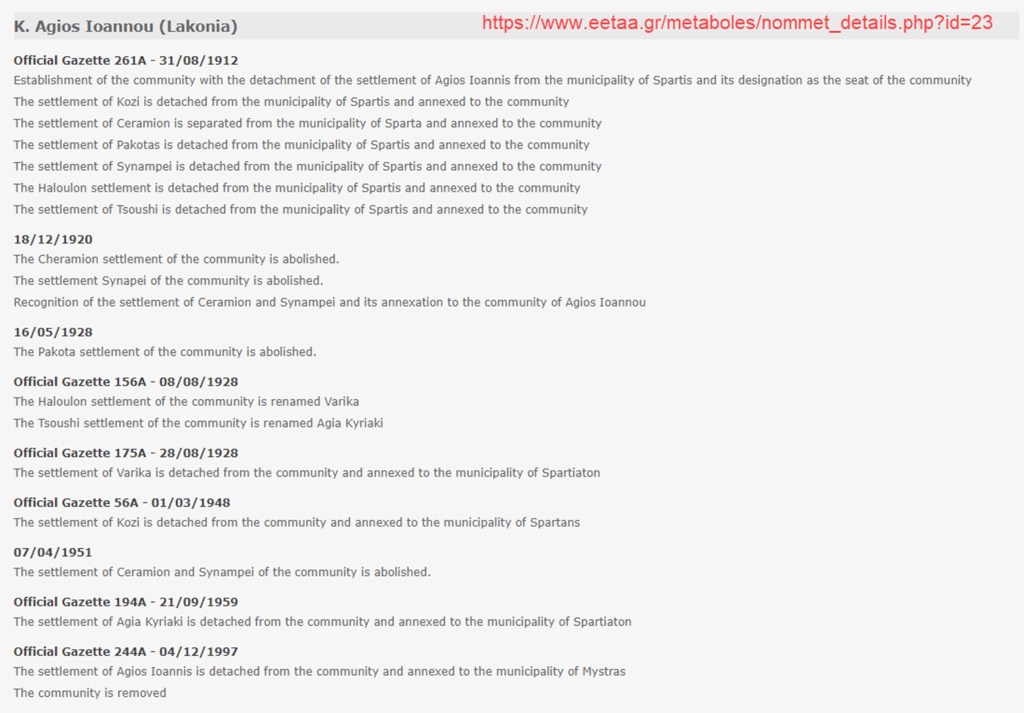
This section gives details on which settlements or neighborhoods were dissolved or incorporated into a larger community. First, find your region (the website uses the outdated word nomos). Click on its name, and the next page lists municipalities and their histories. Scroll until you find one of interest. As of the date of this post, the link to the issue of the ΦΕΚ does not work.

Example: Agios Ioannis Sparta, Lakonia

#3. Administrative Changes of Settlements: https://www.eetaa.gr/metaboles/oik_metaboles.php
Settlements are listed in alphabetical order. Use the alpha list at the top to navigate to a settlement, and the numbers at the bottom to jump ahead. Click on the name of the settlement to access its history and ΦΕΚ links.

#4. ΦΕΚ issues:   https://www.eetaa.gr/metaboles/fek_year.php
The official government gazette has been published since 1833. Use the drop down menu to find a year of interest and to access digital images.

#5.  Census Gazette: https://www.eetaa.gr/metaboles/apografes.html
Population censuses do not list names, but they do give the number of inhabitants in municipalities. These statistics can help you track the influx and outflow of people in your village. Digitized copies are viewable for the following years: 1879, 1889, 1896, 1907, 1913, 1920, 1928, 1940, 1951, 1961, 1971, 1981, 1991, 2001, 2011.


This section has regional maps.

#1. Maps of Greece: https://eetaa.maps.arcgis.com/apps/webappviewer/index.html?id=6501bf4632f24f608a20101faaca205c
The map shows administrative boundaries for municipalities, regions and prefectures, etc. Use the zoom tools on the lower left to drill into your area of interest. Use the Legend and Layers icons on the top right of the page to choose exactly what you want to view on the map.

#2. Glossary of Local Government Terms: https://www.eetaa.gr/lexikon/list_words.php?task_id=71
Click on a word to see a translation of its meaning in English, French and German.

#3. Website Archive: https://www.eetaa.gr/index.php?tag=arxeio

#4. Contact: https://www.eetaa.gr/index.php?tag=contact_eetaa
Contact information for the EETAA offices in Athens, Brussels, Central Macedonia and Thessaly.

This is a complex website, and this post has examined only the areas of interest to genealogy researchers. If there is something else that would be helpful to our community, please send an email to Carol Kostakos Petranek at spartanroots1@gmail.com and I will update the post.

Good luck as you dig further into these government resources to help you learn more about your community and to contact those who can provide further information.

Beware of Translation Tools!

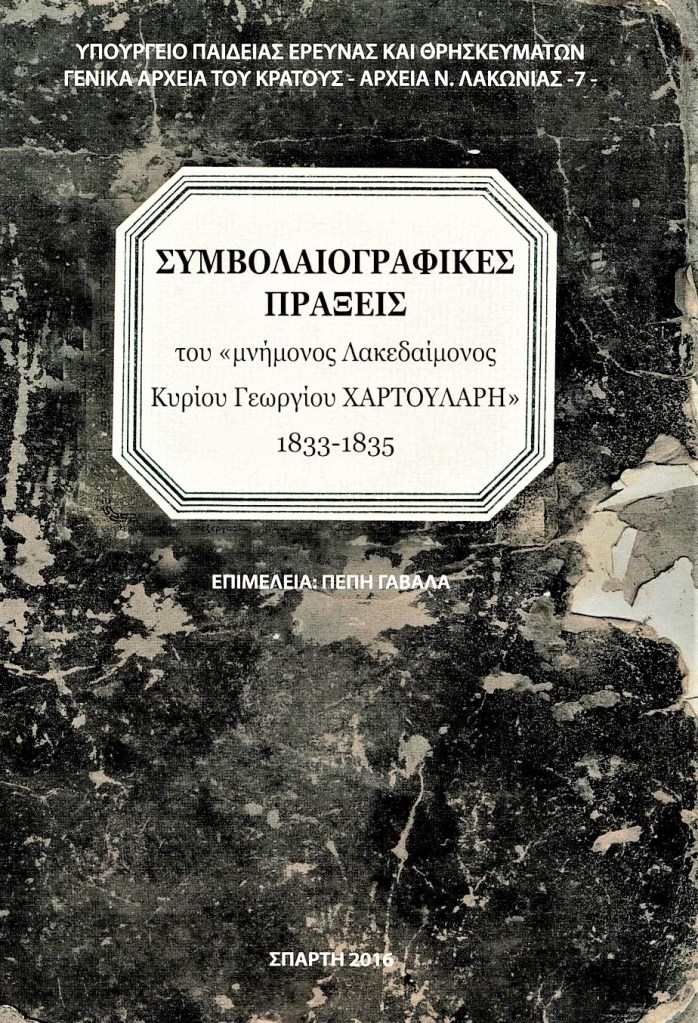
Knowing how important notary contracts are in finding information about our ancestors, I was very excited when Gregory Kontos of Greek Ancestry brought me a book published by Pepi Gavala, Archivist at the General State Archives of Greece, Sparta Office.[1] This book is not just a synopsis, but a full extract, of contracts from the collection of the notary, Georgios Chartoularis, 1833-1835.

Gavala, Pepi. Notary book of Georgiou Cartoularis of Lakedaimonos, 1833-1835. Sparta, 2016

I used the index to find entries of interest to me, and Gregory provided a synopsis of the contracts.

Here is an example: Contract 388, page 365-366; year 1834.
In the parish of Stavros in Mystras. Martha, daughter of the late Diamantis Dimitrakakis and wife of Anagnostis Dimakos. Martha had property which was part of her dowry. She wanted to sell the property to build a house  in Mystras. Martha’s brothers and her nephew gave permission for her to sell the property to another nephew, Ilias Michalopoulos.  It is unclear whether Martha’s brothers actually owned the property with her, or if they just gave permission for its sale.
Martha’s two brothers were: Theodorakis and Dimitrakis Diamantopoulos, sons of Diamantis [note: they took their father’s first name as their surname!]
Martha’s nephews [sons of her two sisters who are unnamed, but I now have her sisters’ married names]: Diamantis Panopoulos; and Ilias Michalopoulos the one to whom she sold her property.
Permission was given by Martha’s brothers, Theodorakis and Dimitrakis, and her nephew, Diamantis Panopoulos, to sell her property to her nephew, Ilias Michalopoulos.
The contract explains exactly where the property was located in Vitinarias, Mystras.

I was curious to learn some details about the property being sold, so I typed the contract into both Deepl and Google Translate. I was both surprised and confused when the word, αυτάδελφος, (relating to Martha’s brothers) appeared with different translations.

I looked in my Collins Greek-English dictionary and the word was not there.

I checked the dictionary, Λεξικό της ελληνικής ως ξένης γλώσσας, and the word was not there.

Babel Fish gave me the message: “failed translation.”

Microsoft/Bing translated the word as: self-brother (what does THAT mean?)

Systran: translated the word as: colleague

Βικιλεξικό: produced several definitions:  self- brother <ancient greek  αὐτάδελφος <αὐτός + ἀδελφός αυτοδελφος male (female cousin and cousin) brother (from both parents).

By this point, I was truly frustrated. Having the exact relationship is critical in genealogy research and I had many variations. Finally it dawned on me that this word, αυτάδελφος, used in 1833, may be obsolete in modern Greek. Giving it one last try, I went to the Google search bar and typed:  What is the definition of αυτάδελφος? A “new to me” website, WordSense gave this definition: (rare) brother-german, full-brother. And under related words and phrases was: see αδελφός (masc.) (“brother”)

Intrigued, I clicked on brother-german, and found this definition: A full brother: a brother born to the same mother and father, as distinguished from half-brothers, step-brothers, or ‘brothers’ established through relationships such as wardship. 

I went back to Greg and he confirmed that αυτάδελφος is obsolete and no longer used.  He also said that old documents may use the term αθταδέλγη as full sister. Another colleague pointed out that ετεροθαλής is a half-brother.

Now I know why the printed and online dictionaries of MODERN GREEK do not have αυτάδελφος (it’s not a modern word!), and why online translation services mistranslated it.

Important lesson learned:  when translating old documents, do not rely on online translations. They’re okay to get a general idea of the context of the document, but when it comes to important items such as relationships, ask Greek Ancestry for translation help. If Greg had not done the translation and I had relied solely on the translating tools, the relationships in my family tree would have been totally wrong, leading not only to misinformation but to utter confusion when corroborating evidence from various sources.

_______
[1] Gavala, Pepi. Notary book of Georgiou Cartoularis of Lakedaimonos, 1833-1835. Sparta, 2016. Contract #388, page 365