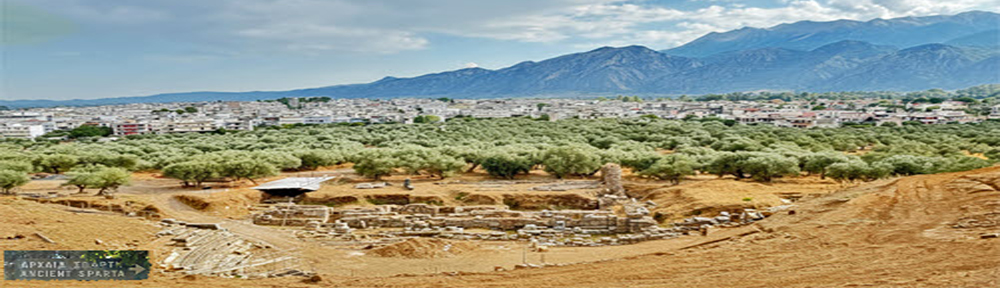
Sparta Municipal Registry Offices (Lixarcheia)

Around 1925 in Greece, Registry Offices for Municipalities were created for the purpose of maintaining civil birth, marriage and death records. These offices are also known as Ληξιαρχεία / Lixarcheia. Village priests retained the responsibility of keeping church books to record baptisms/births, marriages, and deaths in their specific congregations.

I have received requests from people asking where they should write to obtain an ancestor’s birth certificate. The answer is: if you are seeking information for a person born after 1925 and you know the exact village of birth, contact the lixarcheion office for that village.

This post explains how to access contact information for the Lixarcheion offices under the Municipality of Sparta.

  1. Lixarcheia are under the jurisdiction of the Dimos Sparta / Δημος Σπαρτη. The link to the website is: https://www.sparti.gov.gr/.

2. Under the tab for Municipality is the category “Municipal Services”. The direct link is: https://www.sparti.gov.gr/dimos/dimotikes-ypiresies

3. Under Municipal Services, at the very bottom, is an entry for “Registry Offices of the Municipality of Sparta”.
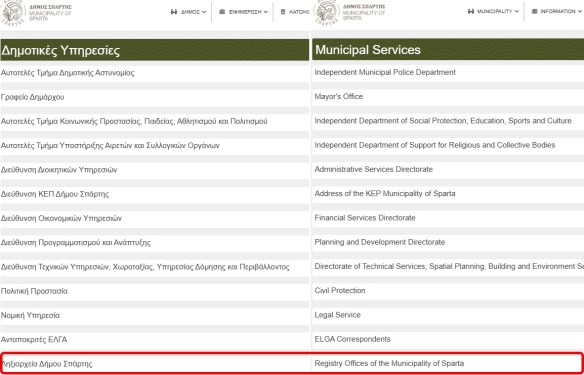
Sparta Dimos Municipal Services from Website

4. Click on the title “Registry Offices of the Municipality of Sparta” to access the chart below with contact information for each Lixarcheio office. The direct link is: https://www.sparti.gov.gr/liksiarxeia-dimou-spartis
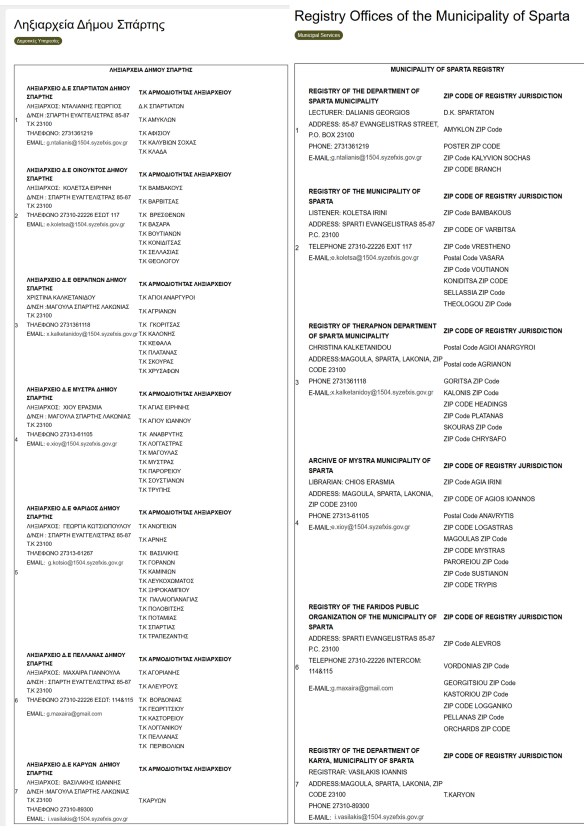
Sparta Registry Offices Lixarcheion contact info

A note about the government structure: The Municipality is Sparta; and under it are several Municipal Units. Each Municipal Unit services several villages. The title of the Municipal Unit reflects its government hierarchy. For example, the first entry on the chart is ΛΗΞΙΑΡΧΕΙΟ Δ.Ε ΣΠΑΡΤΙΑΤΩΝ ΔΗΜΟΥ ΣΠΑΡΤΗΣ which translates to Civil Registry Office of the Municipal Unit of Spartiaton, Municipality of Sparta.

The Municipal Unit office information is on the left column of the chart, and the villages it services are on the right. You must know the exact village and be sure to contact the office which serves your village!

My recommendation is to bookmark this last link for direct access: (https://www.sparti.gov.gr/liksiarxeia-dimou-spartis)

When writing an email to a Lixarcheio office, prepare it in both English and Greek (use an online app such as Google Translate). Or, put your English text into ChatGPT or another AI service for translation. If your Greek is limited, it’s a good idea to enter your text into two different translator apps to check for consistency. Including the English version is important because if the Greek is not well-translated, an English-speaking clerk will be able to read your original English message and understand your request.

Lixarchion Office, Magoula
Civil Registry Office of the Municipal Unit of Mystras, Municipality of Sparta

This is the Lixarcheion office for the municipal unit of Mystras, which services my village of Agios Ioannis. It is located in Magoula, outside Sparta. When I visited in person, the clerk was kind and helpful and I left with both both and death records about my family. I wish you success as you contact a Lixarcheio for assistance!


NOTE: Translate the Sparta Dimos website into English using Google Translate or a similar translation app. In the images for this post, I used screenshots to put the Greek and English side by side; the website does not appear like this.

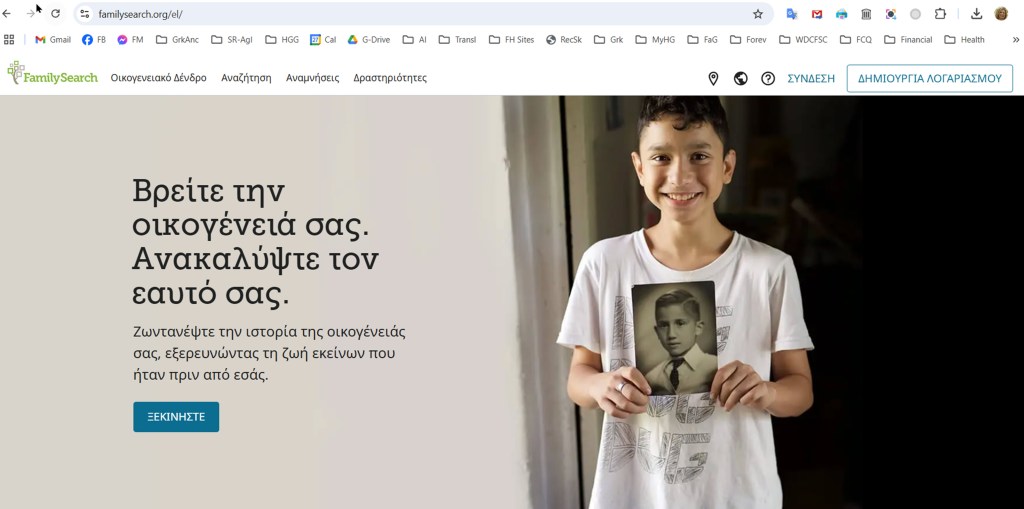
FamilySearch Website is Now in Greek

Today, FamilySearch has published its website in the Greek language! For our Greek-speaking friends throughout the world, and especially for those in Greece, this opens doors of discovery for your family history. The url is: familysearch.org/el. Congratulations to the technical specialists and IT engineers who made this possible!

familysearch.org/el

FamilySearch is the largest FREE website in the world. Its collections of digital images from Greece is unsurpassed, and these can be accessed at any of the over 5,000 FamilySearch Centers worldwide.

I especially like using the FamilySearch tree. Each person has his/her own “page” which serves as a personalized memorial site. This is where I upload photos, documents and stories about each ancestor to his or her page. For example, this is the page for my paternal grandfather, John Andew Kostakos (Ιωάννης Ανδρέας Κώστακος). As you scroll through the tabs at the top of the page, you will see the Sources, Notes and Memories that document his life. The “About” page is a synopsis of all the information about him. Everything I have about my grandfather is posted on his page and is accessible to researchers now and in the years to come.

With all of the unrest in the world today, it is critically important that we preserve the work we are doing to document the lives of our ancestors. This preservation should be both personal (i.e., digitizing documents and sharing with family and uploading to a personal online account) as well as universally accessible (uploading to a reputable online genealogy website so that our research can be accessed by others both now and in the future).

I choose to use FamilySearch as my primary online genealogy website for these reasons:
1. FamilySearch International is a non-profit organization. It has always been–and will always remain–free of charge to use.

2. FamilySearch will never go away. Other genealogy websites are owned by investors and thus are subject to being divested, sold or eliminated. FamilySearch is a service provided by The Church of Jesus Christ of Latter-day Saints to everyone, regardless of tradition, culture, or religious affiliation. FamilySearch resources help millions of people around the world discover their heritage and connect with family members.

3. The FamilySearch tree is a collaborative tree, which enables people worldwide to share information about their common ancestor(s). Anyone can upload a photo or document, or share a source of information, to a person’s page in the tree (see example above of my grandfather, John Andrew Kostakos). By sharing data, we can work together to ensure that correct information is always available for an ancestor.

4. FamilySearch has many thousands of digitized images from Archives and repositories in Greece which are not found on any other website. The catalog for Greece can be found here.

5. The FamilySearch Wiki Greece page is an excellent resource to find historical documents in Greece, and to learn methodologies for researching in Greece.

I encourage you to explore FamilySearch as a provider of research documents and as a repository to preserve your family history research.

Greek Genealogy and Spartan Roots Radio Interview, WNTN Boston

On November 25, 2024, Meletios Pouliopoulos of Greek Cultural Resources interviewed me on his weekly radio program at Grecian Echoes, WNTN Boston. A kind and gracious host, he wrote to his audience: I had the pleasure of interviewing a Greek genealogy expert, who is doing remarkable work. If there are any Greek heritage awards to be given, she and her colleagues should be at the top of the list.

We had a delightful and productive half-hour discussing civil and church records access in Greece; the Bite-Sized Greek Genealogy video series and its companion handbook, the work being done here at Spartan Roots and my village history project at Agios Ioannis, Sparta. We talked about online Greek record resources at Greek Ancestry.net and Hellenic Genealogy Geek website and Facebook page.

The segment is now available on Youtube.

Meletios is a man who is laser-focused on preserving Greek-American music and culture. For years, he has single-handedly collected recordings of Greek music, manuscripts, and films as well as newspapers, books and other publications. This provides a unique resource to musicians, teachers and the public. Read more about Meletios and his non-profit organization, Greek Cultural Resources, here.

Thank you, Meletios, for the opportunity to discuss our shared passion for Greek heritage preservation. I wish you every success in your most important work!

Bite-Sized Greek Genealogy: Free Companion Booklet Now Available

My colleague, Georgia Stryker Keilman of Hellenic Genealogy Geek and I have thoroughly enjoyed creating the video series, “Bite-Sized Greek Genealogy.” These short presentations are our way of sharing what we have learned in researching our Greek family history. We also hope these videos will help others avoid making the same mistakes as we did, and to avoid the myriad of pitfalls that we encountered.

Education for any topic is critical for success! Therefore, we are taking this series one step further.

With the videos now complete, we embarked on writing a booklet to capture the notes and talking points that accompanied our slide presentations. This booklet is now complete and is available as a free download at this link.

The booklet is structured according to the contents of each video. Each chapter contains links to the relevant videos and additional references and website links which correlate to the topic.

SECTION I:
Episode 1: Tips about Names and Villages, page 3

SECTION II: SEARCHING IN U.S. RECORDS, pages 7-11
Episode 2: How to Find Your Grandfather’s Greek Name
Episode 3: How to Find Your Ancestor’s Village of Origin
Episode 4: How to Find Your Grandmother’s Greek Maiden Name

SECTION III: RESEARCHING IN GREEK RECORDS, pages 12-40
Episode 5: How to Find Birth Information in Greece (3 videos)
Episode 6: How to Find Marriage Information in Greece
Episode 7: How to Find Death Information in Greece

SECTION IV: APPENDIX
Greek Document Locator, Parts 1 &2
Greek Word List

The entire Bite-Sized Greek Genealogy video series can be viewed at the Hellenic Genealogy Geek YouTube channel.

Please share this post with those researching their Greek ancestors. We appreciate any feedback and ideas for future videos: spartanroots1@gmail.com.

New Video Series: Bite-Sized Greek Genealogy

My colleague, Georgia Stryker Keilman of Hellenic Genealogy Geek and I have embarked on a new venture: a series of short videos to address the most common research questions that people ask. Each video will address a specific topic and have an accompanying handout.

“Bite-Sized Greek Genealogy” videos are being produced and uploaded to the Hellenic Genealogy Geek YouTube Channel: https://www.youtube.com/@HellenicGenealogyGeek-sp4pf

Our first videos are available now. The first is “Tips about Names and Villages” with information that we wish we had known when we started our research.

The second is “How to Find Your Grandfather’s Greek Name” which shows a wide variety of records that will give you this information. Trying to find ancestors in Greece without the original Greek surname is virtually impossible.

The third is “How to Find Your Ancestor’s Village of Birth.” This can be tricky, as many people gave just a county (prefecture) or the nearest city, rather than their exact village.

Be sure to download the handout for each video, which can be found in the Description area below the video.

We will be announcing more recordings over the next few weeks. We hope they will be helpful to you!