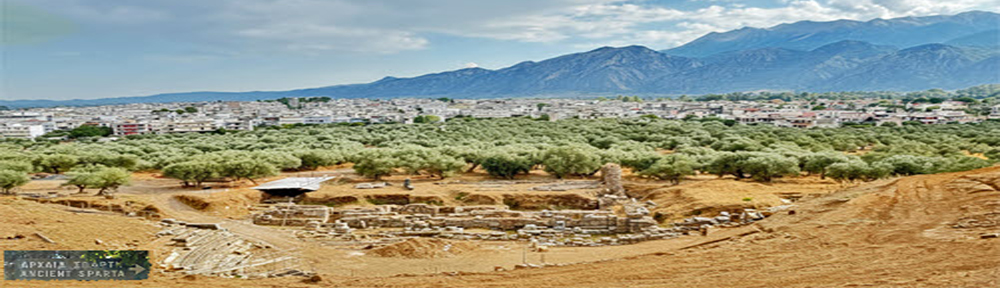
Laconian Studies: Documenting and Preserving Our Heritage

Just imagine that there is an eminent group of academics who gather to write, share, debate and publish scholarly works focused on the region of your ancestral home. Their focus is simple:  to promote continuing scientificresearch about the region with the ultimate goal of creating a written archive that chronicles and preserves the area’s rich history. If you have roots in the southern Peloponnese, you will be enthused to know that the Laconian Studies organization has undertaken this task with dedicated fervor.
Laconia Studies logo

Laconia Studies logo

Formed in Athens in 1966 under the initiative of Δικαίου Β. Βαγιακάκου (Dikaiou V. Vagiakakou), this group of about 130 has met continuously through the years. Members research and write about a myriad of subjects such as: history, archaeology, linguistics, folklore, philosophy, law, art, anthropology, and architecture.  Papers are presented at conferences, where time for debate and dialog is incorporated into the agenda.

This year, a Laconian Studies Conference will be held at the Cultural Hall in the Central Library of Sparta, Greece on November 10, 11, 12. There will be 35 speakers presenting diverse topics such as: The Lighthouse of Gytheio on the isle of Kranai Island; The Perennial Presence of the Komninos family in Xirokambi / Koumasta; Social Welfare in Laconia during the German Occupation; Geraki, Laconia during the Byzantine Period; Information about Mani from a Rare Brochure of the 19th Century.

All of the papers will be published in the Journal of Laconian Studies. There are 21 Volumes and 19 Annex Editions, which contain hundreds of articles about Laconia and Mani. A list of Journal publications is found here. As you browse through the various journal editions, be sure to click on titles of interest. Many titles are linked to pdf files with additional information on the topic.

lakonia-studies-journal-image

The Laconian Studies website has downloadable publications in pdf format, which can be found here. Titles are:  Notebooks on the History of Mani; Mani in the Second Turkish Period (1715-1821) and The Mantineies of Mani. Included in the Notebooks on the History of Mani are ten sub-volumes, one of which is transcribed names of Election Lists from the late 1800’s. Of course, all publications are in Greek, but can be deciphered with the help of a good dictionary and Google Translate.

The Journals and Annex Editions can be purchased by contacting the Laconia Studies office as provided on the website here. The Laconian Studies Library and Office is located at Trikoupi 63, 4th floor, 104 81 Athens. Office hours: Monday – Wednesday – Friday 11:30 a.m. – 1.00 pm; telephone: 210-3304422. To visit the library, make an appointment in advance by sending an e-mail to: etlasp@gmail.com.

Volumes of the Journal of Laconian Studies can also be lakonia-odos-logo-2016purchased through the newly-opened Laconia Odos bookstore in Skala, which can be contacted at lakoniaodos@gmail.com. The bookstore has a Facebook page which features posts about its publications and other items of interest.
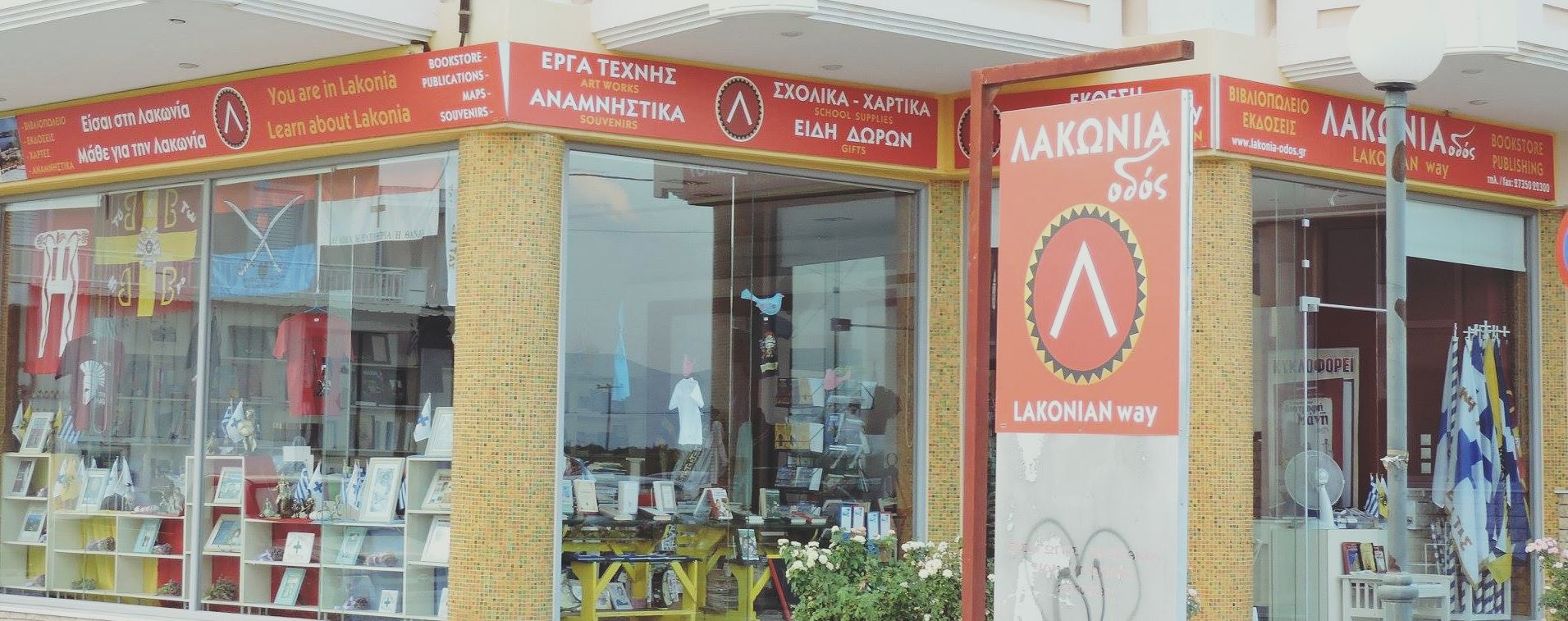
Laconia Odos Bookstore, Skala, Greece

Laconia Odos Bookstore, Skala, Greece

I am very pleased to have these resources to help me study and learn about my heritage.

Addendum: I was delighted to see this Facebook comment from the owners of Laconia Odos:

November 4 at 11:20am ·

·Οι Σπαρτιατικές ρίζες (SPARTAN ROOTS) κοντά μας! Με ιδιαίτερη χαρά και ικανοποίηση είδαμε τη δημοσίευση του Αμερικανικού site που ασχολείται με Λακωνική γενεαλογία. Η ικανότατη και ταλαντούχα υπεύθυνη κυρία Carol Kostakos Petranek, συμπατριώτισσά μας Λάκαινα, βοηθά στο να μεταλαμπαδεύεται το ιλαρό φως της γνώσης στους συμπατριώτες μας στην Αμερική, εκεί όπου ζουν πολλές γενιές Λακώνων, με τη θύμηση της μητέρας Πατρίδας. Carol σ’ ευχαριστούμε πολύ για την όμορφη ανάρτηση και τα πάντα καλά σου λόγια!

The Spartan Roots near us! With great joy and satisfaction we saw the publication of the American site that deals with Laconia genealogy. The very talented and responsible lady Carol Kostakos Petranek, our compatriot Laconian, helps disseminate the cheerful light of knowledge to our compatriots in America, where many generations of Laconians live with the remembrance of the motherland. Carol thank you so much for the beautiful post and all of your good words!

____________
1 the state of knowing :  knowledge as distinguished from ignorance or misunderstanding.
(Merriam-Webster Online Dictionary)

Return to Greece, 2016. Part 8: Meandering in Mani

This is the eighth post in a series about my trip to Greece, June 30-July 20, 2016 — an amazing journey of history, family and discovery. Previous posts can be found here.

Mani. There’s something about this land that speaks to my soul. From the moment I left two years ago, I couldn’t wait to return. The forbidding mountains, expansive plains, and impenetrable stone structures exemplify resilience, fortitude, and never giving up. It is the land of some of my ancestral families. On my first trip to Greece years ago, a man at the Archives looked at my surnames and exclaimed, “Oh, your families are from Mani!” Then he looked at my husband and said without any humor, “Watch out! She’s a Maniot. She  comes from tough people.”

Since then, I have learned so much about these “tough people.” There’s a reason they are so strong and self-reliant. They have weathered the elements and tamed the forbidding soil. They repelled any potential invaders by using rustic, yet effective methods. The Turks never penetrated or conquered the Mani. Neither did the Nazis. The people hid in caves in the hills until danger passed, then returned to their villages and their simple lives. Although the spirit of independence from Ottoman rule had been simmering for years throughout Greece, the spark that ignited the Revolution was in Mani on March 17, 1821.

By al-Qamar - File:Peloponnese relief map-blank.svg, GFDL, https://commons.wikimedia.org/w/index.php?curid=36370154

By al-Qamar – File:Peloponnese relief map-blank.svg, GFDL, https://commons.wikimedia.org/w/index.php?curid=36370154

There are three regions in Mani:  “exo” or outer; “kato” or lower; “mesa” or inner. As the map clearly shows, the entire region is mountainous and sustains little vegetation except wild olive trees, cactus, and brush. Goats scrape by on the sparse grasses, and an occasional flat valley may support orange trees. Wild herbs such as sage and oregano fill the air with a tantalizing scent. Even during hot summers, cool breezes sweep the mountains.

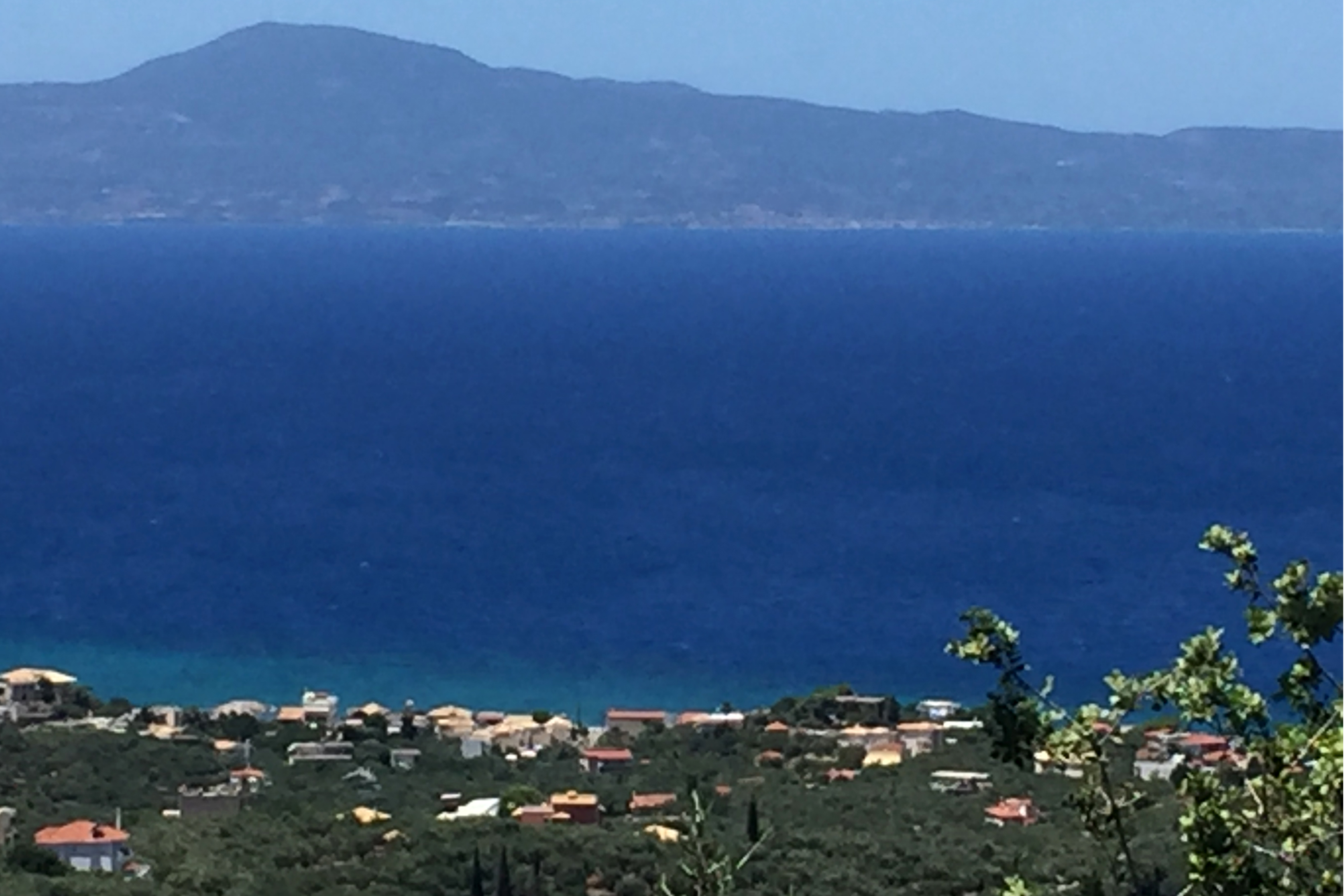
I fulfilled a dream by driving the beautiful, winding road from Kalamata to Areopoli. My GPS estimated the driving time at 1-1/2 hours, but it took me seven. All I did was stop, take photos, and savor every unique site and beautiful view. Being alone, I was able to absorb the atmosphere and revel in the rugged beauty of the land. I felt so peaceful and happy as I drove. I feel like I belong here.

Driving from Kalamata to Areopoli; the mountains, July 2016

Driving from Kalamata to Areopoli – the mountains. July 2016


kalamata-to-aeropoli-9-07-16

Driving from Kalamata to Areopoli – the sea. July 2016


Kalamats to Areopoli - the buildings. July 2016

Kalamats to Areopoli – the buildings. July 2016

A major item on my Plan A was to visit the village of Pyrgos Lefktro in Messinia. I had been told by an elderly aunt that my great-grandfather, Andreas Kostakos, may have come to Sparta from “Pyrgos over the mountains.” This particular Pyrgos seems to be the most logical place. The village is literally at the top of the mountain. When the mountain road ended, I had to park my car and walk because the village “road” was actually a narrow cobblestone winding path, lined with what seemed like ancient stone homes. It was mid-afternoon when I arrived, so of course, not a soul was to be seen except a stray cat. I wandered all around the town, taking many pictures. I found the church, the cemetery, and even went into the osteofilakio (οστεοφυλάκιο), the ossuary building, and looked at the names on the boxes. I did not see anything that could possibly be Kostakos, but my great-grandfather would have left in the middle 1800’s. If he did come from here, there are no descendants remaining.

At the front of the village was a sign on a tree that read “500 years old”. It would have been in full leaf during my great-grandfather’s time.

500 year old tree, Pyrgos, Messinia. July 2016

500 year old tree, Pyrgos, Messinia. July 2016


Buildings in Pyrgos, which overlooks the sea. July 2016

Buildings in Pyrgos, which overlooks the sea. July 2016

There is a very old museum which was locked; there was no sign as to when it opens. I peered in the windows and was taken aback at the life-size figures in full costume, standing watch over the treasures of the village.

Museum in Pyrgos, Messinia. July 2016

Museum in Pyrgos, Messinia. July 2016

As I was leaving, I did see two elderly women sitting on a veranda. They beckoned me to join them. I asked if they had ever heard the Kostakos name in the village, but their answer was no. I wanted to ask what type of life they had led; what type of work their husbands did; how often they left the village to “go to town” (wherever that was, somewhere down the mountain). They had a hard time hearing me and my vocabulary is limited, so the conversation was limited to pleasantries. One of them blew me a kiss as I said goodbye.

Saying goodbye; Pyrgos, Messinia, July 2016

Saying goodbye; Pyrgos, Messinia, July 2016

Driving back down the mountain, I wondered if I may have come — literally — to the end of the road in trying to learn more about the origins of Andreas Kostakos. But I resolutely pushed that thought from my mind. I guess it’s the fighting Spartan and tough Maniot in me that just refuses to give up!

Continuing on the road to Areopoli, I found a settlement, Tzokeika, that is being reconstructed to portray a traditional Maniot village, including a tower, a church, individual homes and an olive press. How fascinating to walk through the buildings that are under construction! This is a living settlement, with people occupying houses. I spoke with a man who had moved in last year, and he was very enthusiastic about his new home, the beauty of the scenery, and the pleasures of living in a closely knit community.

The settlement of Tza

The settlement of Tzokeika, Messinia, July 2016


Tz

Tzokeika settlement, Messinia, July 2016

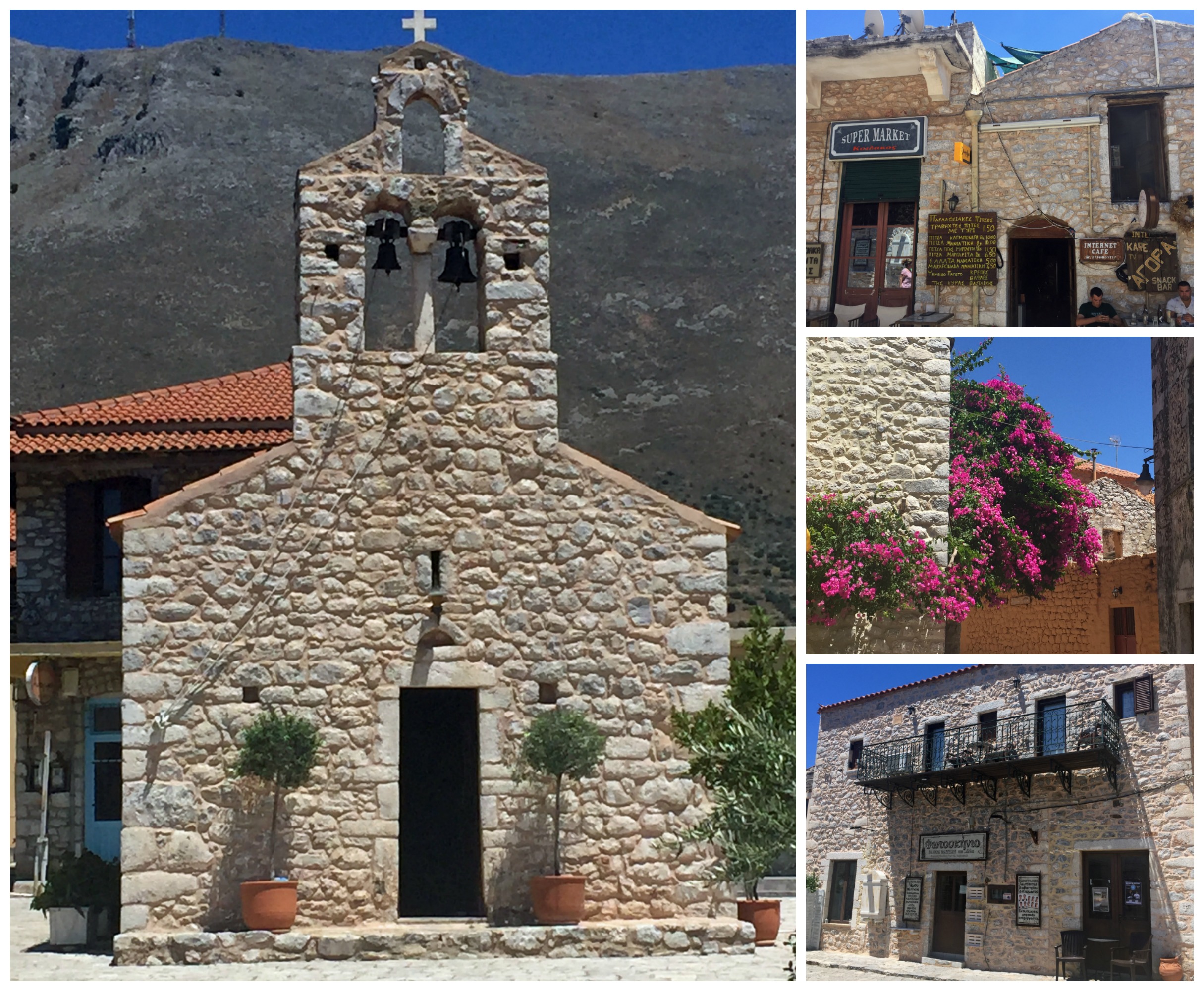
I was in Areopoli, the capital of Mani, by 7:00 p.m. It was Saturday evening and the town was filled to capacity with both locals and tourists. When I went to dinner at 11:00 p.m., I could not find an empty table. I love this village! It eneaeropoli-07-16rgizes me. The ambiance is lively, the buildings are beautifully maintained, and it is the home of a favorite bookstore, Adouloti (owned by Georgios Dimakogiannis). There are dozens of tavernas and cafes, and many unique shops. As are most Maniot villages, Areopoli is pure stone — buildings, roads, walkways. The starkness of the rock is punctuated by brilliantly colored flowers. It is a beautiful study in contrasts. Perched at the edge of the sea, the picturesque town is a visual and sensory delight.

Approaching Areopoli, a village by the sea. July 2016

Approaching Areopoli, a village by the sea. July 2016


Adouloti Mani Bookstore, Areopoli, July 2016

Adouloti Mani Bookstore, Areopoli, July 2016


Areopoli, July 2016

Areopoli, Laconia, July 2016


Areopoli, Laconia, July 2016

Areopoli, Laconia, July 2016

On the way back to Sparta, I stopped at Karavelas to see my friend, Margarita Thomakou, and visit her adopted village. Margarita and I had a delightful visit and a delicious lunch, made by her friend, Pietro. Pietro showed me a book about the history of the village. It is heartwarming to see that many villages in Laconia, even some of the smallest, have these wonderful histories.

Karvelas, Laconia, with Margarita Thomakou and Pietro, July 2016

Karvelas, Laconia, with Margarita Thomakou and Pietro, July 2016

My meanderings in Mani were almost over. The road to Sparta threaded through fertile plains, filled with orange and olive groves. Wild and lovely; fruitful and plentiful, this region of Laconia is truly the breadbasket of Greece.

On the road to Sparta, July 2016

On the road to Sparta, July 2016


Eftaxias / Eftaxas in Laconia

Searching my Eftaxias family in Laconia is yielding some exciting results. My great-great grandfather, Ioannis Eftaxias1, was born in 1809 in Mystras. As far as can be determined, he is the oldest Eftaxias in Mystras. He had two sons listed in the 1872/1873 Election Rolls: my great-grandfather, Konstandinos2, (born 1840) and Georgios(born 1848).

Dimitrios Eftaxias4, born 1846 in Mystras, is also found in these Election Lists; however, his father is not named. It is very likely that Ioannis is his father, because Ioannis is the only male Eftaxias in Mystras who is of the age to be a father during that time period. I am hoping that the staff at the Archives office in Sparta will be able to resolve this by finding Dimitrios in the Male Register, which will list his father.

My friend, historian and teacher, Giannis Michalakakos, has found the name in two areas in Laconia: Mystras and Lagia (Mani). He said this name is rare and may be Byzantine in origin. It is likely that all Eftaxias from Laconia are blood-related. Giannis surmises that members of the Eftaxias family moved from Lagia north to Mystra after the 1821 Revolution, as this was a time of widespread migration throughout southern Greece. When the Ottoman occupation ended, families were free to move about, unmolested and unafraid. It was common for families to leave their hiding places in the forbidding mountains to find work in cities and farming opportunities in the fertile plains of Laconia.

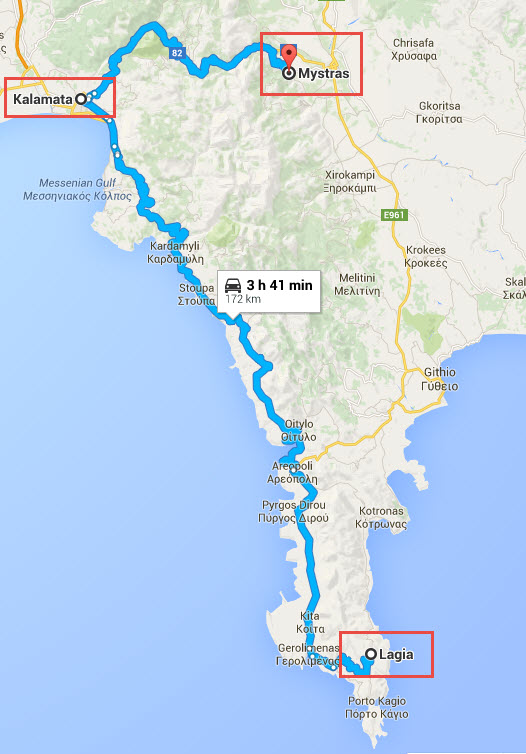
A newly-found Eftaxias relative was told by his father that his family originated in Kalamata. Corroborating this, the map below reveals the route from Lagia through Kalamata to Mystras. Understanding migration patterns helps us move back through time.

Lagia-Kalamata-SpartaGiannis determined that the oldest Eftaxias in the village of Lagia is Mihalis Eftaxias, born about 1800. He fought in the 1821 Revolution. Mihalis had a son named Vrettos, and Vrettos had two sons: Michalis5 (born 1826) and Panagiotis6 (born in 1832).

The Eftaxias name is found in Atatka, the first Modern Greek dictionary! The Atatka was compiled by Adamantios Korais, a Greek humanist scholar who played an influential role in the Greek Enlightenment, the 1821 Revolution, and in particular the development of the “purist” Greek language, Katharevousa. His monumental work, Atatka, is comprised of 17 volumes and was published in France in 1832.

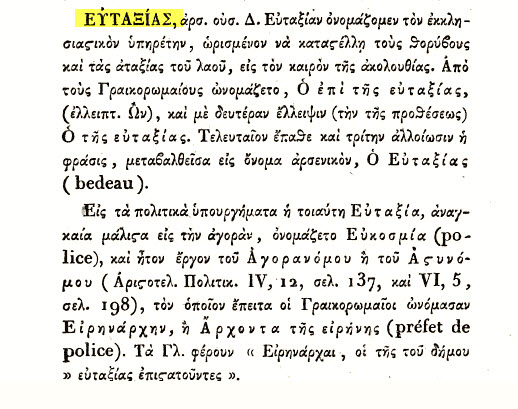
Recently Giannis sent me an entry from page 147 of Volume One of Atakta, where the name “Eftaxias” appears.

Page 147, "Eftaxias"

Page 147, “Eftaxias”

A rough translation reveals that Eftaxias is an ecclesiastical servant; one who keeps the order of the church. [From Gregory Kontos: Ευταξίας: good=ευ, order=τάξη]. He is the one that ensures there is orderliness among the people by preventing disorderly conduct, noise and mischief. There is reference in this document that Eftaxias was named “the Lord of peace.” This description gives me a most interesting insight into my ancestor who was first given (or adopted) this name.

Some families spell the name without an “i”:  Eftaxas. Giannis explained that in the Maniate language, the name is pronounced Eftaxeas (accent on the 2nd e, and pronounced as a long e). The family is part of a Maniat clan (blood related families with different names) named Ksifomaheridianoi. Other branches of families from this clan are Kassimis, Royssakos, and Kapylorihos, all of whom remained in Lagia.

Along with clan affiliations, name changes pose real challenges. Most occur from either παρατσούκλι (paratsoúkli) which is a nickname; or creating a surname from a given name —  males taking the given names of their fathers and adding -akos to indicate “son of.” Example: my surname, Kostakos, means “son of Kostas.” Thus, the original surname is lost. Reading through Election Rolls, I see this phenomenon on almost every page in Mani records. With the Eftaxias name having a distinct definition, there is no name change. Tracking down the “first” Eftaxias would be a fabulous find!

Sources:

1General Archives of Greece, Election Lists, 1843-44
File 22, Image 62, Line 239, Mystras
Ioannis Eftaxias, age 35, owns property; gardener; no father listed

2General Archives of Greece, Election Lists, 1872
File 25, Image 404, Line 573, Mystras
Konstandinos Eftaxias, age 32, shepherd; father: Ioannis

3General Archives of Greece, Election Lists, 1875
1872: File 25, Image 402, Line 480, Sparta-Mystras
Line 480 : Georgios Eftaxias, age 24, b.1848; occupation: student; father: not named

4General Archives of Greece, Election Lists, 1872
1872: File 25, Image 403, Line 506, Sparta-Mystras
Line 506: Dimitrios Eftaxias, age 26, occupation: shepherd; father: not named

5 General Archives of Greece, Election Lists, 1875
File 9, Image 99, Line 188, Lagia
Mihalis Eftaxias, age 49, farmer, father: Vrettos,

6 General Archives of Greece, Election Lists, 1875
File 9, Image 100, Line 237, Lagia
Panagiotis Eftaxias, age 43, farmer; father: Vrettos