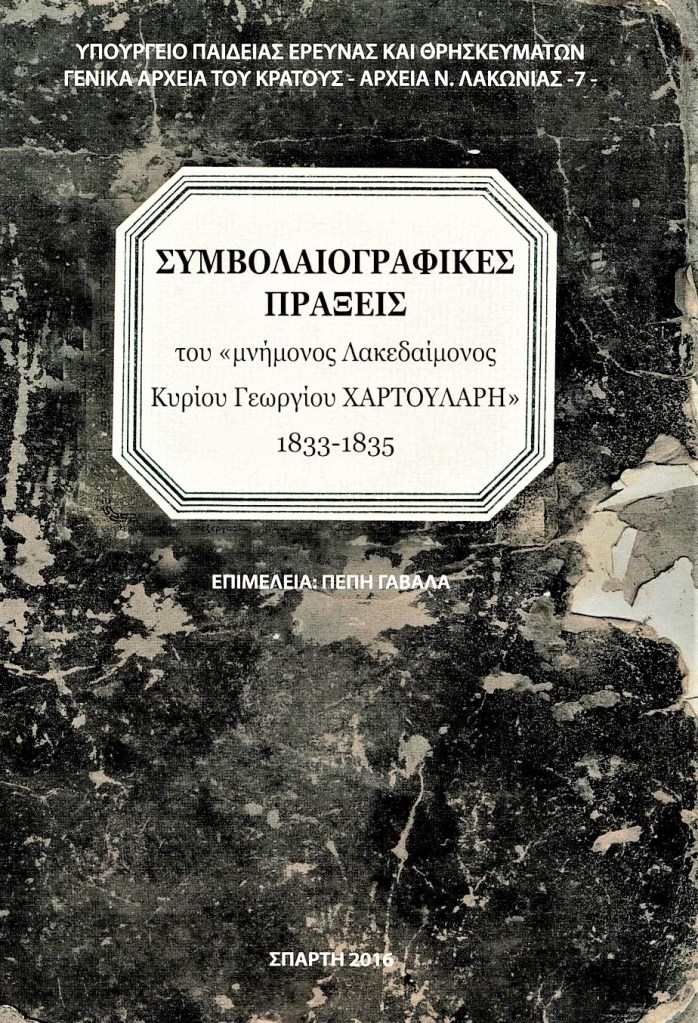
Knowing how important notary contracts are in finding information about our ancestors, I was very excited when Gregory Kontos of Greek Ancestry brought me a book published by Pepi Gavala, Archivist at the General State Archives of Greece, Sparta Office.[1] This book is not just a synopsis, but a full extract, of contracts from the collection of the notary, Georgios Chartoularis, 1833-1835.
Gavala, Pepi. Notary book of Georgiou Cartoularis of Lakedaimonos, 1833-1835. Sparta, 2016
I used the index to find entries of interest to me, and Gregory provided a synopsis of the contracts.
Here is an example: Contract 388, page 365-366; year 1834. In the parish of Stavros in Mystras. Martha, daughter of the late Diamantis Dimitrakakis and wife of Anagnostis Dimakos. Martha had property which was part of her dowry. She wanted to sell the property to build a house in Mystras. Martha’s brothers and her nephew gave permission for her to sell the property to another nephew, Ilias Michalopoulos. It is unclear whether Martha’s brothers actually owned the property with her, or if they just gave permission for its sale. Martha’s two brothers were: Theodorakis and Dimitrakis Diamantopoulos, sons of Diamantis [note: they took their father’s first name as their surname!] Martha’s nephews [sons of her two sisters who are unnamed, but I now have her sisters’ married names]: Diamantis Panopoulos; and Ilias Michalopoulos the one to whom she sold her property. Permission was given by Martha’s brothers, Theodorakis and Dimitrakis, and her nephew, Diamantis Panopoulos, to sell her property to her nephew, Ilias Michalopoulos. The contract explains exactly where the property was located in Vitinarias, Mystras.
I was curious to learn some details about the property being sold, so I typed the contract into both Deepl and Google Translate. I was both surprised and confused when the word, αυτάδελφος, (relating to Martha’s brothers) appeared with different translations.
I looked in my Collins Greek-English dictionary and the word was not there.
I checked the dictionary, Λεξικό της ελληνικής ως ξένης γλώσσας, and the word was not there.
Babel Fish gave me the message: “failed translation.”
Microsoft/Bing translated the word as: self-brother (what does THAT mean?)
Βικιλεξικό: produced several definitions: self- brother <ancient greek αὐτάδελφος <αὐτός + ἀδελφός αυτοδελφος male (female cousin and cousin) brother (from both parents).
By this point, I was truly frustrated. Having the exact relationship is critical in genealogy research and I had many variations. Finally it dawned on me that this word, αυτάδελφος, used in 1833, may be obsolete in modern Greek. Giving it one last try, I went to the Google search bar and typed: What is the definition of αυτάδελφος? A “new to me” website, WordSense gave this definition: (rare) brother-german, full-brother. And under related words and phrases was: see αδελφός(masc.) (“brother”)
Intrigued, I clicked on brother-german, and found this definition: A full brother: a brother born to the same mother and father, as distinguished from half-brothers, step-brothers, or ‘brothers’ established through relationships such as wardship.
I went back to Greg and he confirmed that αυτάδελφος is obsolete and no longer used. He also said that old documents may use the term αθταδέλγη as full sister. Another colleague pointed out that ετεροθαλής is a half-brother.
Now I know why the printed and online dictionaries of MODERN GREEK do not have αυτάδελφος (it’s not a modern word!), and why online translation services mistranslated it.
Important lesson learned: when translating old documents, do not rely on online translations. They’re okay to get a general idea of the context of the document, but when it comes to important items such as relationships, ask Greek Ancestry for translation help. If Greg had not done the translation and I had relied solely on the translating tools, the relationships in my family tree would have been totally wrong, leading not only to misinformation but to utter confusion when corroborating evidence from various sources.
_______ [1] Gavala, Pepi. Notary book of Georgiou Cartoularis of Lakedaimonos, 1833-1835. Sparta, 2016. Contract #388, page 365
by: Georgia Stryker Keilman and Carol Kostakos Petranek
With the recent launch of the new Hellenic Genealogy Geek Research Links website, Georgia noticed an interesting trend–a majority of searches were in the category of Greek Names. We know that researching Greek surnames can be challenging, and the information here will inform and help you.
It’s happened to all of us. We are sure that our ancestor lived in a specific town in a specific country, but a name search yields no results. We try alternative search parameters, such as using special “wildcard” characters (e.g., * or ?) or eliminating the surname and searching by given name and date / place. Whether you search in an English language website or one of the new searchable Greek websites (GreekAncestry and the Greek record collections on MyHeritage), the tips below are applicable universally.
We have identified four primary reasons for difficulties in finding Greek surnames:
Spelling Variations
Use of Double Surnames and/or Nicknames
Human Error
Transliteration Methodology and Use of Digraphs
1. Spelling Variations “Based on their origin, Greek surnames can be divided into four categories: 1) patronymic/matronymic, 2) toponymic, 3) occupational, and 4) nickname-derived surnames,”[1] writes Gregory Kontos in the Greek Genealogy Guide.
Analyze your surname. Identifying its root and examining its suffix will provide clues to the meaning of the name and its region of origin.
EXAMPLE–surname of Manousos:
Manousos is a male given name, found predominantly in Crete; therefore, we know that its use as a surname originated from a patronymic naming pattern.
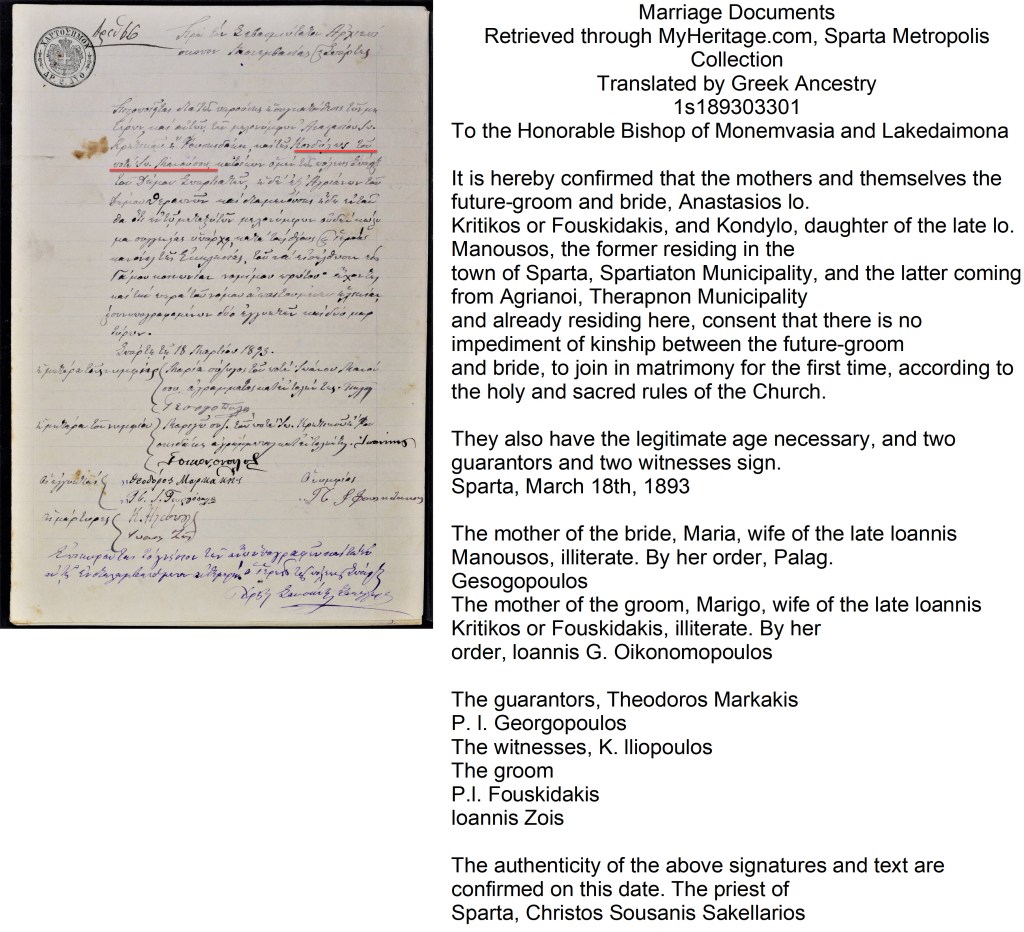
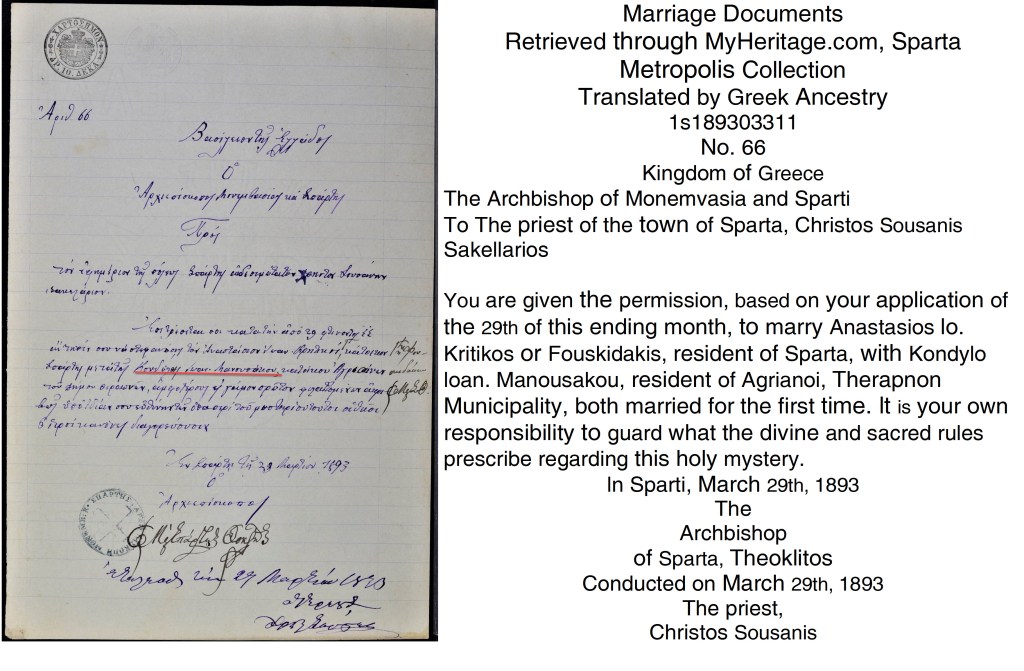
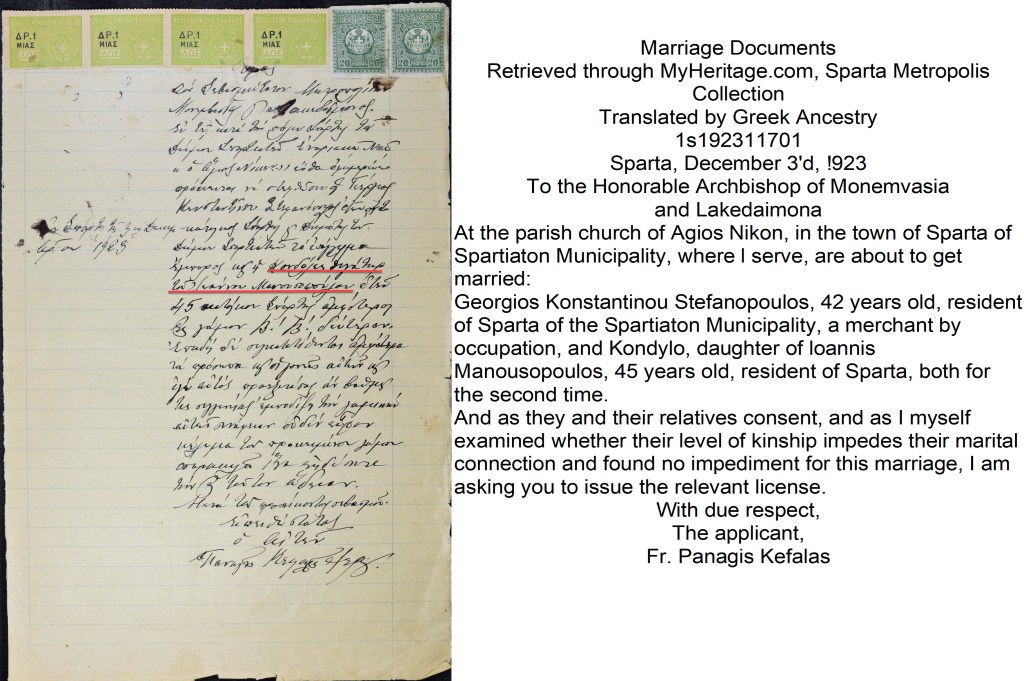
Georgia’s great-grandmother, Kondylo Manousos, daughter of Ioannis, was born about 1884 in Agrianoi, Therapnon, Lakonia. She was married twice and divorced. The marital papers record her surname as:
March 18, 1893 – 1st marriage – surname MANOUSOS
March 29, 1893 – 1st marriage – surname MANOUSAKOU
November 17, 1923 – Divorce – surname MANOUSAKIS
December 4, 1923 – 2nd marriage – surname MANOUSOPOULOS
December 3, 1923 – 2nd marriage – surname MANOUSOPOULOS
The red lines in the following marriage documents underscore the various spellings of Manousos as written by the priests (translations by GreekAncestry and used with permission):
The Greek Genealogy Guide, published by Greek Ancestry, has a section on Greek Names with a Suffix Chart that pinpoints the locality of various name endings. This helpful resource illustrates that all the Manousos name variations, as written by the priests, are technically correct for a family residing in the southern Peloponnese.
The common practice of families using more than one surname and/or a nickname (i.e., paratsoukli) makes Greek research especially challenging, as described in a previous post. How can you determine which is the “original” and which is the nickname? Again, examining the root of the name and its suffix can reveal clues.
Returning to Kondylo’s marriage documents: her first husband was Anastasios Ioannis Kritikos or Fouskidakis. In this case, it is easy to recognize that Kritikos is the nickname: a literal translation is “the man from Crete,” denoting that the first Fouskidakis person who arrived in the village had originated in Crete. Villagers bestowed the migrant with the nickname Kritikos, but he retained his original name. Thus the family was known by–and used–both appellations interchangeably, in Greece and in the U.S.
For families that used two names, you must research both!
3. Human Error
Humans are fallible and errors are inevitable. When name indexes are created, the indexers are instructed to “key what they see”–meaning, they must type names exactly as written on the document. If they suspect a spelling discrepancy or perceive an error, they are not to make any changes or corrections. The way a priest or clerk writes a name is the way it must be indexed.
To further complicate research of the Fouskidakis-Manousos family, the groom’s name is misspelled in the marriage documents! The correct spelling is Fousketakis as found in the Mitroon Arrenon (Male Registers) of Crete. Having the accurate spelling of Fousketakis in her records, Georgia was stumped when she could not find that name in MyHeritage’s collection of Sparta Marriages. When she searched using the bride’s name (Kondylo Manousos), a match appeared. The original documents revealed the misspellings by the priests. As instructed, the indexer typed the name as it appeared on the document. The case of the “missing” name was solved.
4. Transliteration Methodology and Use of Digraphs
Have you spoken the surname aloud? What sounds do you hear? And how are those sounds converted from Greek into English?
As this article explains, transliteration is not the same as translation. “A translation tells you the meaning of words in another language. Transliteration changes the letters from one alphabet or language into the corresponding, similar-sounding characters of another alphabet… Our ancestors often would transliterate their names so Americans could spell and pronounce them, producing many variant spellings.”
There are many transliteration tables found on the internet. This one is used by Greek Ancestry and MyHeritage:
Variant name spellings are also generated by digraphs[2]—two adjacent consonants which make a single sound. There are seven digraphs in the Greek language. A name written in Greek using any of these digraphs will surely sound differently from how it is spelled. Note the three digraphs which can be transliterated into two totally different spellings:
Greek
English Transliteration
Sounds like/written as
γγ
g
English
γκ
g or ng
garment or English
γχ
nh
enhance
μπ
mb or b
bravo or embassy
vτ
nd or d
door or Andy
τζ
ds
rods
τσ
ts
oats
Therefore, if you are researching the name Μπιρμπατάκος, it could be properly transliterated as either Birbatakos or Birmbatakos or Mbirmbatakos. You must search using all possible variants!
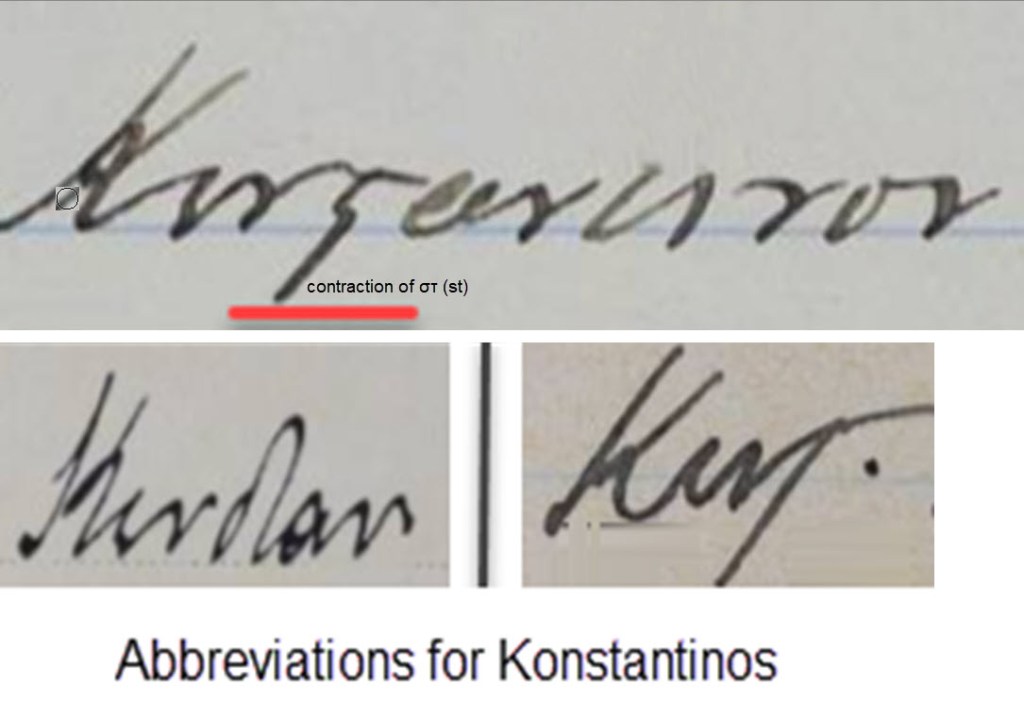
Abbreviations of names and contractions of letters are often written by clerks and priests. The name Konstantinos is shown below. The upper image shows how the letters στ-st (underlined in red) are written as one character. The lower images are examples of abbreviations; the most commonly used is Kon/tinos (Κων/τινος).
We can assume that a Greek indexer easily recognizes abbreviations and contractions. But in many documents—especially those of the 1800’s–the handwriting is scrawled and almost illegible. Combining that with abbreviations makes proper indexing an almost impossible task.
Summary
It’s a great time to be researching our Greek families! Genealogy websites, both in English and Greek, are uploading new records daily. Their algorithms are designed to do “fuzzy searches,” which broaden search parameters to find similar naming patterns. However, computers only work from the information that we input.
Our recommendations:
Be open to spelling variations. Don’t reject a record because the name is spelled differently. Examine the entire document before deciding if it is or is not the correct family.
Don’t rely on indexes alone. Always read the original image! Even if it is in Greek script, you can learn how to read your names. You may spot an error in the index or transliteration.
Omit the suffix and type the root of the name followed by a wildcard (usually an *). Or, type only the first 2-3 letters followed by a wildcard. This will bring up variations of the name which may have been transliterated incorrectly.
Remember that female surnames are written in the genitive (possessive) format which usually end in -ou. Thus, Alexandropoulos and Alexandropoulou are the samename; the first is masculine, the second is feminine.
Male names are also written in the genitive, primarily when the father’s name is placed in the middle of a child’s name: Apostolos Georgiou Pantazos is Apostolos Pantazos, the son of Georgios.
Browse the record of the entire village. Although this takes more time, it is worth the effort when you find your family with a misspelled or incorrectly transliterated name.
Do you have any tips, successes or frustrations to share? Please let us know so we can learn from each other. Good luck with your Greek name searches!
I spoke Greek before I ever learned English. My birth and early years in Brooklyn were immersed in the language and culture of my immigrant grandparents and our extended family. “Why teach her English?” my parents reasoned, “she’ll learn it fast enough when she is older.” So true. I was four years old when we emerged from that urban ethnic cocoon and were instantly submerged into middle class, English-only America. The shock of moving to a small New Jersey town left me speechless–literally. No one spoke Greek and I didn’t speak English.
Without exaggeration, this was traumatic. The first day that neighborhood children came to play, I was considered strange and branded as different. I wanted to fit in, and communication was the key. I dropped Greek and quickly learned English, refusing to speak my native tongue at home and only to my grandparents. Years of weekly Greek school lessons were detested, as it was a reminder that I was “not like the other kids.” My defaced and marked-up Greek language primers were an outward symbol of my inner conflict.
Fast forward. I have traveled to Sparta four times in the past five years and I am going again in May. I am desperate to regain my language skills. With every trip, I foolishly hoped that immersion would work its magic and that I would wake up in Sparta with a fluent four-year old’s vocabulary–certainly not admirable, but passable. After all, this is my native language. It’s all up there, floating around in the grey matter, isn’t it? Reading articles such as this one reassured me that I was not alone, yet I was being unrealistic. We most certainly can–and we often do–forget our first tongue.
Determined to do better, I have enrolled in private online Greek language lessons. I have doubled up on the lessons, two per week for twenty weeks. Despite many hours of study, I am struggling mightily. The verb tenses are making me tense, and the multiple formats of nouns are confusing and exasperating. After 10 weeks of frustration, I have designed and fine-tuned these color-coded “cheat sheets” for nouns and verbs. Except for those pesky irregulars and exceptions, they work!
Verb Cheat Sheet
Nouns Cheat Sheet
Many native Greeks speak English (children learn in school, and are fluent by graduation), and a non-Greek speaking tourist can get by quite nicely. But, I am not a tourist. When I am in Sparta, I have work to do, family to visit, and books and articles to read. Although I am blessed by good friends and cousins who cheerfully help with translation, I am losing out by not being able to read and communicate. Many older people (the ones who know our family history!) speak only Greek, and there are historical writings such as village histories, which are of significance.
I am halfway through my 20-week course and slowly feeling a bit more confident. This summer, I won’t be fluent but I hope to be understandable. It’s easy to lament my childish rejection of the language, but that won’t bring it back. I am reading those primers now and smiling at the full circle that I have made.







 Spartan Roots (Σπαρτιατικές Ρίζες)