
My friend Debbie, who reads old Greek newspapers as part of her research strategy, recently sent me a gem. As she was looking at a New York City Greek-American newspaper from 1917, an article mentioning Papagiannakos from Hoboken caught her eye. Incredibly, she remembered this was my grandfather’s surname, and she sent me the following newspaper page with this message: “didn’t know if you would need this, but maybe?”
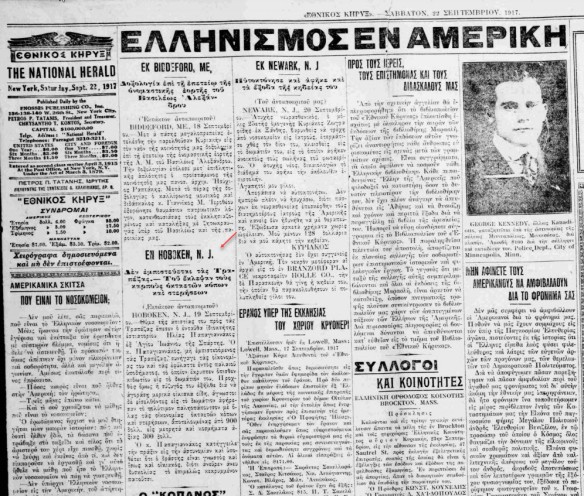
September 22, 1917; Ethniko Kirika
Maybe? Good heavens, YES! This is about my maternal grandfather, Ilias Papagiannakos.

News clipping about Ilias Papagiannakos, September 19, 1917, Ethniko Kirika
The article states that because he did not trust banks, he hid his money in an old shoe which was kept in the back of his clothes closet. A thief stole the fruits of eight years’ hard work and sacrifice, and now the money was gone.
The translation reads:
In Hoboken, N.J.
He doesn’t trust banks – They stole savings of eight years of toil and sacrifice
(Special Correspondent)
HOBOKEN, N.J., September 19 [1917] – A victim of his mistrust of banks was the local restaurant owner Elias Papagiannakos, originally from Agios Ioannis, Sparta. Mr. Papagiannakos, distrusting banks, had been saving his money and kept it inside an old shoe, which he hid behind a box in his room.
The day before yesterday, however, while his wife went out to buy some household goods, unknown individuals entered the room and stole the precious old shoe containing all the savings from eight years of toil and sacrifice — amounting to $900 in cash and $300 worth of jewelry.
Mr. Papagiannakos reported the incident to the police and suspects the perpetrator is someone familiar to him, possibly even a household acquaintance, since they found the well-hidden shoe without any difficulty.
My first reaction was shock, then sadness. An inflation calculator estimates that in today’s dollars, the sum of my grandfather’s loss would be $25,502.48, a significant amount of money! Ilias immigrated at age 15-17 under an alias to avoid conscription into the Greek army. He had no money and worked hard to accumulate enough funds to purchase a small restaurant in Hoboken. To save $1200 after eight years’ labor was quite a feat.
At first I wondered why my mother (Catherine) and her sister (Bertha) never told me this story; then I realized that they may not have ever known this happened. My mother, the oldest living child, was 6 months old in September 1917. When my grandmother went shopping on the day of the robbery, she would have taken my infamt mother with her. Many years later when my mother was an adult, they may have forgotten or chosen not to mention this unfortunate event.
There are many questions that will forever remain unanswered. Who could possibly have known where my grandparents stashed their money? If it was someone close to them, how could he/she have perpetrated such a breach of trust? How did my grandparents cope with the loss of their savings? My grandmother had $300 worth of jewelry — that is significant for immigrants! Were they wedding gifts?
I am so grateful to Debbie for finding and sending this article, which gives me insight into a difficult event in the lives of my grandparents. It is said that we can gain strength from learning how our ancestors met and overcame challenges. Knowing that yiayia and papou weathered this setback and continued on to financial freedom is encouraging and inspiring to me.
(My appreciation to Giannis Michalakakos for translating the news article)

 Spartan Roots (Σπαρτιατικές Ρίζες)