Greece 2017. Part Three: Corinth

I have wandered along many paths of my ancestral villages, but in Corinth I walked where the Apostle Paul walked. Standing on holy ground was a sacred experience which renewed my connection to my faith and to the Lord.

Ancient Corinth, Temple of Apollo

After he preached to the Athenians on Mars Hill, Paul continued his ministry in Corinth where “many of the Corinthians hearing believed, and were baptized.” Paul’s first mission in Corinth lasted 18 months, A.D. 50-52 (Acts 18:11).  As he walked the narrow stone paths, he established the church of Christ and preached His gospel.

Stone inscribed with the words of Paul ( 2 Corinthians 4:17).

Spot where Paul was put on trial before the proconsul Gallio in AD 51. The case was dismissed and Paul was released (Acts 18:12-17).

Ancient Corinth was one of the largest and most important cities of Greece, with a population of 90,000 in 400 BC. Both destroyed and rebuilt by the Romans, it became the provincial capital of Hellas with a mixed population of Romans, Greeks and Jews. Situated halfway between Sparta and Athens on the Isthmus of the Peloponnese, it was the crossroads between northern and southern Greece. In addition, its two ports–west on the Corinthian Gulf and east on the Saronic Gulf—positioned it as the major trade route between Asia and western Europe.

The archaeological sketch below (photo taken at the site) depicts the magnitude of the ancient city.

The ancient city of Corinth

I had to stretch my imagination to visualize the city portrayed above, with what remains today.


The Museum was filled with artifacts excavated from the site. They were meticulously preserved and displayed in a manner befitting the glory of the ancient city.

Museum interior at Corinth

Every display case was a “feast for the eyes” and a delight to the historian. These are just a few of the photos I took.

Museum artifacts

Museum cabinet

The life-size statuary both inside and outside the Museum were astounding to see. The marble carvings remained remarkably pristine throughout the centuries.

Statuary, interior

Statuary, exterior

Immersing myself in the site of Corinth reminded me that one can be a tourist, or one can be a traveler (see the difference). I prefer the latter.

Laconian Studies: Documenting and Preserving Our Heritage

Just imagine that there is an eminent group of academics who gather to write, share, debate and publish scholarly works focused on the region of your ancestral home. Their focus is simple:  to promote continuing scientificresearch about the region with the ultimate goal of creating a written archive that chronicles and preserves the area’s rich history. If you have roots in the southern Peloponnese, you will be enthused to know that the Laconian Studies organization has undertaken this task with dedicated fervor.

Laconia Studies logo

Laconia Studies logo

Formed in Athens in 1966 under the initiative of Δικαίου Β. Βαγιακάκου (Dikaiou V. Vagiakakou), this group of about 130 has met continuously through the years. Members research and write about a myriad of subjects such as: history, archaeology, linguistics, folklore, philosophy, law, art, anthropology, and architecture.  Papers are presented at conferences, where time for debate and dialog is incorporated into the agenda.

This year, a Laconian Studies Conference will be held at the Cultural Hall in the Central Library of Sparta, Greece on November 10, 11, 12. There will be 35 speakers presenting diverse topics such as: The Lighthouse of Gytheio on the isle of Kranai Island; The Perennial Presence of the Komninos family in Xirokambi / Koumasta; Social Welfare in Laconia during the German Occupation; Geraki, Laconia during the Byzantine Period; Information about Mani from a Rare Brochure of the 19th Century.

All of the papers will be published in the Journal of Laconian Studies. There are 21 Volumes and 19 Annex Editions, which contain hundreds of articles about Laconia and Mani. A list of Journal publications is found here. As you browse through the various journal editions, be sure to click on titles of interest. Many titles are linked to pdf files with additional information on the topic.

lakonia-studies-journal-image

The Laconian Studies website has downloadable publications in pdf format, which can be found here. Titles are:  Notebooks on the History of Mani; Mani in the Second Turkish Period (1715-1821) and The Mantineies of Mani. Included in the Notebooks on the History of Mani are ten sub-volumes, one of which is transcribed names of Election Lists from the late 1800’s. Of course, all publications are in Greek, but can be deciphered with the help of a good dictionary and Google Translate.

The Journals and Annex Editions can be purchased by contacting the Laconia Studies office as provided on the website here. The Laconian Studies Library and Office is located at Trikoupi 63, 4th floor, 104 81 Athens. Office hours: Monday – Wednesday – Friday 11:30 a.m. – 1.00 pm; telephone: 210-3304422. To visit the library, make an appointment in advance by sending an e-mail to: etlasp@gmail.com.

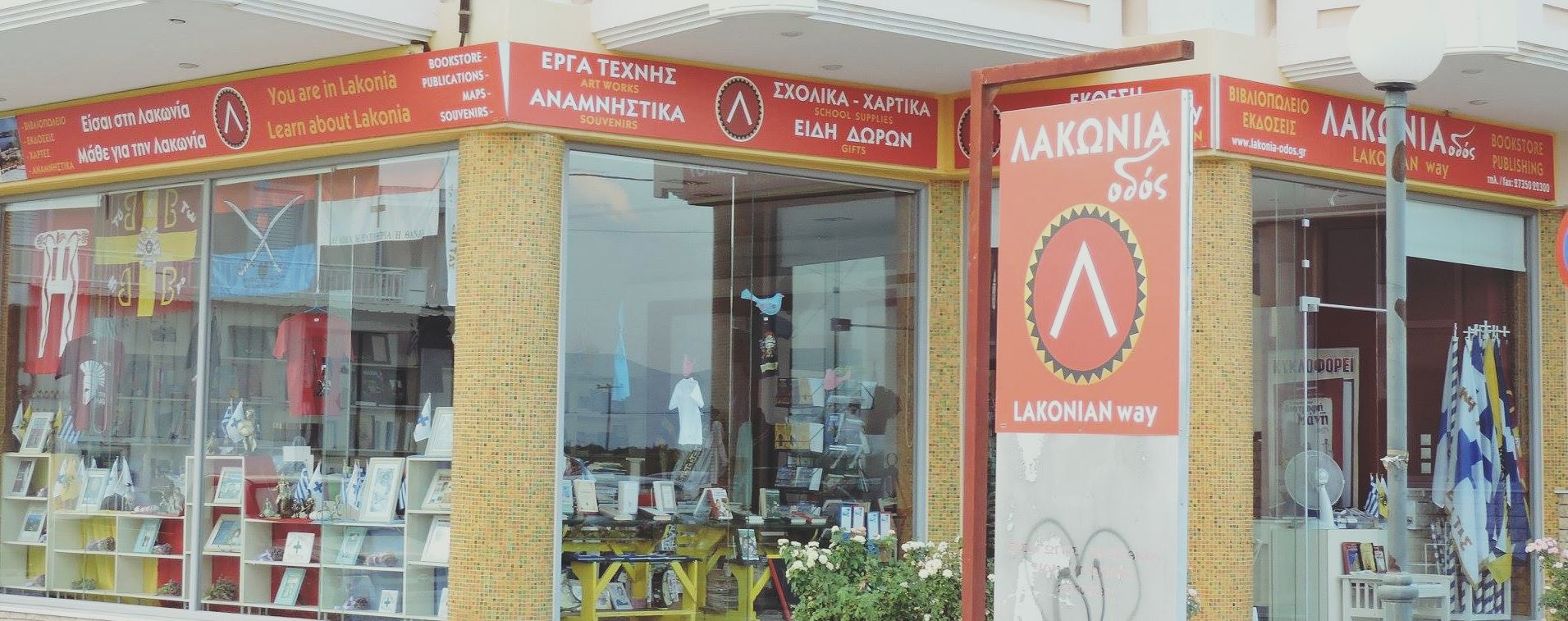
Volumes of the Journal of Laconian Studies can also be lakonia-odos-logo-2016purchased through the newly-opened Laconia Odos bookstore in Skala, which can be contacted at lakoniaodos@gmail.com. The bookstore has a Facebook page which features posts about its publications and other items of interest.

Laconia Odos Bookstore, Skala, Greece

Laconia Odos Bookstore, Skala, Greece

I am very pleased to have these resources to help me study and learn about my heritage.

Addendum: I was delighted to see this Facebook comment from the owners of Laconia Odos:

November 4 at 11:20am ·

·Οι Σπαρτιατικές ρίζες (SPARTAN ROOTS) κοντά μας! Με ιδιαίτερη χαρά και ικανοποίηση είδαμε τη δημοσίευση του Αμερικανικού site που ασχολείται με Λακωνική γενεαλογία. Η ικανότατη και ταλαντούχα υπεύθυνη κυρία Carol Kostakos Petranek, συμπατριώτισσά μας Λάκαινα, βοηθά στο να μεταλαμπαδεύεται το ιλαρό φως της γνώσης στους συμπατριώτες μας στην Αμερική, εκεί όπου ζουν πολλές γενιές Λακώνων, με τη θύμηση της μητέρας Πατρίδας. Carol σ’ ευχαριστούμε πολύ για την όμορφη ανάρτηση και τα πάντα καλά σου λόγια!

The Spartan Roots near us! With great joy and satisfaction we saw the publication of the American site that deals with Laconia genealogy. The very talented and responsible lady Carol Kostakos Petranek, our compatriot Laconian, helps disseminate the cheerful light of knowledge to our compatriots in America, where many generations of Laconians live with the remembrance of the motherland. Carol thank you so much for the beautiful post and all of your good words!

____________
1 the state of knowing :  knowledge as distinguished from ignorance or misunderstanding.
(Merriam-Webster Online Dictionary)

Lakonia Studies

Last summer when I was in Greece, my friend Giannis Michalakakos gave me a copy of Book of Lakonia Studies which contain excerpts of letters and documents from the Venetian conquest of the Peloponnese in the late 1600’s. Specifically, there are transcripts of letters of Francesco Morosini, Doge of Venice 1688-1694, pertaining to Mystras and its surrounding region. The book is in Greek, of course, and my language skills are elementary at best. But, with the help of my teacher, Theodore Papaloizos, Google Translation tools and a Greek-English dictionary, I have begun to read this fascinating history.

I will write posts as I go through this book so others can learn and join me on this journey into the past. Please understand that my translations may not be accurate.

Lakonia Studies

Because this is a transcript of original documents, I am immersed in the first-hand accounts of Morosini, admiral of the Venetian fleet, as he writes to his superiors regarding the state of affairs in the Peloponnese.

The goal of the Venetians and the Turks is to conquer Mani. Both want control of Mystras. The Turks are losing control, and the Venetians don’t want Muslims in Mystras. An agreement is made between the Turks and the Venetians to subdue the Maniates.

12 July 1687. Fleet Admiral Morosini is on board a ship in the sea of Patras. He writes to the Doge of Venice about a new attack made against Mystras. The Venetians and Turks were fighting for Mystras, and the Venetians needed help from the Maniates. Mystras was being guarded by 600 men from Mani and the town of Koroni, in addition to 100 soldiers of the guard. When the Greeks heard the name of the Turk, they threw their axes, swords and their stolen spoils on the ground and fled from the mountain in desperate escape. They were shamed into retreat by 70-80 Turks. Morosini closes his letter by writing that this is a sad report.

20 August 1687.  Morosini writes to the Doge from the Gulf of Lepanto.

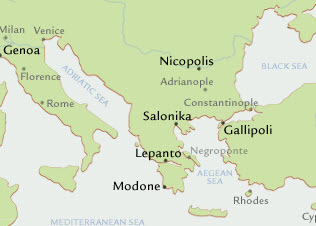
Gulf of Lepanto map

The Maniotes, Captain Bollani and others went to Mystras with a raised white flag and a plan for the mutual exchange of hostages. The Maniates were greedy about the spoils they obtained by looting and stealing, and negotiations had to be done with utmost care. Morosini cautions against not exercising the utmost possibly leniency to the Mystriotes until the Venetians occupied the entire province. He recommends that robust men could be useful as slaves as rowers on boats, and the women, children and the elderly over 50 years could go back to their villages.

Morosini writes a letter to Pasha stating his terms which are dictated by his desire for the common good and to emphasize the decision taken by the Council: Turks are to pay a ransom; a deposit of 200,000 rialia in gold and silver. This money will increase the treasury and operations of the armies. If they do not accept the terms, they will receive notice of a general slaughter.

With other successes, the war will end gloriously. However, the Venetians must not abandon any attempt to ensure the fall of Monemvasia. Efforts will be made in this region as in others, so as not to leave even one Muslim in Mystra.

(Link about the Venetian conquest: http://en.wikipedia.org/wiki/Morean_War)