Abbreviations in Handwritten Records

This week, I came across a few abbreviations while extracting family names from the Dimotologion Koinothtos (Town Records) of Amykles and Agios Ioannis, Sparta. With limited space and long, complicated names, it is obvious why clerks would use abbreviations. To the uninitiated, it is not obvious as to what these abbreviations are. However, we can learn to recognize certain patterns.

It is important to know the most common first names and surnames of the areas you are researching. This will help you spot an abbreviation, rather than struggling to decide if it is a full name.

This is an example of an abbreviation for the male name, Konstandinos / Konstantinos (Κώνστανδινος / Κώνσταντινος) Georgios Zarafonitis. Konstandinos is a 4-syllable word. Note the slash / that separates the first syllable (Konst) from the last syllable (nos). If I did not know that Konstandinos is a name used frequently in my area, I might mistranslate this as:  Konstnos, Konslnos, or something else that doesn’t make sense.

abbreviation-name

Abbreviations of places are also common. Again, it is critical to know the area you are researching, and all of the villages and hamlets in the surrounding area. The red arrow points to two village abbreviations:  on the first line is Agios Ioannis (Αγ. Ιώαννης); on the second line is Paleologio (Παλεολόγιο). Agios Ioannis has a period between Ag. and Ioannis. Paleologio is a 5-syllable word, and it has a slash to separate the first and last syllables.

abbreviation-place

This is a record from the Dimotologion of Agios Ioannis, Sparta, for the family of Dimitrios Geroulakos (father: Panagiotis; mother: Garifalia), born 1875 in Agios Ioannis; and Polyxeni, daughter of Aristedis Smyrnios born 1902 in Paleologio.

Again, I would have been stumped if I did not know that Paleologio is a small village just north of Agios Ioannis.

paleologio

The last example is another place name abbreviation. This one is trickier, as it is for an area outside of mainland Greece — Anatolia, Thrace (in present-day Turkey). It  is abbreviated as Anat. Thraki (Ανατ. Θράκη).

abbreviation-name-1

At first, I was puzzled as I did not recognize the Greek words as being an area near Sklavachori (the name in the next column). Studying the words, I guessed that  Θράκη was Thrace. My friend, Giannis Michalakakos, verified that was correct, and also identified Ανατ. as Anatoli.

Learning to read old handwritten records in any foreign language is challenging, but do-able. Eventually, your eyes begin to discern how the letters are formed. If you do your homework and learn the names and places of your area, your mind will recognize what has now become familiar, and you will have success!

2022 UPDATE to original post: Our friends at GreekAncestry and HellenicGenealogyGeek can help with questions about abbreviations of names and places. Also, the Greek Ancestry Guidebook has a Dictionary of commonly used words in documents which can help you learn the vocabulary and recognize words in genealogy documents.

Two Perspectives: One Heritage

Quote

“It’s not the same here,” is a phrase that I frequently hear from Greek natives. “Genealogy research may be a priority for immigrants, but not for us.”  As a third generation American and the descendant of immigrant grandparents, I was surprised and somewhat bemused to find that people in Greece regard my research as interesting, but not necessarily relevant or important. Why?

My friend, Giannis Michalakakos, a Greek native, has patiently discussed this topic with me for hours. We recognize that there is a sharp difference between the two groups: an immigrant descendant is motivated by a quest for knowledge and identity; a native Greek is motivated by curiosity and a desire to delve more deeply into local history and culture.

Giannis placed genealogy in a broader historical context. He likened it to a pyramid where history builds upon itself—broadest at the base, to singular at the pinnacle. I scribbled a rough drawing as he spoke, and came up with this.

pyramid-historicalgenealogical-research

General historians begin at the bottom of the pyramid and move up. They study the basic foundation—global or world history—then progress into regional and local histories. The focus becomes narrower until the story of the family and its individuals are reached at the top. How does each category in the pyramid relate to the one below and above? What part did a village play in the history of the country? Or a family in the history of its village? Sometimes, individual leaders may rise in power to exert influence far beyond their locality—perhaps to lead a country to military victory or become a national leader who, in turn, influences world events.

Genealogical historians, in contrast, begin at the top of the pyramid and move down. The pattern is the same regardless of ethnicity or country of origin:  start with oneself, then gather information about parents, grandparents, great-grandparents, and beyond. Learning about the village, and its relation to the larger region and country, usually comes as the researcher discovers the part his ancestor played within the community. At times, the researcher may study a local history to glean information about its families. The process is fluid and depends on the goals and interest of the researcher.

So, how does the pyramid relate to the differing views of genealogy by Greek natives and Immigrant descendants? To quote Giannis, “It all comes down to knowledge.”

A Greek native has knowledge about his family; therefore, his motivation may be one of curiosity, not identity. He has been raised with oral histories and can often recite his lineage back several generations. He or his parents/siblings may be living in a family home built by a great-great-grandparent. He may own land in his village of origin. He may interact regularly with second, third, and fourth cousins from both sides of his family. There is no need for genealogical research–he knows his identity. Rather, genealogy could be a tool to better understand local society, customs and history. Many small Greek villages are populated by just a few clans; thus, a study of  local history necessitates knowing the genealogy of the residents as well as their traditions.  Perhaps he is curious as to how his family fits into the larger historical context of the region and country. He may be motivated to learn if his ancestor received an aristea (award) for fighting in the Greek Revolution of 1821. He may be interested in studying the history of his village if it had been the headquarters of a bey (Turkish ruler) during the 1700’s. Perhaps his family started a business that provided financial security for people in his community.

Raised with strong traditions and steeped in culture, the Greek native is living his history.

In contrast, a typical third or fourth generation immigrant descendant is seeking identity. The farther removed from his immigrant ancestor, the dimmer his knowledge. He may not know the original family name as many newcomers shortened or entirely changed their names (Poulos – from Papadapoulos? Or Stathopoulos?). He may not know the exact village of origin (Arcadia? which village – there are hundreds!) He may have heard family stories whose details were lost in translation; or, perhaps, only parts of the story were passed down. His Greek language skills are waning or non-existent (despite attending Greek school as a youth).

At some point–usually in adulthood when the elders pass on–the descendant realizes that a part of him is gone. There is no parent/grandparent/great-grandparent to ground him to the ancestral land. It is now his duty to pass on family stories and traditions; but to his shock, they are unknown or unclear to him. At this point, he has been thoroughly assimilated into American, or Canadian, or Australian culture. His spouse may not be Greek, and this may have accelerated a drift away from his native religion, culture and traditions.

That’s when something new rises within–the gnawing desire to relearn who he is. The past suddenly becomes present; he feels an urgency to reconnect with his roots and to reconstruct his family lineage. If he has children, his drive to pass on the family heritage may become acute. His search for knowledge begins. Of necessity, it starts with himself–the individual at the top of the pyramid–and filters down as discussed earlier.

Although Greek natives and immigrant descendants share families, genetics and bloodlines, it is understandable why and how they differ in genealogical perspective. To the Greek native, genealogy is irrelevant to identity but essential in the study of local history and culture. To immigrant descendants with dual heritage, genealogy is essential to identity and relevant to understanding ethnic tradition and culture.

Thankfully, the roots that unite us are stronger than the perspectives that divide us.

Honoring My Cousin, Father Eugene Pappas

There’s nothing that compares to a Brooklyn, New York gala — live band, gourmet food, beautiful venue — everything needed for a first-class celebration. On December 2, my cousin, The Very Reverend Father Eugene Pappas, Archimandrite, was honored at an elaborate and festive gala held in commemoration of his 50 years of service as a Greek Orthodox priest, and 35 years as priest at Three Hierarchs Church in Brooklyn. To say that I was delighted to be there is an understatement; this was an event to be long-remembered and I was thrilled to be part of it.

pappas-fr-eugene-2

Father Eugene Pappas

Nicholas Leon Pappas (Father Eugene) is the son of Pauline Drivas and Leon Pappas (Papagiannakos). He and his siblings, Konstandinos and Georgeanne, were born and raised in the Sheepshead Bay area of Brooklyn, in the center of a thriving Greek-American community. Although he studied law, Father Eugene had deep desires to become a priest. The family name “Papagiannakos” indicates that in the past, a man in the Giannakos family became a priest (παππάς – papa) — thus, forever changing the surname to indicate this honor. Father Eugene told me that he felt, from childhood, that he was destined to be a priest and to carry on the tradition initiated by our ancestor. He was ordained into the priesthood in 1965.

Father Eugene began his ministry in South Korea as the First Foreign Missionary of the Holy Archdiocese of Archbishop Iakovos. In 1969, he opened an orphanage and worked in a boys’ home. His service in South Korea helped pave the way for the Orthodox Christian Mission Center of the USA. Along with South Korea, Father Eugene served in many foreign posts including Japan, the Philippines, Switzerland and Greece. Upon returning to the United States, he became pastor in the faith community where he was baptized, raised and educated.

pappas-fr-eugene-8

Father Eugene preaching the gospel at Three Hierarchs Church, Brooklyn, NY

Father Eugene’s service is not confined to either religious causes or his parish. He is a renowned civic activist and public speaker and is esteemed by civic and faith leaders of all political affiliations and religions. As scholar educator, he has taught Orthodox Theology in the Roman Catholic Diocese of Brooklyn/Queens, and a special commemoration was held for him by the Catholic community. He is lauded for his leadership and participation in public causes and numerous community initiatives. The walls of his office are lined with plaques, degrees, and honorary citations.

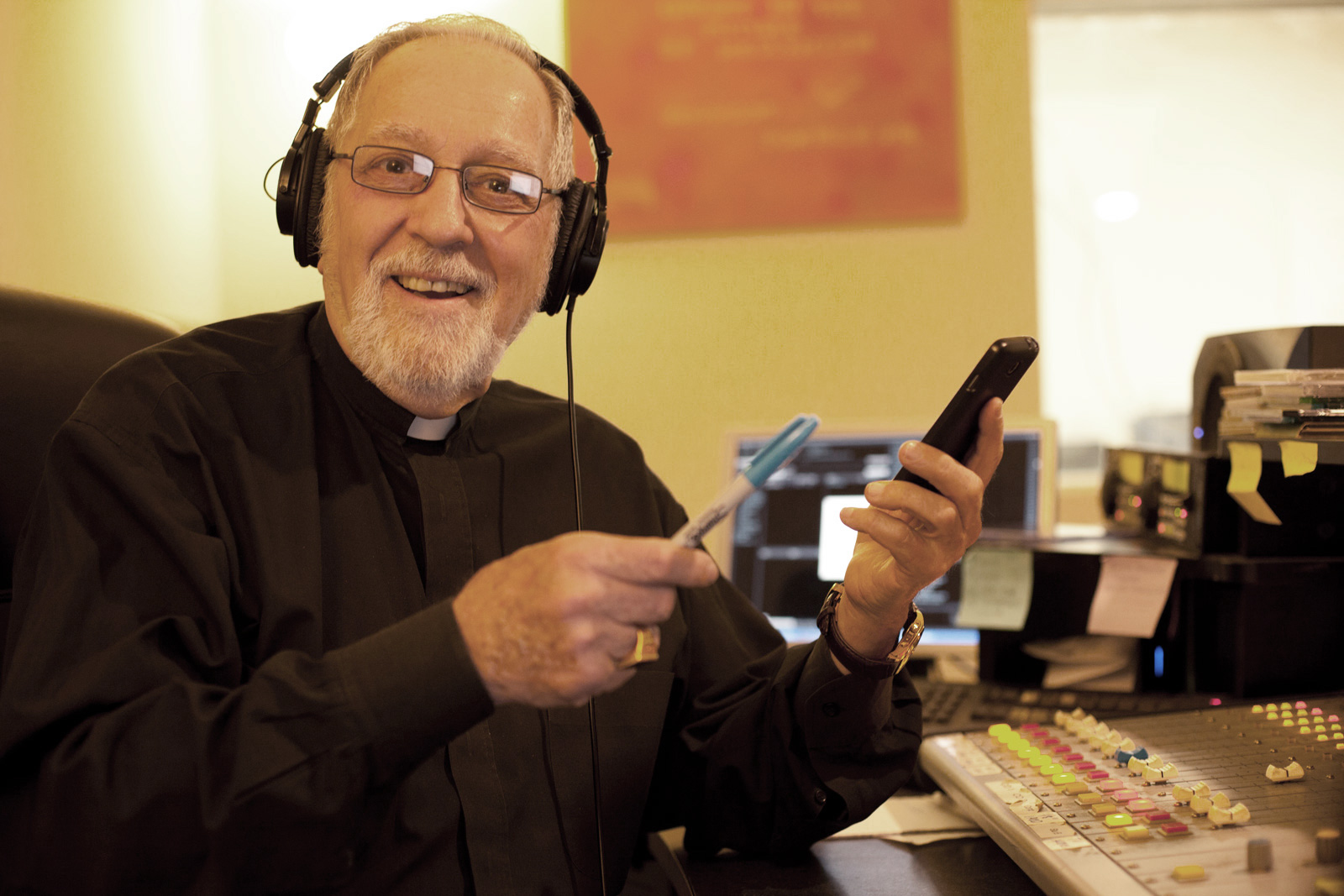
As a man of the times, Father Eugene uses today’s media to exhort and educate audiences far beyond Brooklyn. For the past 18 years, he has hosted a radio program, “Matters of Conscience” on COSMOS FM every Saturday from 1 to 2 P.M.

Father Eugene broadcasting at Cosmos-FM studios. His radio program, Matters of Conscience, has aired for 18 years.

Father Eugene broadcasting at Cosmos-FM studios. His radio program, Matters of Conscience, has aired for 18 years.

He also has a presence on YouTube. This interview gives a brief perspective of his influence in the community:

Despite a schedule that would wilt an ordinary man his age, Father Eugene takes time for the individual. During a recent visit to his office, he paused our discussion to minister to a stranger who walked in off the street and asked for a blessing. His love of family has broadened to a passion for learning about his family history. We have shared many stories, photos, and discussions of our ancestry–much to our mutual delight.

This Saturday, I will be Father Eugene’s guest on Cosmos FM, and we will be discussing Hellenic genealogy–the rewards, the challenges, and how to get started. The radio show will be broadcast at this link, beginning at 1:10 PM Eastern time:  http://www.cosmosfm.org/podcast/.

Along with the many religious and civic dignitaries who have honored this man, I add my voice–thank you, Father, for your faith, your service, and the honor you have brought to our Papagiannakos/Pappas family.

A few photos from Father Eugene’s 50th Gala Celebration.

Father Eugene and his family, Brooklyn, NY, December 2, 2016

Father Eugene and his family, Brooklyn, NY, December 2, 2016

Georgeanne Conis, Carol Kostakos Petranek, Father Eugene Pappas; Brooklyn, NY, December 2, 2016

Georgeanne Conis, Carol Kostakos Petranek, Father Eugene Pappas; Brooklyn, NY, December 2, 2016

Father Eugene and his siblings: Konstandinos (Dino) and Georgeanne Pappas Conis; Brooklyn, NY, December 2, 2016

Father Eugene and his siblings: Konstandinos (Dino) and Georgeanne Pappas Conis; Brooklyn, NY, December 2, 2016

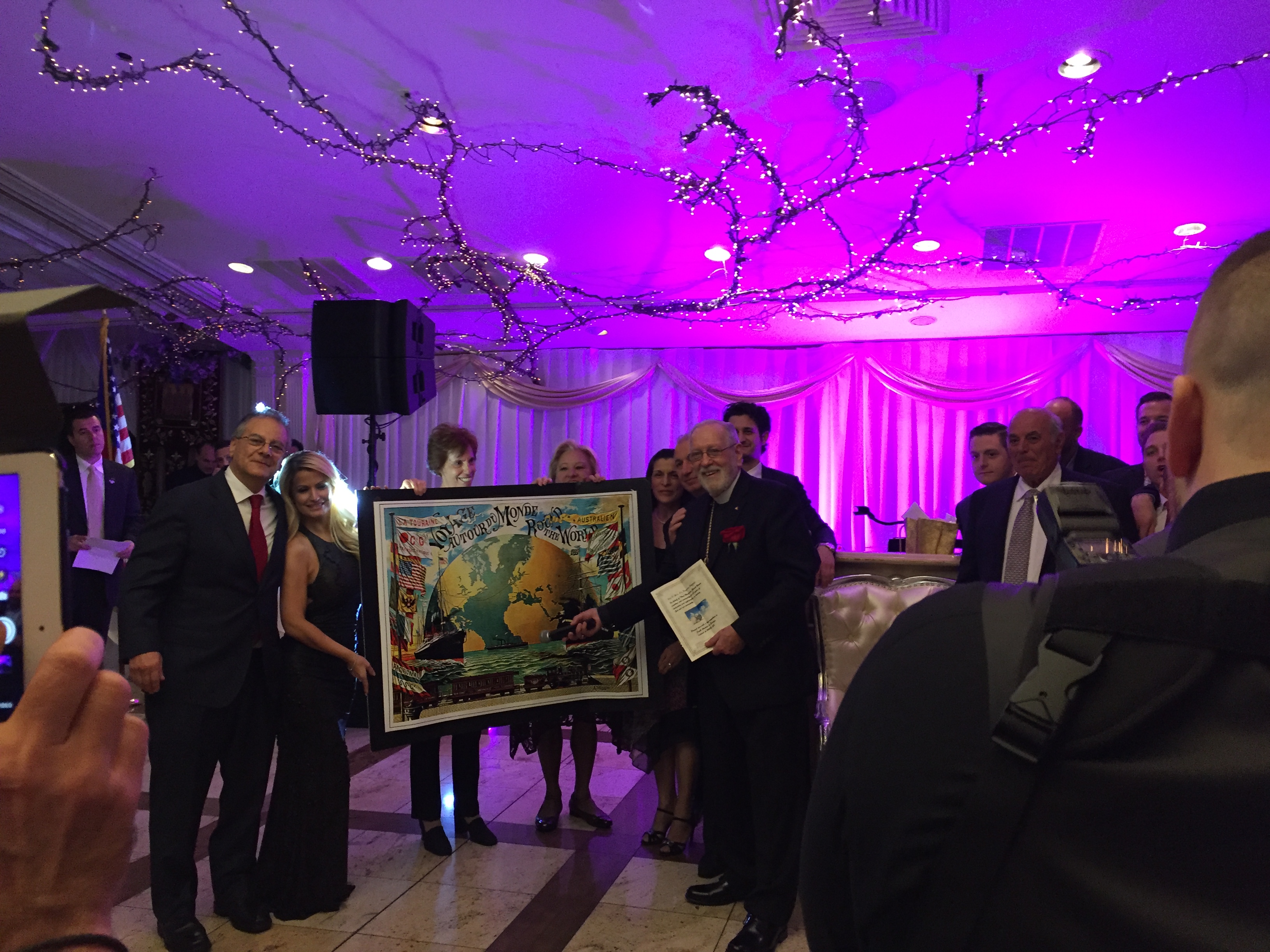
Father Eugene receives a gift from the parishioners of Three Hierarchs Church -- a trip to anyplace in the world he wants to go! Brooklyn, NY, December 2, 2016

Father Eugene receives a gift from the parishioners of Three Hierarchs Church — a trip to anyplace in the world he wants to go! Brooklyn, NY, December 2, 2016

The Genealogist’s Dictionary

At some point in the research process, most of us will have to leave the comfort of our native language and enter the new world of a foreign vocabulary. For those whose plunge is into a language which uses non-Roman letters, this can be intimidating and even scary. Because I spoke Greek before English and spent many restless childhood hours in Greek school, I thought my ultra-rudimentary grasp of the language would give me a good base to jump into Greek records. I was right–and I was wrong!

Reading old Greek handwriting and learning more sophisticated genealogical terminology was difficult. I continue to struggle. But, now there is a new and extremely useful booklet, The Genealogist’s Dictionary, which has been developed by my friend and fellow researcher, Gregory Kontos. The description reads:

One of the hardest aspects of Greek genealogy is reading and translating the old Greek records. Based on our team’s research experience, this dictionary was created to help English-speaking researchers translate and understand basic lines of an old Greek document. Using a wide variety of 19th century records, we managed to create a wide database of more than 400 words, which, expanding geographically and socially, wishes to cover the most crucial translational needs of a Hellenic genealogist.

This 24-page guide will help both the new and experienced Hellenic researcher. It is divided into two sections:

Part 1:  The Greek Alphabet, typed and handwritten; Numbers, cardinal and ordinal; Units of Time, days, months

Part 2:  Words and phrases for general records; school records; and professions/occupations

A sample page:

genealogists-dictionary

The Genealogist’s Dictionary is priced at $12.00 and is a pdf download from Lulu.com. The URL is: http://www.lulu.com/shop/gkfamilytrees/the-genealogists-dictionary/ebook/product-22958289.html

Gregory Kontos can be reached at: gkfamilytrees.wordpress.com, or on Facebook at: https://www.facebook.com/Gkfamilytrees.

I trust that this guide will be as great a help to researchers as it is to me.

Double Date

No, this is not a post about two couples going out for dinner or a movie date. It is, however, a description of something important that I learned this past weekend.

On Saturday, at the Greek Genealogy Conference held in Tarpon Springs, Florida, I taught a class entitled, “Using U.S. Records to Begin Greek Research.” In this presentation, I used numerous examples of records that may have information to help  find the original name of an ancestor (such as Papadopoulos, not just Pappas), and also the village of birth (very important, as records in Greece are cataloged by location).

I emphasized the importance of finding every record that could have possibly been created in the U.S. for an ancestor. The reason is that each document may have new or different information. When documents for a direct ancestor are hard to find, look for documents of siblings or other family members, and do your best to locate every piece of paper on which they could possibly be listed.

As an illustration, I used both civil and church marriage records for my maternal grandparents. This is the State of New York Certificate and Record of Marriage for Ilias Papagiannakos and Angelina Eftaxias; note that the date is May 10, 1914:

New York State Certificate and Record of Marriage, Ilias Papagianakos and Angelina Eftaxias

State of New York: Civil Marriage Record Louis Papagianakos and Angelina Eftaxia GROOM: age 32; occupation: oyster dealer; birthplace: Greece; father’s name: Panagiotis; mother’s maiden name: Caterina Eliopoulis BRIDE: age 20; birthplace: Greece; father: Constantinos; mother’s maiden name: Stafia Zaharopoulo. Joined in marriage at 358 West 44th Street, Manhattan on 10th of MAY 1914

This is the Greek Orthodox Marriage Certificate from Holy Trinity Church in New York for the same grandparents. Note that the date of marriage is:  27/10 April, 1914.

pappas-louis-angelina-marriage-certif-001

Greek Orthodox Marriage Record; Holy Trinity Church.   Of Agios Ioannis, Sparta, Ilias Panag. Papagiannakos and of Mistra Aggeliki Kon. Eftaxia married on 27/10 APRIL 1914 Best man: Christos Aridas FATHERS: Panagiotis Papagiannakos KON [Konstandinos] Eftaxias

As I described the differences between the civil and the church marriage records, I mentioned that I was puzzled by the “double date” on the church record. I did not understand the discrepancy between the two dates and what 27/10 April was referring to.

After the presentation, Adamantia Klotsa, Consul General of Greece, approached me and solved the mystery. She explained that the “double date” on the Greek certificate referred to the dates as they were calculated by both the Julian Calendar (27 April) and the Gregorian Calendar (May 10). There is a 13-day difference between the dates in these calendars, and the Greek record reflected both because Greece used the Julian calendar until 1922. With this marriage occurring in 1914, it now makes sense as to the correctness of the date as noted on the Greek Orthodox Marriage Record–the difference between April 27 and May 10 is exactly thirteen days.

Genealogy is never boring–there is always something new to learn!