My dear friend and colleague, Gregory Kontos, founder of GreekAncestry, was honored by Forbes magazine as one of “30 Under 30” entrepreneurs in Greece. This award brings me great joy. I have been friends with Gregory for over ten years and have watched him work with diligence and integrity to create GreekAncestry and guide it to its premier place in the genealogy community.
This is Greg’s announcement of his award:
I was extremely honored to be included in Greece’s Forbes Under 30 List released yesterday morning.
This is not an honor for myself only, but for the entire field of Greek genealogy, which is finally recognized as innovative and influential! We at Greek Ancestry will continue to serve our community and pursue our mission for high-standard genealogy research and access to genealogical data.
The official ceremony is to take place at the Athens Concert Hall on November 25 with Prime Minister Kyriakos Mitsotakis.
Here is an English translation of the text in the article:
DIGITAL GENEALOGY – Greek Ancestry “Gregory Kontos, with studies in migration history and a passion for Greek heritage, transforms forgotten archival traces of the past into a vibrant, global digital experience of exploring our genealogical history.
He began at the age of 15 by mapping his own family tree and, at 24, founded Greek Ancestry, the first Greek genealogical research platform that reconnects Greeks from every corner of the world with their roots.
Until recently, genealogical research in Greece was nearly impossible, as historical records were fragmented and inaccessible. In just five years, Greek Ancestry has radically changed the landscape: through pioneering collaborations with the General State Archives, the University of Athens, metropolises, and local communities, it digitizes centuries-old genealogical records — from civil registrations and church registers to family archives from across Greece. The result is a constantly growing database of more than 8 million ancestral names, spanning from the 18th century to today, and accessible worldwide.
From uncovering the ancestors of Jennifer Aniston and George Stephanopoulos for American television programs to documenting the history of Asia Minor refugees, Greek Ancestry modernizes and deepens Greek genealogy, revealing small, everyday, yet often astonishing stories of the past.
More than just a service, the platform is a global bridge “with roots”, reconnecting millions of Greeks of the diaspora with their history—using technology to preserve and showcase our cultural heritage for generations to come.”
Congratulations, Greg! Wishing you continued success as you advance the mission of Greek Ancestry, build its database of records, and help people connect with their Greek ancestral history!
UPDATE: December 22, 2025. Gregory’s interview on Greek television’s “Rush Hour.”
In the villages of our region, as in almost all the villages of the non-urban areas of the country, until the end of the previous century, their economy was and remained almost self-sufficient and based on exchange among the households as well as the craftsmen of the area. This meant that almost all the needs of homes and families were covered or met through the exchange of their agricultural and livestock farming products and through the exchange of labor and working hours among the residents.
Even the making and the use of “tools” that required specialized knowledge or skills were carried out within the communities of the villages (or in their neighboring ones) by self-construction and self-use. A most characteristic example was the loom which covered the entire process of design, creation, and making people’s clothing (the woolen garments), as well as the necessary bedding, coverings, and decorations of the houses.
Modern Greece Weaving Loom Greek History exhibit, Benaki Museum, Athens, Greece. Complete indexed photo collection at WorldHistoryPics.com.
Here we must refer to our multiskilled ancestors who learned from improvisation, experimentation, applications and improvements, to reach the rationality and the experience of perfection in their self-made constructions (…). Most of them practiced many and different professions (and crafts) at the same time. Giorgis St. Rigakos (or Stylianakos), for example, practiced in Goranoi until his eighty-fourth year, in old age, the professions/crafts of farmer, lumberjack, carpenter, floor-layer, cooper, basketmaker, house roofer, farrier, saddle-maker, tool and loom maker…
We must also mention the women of our villages who had -all of them- exceptional skills and endurance to be wives, mothers, and housekeepers, but also nurses, farmwomen, cooks, seamstresses, bakers, weavers, embroiderers, knitters… with imagination and lateral thinking.
Along with the self-construction and self-use of the loom, we refer in this note to the process of searching, testing, and selecting natural dyes for the threads/yarns from local plants and herbs, completing the making and artistry of the woven fabrics.
We must, of course, remember that up until the end of the previous century there were no such dyes available commercially in a variety of colors. But we must also correct the notion cultivated by many people that every substance (food, medicine, dye, cosmetic, …) that comes from nature is more effective and safer, without side effects, than the corresponding substances that come from chemical laboratories.
Their supposed “purity” (!?) should not be attributed only to their composition—since they consist of the same chemical elements and compounds as the commercial ones—but mainly, their dosage and other characteristics must necessarily be controlled, such as the pesticides, the environment in which they grow (temperature, rainfall, humidity, …), their processing, etc. The artisans of the dyeing industry learned empirically the secrets for achieving beautiful, bright, and -above all- indelible / unalterable colors resistant to light and washing.
Woven wool blanket on the loom. It was woven and dyed with natural dyes from plants around 1945 by our compatriot Valaso Solomou, daughter of Konstantinos, wife of Fotios Asimakopoulos, son of Ioannis.
The dyeing of the yarns, after they were washed (always in lukewarm water and with the homemade soap that each family made), was done carefully—coordinating the fire with the boiling—then spreading / wringing them in natural air and without strong sunlight, so that the dye would “set” and become uniform, but without the yarns becoming moldy.
First, however, they had to search for, test, experiment in practice, and select roots, leaves, but also barks and fruits of trees and wild herbs, to create the colors of the dyes they desired. All these were pounded, soaked overnight or boiled, strained, cooled, and afterwards poured into the water where the yarns were, and boiled for four to five hours. They often rinsed them with *alísiva* (lye).
For example, to get the brown color for the yarns (threads), they used husks from green walnuts. To get the dark walnut color or honey color, they added tobacco, while to get the sweet light brown of the ripe apple, they used leaves and soaked dry onion peels. For dark olive or khaki color (and oak color), they used dried acorns. For yellow, they used venetian sumach (Cotinus coggygria) and daffodils; for beige, bark of wild almond trees; while for red, roots and leaves of holly oak and heather. Finally, for dark blue, they bought (!) from the flower shops indigo (a mineral imported from China), which they washed in lukewarm water.
___
NOTE: In 2022, the Stavros Niarchos Foundation initiated a collaboration with the Cultural Society of Geraki to investigate and relate the story of the history of weaving in Geraki. The Geraki Weaving website has photos, videos, and descriptions of the project.
I (Carol Kostakos Petranek) am honored to receive permission from the Katsoulakos family to translate and share articles from The Faris. Translation verification and corrections have been made by GreekAncestry.net. This is the twenty-fourth article of the ongoing series. Previous articles can be viewed here.
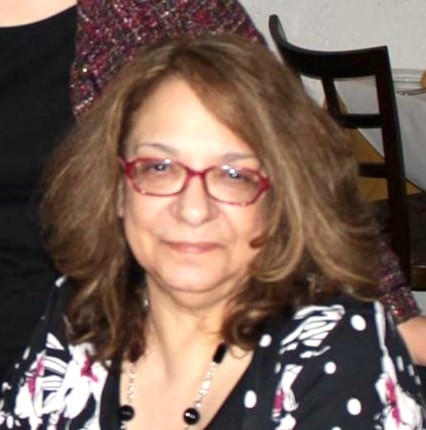
My dear friend and Greek genealogy colleague, Georgia Stryker Keilman, left earth suddenly and unexpectedly on January 5, 2025. Over the past fifteen years, we have collaborated and planned and worked together on many projects and initiatives to benefit our worldwide Hellenic genealogy community. We encouraged each other to keep moving forward on both our personal research, and on our individual and joint efforts to help people of Greek descent learn how to find their ancestral families. Words cannot describe my intense feelings of loss.
Georgia was a pioneer in the Greek genealogy community. On April 16, 2010, when Facebook was in its infancy, she conceptualized a group with a two-fold mission: a place where she could share information about Greek genealogy, and a forum where Greeks worldwide could help each other with their genealogy research. Her Hellenic Genealogy Geek Facebook group is now the meeting place for our community with an astounding 45,800 members (as of this date)!
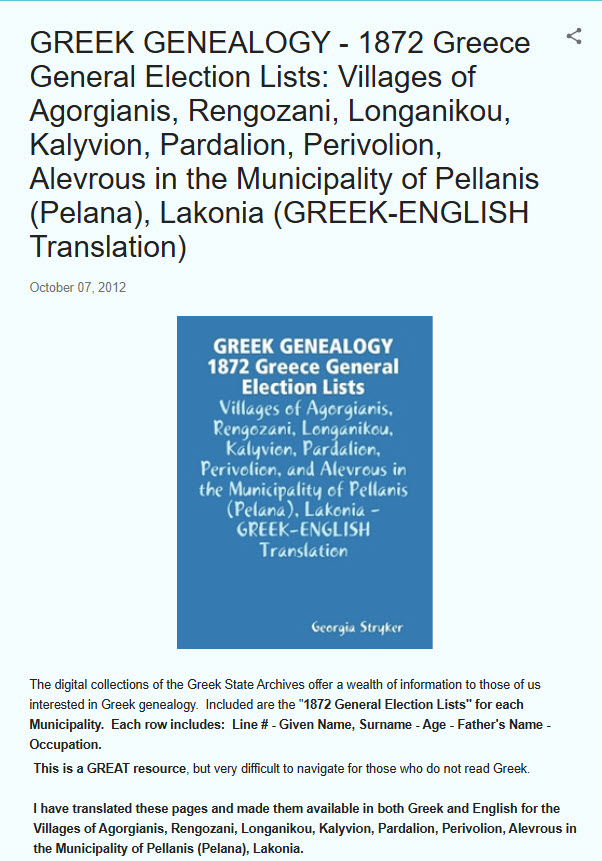
But Georgia did not stop there. She created a companion Hellenic Genealogy Geek Blog which gave her a narrative format to write about print, photographic and online resources. In 2012, Georgia discovered that Election Registers for the years 1872-1873 were online at the General State Archives of Greece website. She downloaded hundreds of pages and began transcribing the names from Greek into English. She published these lists on her blog and printed them in books, thus creating what most likely is the first online-accessible indexed records of Greek names on both the internet and in print.
The community’s enthusiastic response to Georgia’s work encouraged her to keep going. Her number of translated lists grew rapidly.
Georgia continued this work for several years, completing translations for the astounding number of 253 villages! She reluctantly “retired” from this project only when our friend, Gregory Kontos founded GreekAncestry.net. Georgia’s lists are still in use and remain online here. Their organization by village makes them especially useful, allowing researchers to easily identify family surnames specific to each village.
In 2021, Georgia felt it would be helpful for the community to have a website of Greek research links–a “one stop shop” of sorts, where people interested in a specific topic could find information without having to spend hours surfing the web. That’s when Hellenic Genealogy Geek Research Links was created. Our conversations for weeks centered on this project. Georgia spent countless hours combing through both the web and her personal data collections to compile and organize thousands of online links.
In addition to the Facebook group and her two websites, Georgia helped organize the first-ever in-person Greek genealogy conferences in the United States: April 2015 at Holy Trinity Cathedral Ballroom in New York City with Ilias Katsos and the Education and Culture Committee of the Hellenic American Chamber of Commerce; and September 2015 at the Hellenic Memorial Building at Holy Trinity Cathedral in Salt Lake City with the Hellenic Cultural Association and the Ethnic and Mining Museum of Magna, Utah. She and I worked together and rejoiced together at these historic events which enabled diaspora Greeks to meet, learn and share their passion for genealogy.
Georgia’s friendship with Gregory Kontos of Greek Ancestry was priceless–filled with humor, mutual appreciation and respect. She so enjoyed working with him to plan and organize Greek genealogy conferences and webinars; and to coordinate the first-ever podcast for Greek genealogy, “G(r)eek Talk.” Georgia’s analytical mind always predominated in these planning sessions, and we were confident that she would find any “hole” or missing piece in whatever was being considered. And she always did!
The most recent initiative that Georgia and I completed together was the video series, “Bite-Sized Greek Genealogy.” We noticed that new members of HGG were asking the same questions and decided that brief recordings would be an effective way to provide answers. We brainstormed topics and ideas, found relevant materials, and had many laughs in creating the series. When it was finished, Georgia suggested that we create a companion booklet which would contain the talking points of our videos as well as additional information and online links. She was always seeking ways to make something good even better.
These initiatives were on top of Georgia’s daily tasks: to administer the ever-growing HGG Facebook group, to continue to locate and publish information for her websites, and to work on her own personal research. The project of most importance to her personally was “Your Greek Roots,” a family history book she wrote in 2019. Dedicated to her nieces and nephews, it represents Georgia’s desire to ensure that her closest family members understand their heritage and never forget their roots. I can testify that compiling this book and contemplating its importance to her family brought Georgia immense joy.
“Excellence is never an accident. It is always the result of high intention, sincere effort, and intelligent execution; it represents the wise choice of many alternatives – choice, not chance, determines your destiny.” ~ Aristotle [Nicomachean Ethics]
Georgia’s intentions, efforts and choices led to her to devote this stage of her life to helping others. This is her legacy and for it, she will remain highly respected, deeply loved and forever missed.
Please see this wonderful article about Georgia which was published in NeosKosmos on February 26, 2018.
OBITUARY
Georgia Stryker Keilman, aged 74, passed away peacefully at her home on January 5, 2025, in Mount Prospect, Illinois. She is survived by her brothers, Tom and Peter, as well as her adult nieces and nephews: Alexandra (Daniel), Christine, Christopher (Lindsey), Steven (Kellie), George, Michael, Katherine (Zar), and Sergio. Georgia was also a devoted great-aunt to her beloved grand-nephews and nieces: Elijah, Isaac, Maddie, Evelyn, Jack, and Nina.
Born as Georgia Ann Stryker, she was the eldest daughter of Ann and George Stryker of Chicago, Illinois. Georgia’s warm personality and adventurous spirit shaped her remarkable life. She pursued a successful career as Director of International Marketing in the medical device industry, which afforded her opportunities to travel extensively. During her career, she lived in Boston, Massachusetts; Sydney, Australia; and Athens, Greece, before ultimately returning to the Chicago area to be near her family.
Georgia had a deep love for her family, a keen talent for research, and a genuine curiosity that inspired her to embark on a meticulous investigation into her family’s Greek genealogy. In 2009, she founded the online community “Hellenic Genealogy Geek,” a platform dedicated to sharing and exploring Greek ancestry. This community, which began as a passion project, eventually grew to include over 45,000 members from around the world. Georgia found immense joy and purpose in connecting Greeks in the diaspora with their familial heritage and ancestral roots.
Her contributions to the Hellenic Genealogy community are considered her life’s work. Georgia’s dedication to assisting people worldwide in uncovering and cherishing their family legacies is a lasting testament to her generous and inquisitive spirit.
Georgia will be deeply missed and lovingly remembered by her friends, family, and the global community she nurtured. A private family gathering will be held in her honor. Additionally, condolences and prayers from her online community will be shared at a memorial event hosted virtually.
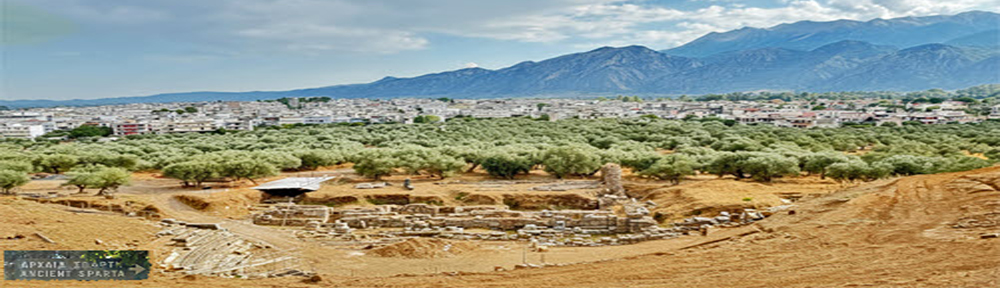
On Tuesday, September 3 at 6:00 p.m., I have been invited to give a presentation in Sparta, Greece on “Genealogy Tourism” (see news article here). My cousin, Georgios Kostakos, recently organized Sparta.Komvos, a group that hosts a variety of speakers and events that both educate and interest youth and modern Spartans.
Georgios asked if I could talk about the work I have been doing for many years with Spartan genealogy research. As I considered what could be of interest for this audience, I decided to help them understand the concept of Heritage Travel, or Diaspora Travel, or Genealogy Tourism — whichever term is used — and the opportunities it can bring. Businesses, artisans, shop owners and the hospitality industry could reap significant benefits by welcoming family historians.
We are a niche group with specific needs and expectations when we travel to visit our ancestral land. We want to find living cousins, go to the archives and research, understand our heritage, immerse ourselves in culture, and “walk where our ancestors walked.” Going to the beach and touring ancient ruins is a side note, not the purpose of our visit. I think it would be helpful for the Spartan community understand this type of tourism, and how they can prepare to help us researchers when we visit. The benefits that will come to them could be significant.
If you have suggestions to share with me that I can share with this group, I would love to hear from you. Please, send me a message and I will pass along your thoughts.
I’ll let you know how the event is received. Wish me luck! 🙂
My colleague, Georgia Stryker Keilman of Hellenic Genealogy Geek and I have embarked on a new venture: a series of short videos to address the most common research questions that people ask. Each video will address a specific topic and have an accompanying handout.
Our first videos are available now. The first is “Tips about Names and Villages” with information that we wish we had known when we started our research.
The second is “How to Find Your Grandfather’s Greek Name” which shows a wide variety of records that will give you this information. Trying to find ancestors in Greece without the original Greek surname is virtually impossible.
The third is “How to Find Your Ancestor’s Village of Birth.” This can be tricky, as many people gave just a county (prefecture) or the nearest city, rather than their exact village.
Be sure to download the handout for each video, which can be found in the Description area below the video.
We will be announcing more recordings over the next few weeks. We hope they will be helpful to you!





 Spartan Roots (Σπαρτιατικές Ρίζες)