The birth of a child used to occur in the house in the presence of the midwife, a respectable person of the local community. In cases where labor presented difficulties, a doctor intervened and sometimes took the child with “spoons” [known as forceps].
The midwife, the mother-in-law, and the mother burned incense to icons so that God would help with the birth. Primarily, they invoked St. Stylianos, protector of children [paretymologically from stelos, (verb stelono), which is a strong pillar or beam]. They believed that the diet of the mother should be very light. She usually ate chicken soup with angel hair pasta and oregano or boiled greens.
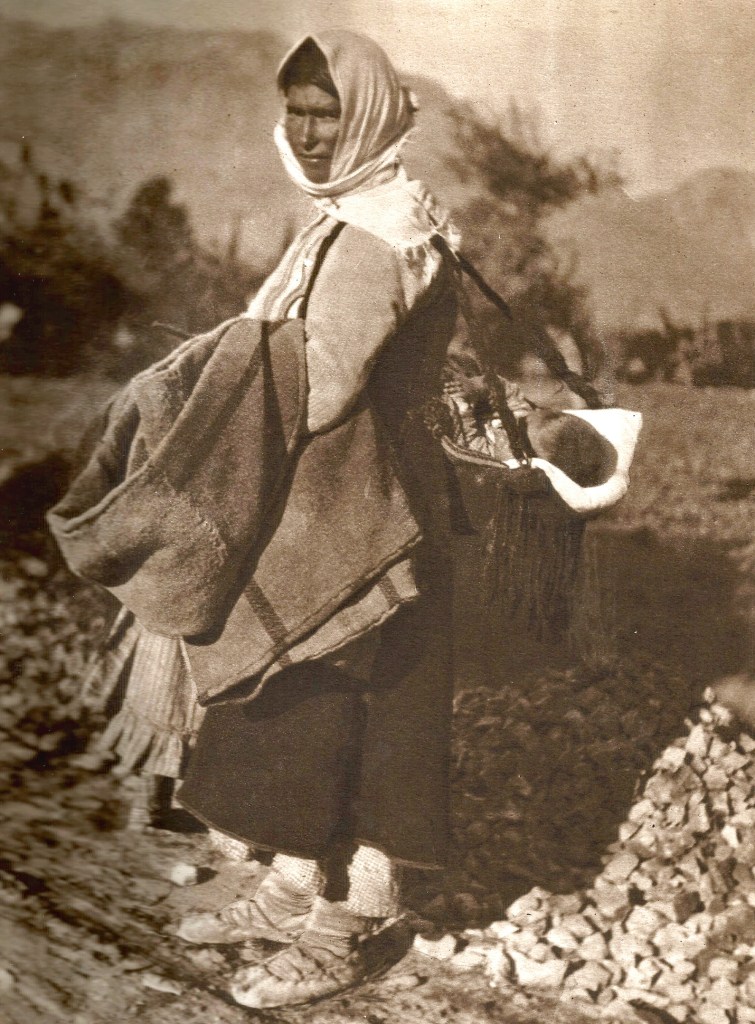
Spartan Woman in Field, 1929 by Francesco Perilla Wikimedia Commons andLakoniki Bibliothiki Χωρική της Σπάρτης 1929. Στον ώμο έχει την νάκα με το μωρό Από το βιβλίο του Francesco Perilla, Mistra. Histoires franques-byzantines -catalanes en Grèce = notes d’art et de voyages (Athènes 1929)
Immediately after the birth they did not wash the baby, but cleaned it with cotton that was saturated with warm water and put powder on it. For the first bath of the baby, the midwife put salt in the water, so that the child would not become “unsalted”, meaning probably insipid, bland. The new mother was not supposed to left alone in the house, at least for three days, as it was believed that new mothers, because of the impurity of childbirth, were under the influence of demons.
It was believed that on the third day after the birth, the Fates would come to determine the child’s luck. In many places, in order to appease the Fates to predict a fate of good fortune for the child, a plate of bread, honey, nuts and sweets would be placed by the mother’s bedside so that the Fates could take it themselves. If it was necessary for the mother to be left alone, they would place under her pillow incense, bread, an icon, a cross, a holy flower, a bit of holy water or a little kid by her, because of the belief that small children have a deterrent power.
When the baby was forty days old, the midwife would take it together with a small child and they would go to the church to get blessed. If it was a boy, he would be taken to the chancel (the altar area). The baby was usually swaddled so it would not hunch and it could stand upright and strong. For the best wishes, they made sweets, diples if it was a boy, in order to double itself or kouriambiedes and ravani for the girls. Relatives brought sweets or a silver coin.
The couple usually preferred to give birth to boys, so that the family (soi) could continue (male preference). Instead, girls needed a dowry and a lot of attention during their upbringing, so they had to live with limitations so as not to be given a bad name. Many customs are common in many regions of Greece and some of them have their roots in antiquity.
I am honored to receive permission from the Katsoulakos family to translate and share articles from The Faris. Translation verification and corrections have been made by GreekAncestry.net. This is the fourth article of the ongoing series. Previous articles can be viewed here.
by Nicholas Bourazelis, Colonel (retired) Published in The Faris Newsletter, October 2020, issue 27, page 17
No marriage was made for love, it was made through matchmaking and mediated by a woman, the well-known matchmaker. Along with the parents of those who were to be married, the symbetheri (parents-in-law) as they were called, arranged all the details, the dowry to be given, etc. When the agreement was finally reached, it was drawn up and signed by the parties concerned. The father of the groom paid the matchmaker, and the work of the matchmaker was over.
A peasant bride, in splendid gold adorned costume, at the annual religious feast, Mandra, near Eleusis, Greece. Library of Congress Prints and Photographs Division, Washington, D.C.
When night fell, two or three shots used to be fired at the groom’s house. This custom was intended to inform the villagers that the match, which they had suspected, had come to a happy end. Engagement ceremonies followed in a short time without any particular formality. They simply exchanged the rings.
Finally, the wedding took place. However, since one of the betrotheds did not come from the same village, the relatives of the groom usually went to the other village to pick up the bride. A convoy of men wearing fustanellas was then formed. All the guests rode on mules and horses. In psyki, as the procession was called, they did not use donkeys. The animals’ bodies were covered with white mandani (blankets), the kilimia (woven blankets). The procession began with songs. As the first wedding song, it was customary to sing: “Let my eyes see, let my eyes see how my love is doing.” With songs, joking and cheerful conversation, they came to the bride’s village.
In front of the village church the bride-to-be and her father were waiting. When the bridegroom arrived, the prospective bride’s father would kiss him and hand over his daughter. The priest would then take the couple and bring them to the middle of the church where the ceremony would take place. During the “Isaiah dance,” the guests showered the newlyweds with rice, flower petals and confections. The atmosphere was joyful and happy. The sacrament was over and the newlyweds received the embraces of those present with the wish: May your life be lucky and happy.
The company then, with the bride on a decorated horse, was on its way back. The singing by men and women continued all the way to the groom’s house. There the bride was welcomed and the dance began, which was started by her, while everyone sang together: “My fortunate bride, may you live, may you grow old, may you live to be a hundred years old and more.” The feast continued with rich food and drinking until the early hours of the morning. That is how the marriage ended.
What happens today? Time has changed a lot. Life goes on with all the changes. This is not a concern, as long as the couple has mutual love. Otherwise, divorce follows with all the consequences. Mutual love leads to a peaceful old age.
I am honored to receive permission from the Katsoulakos family to translate and share articles from The Faris. Translation verification and corrections have been made by GreekAncestry.net. This is the third article of the ongoing series. Previous articles can be viewed here.
by Georgia Th. Tartaris published in The Faris Newsletter, December 2020, issue 73, pages 22-23 Note: Footnotes in the original publication have not been translated.
This photo is a little treasure. We are lucky when such small treasures come into our hands and connect us with loved ones and things of another era almost forgotten.
The person depicted in the photo is Emilia (Milia) Moutoula (1860-1940), wife of Vasileios Laskaris. She lived in the neighborhood of Laskaris, in Agia Lavra, Xirokampi. An unfortunate woman, she lost her husband early and was widowed, struggling under adverse conditions to raise her daughter Stavroula and her son Vassilis, who as a young child left for the USA, where he became successful. Later, she lost her daughter as well and supported her granddaughter Eugenia. She used to help people in need and was much loved by the villagers, who welcomed her into their homes to offer her coffee and to tell them stories about Koumousta and Xirokampi. Her name is engraved on the plaque of the benefactors of the Holy Trinity of Xirokampi, which has been posted in the narthex of the church. The photo was sent from Philadelphia, USA by her great-granddaughter Melissa Laskaris, daughter of Anastasios.
Emilia (Milia) Moutoula (1860-1940), wife of Vasileios Laskaris of Xirokampi. Photo courtesy of Melissa Laskaris Stolarcyz, Milia’s great-granddaughter.
The old woman Milia is wearing a headscarf, a sack jacket and a half-skirt (or petticoat), as worn by many women of our region. The headscarf was tied in various ways: sometimes in front of the neck, sometimes behind it and sometimes behind and tied high on the head, to the side.
On top they used to wear the sack jacket, which looked like a shirt. It had buttons on the front, usually covered by a small strip of fabric, known as “patileta” to make them invisible. Underneath they wore the half-skirt or petticoat. It had a pleated sash and was tied at the side of the waist. The more fabric a woman could afford to buy, the more pleats in her half-skirt. The sack jacket fell over the half-skirt and reached to the hips.
Stavroula and Polyxeni Laskari from my own neighborhood, but also my grandmother, Georgia Tartari, née Laskari, wore the same clothes except that their skirts had fewer pleats.
I remember most of them being dressed in black; elderly women, holding onto their mourning. I remember that relatives of my grandmother’s, who were not widows, were dressed in brown. Aunt Malamo from Koumousta, who was unmarried, wore brown, as well as my great-grandmother, Artemis Mandrapilia, née Kapakos from Paliochori, married in Koumousta, who died young when she fell from a mule. I did not meet the latter, but my mother, who used to sew, often mentioned her own grandmother’s clothes.
My grandmother’s clothes were sewn by my mother. Certain women sewed clothing by themselves; others used to go to the local seamstress. The fabrics were not woven. They were purchased from the village merchants. In Xirokampi there were commercial shops: the shops of Liakakos, Theofilopoulos, Stergianopoulos. Woven clothes were worn by the older women, that I did not have the chance to meet, like my great-grandmother, and this was the difference that made my mother refer to her own grandmother’s clothes. One of the last women to keep this way of dressing was Aunt Liou Xiropodi and Panagiota Karkabasi (Karaskoutaina).
The changes in everyday life, the progress and evolution of society were factors that influenced the way people dressed. Over the years, women’s clothing changed drastically. The entry of women in a massive way into manufacturing in all sectors of the economy, the change in the family unit, and the release from prejudices and other forms of oppression fostered a new dress code for women, which was adapted to their needs.
The knowledge of the elders’ lifestyle and the transmission of this knowledge helps us to understand the evolution of society, but also the necessary changes to improve our own ways of life. All of us, more or less, have something that connects us with the past: a photograph, a piece of clothing, a tool, a piece of furniture. We are the bearers of history and its continuators. Let’s pass it on to the next generation.
I am honored and humbled to receive permission from the Katsoulakos family to translate and share articles from The Faris. Translation verification and corrections have been made by GreekAncestry.net. This is the second article of the ongoing series.
Those with ancestral ties to the modern municipality of Farida, Lakonia (villages include Xirokampi, Palaiopanagia, Anogia and several others) are immeasurably enriched by the writings of scholars from the area. The publication, The Faris, History, Folklore, Archaeology (‘Η Φαρις), has been produced semi-annually since 1966 and contains many hundreds of articles about the people, history, folklore, archaeology and culture of the region. An appendix in each issue includes notices of births and deaths of local residents. The publication was initially known as The Xirokampi and maintained that title from 1966 to 1977, when the name The Faris was adopted.
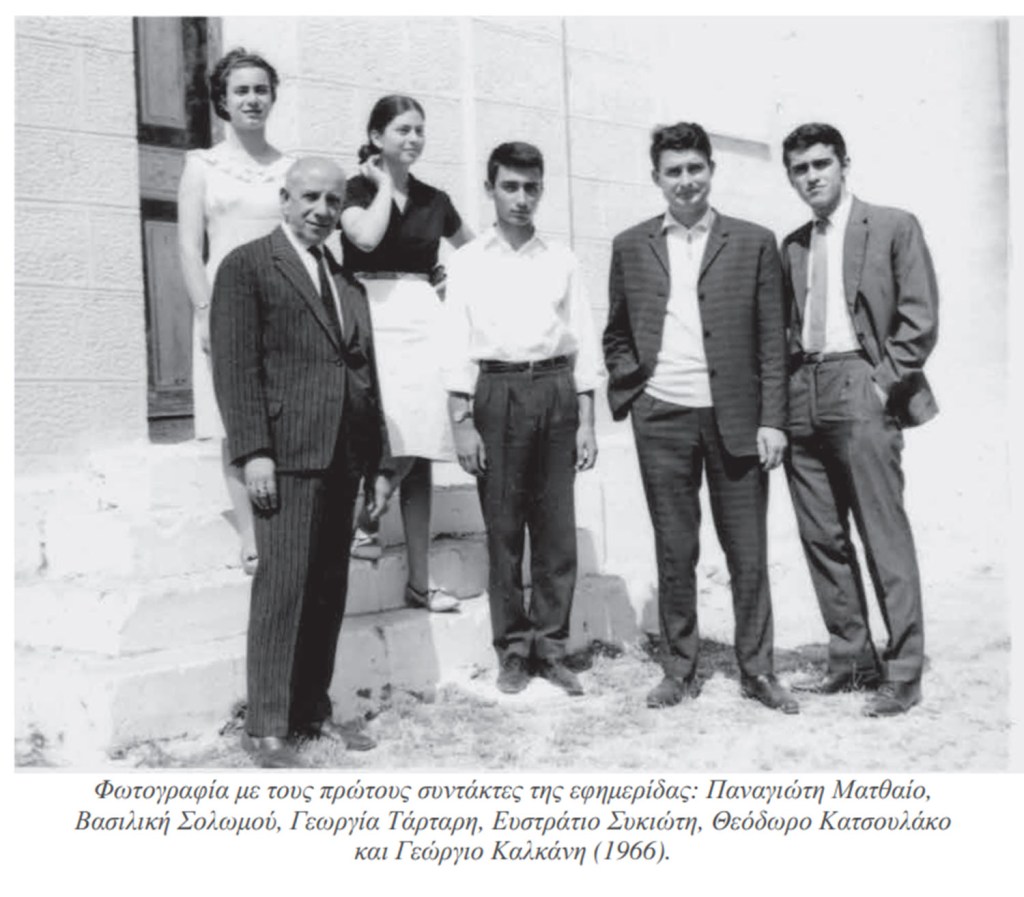
Those who write for The Faris descend from local ancestral families and know its past well. The founding editors, pictured below in 1966, were: Panagiotis Mathaio, Vasiliki Solomou, Georgia Tartari, Efstratios Sykiotis, Theodoros Katsoulakos, and Georgios Kalkanis. The current editorial committee is: Georgios Th. Kalkanis, Theodoros S. Katsoulakos, Panagiotis H. Komninos, and Ioannis Panagiotis Konidis. These, and dozens of other authors, have made Τhe Faris periodical a vital and unique resource to study the people and times of rural Lakonia.
The founding editors, from the 50th anniversary issue of The Faris, April 1996: left-right: Panagiotis Mathaio, Vasiliki Solomou, Georgia Tartari, Efstratios Sykiotis, Theodoros Katsoulakos, and Georgios Kalkanis
All issues of TheFaris can be accessed here. This link is to an index of articles from 1966-2001. This link is to the e.faris website.
I am honored and humbled to receive permission from the Katsoulakos family to translate and share articles from The Faris. Translation verification and corrections have been made by GreekAncestry.net. This is the first article of the ongoing series.
The Endings in -akis and -akos of the Surnames of our Region author: Theodoros S. Katsoulakos
The writing of a historical study presupposes the existence and substantial utilization of evidence and historical sources. However helpful the assumptions may be, if they are not supported and confirmed by direct or indirect evidence, no opinion can be substantiated or founded.
In our area, the wider region of the municipality of Farida, if one excludes a few monuments, remnants of the distant past, few writings have remained from the years of the four centuries of Turkish rule. The latter is explained if we take into account the low (intellectual) level of the Greeks of the time and the bloody struggle for the liberation of the country, during which everything that was left was destroyed.
Fortunately, the monasteries saved some written sources of the Turkish Occupation: their contribution in this field as well was undeniable. In particular, a number of documents from this era are preserved in the monastery of Zerbitsa. Some of them are from the 17th century and more from the 18th century. These are notarized sales, exchanges, wills of monks of Zerbitsa and Gola. The monastic zeal protected the assets from various schemes in moments especially of anarchy and fear. It is surprising and impressive, of course, how these historical documents reached us, while it is known that the monasteries of Zerbitsa and Gola were attacked, suffered disasters, and their administrative status changed.
The language in which these witnessed agreements are written is Greek, with a standard that is an amalgam of colloquial language and elements from the legal and religious tradition. This means that this bipartite contract concerned the Greeks and was of value only to them. From the study of many jurisprudential documents of the monasteries in the region, it emerges that there are very few Turkish words that had infiltrated and these concern terminology closely related to the financial interests of the conqueror, such as mulkia, from the Turkish mülk, meaning private property, lakas, possibly a Persian word (alaka), meaning share, and amanati (bequest), which survives to this day.
The documents and various records are reliable witnesses of the presence of the families in our place, such as: Komnenos (1465, 1762 onwards), Goranitis (1634), Laskari (1634, 1751 onwards), Aliferis (1698), Menouti and Sahla (1751), Meropoulis (1753), Karadontis (1754), Konidis (1754), Stoubou (1754), Koutsika (1757), Theofilakou (1757 and 1776), Tsaggari (1757), Niarchou (1759), Moutoula (1760), Rizou (1761), Papastrati (1764) Fragki (1764) Mathaiou (1769) Kalkani (1789) Vourazeli (1795), Psyllou (1796), etc.
Of great interest is the information provided by the documents regarding the diminutive endings in -akis, which are proportionally more than the corresponding endings in -akos.
After 1830, the ending of -akos began to prevail in the region. Useful conclusions are drawn from the study of the report of the local notables of the region to the Holy Synod (1835). It is noteworthy that only one surname was found ending in – æas (Niareas 1826).



 Spartan Roots (Σπαρτιατικές Ρίζες)