Faris at the Library of Congress

I am so pleased to share exciting news that the Faris (Φαρις) newsletter of Xirokampi, Lakonia, is now in the Library of Congress, Washington, D.C. Archivist Nevila Pahumi, who oversees the “Greece and Cyprus” collection in the European Reading Room, enthusiastically received the printed copies for the years 1979 to present. Earlier copies (1966-1977) which were published under the title Xirokampi, will be reprinted and donated at a later date.

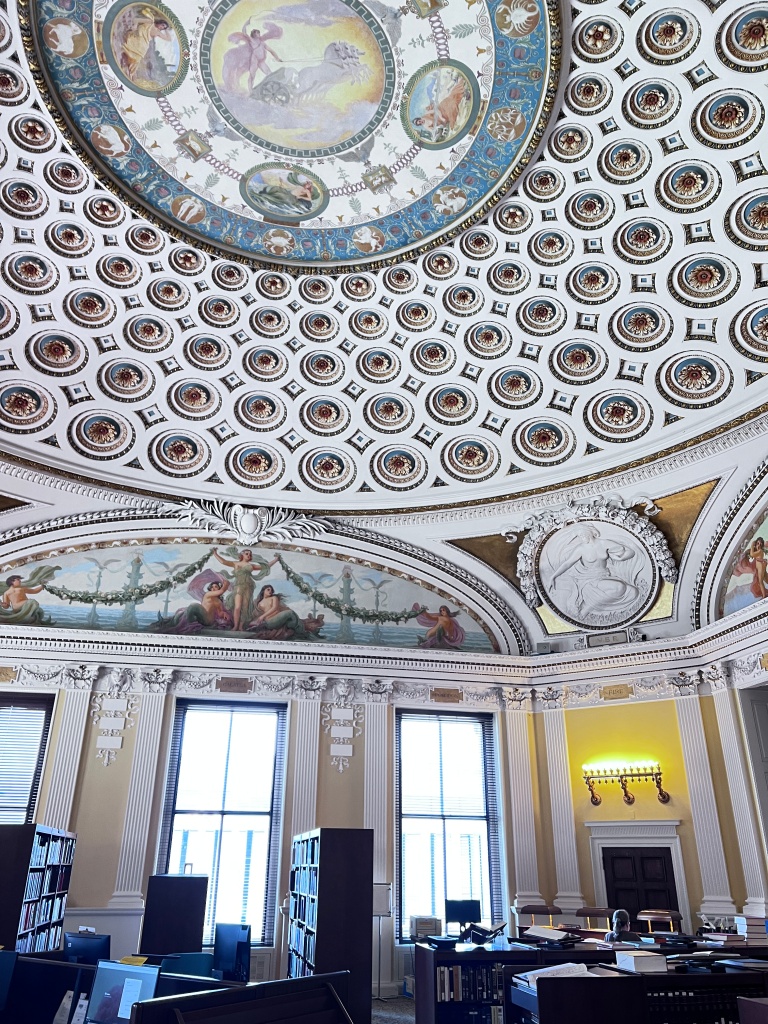
Nevila Pahumi welcomes the donation of Faris, July 18, 2023

Last month in Athens, Dimitris Katsoulakos brought me forty-four years of printed editions of Faris. It was a thrilling experience to bring these back to the U.S. and donate them to the Library.  Ms. Pahumi explained that it is quite difficult for the Library to obtain printed copies of publications that are created at the local level, especially from rural villages. “We are very happy to have it in our collections, so that generations of future users can access it in both physical and digital form. The ability to service it to users in both formats increases the likelihood that they can work with the historical and more current issues. This kind of primary resource is invaluable, and I thank you for personally bringing it in all the way from Xirokampi.”

Faris is unique because its contents are not only empirical research, but also — and more importantly — it has captured oral histories and first-person accounts of village life and historic events. People who are conducting research about life in Greece will use Faris as a prototype of village life. It is exciting to think of our village of Xirokampi as being a primary source for academicians worldwide!

To access digital copies of Faris, click here. I am honored to have permission to translate and republish selected articles from Faris on an ongoing basis. These posts can be found here.

European Reading Room at the Library of Congress, Washington, D.C., July 18, 2023

If you know of other publications from Greece which could possibly be donated to the Library of Congress, please email me. Ms. Pahumi is seeking to expand the Greece collection.

While at the Library, I also brought copies of the family history books that I have written about my maternal and paternal grandparents. These were donated to the Local History and Genealogy Reading Room. Please note: the Library gratefully accepts ALL books which are biographical, family history or local history. They can be mailed to:

Library of Congress
U.S. Special Acquisitions Section – RG
101 Independence Avenue, SE
Washington, DC 20540-4275

The archivist suggests sending books via UPS or FedEx, not U.S. Mail, because the U.S. Post Office irradiates all incoming mail which could permanently damage or destroy books. If possible, also provide the carrier’s name and tracking number.

The Smells of Parcels from America

written and translated by Stratis A. Solomos
published in The Faris Newsletter, Issue 77, December 2022, page 6

During the 1950s and early 1960s, immigrants to America and Canada wanted to help Greece, which was poor at the time. They sent, especially to their relatives, parcels containing various useful items, generally clothes. It is not certain whether this aid was essential to the then rapidly economically developing petty-bourgeois society, but it was certainly welcomed by the poorest. These parcels mainly contained clothes and objects that had new and rather pleasant smells.

The strongest smell was that of clothes. The explanation for most was that they had been disinfected, which reassured those who feared germs. But the reality was that this smell was due to the synthetic fragrance of modern detergent powders, which had been used to wash them. They were still unknown in Greece. They did not arrive until the end of the 1950s. The first and most widespread was the American Tide. Along with this powdered “soap” also came the American “soap-opera,” a long-running sentimental radio and later TV series. The first such Greek soap opera was “Πικρή μικρή μου αγάπη” (My Bitter Little Love), the endless sentimental story of Alexis and Vana, played by Stefanos Linaios and Elli Fotiou.

The parcels were usually sent by relatives. In addition to clothing, they also contained other items, often unknown in the villages. Chewing gum with new flavors and aromas. Toothpastes which it is said that some people, who did not know their use, tried to eat!

My father and teacher Alexander Solomos, who also did educational research, received beautifully bound American elementary school books. With these books, he taught me my first English lessons. These books also had a particular smell, which has since remained an indelible and pleasant memory. I don’t know what caused that smell, perhaps the binding glue used. I rediscovered this smell in my teenage years when I frequented the American Library of Athens and later read American science books.

Sometimes there were also more valuable items like watches, which after consultation were carefully hidden in certain pockets, but most of the contents were clothes of all kinds. Taffeta ball gowns and hats for women. Suits for men. Colorful Hawaiian shirts and plaid pants. Belts with large cowboy buckles. Jackets that featured monstrous comic book characters on the back. With the exception of a few young people from the big cities, American fashion had not yet reached the conservative Greek society of these times. Few dared to wear them, except perhaps during Carnival. T-shirts with visible inscriptions and brands were only seen in the cinema. So it was very funny to see a Greek peasant picking olives wearing a Harvard University t-shirt.

The skillful seamstresses and several equally competent housewives did wonders to transform the eccentric American gowns into dresses compatible with the European fashions of the time propagated by the women’s magazines Ρομάντζο (Romance), Θησαυρός (Treasure) and Γυναίκα (Woman) . The men’s suits, those whose fabric was not too colorful, were transformed by our local Xirokambi tailor Charalambos Arabatzidis. These clothes weren’t worn very much. They were often new. But they were still deliberately wrinkled and a few buttons were removed to make them look second-hand. It seems that there were special customs exemptions for these aid parcels with used clothes. Later, when American jeans, jackets and cowboy boots became fashionable, some shrewd traders devised the ploy of passing off imported goods as packages of “gifts from America’s uncle “.

___

I (Carol Kostakos Petranek) am honored to receive permission from the Katsoulakos family to translate and share articles from The Faris. Translation verification and corrections have been made by GreekAncestry.net. This is the twelfth article of the ongoing series. Previous articles can be viewed here.

The Field Guard

by Dimitrios G. Prevas, Palaiopanagia, February 7, 2011

Published in The Faris Newsletter, Issue 54, July 2011, page 20

There’s a scientific principle that any gap that is created in nature is inevitably and typically filled by other elements of inferior quality. We all tend to forget this when old values are abandoned or lost.

The field guard is also one of the old values, who protected the land, the countryside, the outdoors that is now unguarded and where countless outlaws roam freely, terrorizing the elderly, taking their wages, stealing everything, whatever they can find: lambs, chickens, kettles, irrigation valves, with a great risk of killing you or, you killing them and going to jail.

Every village used to have a capable field guard, the protector of nature. Every day, alone but also with other field guards, he roamed the land, a vigilant sentinel, observing everything in his grey uniform with boots and a hat, like a constable.

A juvenile Greek shepherd guarding his flock; photo courtesy of the Library of Congress; http://hdl.loc.gov/loc.pnp/stereo.1s26252

And although before you saw him passing, in another part of the village you heard him whistling. He was a fickle person, an excellent tracker who could find any trace, even in the mud or dust. He investigated the tracks and acted accordingly. He knew the owner of every field, the flocks, and every estate whether it was sown, fallow or obstructed. He settled the villagers’ disputes and always made a proper assessment of their damages. At night he conducted raids, frequently patrolling and setting up several ambushes, and even staying up all night. So, no one would dare to break the law because the invisible guard would punish fairly. He did his job right and the farmers acknowledged him. Well done, they said to themselves, and they slept peacefully. The field guards guarded the outdoors which is now unguarded and countless outlaws roam freely. They terrorize, burn and loot. This phenomenon is in great need of the government to address it. When you guard yourself from all danger, then you will learn to guard ordinary citizens as well.

Aristotle had said that, when there are law-abiding citizens, there is no need for the state. For this reason, the real power must institute draconian laws to secure order.

Field guards I have known:
Anogeia: Petros Vivliotis, Leonidas Stathakos, Christos Menoutis.
Palaiopanagia: Vasilis Kourniotis, Dimos Giannopoulos, Giannos Smyrnios, Panagiotis Perentesis, Pavlos Mylonas.
Trapezonti: Evaggelos Asimakis; Achilleas Miridis, Dimitrios Roumeliotis.
Xirokampi: Georgios Kalogeras, Athanasios Vergados, Giannis Mpouzas.
Kaminia: Apostolos Kritikos.
Gorani: Evaggelos Katounas.


I am honored to receive permission from the Katsoulakos family to translate and share articles from The Faris. Translation verification and corrections have been made by GreekAncestry.net. This is the eleventh article of the ongoing series. Previous articles can be viewed here.

“Light-Water-Telephone” in Xirokampi (Part 3 – Telephone)

by George Theoph. Kalkanis

published in The Faris Newsletter, Issue 62, July 2015, pages 3-6

(Note: this post, “Telephone” is the third of three parts describing the earliest modern developments in Xirokampi. Part 1: Light, can be read here; Part 2: Water, can be read here.)

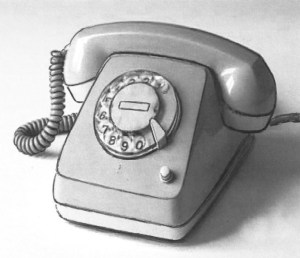
The OTE telephone network entered the houses and shops of the village in the late 1960s and early 1970s. OTE, founded in 1949, succeeding the 3Ts (Post Office [“Tachidromio”] – Telephony – Telegraphy), then began to install telephones connected to automatic dialing systems. The systems for each rural area were operated in the, so-called, Rural Telephone Centers.

In Xirokampi the center was housed for a brief time in the post office that was installed on the ground floor of the house of Dimitris Xanthakos and was to serve the telephones of the inhabitants of the villages of the whole area. The first employee and supervisor was Georgios Evag. Karampelas, who took over all the operations related to telephone and telegraph communications. Then the center was relocated to the ground floor of Ilias Kapetanakos’ house. Panagiotis Il. Komninos and Vassilis Il. Christopoulos also worked at the center temporarily, before Efstratios Ioan. Kritikos was hired as a permanent employee.

In the past, telephones were operated by means of manual systems, whereby the selection of telephone connections was made by means of plugs that operators/answering staff inserted into holes in a panel. They measured with mechanical timers the duration of calls as well, while calls required the turning of a small ‘crank’.

Photo credit: Library of Congress. Kansas City, Missouri. Private branch exchange (PBX) operator at her switchboard in the freight depot, photographer: Jack Delano; created 1943. https://www.loc.gov/item/2017847312/; accessed March 16, 2023

The office of Xirokampi was connected through a telephone line to every neighboring village. Even earlier, communications were made from station to station by telegraph or teletype, which in Xirokampi were originally installed in the house of Sotiris Papadakos (or Kokkinos).

Automation, the expansion of the telephone network and the proliferation of telephones caused (also) in our villages, for some time, an upsurge in pranks among the residents. In Xirokampi, coffee shop waiters would move around with trays throughout the market after telephone orders turned out to be pranks. Also, some people woke up one night after a call from the headquarters – supposedly – of OTE and cut the wires of their phones when they were warned of an imminent explosion of their device (!). However, at the same time they enabled family members who were away – especially abroad – to talk more often and more privately (since the privacy of telephone conversations was not guaranteed by the – very little – soundproofed ‘booths’ in call centers). But they also reduced the frequency of the letters they exchanged, as the postal employees of the time (Dimitris Georgountzos, Georgios Katsaros and Kleomenis Anastasakos) found and claimed.


I am honored to receive permission from the Katsoulakos family to translate and share articles from The Faris. Translation verification and corrections have been made by GreekAncestry.net. This is the tenth article of the ongoing series. Previous articles can be viewed here.
“Light-Water-Telephone” in Xirokampi; Part 2: Water

by George Theoph. Kalkanis
published in The Faris Newsletter, Issue 62, July 2015, pages 3-6

(Note: this post, “Water” is the second of three parts describing the earliest modern developments in Xirokampi. Part 1: Light, can be read here.)

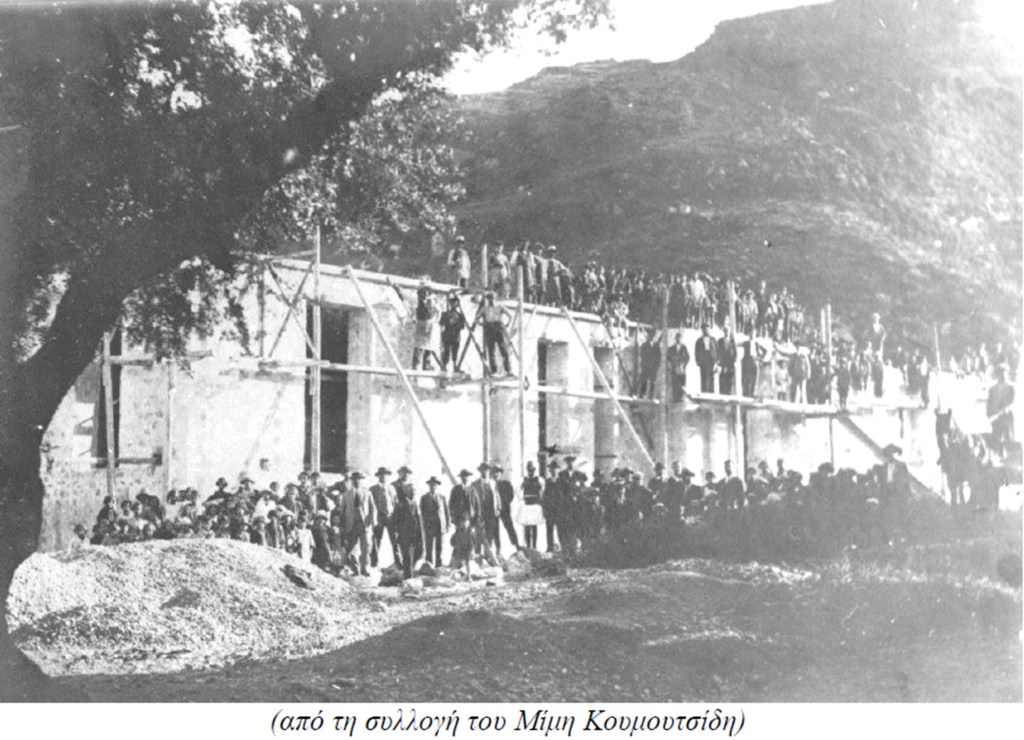
The construction of a complete network of drinking, running water with pipes in the village was attempted and completed in the 1960s or even the early years of the 1970s, during the presidency, initially of Georgios Koumoustiotis and then of Nikolaos Koumoustiotis. It was preceded by the construction of a small stone tank, under the presidency of Ioannis Karambelas and Efstratios Skouriotis, at the highest point of the village, at the exit of the Anakolo gorge. There, the water was collected with metal pipes from many small springs – such as Sotiritsa – that were expropriated by the state.

Initially – in 1953 or 1954 – “public” taps with brass spigots were installed in central points and in the large neighborhoods of the village. The network, made of metal pipes, did not supply these taps with water around the clock, due to its inadequacy. Thus, the sight of long lines of women with buckets, jugs  or pitchers and wooden water barrels (. . . ) was a daily occurrence, from dawn. It was there that the women informed each other about the news of the village. 

However, the public water fountains made the life of the villagers so much easier, that today’s children cannot imagine. Until then, the transport of drinking water was carried out by springs [“αμπουλάδες”] which gushed with a natural flow in the banks of the Rassina, from a small spring on the right bank of the Anakolo – at the height of the “Komnini” small lake; but also (after the middle of the 19th century) from wells dug in the village, at a depth of 4 or 5 meters, in various places: Iatrideika, Feggareika (of Kalamvokis or Magganiaris), Volteika, Poulakeika, Rassina (of Aivaliotis), Liakeika … All of the wells were communal. Of course, with the operation of the wells, the springs gradually dried up, since the underground water level went down due to constantly increased consumption, especially during the 1960s.

With the completion of the network and the replenishment of the reservoir, water reached every house in 1961 and 1962. But the process was long, arduous and costly. Trenches in the streets had to be opened with a pickax and a shovel. Pipes had to be bought, transported, placed and connected together. Then, the local handymen worked as plumbers in the public network and in the networks inside the houses:  Giannis Chatzigeorgiou, Stavros Argyropoulos, Michalis Tsapogas and Elias Christopoulos. To deal with the large expenditure, the community rulers resorted to the then common measure of compulsory (co-)contribution from the inhabitants – alternatively or additionally – of money or oil, personal labor or the labor of their animals for the transport of the pipes and materials. Each family was estimated to bear the cost of 10 meters of the network.

The consequences of the construction of the water supply network were, of course, crucial for the quality of life of the inhabitants, but they also had secondary, controversial results. Horticultural production increased, but it was also necessary to transport water even from Taraila, bypassing the route of centuries and reducing the underground water. Undoubtedly, however, the project was large and innovative for its time, it improved the life of the inhabitants and attracted new residents from the surrounding villages, being one of the strongest incentives for them.

Part 3 of this series, The Telephone, will be published next.


I am honored to receive permission from the Katsoulakos family to translate and share articles from The Faris. Translation verification and corrections have been made by GreekAncestry.net. This is the ninth article of the ongoing series. Previous articles can be viewed here.