Marriage constituted and continues to constitute one of the most important events for community life in our villages and especially for the families and relatives of the newlyweds. The institution of the dowry was a prerequisite for the creation of marriage and at the same time became a special event with the habits and customs that accompanied the dowry.
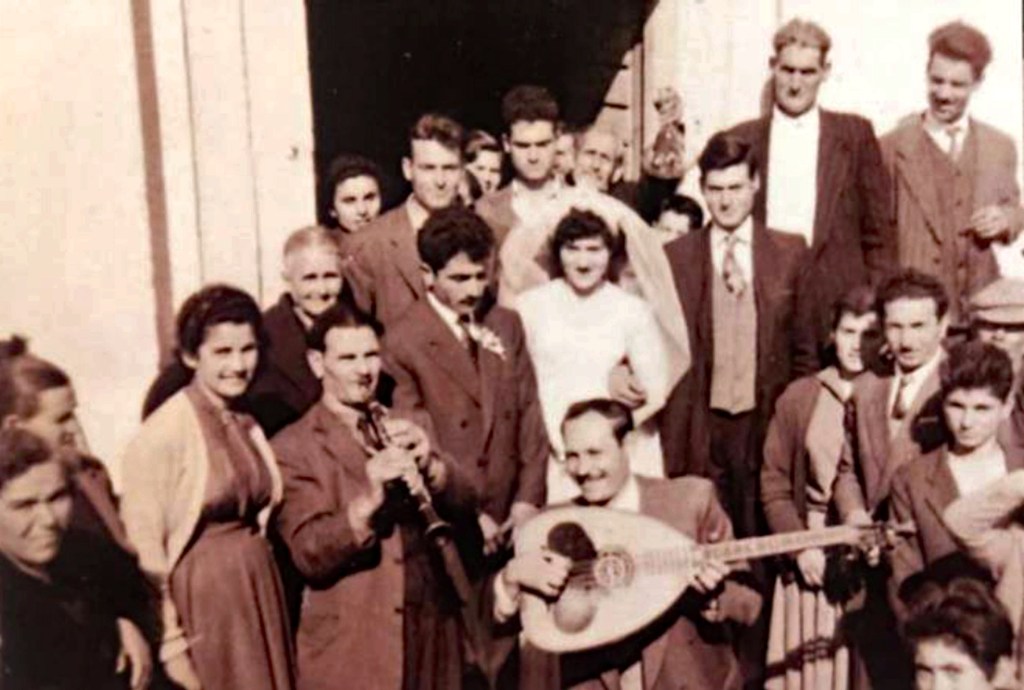
The Newlyweds Panagiotis and Eleni Kastri (Calendar 2022 of the Association of Women of Anogia “The Refugee”)
In Anogia in earlier times, a few days before the wedding, customarily on Thursday because weddings were held mainly on Sunday, the groom with his close relatives and friends, would harness the horses and mules in the late afternoon and prepare to go to the bride’s house. They wore their best clothes and even on the animals they placed kilimia (woven rugs) on their backs, so that they would also be decorated. They loaded the baskets and proceeded to the bride’s house accompanied by local singers and musicians. The bride’s family awaited them with the dowries ready. They were mainly clothes, woven fabrics for every occasion, blankets, rugs and general household utensil such as trays, dishes and whatever else the family could provide. After the dowries were presented to the groom’s family, the bride’s relatives sat on the trunks and only left when the groom paid them in gold, so that the dowries could then be loaded onto the animals. The families mingled at the lavish table that had been prepared, dancing followed and wishes were exchanged for the upcoming wedding. The neighbors of the bride’s house gathered around, listening to the songs, and participated in the couple’s joy. In fact, the groom’s friends had an unwritten custom of “stealing” something small from the bride’s house, such as the glass they drank their wine in, or even a plate, etc.
The wedding day was special. The relatives had gathered early at the bride’s house and the women of the family and the bride’s friends took charge of her preparations, singing wedding songs. Before departing, the musicians arrived and the bride danced together with her family. Later on, they all left the house together and the instrumentalists played the patináda (wedding procession music).
The procession arrived at the church, where the groom was waiting at the door with his family and the priest. At the end of the ceremony, a commemorative photo was taken in front of the church. The wedding reception took place at the groom’s house, where the couple would live permanently. The meal was prepared by professional village cooks with the help of relatives, consisting mainly of roasted meats on spits and stews. At the end, the wedding chamber was decorated with a wish for fertility and a happy life.
I (Carol Kostakos Petranek) am honored to receive permission from the Katsoulakos family to translate and share articles from The Faris. Translation verification and corrections have been made by GreekAncestry.net. This is the twenty-fifth article of the ongoing series. Previous articles can be viewed here.
In the villages of our region, as in almost all the villages of the non-urban areas of the country, until the end of the previous century, their economy was and remained almost self-sufficient and based on exchange among the households as well as the craftsmen of the area. This meant that almost all the needs of homes and families were covered or met through the exchange of their agricultural and livestock farming products and through the exchange of labor and working hours among the residents.
Even the making and the use of “tools” that required specialized knowledge or skills were carried out within the communities of the villages (or in their neighboring ones) by self-construction and self-use. A most characteristic example was the loom which covered the entire process of design, creation, and making people’s clothing (the woolen garments), as well as the necessary bedding, coverings, and decorations of the houses.
Modern Greece Weaving Loom Greek History exhibit, Benaki Museum, Athens, Greece. Complete indexed photo collection at WorldHistoryPics.com.
Here we must refer to our multiskilled ancestors who learned from improvisation, experimentation, applications and improvements, to reach the rationality and the experience of perfection in their self-made constructions (…). Most of them practiced many and different professions (and crafts) at the same time. Giorgis St. Rigakos (or Stylianakos), for example, practiced in Goranoi until his eighty-fourth year, in old age, the professions/crafts of farmer, lumberjack, carpenter, floor-layer, cooper, basketmaker, house roofer, farrier, saddle-maker, tool and loom maker…
We must also mention the women of our villages who had -all of them- exceptional skills and endurance to be wives, mothers, and housekeepers, but also nurses, farmwomen, cooks, seamstresses, bakers, weavers, embroiderers, knitters… with imagination and lateral thinking.
Along with the self-construction and self-use of the loom, we refer in this note to the process of searching, testing, and selecting natural dyes for the threads/yarns from local plants and herbs, completing the making and artistry of the woven fabrics.
We must, of course, remember that up until the end of the previous century there were no such dyes available commercially in a variety of colors. But we must also correct the notion cultivated by many people that every substance (food, medicine, dye, cosmetic, …) that comes from nature is more effective and safer, without side effects, than the corresponding substances that come from chemical laboratories.
Their supposed “purity” (!?) should not be attributed only to their composition—since they consist of the same chemical elements and compounds as the commercial ones—but mainly, their dosage and other characteristics must necessarily be controlled, such as the pesticides, the environment in which they grow (temperature, rainfall, humidity, …), their processing, etc. The artisans of the dyeing industry learned empirically the secrets for achieving beautiful, bright, and -above all- indelible / unalterable colors resistant to light and washing.
Woven wool blanket on the loom. It was woven and dyed with natural dyes from plants around 1945 by our compatriot Valaso Solomou, daughter of Konstantinos, wife of Fotios Asimakopoulos, son of Ioannis.
The dyeing of the yarns, after they were washed (always in lukewarm water and with the homemade soap that each family made), was done carefully—coordinating the fire with the boiling—then spreading / wringing them in natural air and without strong sunlight, so that the dye would “set” and become uniform, but without the yarns becoming moldy.
First, however, they had to search for, test, experiment in practice, and select roots, leaves, but also barks and fruits of trees and wild herbs, to create the colors of the dyes they desired. All these were pounded, soaked overnight or boiled, strained, cooled, and afterwards poured into the water where the yarns were, and boiled for four to five hours. They often rinsed them with *alísiva* (lye).
For example, to get the brown color for the yarns (threads), they used husks from green walnuts. To get the dark walnut color or honey color, they added tobacco, while to get the sweet light brown of the ripe apple, they used leaves and soaked dry onion peels. For dark olive or khaki color (and oak color), they used dried acorns. For yellow, they used venetian sumach (Cotinus coggygria) and daffodils; for beige, bark of wild almond trees; while for red, roots and leaves of holly oak and heather. Finally, for dark blue, they bought (!) from the flower shops indigo (a mineral imported from China), which they washed in lukewarm water.
___
NOTE: In 2022, the Stavros Niarchos Foundation initiated a collaboration with the Cultural Society of Geraki to investigate and relate the story of the history of weaving in Geraki. The Geraki Weaving website has photos, videos, and descriptions of the project.
I (Carol Kostakos Petranek) am honored to receive permission from the Katsoulakos family to translate and share articles from The Faris. Translation verification and corrections have been made by GreekAncestry.net. This is the twenty-fourth article of the ongoing series. Previous articles can be viewed here.
by Tasou D. Volti published in the Faris Newsletter No. 66, July 2017, page 11 Author Note: In issue 64, there is an interesting retrospective on the old means of road transportation. There, testimonies and memories are mentioned concerning the appearance of the first automobiles in our village, Xirokampi. To this valuable account and presentation by Stratis S. Solomos, I will add some of my own references with supplementary details on this fascinating topic of that era.
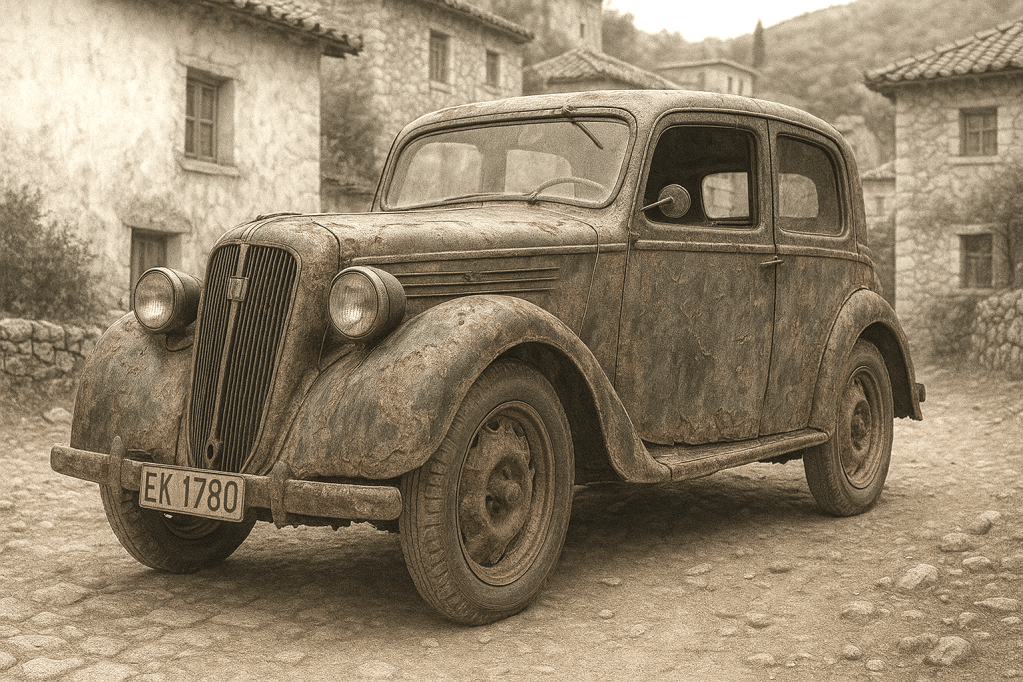
The late Vasileios Kountouris, a remarkable and restless individual with an entrepreneurial spirit, was among the first motorists of the 1930s and 1940s. He had bought the first small passenger car of the FIAT brand.
Fiat, circa 1930, image generated by ChatGPT
I remember my late uncle, Lampros Sakellariadis, who later became a judge at the Supreme Court (Areios Pagos), recounting an incident involving that car. Kountouris had driven the FIAT up to the village cistern to wash it. With him were my uncle Lampros—then a teenager—and Kountouris’ son Kostas, who was younger. During the washing, the handbrake came loose, and the vehicle rolled off the edge of the rock and plunged into the ravine, above the path leading to the Rasina bridge. It suffered severe, irreparable damage. After the difficult recovery, it remained in a corner of the large sandlot at the village square, the “Chortarakia,” just below the barbershop of Yiannis Sykiotis. The famous “Chortarakia” was our exclusive play area. And here the saying “nothing is more permanent than the temporary” held true, as the car—according to its owner—was to remain there for possible repair. But it became permanently immobile. Kountouris’ repeated efforts and shouted threats failed to deter us or drive us away from the car, which we had now turned into one of our favorite playgrounds. Uncle Vasilis eventually gave up trying to remove us. And then, our destructive tendencies—more so driven by curiosity—gradually left only the skeleton of the FIAT!
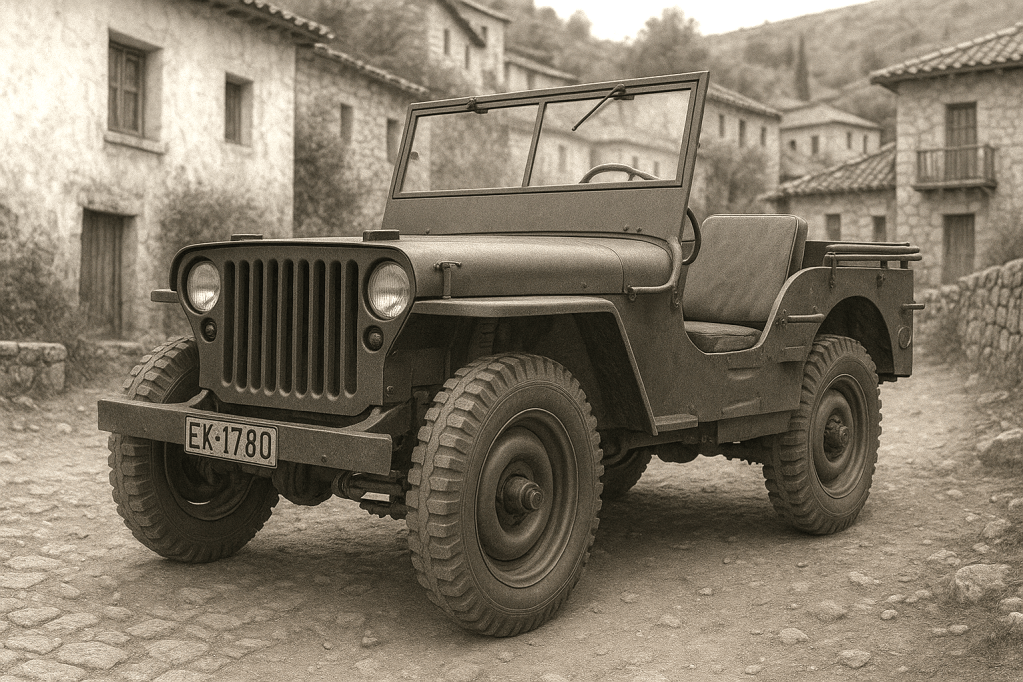
Kountouris later brought another small car—a kind of jeep—which had the starter button on the floor. It was always parked outside the gate of his house, next to the notary office of my grandfather Kostis Sakellariadis. That jeep aroused our curiosity and, approaching it cautiously, we would press the starter with our hand—resulting in, to our great satisfaction, the jeep making little hops, as the gear lever was jammed. No matter how much Uncle Vasilis threatened us, we had fun.
Jeep, circa 1940s. Image generated by ChatGPT
I remember one time Uncle Vasilis stopped me on the road—strangely, he wasn’t angry—and, with fluent expression in his Katharevousa eloquence, he told me something I still remember today: “Even though you are the son of a professor, you are no different from the other street urchins by taking part in such acts of mischief. A pity!” It has stayed in my memory—as if I can still hear him. I was ashamed and never again tried to go near the car.
Here I will also mention the small car of Kostas Feggaras, which ran the route: Xirokampi – Kaminia – Potamia – Goranous. The older folks will remember the unfortunate incident when a drunk passenger, standing and holding onto the door, fell out and died on the road to Kaminia. That incident brought serious troubles for Kostas.
I also remember the small truck of Gavvaris, which we children admired so much when he first brought it to the village. His son Vasilis, who later became a professor of literature—one of the finest in our region—asked his father, I recall, and received permission for us to climb into the truck bed for a ride to Agios Vasileios. Holding on to the truck’s railings, we jumped with joy. And I remember a phrase from Vasilis, who, excited by the speed of his father’s new vehicle, shouted: “It flies—it’s flying! These little cars fly!”
As for the large truck of Giannis Kakagiannis, we were so full of admiration that we opened our eyes wide and stood still watching… its ten wheels—tires that seemed to us something completely new and unimaginable.
All this may seem… funny to today’s youth. But to us children of that era, when transportation was a novelty, everything was magical. No matter how insurmountable the difficulties were, we loved everything that amazed us, even if it seems so distant today. Those were our most important years—and so they remain in our memories, despite the passage of time.
by Stavros Theof. Kalkanis published in The Faris Newsletter No 68, July 2018
NOTE: In Greek villages, empirical (self-taught) or folk doctors treated all types of medical conditions during the 1800’s up to modern times. Doctors passed down their remedies to other practitioners and members of their families. Many cures are still practiced in rural homes. The author is from a family of physicians which stretch back to his 3rd great-grandfather who was a folk doctor during the Greek Revolution of 1821.
Our family’s oral tradition also refers to empirical (self-taught) doctors among its members, both before and during the Revolution of 1821. Vasileios (Vasos) Nikitas Kalkanis (1903–1983) passed on to my father and brother the information that our great-great-great-grandfather Georgios Kalkanis, who was the elder if Gorani during the Revolution, took care of the wounds of his fellow villagers using empirical knowledge and practices he had learned from his father. A century later, in the villages of Kato Riza, his namesake and my grandfather, Georgios Christofilou Kalkanis (1858–1950), served as a graduate of the University of Athens School of Medicine.
George Kalkanis signs as community elder of Gorani and Liantina, with all the distinguished community elders and other residents of the villages of Kato Riza and Vardinochori of Lacedaemon”, in Arna in 1835, a “plea” to the Holy Synod “to act for the preservation of the Holy Monastery of Gola which we have as an asylum and refuge in times of need and sorrow” (from the General State Archives)
The actions of the empirical doctor G. Kalkanis appear to have been particularly notable during the battles of our compatriots (in the period 1825–1826) against Ibrahim’s army, which was operating in Taygetos to destroy our villages and subjugate their inhabitants in his effort to reach Mani. It is recorded that Ibrahim “burned to the ground” all the homes in Goranous, Kourtsouna, and Koumousta (as well as in other villages), forcing the residents of the whole region to take refuge in the mountains of Taygetos.
At that time, wounded fighters, residents of our villages who supported our villages and protected their inhabitants and civilians, needed immediate care for their injuries from sharp weapons, firearms, and even cannons.
Of course, in our villages,– but also more widely in southern Lakedaimona and even throughout the southern Peloponnese—five brothers of the Giatrakos family were particularly active and known as empirical doctors (in addition to being warriors and chieftains). Descendants of the Italian Medici family who initially settled in Mani, they Hellenized their surname and, with towers in their possession immediately after the declaration of the Revolution, played a significant role in revolutionary and post-revolutionary Greece. Their ability to provide medical surgical care to the wounded led many warriors to join their ranks. In nearly every Greek camp set up near a battle zone, the Giatrakos brothers would organize a makeshift “hospital.”
From their archives – their records – it appears that they “treated” many wounded with severe injuries and amputations for many weeks, removing fragmented bones from their wounds. Panagiotis Giatrakos had even traveled to Italy a few years before the Revolution and brought with him knowledge from the University of Padua, as well as medical supplies and techniques, anticipating that they would be needed in the impending revolution. Later, his brother Ilias created a Medical School and Hospital in Mystras.
At the same time, many empirical doctors throughout the revolutionary country were trying with minimal means to care for the wounded and provide therapeutic care in houses and monasteries, or onsite, in the countryside. In the area of Mystras, even two Muslim empirical doctors, Hasanakos and Drizakos Gioupis, who remained in the country, participated in the effort. Of course, most of the empirical doctors did not have degrees, except for a few who were trained mainly in Italian universities. Many empirical doctors who did not have degrees were provided after the Revolution with licenses from the Prefectures of the newly established State (since 1835 with royal decrees) to “practice minor surgery.”
But with what tools, practices, or materials did these empirical doctors/surgeons provide care to the wounded of the Struggle before the groundbreaking discoveries and changes that took place in the second half of the 19th century and defined modern medical science? I have often wondered about this because of the tradition that includes practical doctors in my family and because I am a doctor. In this essay, I will focus on injuries and not the milder ailments treated by these doctors or by the mothers and grandmothers of every family. The most common of these illnesses were pustules, fevers, runny noses, moles, obstructions, pimples, calluses, sores, abdominal pains and even evil eye.
Common treatments for these ailments included rubs or antisepsis with raki, wine, and vinegar (which contain alcohol); warming drinks like “kaftoura” (made of red wine, peppers, and cinnamon); dry or wet cupping; bloodletting or leech therapy; enemas; opium (from poppies); moldy bread; poultices from flaxseed—and also censing with flowers from the Epitaph, lighting the Easter candle, sprinkling with Holy Water… In our villages, cleaning earwax was done with a wise and simple method: one end of a horsehair was placed in the ear, and drops of hot wax were dripped along the length of the hair. When the wax hardened inside the ear and stuck to the wax plug, they pulled the hair along with the wax and the ear plug.
Injuries or wounds from swords and scimitars or bullets that tore the soft tissues of the body seem to have been treated at the time of ’21—and before or shortly after—with poultices or “blastria” (plasters). These were therapeutic dressings made of cloth or unwashed sheep wool soaked with ointments (balms) made from everyday easily available materials, that had been recognized through centuries of experience—even by Hippocrates. It is characteristic that in texts of the “Hippocratic Collection” “many dirty wounds mixed with wine and oil” are recommended (!) The fatty coating of the “dirty” sheep’s hair seems to replace the lanolin of modern medical science and pharmaceutical technology.
The basic materials used in the plasters were wine or raki and vinegar, oil, and egg white. The first were used to clean/wash the wound and to stop bleeding. In more serious cases, they cauterized it with a red-hot iron or hot tar. They filled the wound with ointments from the above materials or soaked cotton, cloth, or linen threads with them to form the wax, which they used for the bandages. The wax was also smeared with melted wax, which is why they often spoke of “cerates” (wax ointments). Wax ointments are mentioned in many “giatrosofia” (written instructions from experienced doctors) and of course refer to the “waxed plasters” of the Hippocratic texts and to the Italian word “tsiroto” which is a reborrowing.
The wounds were not sewn up so that the pus could drain, but they were cleaned daily and the plaster changed. The above antiseptic and healing materials were found in homes or monasteries, but the healing of the wounds required weeks or even months of care. It is noted that often, due to lack of dressings, or following ancient Greek medical practices, the empirical doctors and the companions of the wounded put herbs or grasses (the so-called “flesh herbs”) on the wounds. These herbs, known from tradition for their anti-hemorrhagic, analgesic and healing properties, were referred to by Homer as “odynifata” or “pain-killing roots”, and were described in detail by Hippocrates and Dioscorides.
But wounds caused by scimitars, hatchets or axes usually involved bone fractures in the skull, limbs, or the chest. Many wounds, especially in the limbs, resulted in amputation followed by cauterization. The horror is described by the fighter and historian Fotakos, who shudders even at the memory of the “shattering” and the “grinding of bones” in the battles and amputations.
In these cases, crushed tile or crushed marble, and even ash, were added to the ingredients of the ointments, perhaps to create a cohesive material between the broken bones, while the limbs – arms or legs – were also immobilized with reeds and boards. During healing, empirical surgeons often remove small, shattered bones from the wound, during the long rehabilitation of fractures and the closure of wounds. Of course, they continued to use mainly unwashed sheep’s hair as bandages.
Τhe ingredients in the ointments included crushed ceramic or marble—and even ash—perhaps to create a cohesive material between broken bones. Immobilization of limbs—arms or legs—was done using reeds and planks. During healing, empirical surgeons often remove small shattered bones from the wound, during the long recovery of fractures and wound closure. Of course, they continued to use unwashed sheep wool as bandages.
Great contributions to the medical aid and nursing care of the wounded residents and fighters in our region—both during the Struggle and in the time of the “klephts” (after the Orlov Revolt)—were provided by the Monastery of Golas, despite the hardships and destructions—even the desolation—that it suffered through the years. In its centuries-old tradition, the Monastery of Golas—when it had not suffered destructions by the Turks—offered solace, assistance, and care, because besides its facilities and necessary materials for treating injuries (lacking in the poor homes and inaccessible to the “klephts”), it also had a monk with empirical medical knowledge and knowledge of healing herbs. It should be noted that the in the Monastery of the Zoodochos Pigi Kastriou, near Kastori, there was—and has been preserved—a special “Recipe Book” with recipes for prescriptions/formulas for remedies and healing herbs.
In conclusion and with due respect, I note that the experienced doctors/surgeons of the Struggle of 1821, in our region and throughout the then revolutionary country, though overlooked by historiography, are acknowledged by history. They applied life-saving medical methods still unknown to the science of Medicine, contributing to the care and survival of thousands of wounded.
I (Carol Kostakos Petranek) am honored to receive permission from the Katsoulakos family to translate and share articles from The Faris. Translation verification and corrections have been made by GreekAncestry.net. This is the twenty-third article of the ongoing series. Previous articles can be viewed here.
The conquest of the Peloponnese by the Venetians (in 1685/87) had very serious consequences for its inhabitants, both for Christians and for Muslims. One of these was the Christianization of about 4,000 Muslims, mainly in the regions of Gastouni and Mystras, where the presence of the Turkish-Muslim element was more intense than in any other region of the Peloponnese, during the period of the first Turkish rule. The Venetian officials in their reports do not agree among themselves on the assessment of the causes that led to these mass conversions to Christianity: some, such as the ledger keepers Griti and Mikiel, argue that those who became Christians had Christian ancestors, who had previously converted to Islam and found the opportunity, after the expulsion of the Turks, to return to their previous faith or to the faith of their ancestors, while others, such as the Proveditor Fr. Grimani, believe that the motives that drove these individuals to become Christians were fear for their lives and self-interest. Undoubtedly, both views have a dose of truth. However, the absence of testimonies from Ottoman sources (which either have been destroyed or still remain unpublished) does not allow us to see exactly what extent individual or mass conversions to Islam had taken in the Peloponnese during the first Turkish rule, so that we can speak with more certainty about the possible relationship between these two opposite religious conversions (Islamization and Christianization).¹
For the Christianizations in Mystras and in villages of this kaza, we are given information by documents from Venetian archives that were published two decades ago², as well as others that remain unpublished. Specifically, according to this important archival evidence, Christianizations are recorded in Mystras and in the villages of Agios Ioannis, Sklavochori, Arkasas, L(i)opesi, Floka, Kastri and Voaria (?). According to this source, in the settlement of Arkasas or Arkasades, which is known from Byzantine and post-Byzantine sources, ³ the following seven families were Christianized at the beginning of the Venetian conquest:
Village of Arkasa
Michalakis Messinakis, 30 years old his wife, Dimitris his son, Georgoula his sister-in-law.
Panagiotis Gorianitis, 30 years old, his wife Stathou, his mother, a son, 6 months old, Dimitrios, his adopted son.
Panagiota Safitsa daughter of Kanella, Dimitris, her adopted son
Nikolaos Silikanos 25 years old, his wife Gkolfo, his mother.
Thodorakis Karfopoulos 30 years old, from Rizia (?), his wife, Ilias his father, Panagiota, his daughter.
Pieros Maniatis from Kastania 22 years old, his wife, Nikolaos his son, Maroula, his adopted daughter.
Panagiotis Tzourakis, Panagiota Flokiotissa his wife, Dimitris, his son.⁴
Specifically, 25 people were Christianized (13 men and 12 women), who, as we see, are mentioned by name, and with their exact family relationship, some even with their age. Although we do not know the population of this settlement before 1685, we can, judging by the data from the Venetian census of 1700 (38 families/145 people) ⁵, conclude that a significant number of inhabitants converted to Christianity. It appears, in fact, that two of these families had recently or previously settled in Arkasa: Panagiotis Gorianitis from Goranous, and Pieros Maniatis from Kastania of Mani. This record, which is important from the perspective of the composition and size of the families of this settlement in a period where such information is scarce, shows, indirectly, that in this village – as in other neighboring villages – several Muslims lived before 1685. However, since, as we said, we do not have at our disposal reliable testimonies from Ottoman archives, we cannot determine with certainty whether they were genuine Turks – Muslims or Islamized Christians, as is suggested in other sources.
The historian Peter Topping argued that the fact that the individuals who were Christianized then in the Peloponnese bore Greek surnames (as here) shows that they had Greek ancestors, a hypothesis that is repeated by other historians. This argument is very strong, but not absolutely certain. Perhaps these individuals changed, with their Christianization, not only their baptismal name, but simultaneously also their family name, something which happened in certain cases, as other Venetian sources inform us. Unfortunately, the type of records does not help us to give a more certain answer to this very important question. Only the systematic research of the unpublished documents that contain other names of Christianized people from Laconia, with more data, will better illuminate this issue. This is at least what our studies show for other regions of the Peloponnese, regarding the above topic. Moreover, this brief record does not help us at all to answer with certainty whether these individuals were Christianized by baptism – a fact that would lead us to the conclusion that they were genuine Turks/Muslims, given that, according to the sacred canons of the Orthodox Church, baptism is a non-repeatable sacrament – or if they simply received the holy unction as was done then in similar cases, precisely because they were Christians who had converted to Islam and returned to their original faith.
Whatever happened, one thing is certain. These people who lived during the brief period of Venetian rule (1685/87-1715) as Christians, found themselves in a difficult position in 1715, with the reconquest of the Peloponnese by the Ottoman Turks. According to completely reliable testimonies, all the Christianized people of the region of Mystras – in contrast to those of the region of Gastouni – were executed because they were considered murtads, which means, deniers of their faith. They had committed, that is, the gravest sin, according to Islamic law⁶. Thus, would close, at least for some of these individuals, the cycle of successive conversions from the last decades of the 17th century until 1715, which passed through the following phases: original Christian descent – Islamization – conversion to Christianity and again Islamization at the beginning of the second Ottoman rule.
___
¹ See on this issue Georgios V. Nikolaou, Islamizations in the Peloponnese from the middle of the 17th century until 1821, ed. Herodotos, Athens 2006, p. 37-42, where the relevant sources and bibliography.
² Konstantinos Mertzios – Thomas Papadopoulos, “Mystras and its region in the Archives of Venice during the Venetocracy (1687-1715)”, Lakonian Studies, vol. 19th (1988), p. 271-275, document from Mystras dated September 20, 1689.
³ See Theodoros S. Katsoulakos, “Sales documents of the 18th century”, Faris, issue 14 (1996), p. 5, Dimitrios K. Giannakopoulos, “The travels of the Italian Ciriaco de Pizzicoli in late Byzantine Laconia”, Faris, issue 32 (2002), p. 13, where this settlement is identified with the ancient Pharida.
⁴ K. Mertzios – Th. Papadopoulos, op. cit., p. 274.
⁵ Vasilis Panagiotopoulos, Population and settlements of the Peloponnese, 13th-18th Centuries, Athens 1985, p. 284.
⁶See G.V. Nikolaou, op. cit., p. 49-52.
I (Carol Kostakos Petranek) am honored to receive permission from the Katsoulakos family to translate and share articles from The Faris. Translation verification and corrections have been made by GreekAncestry.net. This is the twenty-first article of the ongoing series. Previous articles can be viewed here.





 Spartan Roots (Σπαρτιατικές Ρίζες)