A Walk Through History: The “Greek Circle” at Woodlawn Cemetery

On a clear and lovely day this June, Nicholas Prevas took me to the sacred and historic resting place of the earliest Greek immigrants in Baltimore, Maryland. We were welcomed by flocks of geese as we drove the gently winding road past a rippling lake to the “Greek Circle,” situated at the pinnacle of Woodlawn Cemetery. So named because the 1,000 square foot parcel of land is in the shape of a circle, this hallowed ground holds the stories of families who left their rural villages and thrived in the teeming city of Baltimore in the early 1900s.
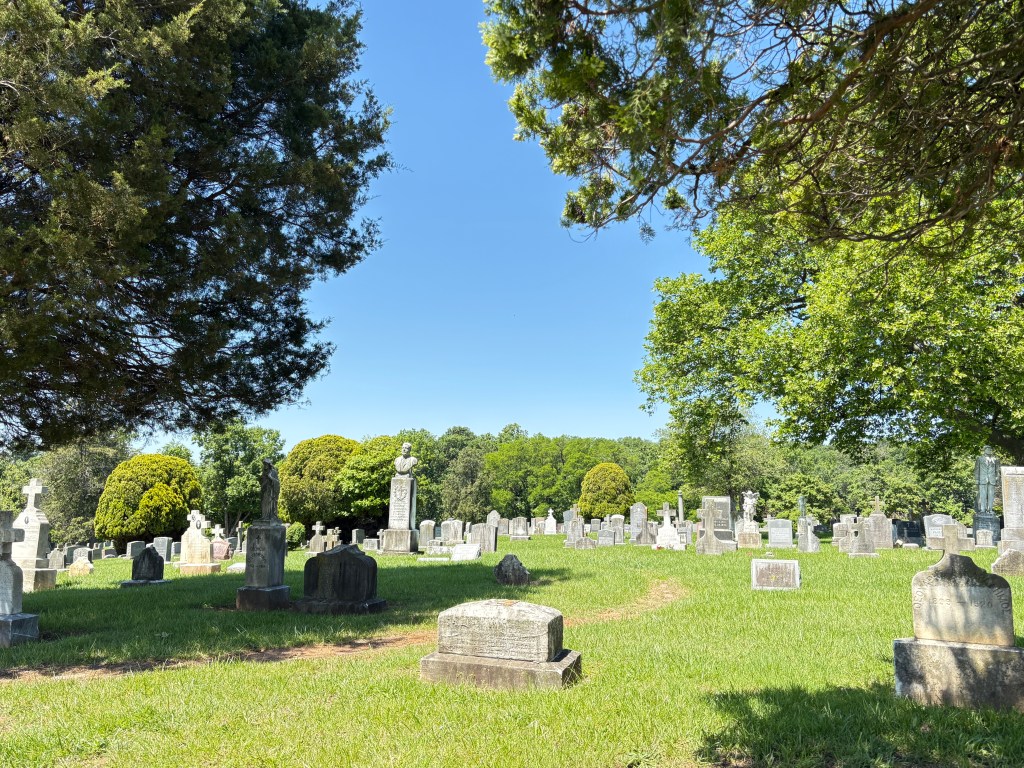
The Greek Circle, June 2, 2025. Note the bricks nestled in the ground, marking the circle.

Nick is the Parish Historian of the Greek Orthodox Cathedral of the Annunciation which owns the Greek Circle. The parishioners of the Church, which was established in 1906, secured this plot in January 1912. The Greek Circle was the first of four parcels (collectively known as the Greek Section) purchased by the Church in the North Avon area of Woodlawn.

page v, Gone But Not Forgotten, A Definitive History of the Greek Section of Woodlawn Cemetery
by Nicholas M. Prevas, Parish Historian, Greek Orthodox Cathedral of the Annunciation, 2001

The Greek Circle is arranged in rows of five. This fascinating diagram of burials is from the Archives of the Woodlawn Cemetery Company.
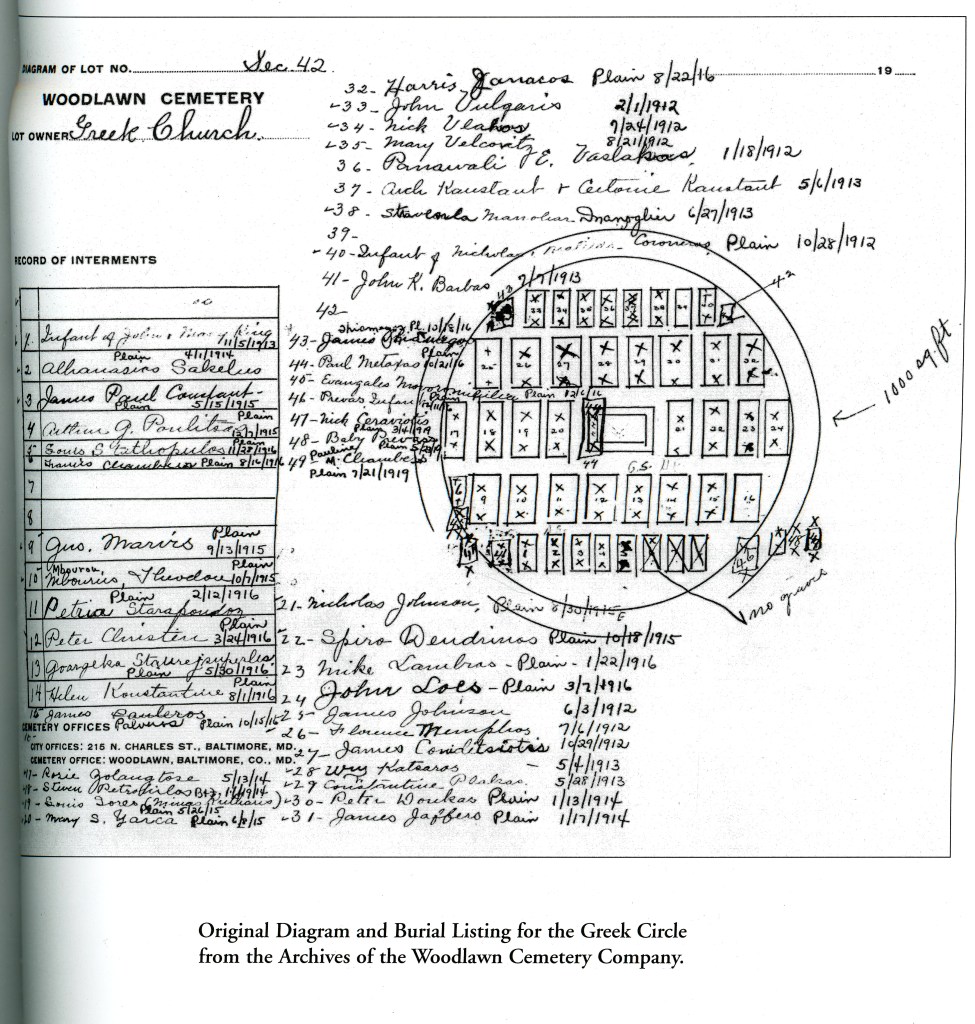
page 119, Gone But Not Forgotten, A Definitive History of the Greek Section of Woodlawn Cemetery
by Nicholas M. Prevas, Parish Historian, Greek Orthodox Cathedral of the Annunciation, 2001

As we stood before each headstone, Nick told me the stories of the families. All were immigrants, many from Lakonian villages. They were pillars of the community, forming the backbone of the Cathedral of the Annunciation and making significant contributions to their Baltimore neighborhoods. Despite their successes and prosperities in their new homeland, they were not immune to the vicissitudes and tragedies of mortality: accidents, drownings, and infant deaths permeated their lives. The Greek Circle holds 45 interments; of those, 25 are children under the age of 18. I could sense the spirits of these people and almost feel sorrows of their families as I stood before each grave. It was a holy moment for me.

In honor of the lives and in memory of those at rest in the Greek Circle, their names, ages, and dates of interment are listed below.

Row 1:
Kerasiotis, Nicholas, age 3 days – March 4, 1919
Barbas, John K., age 9 months – July 7, 1913
Kousouris [King], Christopher J., stillborn – November 5, 1913
Sakelos, Athanasios, age 11 mos., 29 days – April 1, 1914
Constant, James B., age 9 months – May 15, 1915
Poulitsas, Athanasios G., age 8 months – December 7, 1915
Stathopoulos, Leonidas H., age 2-1/2 months – May 28, 1916
Prevas, Infant, stillborn – December 11, 1916
Prevas, Infant, age 2 days – May 23, 1919
Chambers, Pauline Mary, age 3 days – July 21, 1919

Row 2:
Chambers, Frances, age 12 days – August 16, 1916
Mavromihalis, Evangelos, age 1 year – December 6, 1916
Mavris, Constantine, age 46 – September 13, 1915
Mbourzos, Theodore, age 29 – October 7, 1915
Stavropoulos, Patra, age 30 – February 12, 1916
Christen, Peter, age 70 – March 24, 1916
Stavropoulos, Georgia, age 65 – May 30, 1916
Konstantopoulou, Eleni K., age 37 – August 1, 1916
Pavleros, Dimitrios, age 15 – October 15, 1916

Row 3:
Zogalsin, Rose, age 20 – May 13, 1914
Petrohilos, Stylianos, age 39 – November 19, 1914
Kritharis, Minas, age 21 – May 26, 1915
Yarca, Marie S., age 45 – June 8, 1915
Metaxas, Paul, age 55 – October 21, 1916
Johnson, Nicholas, age 52 – August 30, 1916
Dendrinos, Spiros, age 35 – October 18, 1915
Lambros, Michael, age 17 – January 22, 1916
Leos, John, age 23 – March 7, 1916

Row 4:
Mamais, Dimitrios, age 72 – June 3, 1912
Nifakos, Efrosene S., age 16 – July 8, 1912
Koniditsiotis, Dimitrios, age 60 – October 29, 1912
Katsaros, Vasilios P., age 23 – May 4, 1913
Plakas, Constantine, age 38 – May 28, 1913
Doukas, Petros K., age 14-1/2 – January 13, 1914
Kouroupis, Michael, age 35 – October 16, 1929
Zafirakis, Dimitrios, age 29 – January 17, 1914
Gianakis, Harry, age 31 – August 22, 1916

Row 5:
Thiamengos, Dimitrios E., age 4 years – October 18, 1916
Vulgaris, John J., age 1 year – February 1, 1912
Vlahos, Nicholas, age 1 year – July 24, 1912
Velcovitz, Maria, age 3 months – August 21, 1912
Vasilakos, Epaminondas E., age 2 – January 18, 1912 (1st burial in Greek Circle)
Konstantopoulos, Antonia, age 1 day – May 6, 1913
Konstantopoulos, Areti, age 22 days – May 6, 1913
Manolias, Stavroula G., age 4 months – June 27, 1913
Coroneos, Infant, stillborn – October 28, 1912

Woodlawn Cemetery burials can be accessed at FindAGrave: https://www.findagrave.com/cemetery/81791/woodlawn-cemetery

A Note of Appreciation:
Nicholas Prevas, the Parish Historian of the Greek Orthodox Cathedral of the Annunication, has selflessly dedicated years of his life to documenting and preserving the history of the Church and its members. He has authored three comprehensive volumes: History of the Greek Orthodox Cathedral of the Annunciation (1982), House of God…Gateway to Heaven (2007), and Gone But Not Forgotten, A Definitive History of the Greek Section of Woodlawn Cemetery (2001) which has been referenced in this post.

In this book, Nicholas has meticulously written the history of the Greek Circle and the entire Greek Section at Woodlawn Cemetery. Every burial is recorded with notations from both parish and cemetery records. He has included biographical sketches and photos of many families whose members are interred in the cemetery. These photos are of the earliest immigrant families, making them both rare and precious. Nick’s work is historically significant and genealogically vital. The Baltimore Greek community is blessed to have Nick in its “circle,” and I am blessed to have him as a cherished friend. Copies of Nick’s books can be purchased through the author.

Nicholas Prevas stands at the commemorative plaque of the Greek Circle, June 2, 2025

Adding to the Family Tree: Mt. Olivet Cemetery

In late October, my husband, Gary, and I took a road trip to Mt. Olivet Cemetery in Maspeth, Queens, New York. A huge cemetery, it commands a stunning view of the midtown Manhattan skyline.

The influx of emigrants at the turn of the 20th century from Spartan villages to the New York City area is legendary and well documented in Michael Contopoulos’ The Greek Community of New York City: Early Years to 1910. Among them were my four grandparents with many of their siblings, cousins and villagers. Studying their migration and resettlement is fascinating–in essence, they recreated their village in Brooklyn. And that means that I have hundreds of relatives who lived there.

As a child, I ran around my grandparents’ house with my cousins, oblivious to the assortment of “old folks” who would visit on Sunday afternoons. But today, they visit in heaven, and I run around connecting the dots of their relationships.

In preparation for this cemetery trip, I spent days online looking for family death records in the outstanding collection on MyHeritage: New York City Deaths, 1866-1948. Navigating through the corrupted spelling of Greek surnames, I was nevertheless successful in finding dozens of my parents’ cousins and their spouses. These death certificates include the deceased’s burial place at the bottom of page one.

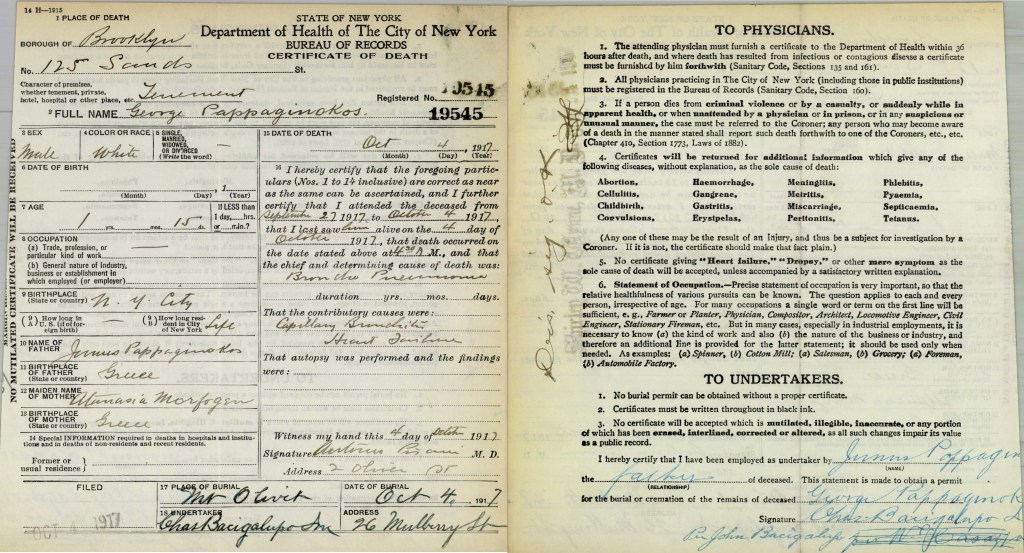
Pappas, George James: infant son of James Papagiannakos and Athanasia Morfogen, died 1917
This baby is my first cousin once removed

I found people buried in several New York cemeteries, but I focused on Mt. Olivet. I created an Excel spreadsheet with 75 names and emailed the cemetery office to request a lookup of those plot numbers. Although many were buried in family plots, there were still a lot of names for the staff to search. (We gave a monetary donation and brought candy to the staff to show our appreciation.)

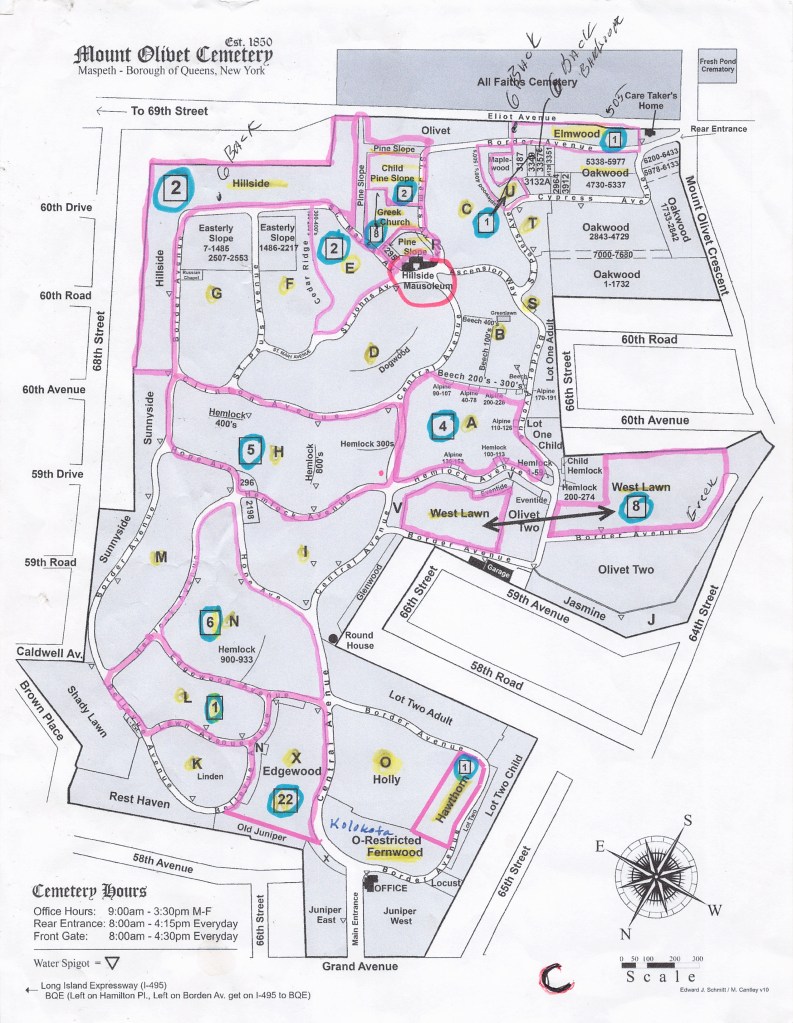
Gary downloaded a map of the cemetery from their website and marked how many people were buried in each section. We felt well prepared as we headed north from our home in the Washington, D.C. suburbs.

Left: My maternal grandparents, Louis Papagianakos and Angelina Eftaxias
Right: My paternal grandparents, John Kostakos, Harikleia Aridas, their daughter, Alice
and John’s brother, William

For two days, we walked and searched, finding headstones for many but surprisingly, not all. Several people whose death certificates listed Mt. Olivet as the burial place were not in the cemetery records. The office staff explained that in such cases, the family chose a different cemetery if there was a plot elsewhere owned by a relative. For those without headstones, we learned that many immigrant families did not have money for both a burial and a monument. The empty spaces in many lots are unmarked resting places.

The West Lawn section of Mt. Olivet. Cemetery records indicate that this lot is full, despite empty spaces. Several members of my family rest here, without headstones or markers.

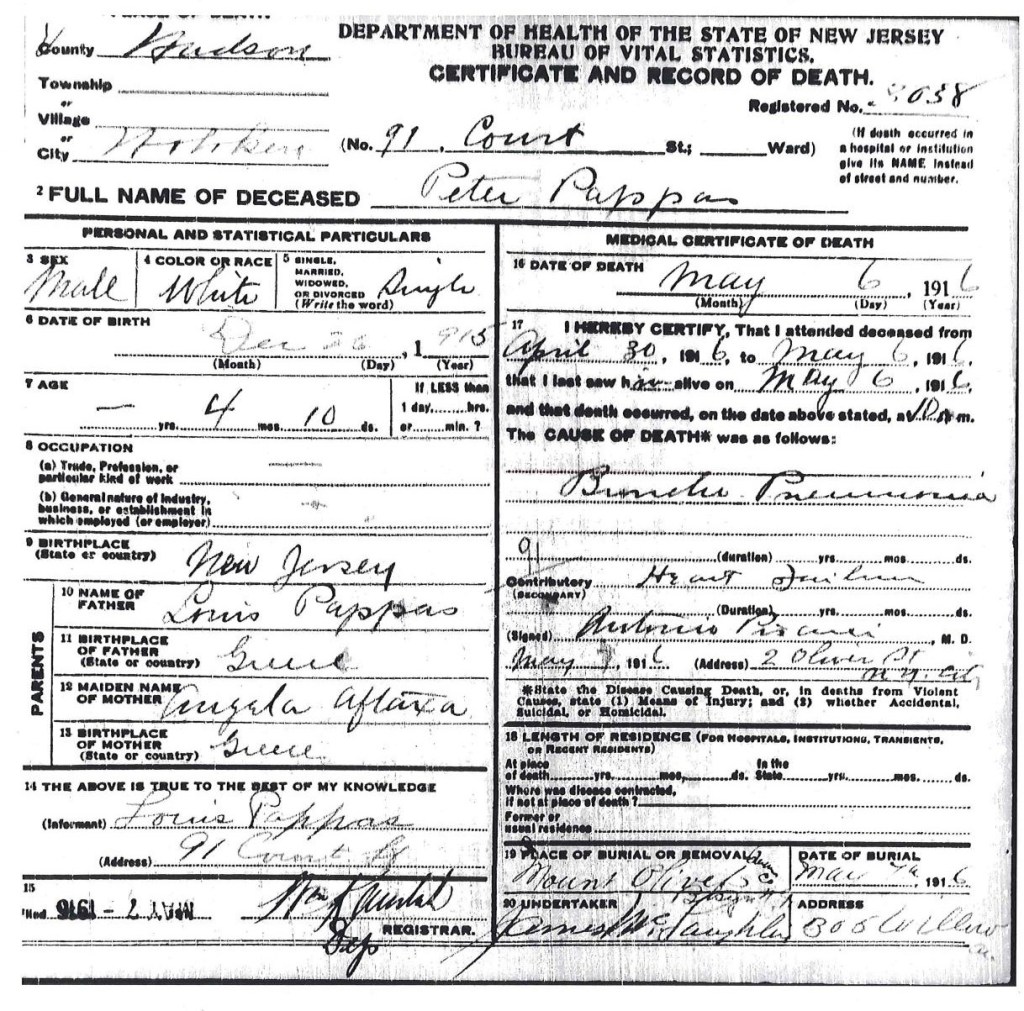
By far, however, the ultimate heartbreak was learning that 13 infants in my family are at Mt. Olivet, and not one has a headstone. Among them are my mother’s baby brother, Peter Pappas, who died of pneumonia at 4 months, 10 days. I have now ordered a monument so he will not be forgotten. All of these babies were born to immigrant parents who suffered their losses in a strange land far from their immediate families. (See list below.*)

My mother’s brother, Peter, who died at 4 months.

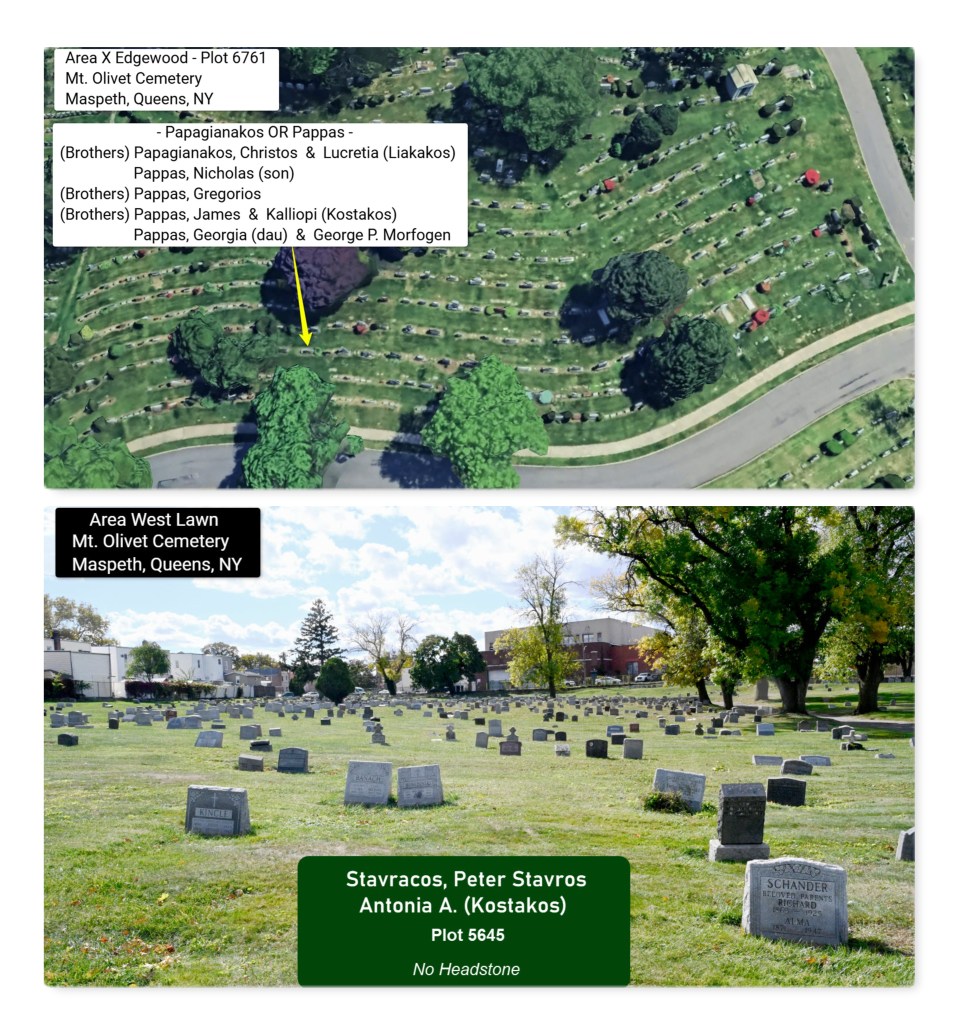
Sometimes it’s hard to find a marker even with the plot number; the dizzying number of granite monoliths can be disorienting. To help others locate our relatives, Gary had a plan to create a map for each burial place. We took a photo of every family headstone and used our phones to pinpoint its GPS coordinates. For those with no headstone, we photographed the general area and created a virtual marker to memorialize who was buried there.

Gary at work
Top: one of Gary’s maps, pinpointing a Papagianakos headstone
Bottom: although the Stavracos’ did not have a headstone, we created a virtual marker

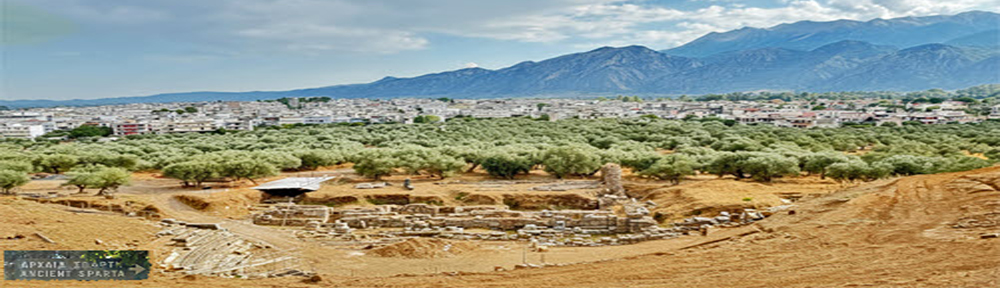
As we walked the grounds, I recognized so many surnames and knew exactly from which Spartan village these people had come. Some of the earliest headstones had the name of the village inscribed–a point of Spartan pride in his/her χωριό.

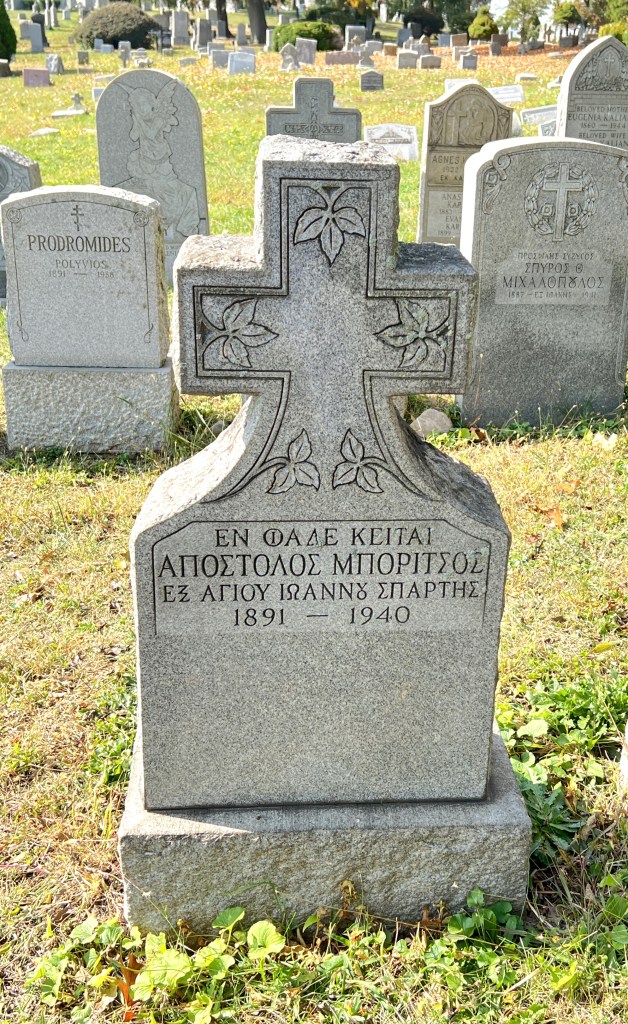
Apostolos Boritsos of Agios Ioannis, Sparta 1891-1940

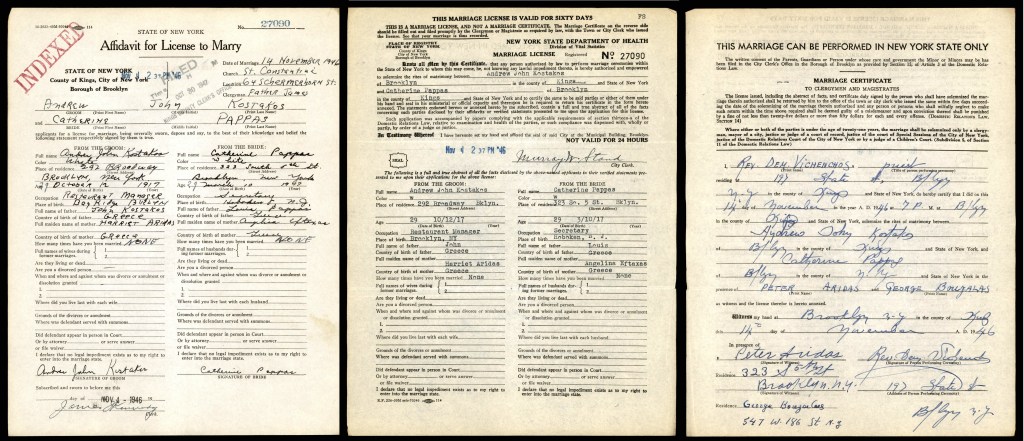
Upon arriving home, the “real work” began: names and data had to be entered into my genealogy database; FindAGrave pages were created for each person with both the headstone and the map; everything was uploaded into family trees on FamilySearch, MyHeritage and Ancestry. The more information that I entered into these genealogy websites, the more “hints” popped up which expanded the profile of each individual and added new members to his/her family. To discover more about married couples, I turned to the MyHeritage collection of New York City Marriages, 1866-1949, a phenomenal resource which has images of marriage licenses and certificates. What makes this collection so valuable is its inclusion of the original Affidavit for License to Marry, which is in the handwriting of the prospective groom and bride. This proves the spellings of the Greek surnames as used by the individuals, thus eliminating the “wonky indexing” done by those who do not know our names. Also, these records include the mothers’ maiden names.

Marriage of my parents, Andrew Kostakos and Catherine Pappas
license handwritten and typed, and marriage certificate

Now that we have a workable system for cemetery research, we will return to Mt. Olivet and other cemeteries in the New York area to continue this work. It’s important to that all information is put on FindAGrave as well as online family trees, so as to enable our ever-expanding web of descendants to have success in finding connections to their families.

*Memory Eternal: babies of my relatives at Mt. Olivet who died without markers

  • Aridas, George Christos 1923-1926, son of Christos Aridas & Stella Lambrianakos
  • Aridas, Louis Basil 1918 (4 months), son of Basil George Aridas and Politime Adamakos
  • Catsores, Bessie 1917-1930, daughter of John Anthony Catsores and Eleni Papagiannakos
  • Catsores, Pota 1909-1910, daughter of John Anthony Catsores and Eleni Papagiannakos
  • Catsores, Theodoros 1918 (4 days), son of John Anthony Catsores and Eleni Papagiannakos
  • Georgas, Christine 1925-1926, daughter of George Georgas and Panagiota Lerikos
  • Londis, Constantina 1919 (7 days), daughter of James John Londis and Pauline Chrisomalis
  • Markopoulos, Konstantine James 1905-1906, son of James Nikolaos Markopoulos and Mary Christakos
  • Moundas, Peter Harry 1922-1924, son of Harry Moundas and Mary Neckles
  • Pappas, George James 1916-1917, son of James P. Pappas (Papagiannakos) and Athanasia Morfogen
  • Pappas, Mimi 1914-1918, daughter of James P. Pappas (Papagiannakos) and Athanasia Morfogen
  • Pappas, Peter Louis 1915-1916, son of Louis Peter Pappas (Papagiannakos) and Angelina Eftaxias
  • Tactikos, Stella 1924 (1 month), daughter of Georgios Nikolaos Tactikos and Katherine Patsakis