by Christos P. Kapsalis
published in The Faris Newsletter Issue 81, January 2025, Pages 15-16
[NOTE: In his remembrance, Mr. Kapsalis refers to the invading army as Αραπάδες, which translates to “Arab.” However, Ibrahim’s father was ruler of Egypt and his army was composed of Egyptians/Ottomans; therefore, Greek Ancestry has corrected the translation of the term to “Egyptians.”]
War, enemy invasion, and scorched earth constitute the grim scenery in Ukraine today. Somehow this reminded me of a story told to me by the late Ilias Kokkoros, known also by the nickname “Tsaparis,” from Potamia, in the 1970s.
We would go to Potamia with my parents on our donkey from neighboring Gorani, my village, to gather olives from the olive groves we had there. We would gather the “pachni” (olive harvest) in the yard of uncle Lias’s house for protection against theft. I remember him very well; he was a respectable elderly man of advanced age (“I’m approaching a century,” he would tell me proudly), gentle, full of kindness. He was also a relative from my mother’s family, and the love and respect was mutual.
Among his many stories, one has been imprinted in my memory and concerns the Struggle of 1821. He remembered when, still a child, his grandmother had told him about those years: To the revolutionary Goranites (his village of origin) came the rumor that we were not alone in the struggle, that help would come and “Fragkia.” The battles were going well, with victories but also discord (how strange…) among the Greeks, until in 1825 came the terrible news that Ibrahim Pasha had landed in the Peloponnese with myriads of troops who burned and destroyed everything in their path. The army also passed through Laconia, destroying villages and countryside. A large part of it reached Gorani. Upon arriving there, the Egyptians burned all the houses, but the residents had managed to hide in the surrounding forests. After the destruction, the army planned to march toward the nearby mountain villages of Kourtsouna and Arna. However, they had not accounted for the Goranites, who planned and implemented a diabolical attack. Throughout the night, they gathered and put into burlap sacks hundreds of “beehives”¹.
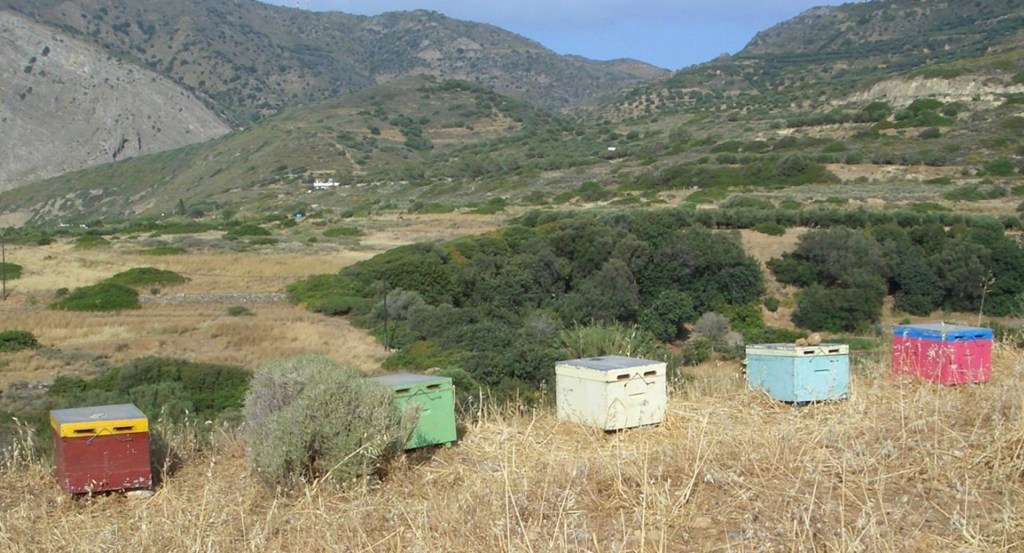
Before dawn, the Goranites raiders took strategic positions, at a safe distance, on the slope along a narrow path at the foot of their mountain village, which led to a crossing at the Gerakaris river, through which the army would pass. Each one held, still closed, a sack with a beehive. The bees, feeling trapped and captive, had already become agitated and were buzzing with anger. The sun had risen just a bit when the Egyptians appeared and began to enter the path. When they were about to reach the river crossing, the Goranites swiftly opened the sacks and hurled them at the enemy. Chaos erupted! The agitated bees attacked anything that moved. The Egyptians, caught by surprise, suffered the merciless stings of the bees and, in a frenzy, scattered to the four winds. Some took the downhill path, jumping over brambles and terraces, others fell into the river, and the swarms of bees followed behind. Swollen, they disappeared, going back down to the flatland. Naturally, they didn’t dare set foot in the area again. The Goranites had taken revenge as sweet as… honey for the destruction of their village.
May the soul of Uncle-Lias rest in peace, for he preserved this unknown episode of the fight for freedom through the tales of his grandmother.
A century and a half later, I read in the newspapers of the time (1975) that the “weapon” with bees was also used in the forests of Vietnam by the Viet Cong guerrillas of North Vietnam against American patrols. It seems that the first users, the Goranites, didn’t bother to patent their invention.
___
¹ At that time, the beehives we know today didn’t exist. Beehives were kept in woven baskets made of reed, and the honeycombs were made by the bees themselves. Consequently, they had heightened reflexes if some external factor shook the beehive.
___
I (Carol Kostakos Petranek) am honored to receive permission from the Katsoulakos family to translate and share articles from The Faris. Translation verification and corrections have been made by GreekAncestry.net. This is the twenty-second article of the ongoing series. Previous articles can be viewed here.








 Spartan Roots (Σπαρτιατικές Ρίζες)