Unknown's avatar

About Spartan Roots

I am of Greek ancestry with roots in villages near Sparta. My paternal grandparents and maternal grandfather were born in Agios Ioannis (St. Johns), and my maternal grandmother was born in Mystras. I love family history research and have been tracing my roots for many years. I was born in Brooklyn, New York and was raised in a predominantly Greek neighborhood close to extended family. I live in the Washington D.C. metropolitan area and work as a volunteer Co-Director of the Washington, D.C. Family History Center and a genealogy aide/project aide at the National Archives in Washington, D.C. I am always updating and adding new information. Please contact me - I would love to hear from you!

Whitewashing and “Chorinkoves”[1]

by Panagiotis K. Kourtalis
published in The Faris Newsletter Issue 81, January 2025, page 3-6

“The dowry of a poor house is the whitewashed walls,” says a folk proverb, which is absolutely accurate if we consider that in the agrarian societies of our villages in the past, luxurious means of beauty were entirely absent, lime—also called “choringki”—was for many years the mark of nobility and proof of τhe tidiness and absolute cleanliness of a household.

At the same time, lime, along with sulfur, was one of the few products available to ordinary people for systematically disinfecting spaces such as courtyards, terraces, pens, trenches, henhouses, kitchens, latrines, and animal stables in times when dangerous infectious diseases such as typhoid, tuberculosis, echinococcosis, and hemorrhagic fever decimated both people and animals.

Lime, of course, was used, as it is today, primarily in construction of walls with stones, adobe, bricks and cement blocks, for plastering (coating) built surfaces, and for painting the surroundings, facades and rooms of houses with the so-called “whitewashes.”
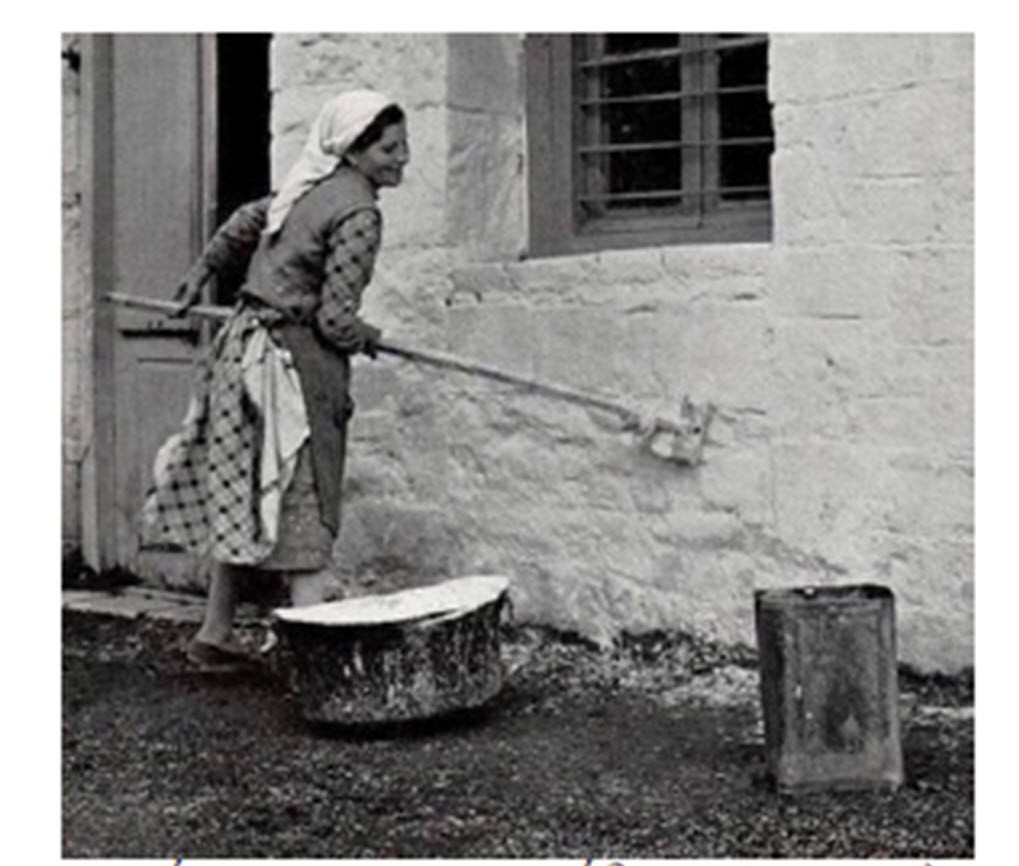
Fig. 1: Whitewashing a wall with a “bandani-brush” and whitewash, that is, “slaked” lime in paste form, diluted in a cauldron[2] with water.

Whitewashes were the paints used instead of today’s plastic paints and were produced either by diluting slaked lime with water for simple whitewashing of walls, courtyards, pens, and terraces, etc., or by diluting slaked lime with water and adding special color pigments, known as “ochres,” to create different shades for painting walls and rooms.

The basis for all this was the so-called “quicklime,” meaning the powdered lime produced by lime-makers in the spring in special outdoor kilns called lime kilns “kaminia” known as asvestokamina. As fuel, all lime kilns primarily used wood cut from olive and oak trees, known as “koutoukia,” and bundles of holly and sunflower branches, which were abundant in the forests and fields, especially after pruning season. Lime kilns were built in areas where the two essential raw materials for lime production, limestone and fuel.

The lime makers, after selecting a suitable location, dug a large pit and built its walls with limestone in successive layers, taking the form of a dome with an opening in its lower part for the supply of fuel. The lower layers of the kiln were built with river stones, while the upper layers were made with marble stones and clay. The river stones [3] were extracted from the streams of our region (e.g., Rasina, Kolopana), while the marble stones [4] were extracted from quarries using chisels, hammers, crowbars, or sledgehammers (e.g., Komninos’ quarry, above the reservoir of Xirokampi). Most kilns in the area were built near the Kolopana stream, hence the name Kaminia of the village, but also next to the Rasina stream in Xirokampi, below the forested area of Barbanitsa, such as the lime kiln of Feggaras.

The temperature generated by the burning fuel inside the kiln dome could reach up to 2000 Celsius degrees, converting almost all the stones into lime. The kiln fire was typically ignited at dawn, and the burning process had to continue uninterrupted for at least 24 to 48 hours, or even longer, if necessary, to ensure that the high temperature fully calcificate most of the stones. After burning, the kiln needed another day to cool down. Then, the workers, who had taken shifts monitoring the fire and constantly feeding it, would carefully enter the kiln and clean the lime. The workers would remove the residues of fuel and stone, then package the lime into linen sacks (linatses),[5] which usually held one kantari, meaning 44 okas of lime.

Fig. 2: Traditional outdoor lime kiln

From the family expense ledger of Vasileios S. Christopoulos, we learn that in the year 1900, “choringki from Giorginas Dogantzos, ten kantaria,” meaning 440 okas of unslaked lime (in raw form), cost the family 22 drachmas.[6] If we do the calculation carefully, this means it was purchased at 5 lepta per oka.[7]

The lime was delivered to homes or to the construction site of a building in the 44-okas linen sacks mentioned above, with animals (donkeys, horses, mules), horse-drawn carts or trucks. In newly constructed buildings, along with the foundations and the cistern of the house, a large pit was dug in the yard, called a choringkogouva. In the choringkogouva, the powder with the quicklime was emptied and filled with water so the lime could “slake” and and turn into a slurry. The process was very dangerous because, when the powder came into contact with the water, it slowly foamed, produced intense fumes, and could cause fatal burns to anyone who touched or inhaled it. That is why they surrounded the choringkogouves (sluice gates) with wire and forbade children and the elderly from approaching due to the deadly danger of tripping and falling inside.   In the desperate verse of the love-struck young man that follows, we clearly discern this danger:

Big pit (choringkogouva)
I will open in your yard
to fall inside
to burn
to extinguish from your life.

With slaked lime, copper sulfate and water, farmers also prepared the Bordigal slurry, a fungicidal pesticide, with which they sprayed to combat downy mildew on vines, potatoes and other plants, rust and anthracnose on figs and pears, and diseases on oranges and olives.

In our villages, it was established and fortunately remains to this day the traditional custom of cleaning and whitewashing the courtyards of houses and churches during Holy Week in preparation for the great feast of Easter. The housewives took care to write phrases with chalk on the ground with the usual wishes of the days (days (HAPPY HOLIDAYS, HAPPY EASTER, HAPPY RESURRECTION) and to draw figures representing white candles and Easter eggs. Families with recent bereavement were exempt from the Easter whitewashing, since according to the proverb: “without whitewashing in the courtyard, Lambri is sad.”

Today, due to the development of technology, open-air lime kilns, traditional lime makers and choringkogouves no longer exist. Lime is mass-produced and marketed by specialized industries in its two traditional forms, namely: a) in powder, which is used in crops as a soil improver and is usually packed in nylon bags and b) in paste, which is used as a building material and is usually packed in transparent nylon bags with special handles, so that, due to its caustic nature, contact with human skin is avoided.
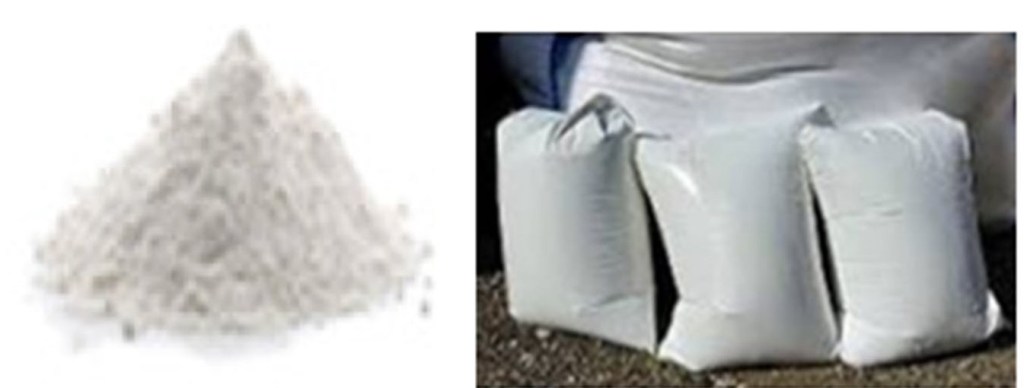
Fig. 3: “Unslaked” lime in bulk powder (left) and “slaked” lime in pulp, packaged in nylon sacks (right)

Notes:

  1. The text that follows is based on the narratives of my late grandparents Nikonas D. Dimitrakopoulos, Georgios K. Kourtalis, and my grandmother Marigo N. Dimitrakopoulou, née Efstratios Orfanakos, residents of Xirokampi, which I recorded as a young student in a school notebook in April 1987. See also I Pharis 51 (2010), pp. 5-7.
  2. Copper cauldron
  3. River stones: White limestone rocks
  4. Marble stones: Gray limestone rocks
  5. Linen sacks: Large woven sacks made from flax fibers.
  6. See Vasileios I. Christopoulos, The Expenses of a Family at the Beginning of Our Century, I Pharis 17 (1997), p. 5.
  7. The okka (Turkish: okka) was a unit of mass measurement used in Greece until 1958, when it was replaced by the kilogram. One okka equaled 400 drams and corresponded to 1,282 grams, while one kantari equaled 44 okkas, or 56.4 kilograms today.

I (Carol Kostakos Petranek) am honored to receive permission from the Katsoulakos family to translate and share articles from The Faris. Translation verification and corrections have been made by GreekAncestry.net. This is the twenty-first article of the ongoing series. Previous articles can be viewed here.

The Rescue of the Kamchi Family from Athens

published in The Faris Newsletter Issue 74,  July 2021,  Page 4
by: Panagiota (Pitsa) S. Katsoulakou (Part I) and
Gerasimos (Makis) St. Katsoulakos  (Part II)

[Note by Carol Kostakos Petranek:  Stories of the German occupation of Greece abide in our families and in our history. The narratives are harrowing, but there are stories, such as this one, which reveal the altruism of humanity. Although there are many accounts of those bravely who sheltered Jews, Dimitris Katsoukakos told me that his family had done so, and that the story was published in Φαρις. It is translated here to acknowledge, with great respect, those who risked their lives to save others.]

Part I:

From the pre-war years [World War II], my uncle Petros Katsoulakos son of Ilias, first cousin of my father, and his wife Eleni Demonti from Smyrna, lived in Athens. They had rented their house in Katsoulaiika of Xirokampi, which was across from ours. Whenever they came to the village, they stayed in our house. Uncle Petros had a brotherly relationship with my father.

Uncle Petros had a good friend in Athens, Victor Kamchi, Jewish by religion. When in autumn of 1943 things became very difficult for the Jewish populations of Greece, Uncle Petros smuggled the Kamchi family out of Athens. He brought them to our house. I was nine years old then. We children did not know who they were or that they were Jewish. I remember they had Christian names. Apparently, they had changed them for safety. We knew they were visitors from Athens, friends of Uncle Petros. My siblings and I gave up our beds to accommodate the visitors. Besides, Uncle Petros often brought guests from Athens to our house.

They stayed in our house for several days; I don’t remember for exactly how long. One day, there came to our house two siblings, Agisilaos and Rosalia Koutsoulieris, our relatives from Kotronas, Mani, the village of our family’s distant origin. The next morning, Uncle Petros, my father, and the two Koutsoulieris siblings took the Kamchi family to the Lykopanagou Inn.1 Their belongings were loaded onto two mules, ours and Uncle Petros’. From the Lykopanagou Inn, the Koutsoulieris with the Kamchis would leave by truck for Kotrona.

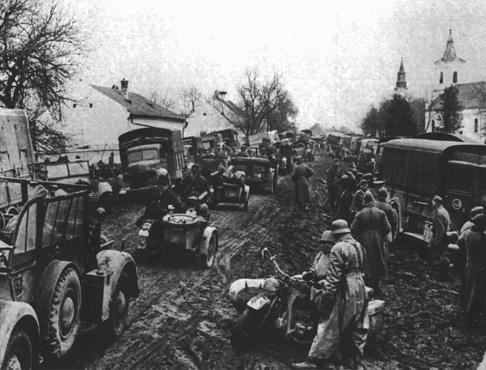
SS troops advance during the invasion of Greece.
National Archives and Records Administration, College Park, MD; US Holocaust Museum – https://encyclopedia.ushmm.org/content/en/photo/invasion-of-greece

Part II:

The Kamchi family came to our house introduced as the Papadopoulos family. I don’t remember how many days they stayed. Besides, a house in the countryside did not face serious food problems, as happened in cities then. However, the issue of security was paramount. The fear of the Germans was pervasive. I remember that our parents sometimes sent me and Nikos, my older brother, to Ai-Lias of Kamini, a hill of the neighboring village, to observe if there were any German movements in the plain. After some days, the Kamchi family left for Kotrona to stay in the house of our relatives Koutsoulieris for better safety.

The Germans left and the war ended. The Kamchi family survived and returned to Athens. After the war, I also lived in Athens for several years. Together with my aunt Lela (my uncle Petros was no longer alive, as he was executed in the December Events), I visited the Kamchi family several times at their house in Patisia on Drosopoulou Street.

___

1An inn of that time on the western side of the national road from Sparta to Gytheio. Today in this space there is a gas station slightly south of KEEM camp.


I (Carol Kostakos Petranek) am honored to receive permission from the Katsoulakos family to translate and share articles from The Faris. Translation verification and corrections have been made by GreekAncestry.net. This is the sixteenth article of the ongoing series. Previous articles can be viewed here.

Memory Eternal: Georgia Stryker Keilman

My dear friend and Greek genealogy colleague, Georgia Stryker Keilman, left earth suddenly and unexpectedly on January 5, 2025. Over the past fifteen years, we have collaborated and planned and worked together on many projects and initiatives to benefit our worldwide Hellenic genealogy community. We encouraged each other to keep moving forward on both our personal research, and on our individual and joint efforts to help people of Greek descent learn how to find their ancestral families. Words cannot describe my intense feelings of loss.

Georgia was a pioneer in the Greek genealogy community. On April 16, 2010, when Facebook was in its infancy, she conceptualized a group with a two-fold mission: a place where she could share information about Greek genealogy, and a forum where Greeks worldwide could help each other with their genealogy research. Her Hellenic Genealogy Geek Facebook group is now the meeting place for our community with an astounding 45,800 members (as of this date)!

But Georgia did not stop there. She created a companion Hellenic Genealogy Geek Blog which gave her a narrative format to write about print, photographic and online resources. In 2012, Georgia discovered that Election Registers for the years 1872-1873 were online at the General State Archives of Greece website. She downloaded hundreds of pages and began transcribing the names from Greek into English. She published these lists on her blog and printed them in books, thus creating what most likely is the first online-accessible indexed records of Greek names on both the internet and in print.

The community’s enthusiastic response to Georgia’s work encouraged her to keep going. Her number of translated lists grew rapidly.

Georgia continued this work for several years, completing translations for the astounding number of 253 villages! She reluctantly “retired” from this project only when our friend, Gregory Kontos founded GreekAncestry.net. Georgia’s lists are still in use and remain online here. Their organization by village makes them especially useful, allowing researchers to easily identify family surnames specific to each village.

In 2021, Georgia felt it would be helpful for the community to have a website of Greek research links–a “one stop shop” of sorts, where people interested in a specific topic could find information without having to spend hours surfing the web. That’s when Hellenic Genealogy Geek Research Links was created. Our conversations for weeks centered on this project. Georgia spent countless hours combing through both the web and her personal data collections to compile and organize thousands of online links.

In addition to the Facebook group and her two websites, Georgia helped organize the first-ever in-person Greek genealogy conferences in the United States: April 2015 at Holy Trinity Cathedral Ballroom in New York City with Ilias Katsos and the Education and Culture Committee of the Hellenic American Chamber of Commerce; and September 2015 at the Hellenic Memorial Building at Holy Trinity Cathedral in Salt Lake City with the Hellenic Cultural Association and the Ethnic and Mining Museum of Magna, Utah. She and I worked together and rejoiced together at these historic events which enabled diaspora Greeks to meet, learn and share their passion for genealogy.

Georgia’s friendship with Gregory Kontos of Greek Ancestry was priceless–filled with humor, mutual appreciation and respect. She so enjoyed working with him to plan and organize Greek genealogy conferences and webinars; and to coordinate the first-ever podcast for Greek genealogy, “G(r)eek Talk.” Georgia’s analytical mind always predominated in these planning sessions, and we were confident that she would find any “hole” or missing piece in whatever was being considered. And she always did!

The most recent initiative that Georgia and I completed together was the video series, “Bite-Sized Greek Genealogy.” We noticed that new members of HGG were asking the same questions and decided that brief recordings would be an effective way to provide answers. We brainstormed topics and ideas, found relevant materials, and had many laughs in creating the series. When it was finished, Georgia suggested that we create a companion booklet which would contain the talking points of our videos as well as additional information and online links. She was always seeking ways to make something good even better.

These initiatives were on top of Georgia’s daily tasks: to administer the ever-growing HGG Facebook group, to continue to locate and publish information for her websites, and to work on her own personal research. The project of most importance to her personally was “Your Greek Roots,” a family history book she wrote in 2019. Dedicated to her nieces and nephews, it represents Georgia’s desire to ensure that her closest family members understand their heritage and never forget their roots. I can testify that compiling this book and contemplating its importance to her family brought Georgia immense joy.

“Excellence is never an accident. It is always the result of high intention, sincere effort, and intelligent execution; it represents the wise choice of many alternatives – choice, not chance, determines your destiny.” ~ Aristotle [Nicomachean Ethics]

Georgia’s intentions, efforts and choices led to her to devote this stage of her life to helping others. This is her legacy and for it, she will remain highly respected, deeply loved and forever missed.

Please see this wonderful article about Georgia which was published in NeosKosmos on February 26, 2018.

OBITUARY

Georgia Stryker Keilman, aged 74, passed away peacefully at her home on January 5, 2025, in Mount Prospect, Illinois. She is survived by her brothers, Tom and Peter, as well as her adult nieces and nephews: Alexandra (Daniel), Christine, Christopher (Lindsey), Steven (Kellie), George, Michael, Katherine (Zar), and Sergio. Georgia was also a devoted great-aunt to her beloved grand-nephews and nieces: Elijah, Isaac, Maddie, Evelyn, Jack, and Nina.

Born as Georgia Ann Stryker, she was the eldest daughter of Ann and George Stryker of Chicago, Illinois. Georgia’s warm personality and adventurous spirit shaped her remarkable life. She pursued a successful career as Director of International Marketing in the medical device industry, which afforded her opportunities to travel extensively. During her career, she lived in Boston, Massachusetts; Sydney, Australia; and Athens, Greece, before ultimately returning to the Chicago area to be near her family.

Georgia had a deep love for her family, a keen talent for research, and a genuine curiosity that inspired her to embark on a meticulous investigation into her family’s Greek genealogy. In 2009, she founded the online community “Hellenic Genealogy Geek,” a platform dedicated to sharing and exploring Greek ancestry. This community, which began as a passion project, eventually grew to include over 45,000 members from around the world. Georgia found immense joy and purpose in connecting Greeks in the diaspora with their familial heritage and ancestral roots.

Her contributions to the Hellenic Genealogy community are considered her life’s work. Georgia’s dedication to assisting people worldwide in uncovering and cherishing their family legacies is a lasting testament to her generous and inquisitive spirit.

Georgia will be deeply missed and lovingly remembered by her friends, family, and the global community she nurtured. A private family gathering will be held in her honor. Additionally, condolences and prayers from her online community will be shared at a memorial event hosted virtually.

For those wishing to make a donation in Georgia’s memory, contributions can be made to support the archives of rural Greek villages via the following link: https://www.facebook.com/100001113949069/posts/8921917944521915/.

To learn more about the Hellenic Genealogy Geek community, please visit:

Mills – Mylovagena (Μυλοβάγενα)

by Charilaou N. Stavrogianni
published in The Faris Newsletter Issue 74, July 2021, pages 8-9

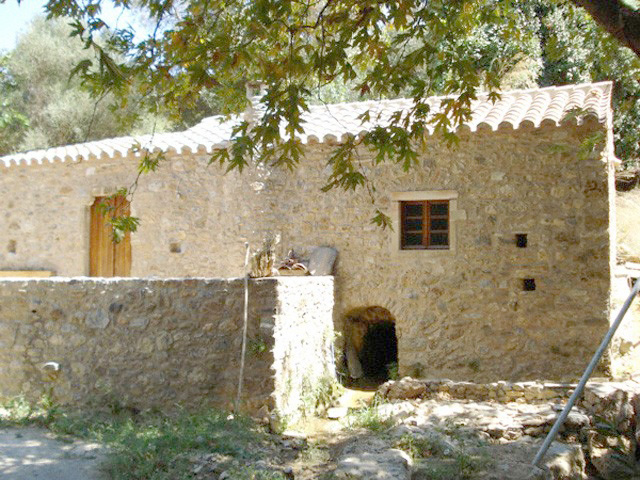
The area around Konstantinos Plainos’s house down to the Rasina river was called Mylovagena because of the pre-existing watermill there.

Flour Mill in Talanta (Monemvasia), Lakonia, Greece
Source: Lakonika.gr

Many times I think of a visit with my mother to get our flour from the mill when I was a small child. Arriving there I heard a loud noice which came from the waterfall through the basins. This made me afraid. Entering into a low-ceilinged, dimly lit room and seeing white dust floating, I became even more afraid, culminating with the appearance of a human shadow full of flour dust. Finally this human shadow came and stood beside me and began to stroke the hair on my head. As he spoke to me, I realized it was my grandfather, the miller of the watermill, who had rented the mill from the monastery of Zerbitsa. Then he loaded our flour onto our animal, which we had tied outside the watermill to a thick wooden post placed there for this purpose, lifted me onto the animal’s saddle between the two sacks of flour, and my mother and I took the road back, which made me feel great relief from the fear that had overtaken me inside the mill.

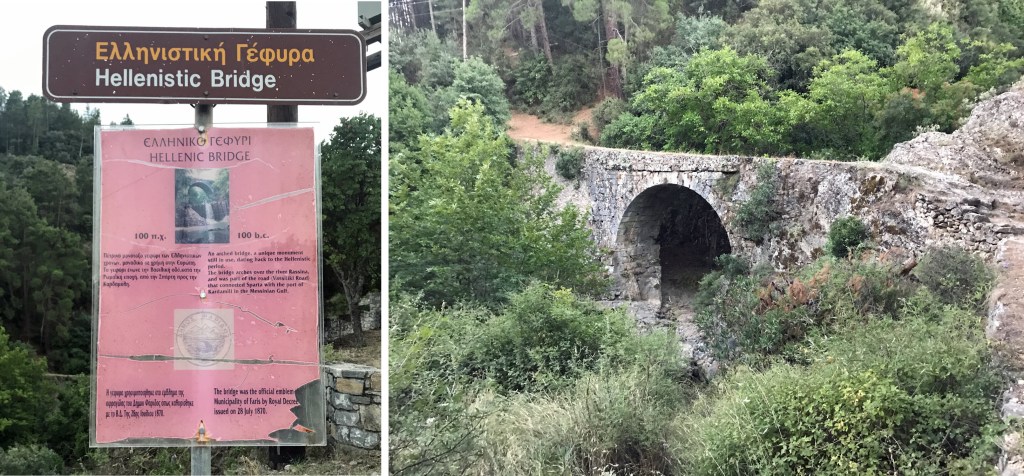
Later, when I was a much older child, I would ask my grandfather to explain to me the the entire process and operation of the mill. He told me that the miller’s biggest problem was the water, which was the driving force for the mill to work. The water came to the mill through a large earthen channel, called the milavlako. It started just under the arch of the Greek Bridge. That is where the dam was.

Hellenic Bridge, Xirokampi; Photos by Carol Kostakos Petranek

He would also tell me: To divert the water, I would climb on the rocks and cut branches of mastic and holly trees and place them in the river water, weigh them down with large stones, and pray to God, making my cross, that the river wouldn’t regularly flood and wash away my dam and I would have to start all over again. This must be how the saying arose “Everyone cries about their pain and the miller about his ditch.”

The milavlako with its abundant water passed over a concrete bridge exactly before and above the mill, so that the road would not be closed and and to form the appropriate height. In the past, before cement, the bridge was constructed with thick boards. On the bridge somewhere in the middle there was a divider for the miller to distribute the water as he wished, before it fell into the barrels. The vats had large, tall openings and were made of thick sheet metal with many external metal rings to withstand the water pressure. From these came the name Mylovagena. The water fell with great pressure and force through the vat onto the wheel, which was a propeller of thick pine boards, which the miller obtained from the woodcutters of Koumusta. The powerful fall of water continuously rotated the wheel, whose axle turned the upper horizontal cylindrical millstone. The bottom stone remained stationary. The miller would pour the wheat through a hole in the center of the upper rotating millstone. With this motion the wheat would break, being crushed between the two millstones and become flour. The producer paid the miller a fee of 8-10% on the quantity of flour, exactly as is done in today’s olive mills.

Millstone from Talanta (Monemvasia), Lakonia, Greece
Source: Δ. Αβούρης, Lakonika.gr

The watermill area was sold shortly after 1950 by the abbess of the Nymphodora monastery, in order to build the building that housed the looms and is today the monastery’s guest house. The mill with all the surrounding area was bought by Stratigis Solomos. Perhaps the mill worked a little longer. After all, the new owner had his own flour mill. Shortly before 1980 the mill was sold again by G. Venetsakos, a primary school teacher from Potamia, who had received the mill from Solomos as dowry.

Today in area around the mill and on both sides of the road, there are two houses. In less than thirty years the mill changed hands four times. Outside the mill there was also the most beautiful well of Xirokampi. Its external appearance was square with beautifully carved pistachio colored stones. Today it does not exist. It seems we did not like the tradition. The only thing that has remained from Mylovagena is the stone staircase, which went down to the mill and the well.

On the Greek islands, where there was not plenty of water but there was plenty of but strong air, the so-called windmills operated. Some are still in operation today.

In almost all the villages of our region there were also household hand mills. These were two horizontal cylindrical millstones, naturally small in size and weight so they could be moved easily. The bottom millstone always remained stationary and at the edge of the top there was a small hole, where a wooden handle was placed, hence the hand mill. In the middle there was a larger hole, where they would drop the wheat. As the top millstone rotated, the wheat was coarsely ground, exactly as they wanted to make sweet couscous and then in the winter the delicious pumpkin pies in the wood-fired oven of the house. The hand mill was a miniature of the watermill and, instead of water as a driving force, it had the power of a human woman’s hand.

It would be an omission to forget the coffee mills. Many times I remember the grandmothers, who with a metal device, the so-called mill, would grind coffee beans in the evenings in the fireplace of their house and the whole neighborhood would smell of coffee beans. To increase the quantity of coffee and for health reasons they would also throw chickpea seeds into the roaster. Today the mills that once ground coffee decorate a shelf or other place in the house as antique souveniers.

Tradition tells many stories and tales about millers and watermills. Also many proverbs, such as: “Everyone cries about their pain and the miller about his channel”, “Without water the mill does not turn”, “A good mill grinds everything.”

Writing the last proverb, I remembered what my grandfather would tell me: During the difficult and poor years of the Occupation and the subsequentl civil strife, in order to survive the watermills had to grind not only wheat and corn, but even barley, lupines and acorns, after drying the latter in the oven. The last three types, without mixing wheat flour and wheat-corn flour, produced very bad black and bitter bread. During the latter part of my life I had heard many times the phrase: “I ate or have eaten the bitter bread of Occupation.”

NOTE: Additional information about the mills of Talanta (Monemvasia), Lakonia can be found in this article at Lakonikos.gr.
__

I (Carol Kostakos Petranek) am honored to receive permission from the Katsoulakos family to translate and share articles from The Faris. Translation verification and corrections have been made by GreekAncestry.net. This is the twentieth article of the ongoing series. Previous articles can be viewed here.
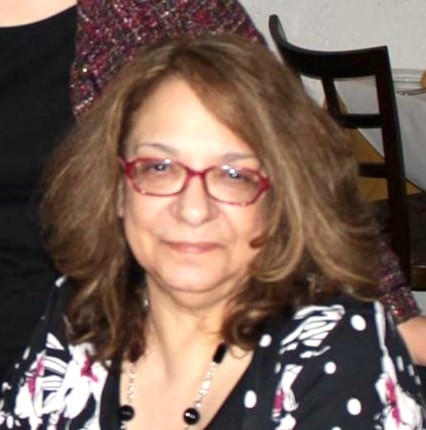
Greek Genealogy and Spartan Roots Radio Interview, WNTN Boston

On November 25, 2024, Meletios Pouliopoulos of Greek Cultural Resources interviewed me on his weekly radio program at Grecian Echoes, WNTN Boston. A kind and gracious host, he wrote to his audience: I had the pleasure of interviewing a Greek genealogy expert, who is doing remarkable work. If there are any Greek heritage awards to be given, she and her colleagues should be at the top of the list.

We had a delightful and productive half-hour discussing civil and church records access in Greece; the Bite-Sized Greek Genealogy video series and its companion handbook, the work being done here at Spartan Roots and my village history project at Agios Ioannis, Sparta. We talked about online Greek record resources at Greek Ancestry.net and Hellenic Genealogy Geek website and Facebook page.

The segment is now available on Youtube.

Meletios is a man who is laser-focused on preserving Greek-American music and culture. For years, he has single-handedly collected recordings of Greek music, manuscripts, and films as well as newspapers, books and other publications. This provides a unique resource to musicians, teachers and the public. Read more about Meletios and his non-profit organization, Greek Cultural Resources, here.

Thank you, Meletios, for the opportunity to discuss our shared passion for Greek heritage preservation. I wish you every success in your most important work!