Unknown's avatar

About Spartan Roots

I am of Greek ancestry with roots in villages near Sparta. My paternal grandparents and maternal grandfather were born in Agios Ioannis (St. Johns), and my maternal grandmother was born in Mystras. I love family history research and have been tracing my roots for many years. I was born in Brooklyn, New York and was raised in a predominantly Greek neighborhood close to extended family. I live in the Washington D.C. metropolitan area and work as a volunteer Co-Director of the Washington, D.C. Family History Center and a genealogy aide/project aide at the National Archives in Washington, D.C. I am always updating and adding new information. Please contact me - I would love to hear from you!

Greece 2017. Archives Research: Sparta

Sparta–the nexus of my family. Wouldn’t you think that three weeks would be ample for research? I worked hard, but I ran out of time. And my “next trip” list continues to grow.

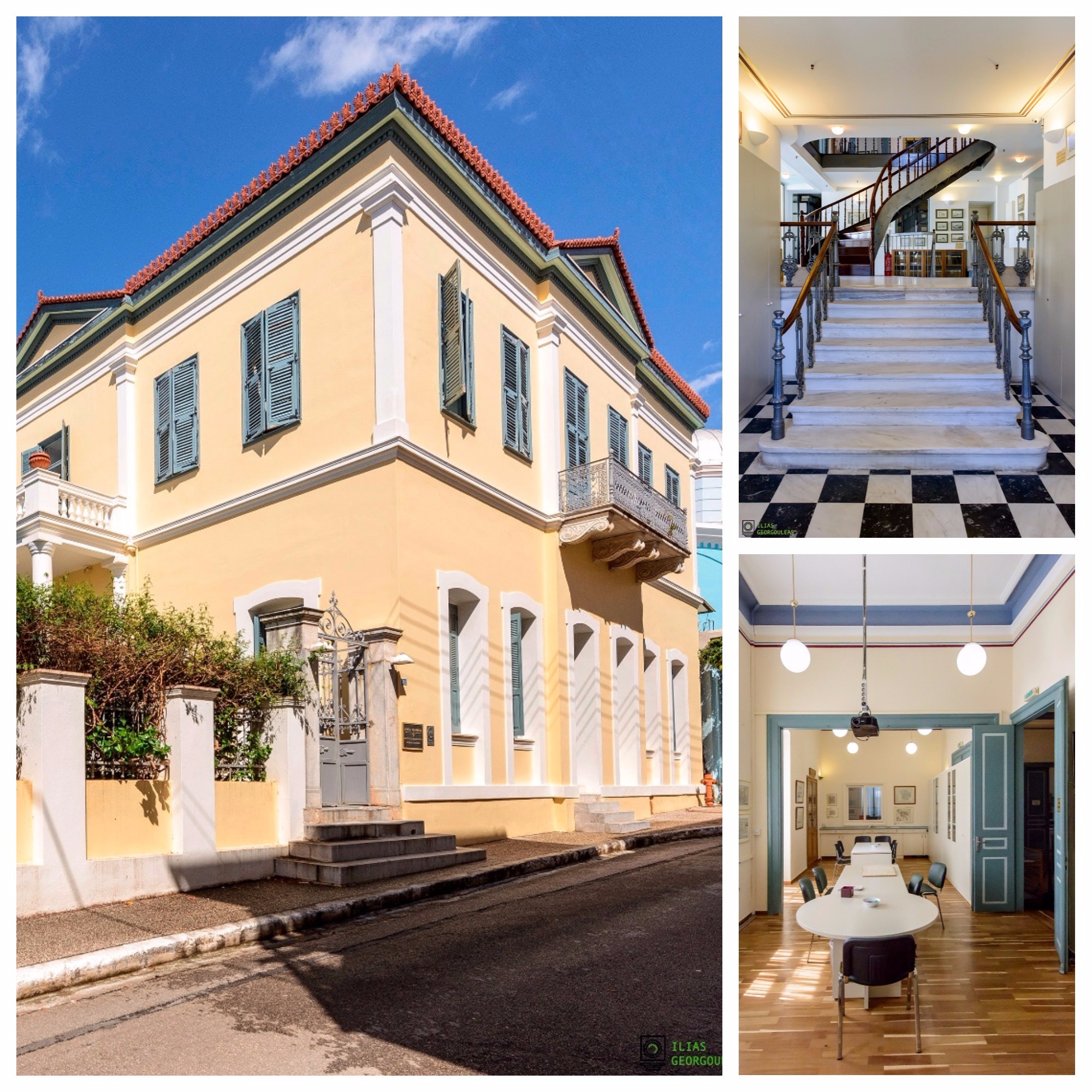
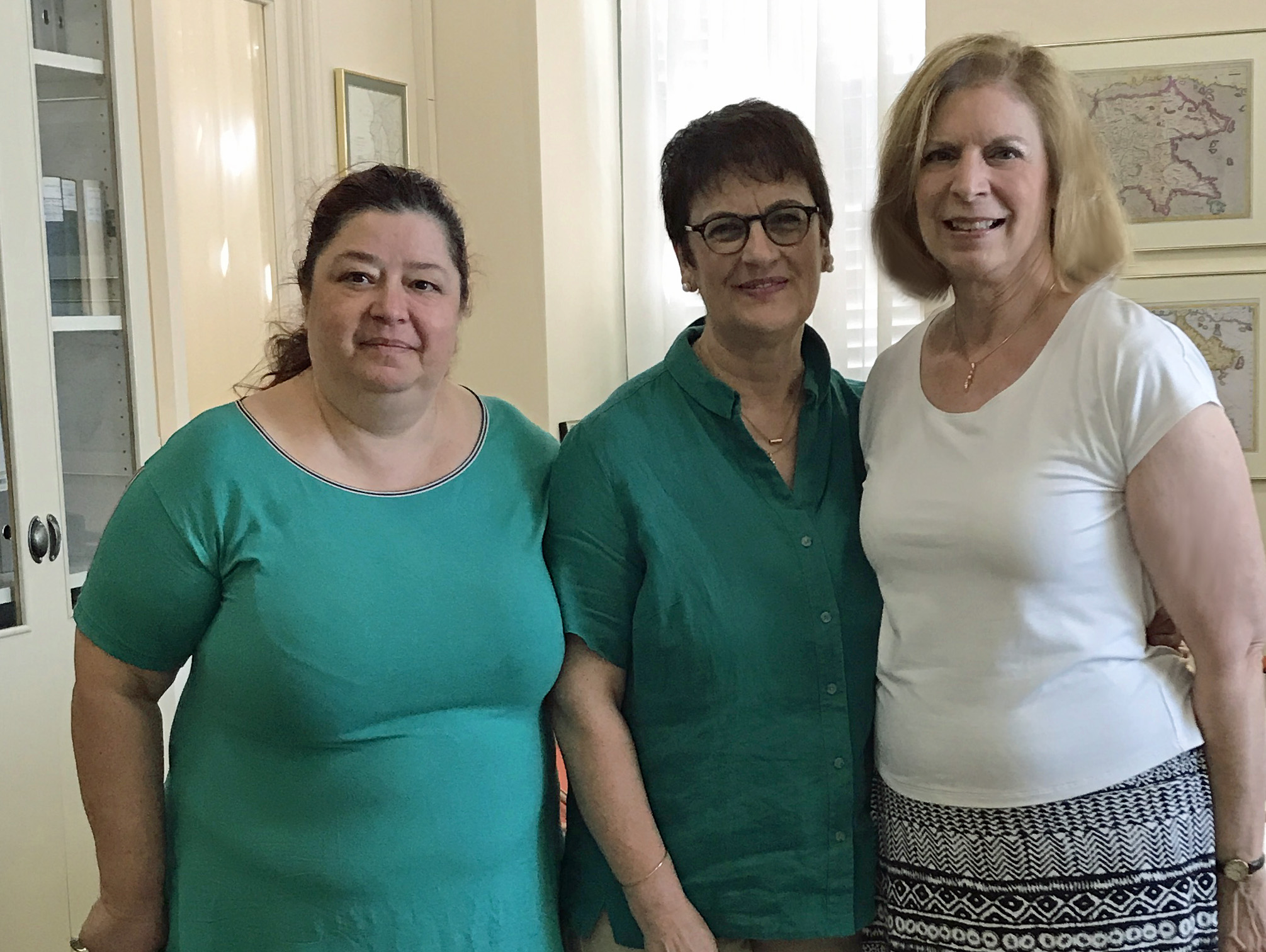
My home base was the General Archives of Greece, Sparta office. Pepi Gavala, Archivist, and her staff, Michalis and Electra, are friends. They welcomed me with much hospitality, patiently answered endless questions and fulfilled requests for many records.

Sparta office of the General Archives of Greece, July 2017

While searching Dimotologion (Town Records), I worked at a computer as these records have been digitized (accessibility is strictly at the Archives, not online). While searching books and documents, I piled records onto the conference room table and spread out as needed.

Sparta office, General Archives of Greece

After three visits (2014, 2016, 2017), how much more can I find there? A lot–and I’m not finished.

As my research expands into collateral lines, I desire to learn about the families that merged with mine. Some days, I spent a full 6-hours finding “new” families in the same Town Registers that I had searched in previous years. My work has expanded into School Records, which are critical in finding the names of girls which may not be found in other records.

And this year, I branched into Contracts. These were written and certified by notaries and include dowries, powers of attorney, deeds, debts and other legal matters. Michalis explained that there are 60 files of contracts, but only two have been digitized and uploaded to the Archives of Laconia page of the GAK website. The others must be pulled from paper files.

The staff have painstakingly compiled name indexes of some of the notary files. These  indexes are kept in notebooks, organized by the name of the notary. Here is a sample page from the notebook for the notary, Konstandinos Dimopoulos.

How to Access Dimopoulos Notarial Records Online

Let’s use the page above as an example.  Note: each step below is hyperlinked (blue text) to the corresponding page on the website.

  1. Find the name of interest: surname, first name, middle initial.  I found Zarafonitis, Ilias of Sklavachori, 2nd from the bottom (red arrow on left)
  2. Look at the reference number (green arrow on right). Write down that number, which is 362/2.5.1864. This means:  the contract number is #362; and the date is 2 March 1864.
  3. Click on this link
  4. This is the page that will appear. The red arrow points to the name of Konstandinos Dimopoulos, so you are on the correct webpage.

Web page for the records of notary, Konstandinos Dimopoulos

Click on the Contents tab.

The following page will appear. Within the red box, we see that there are 26 Files. This screen shot shows Files #001-005.

The Dimopoulos web page contains 26 files

Each of the 26 files has between 200-300 contracts within. There is a total of 7,611 contracts in this collection This is a list of the contract numbers within each file:
File #:   Contract #
File 1: 1-350
File 2: 351-550
File 3: 551-850
File 4: 851-1150
File 5: 1151-1450
File 6: 1451-1760
File 7: 1761-2060
File 8: 2061-2360
File 9: 2361-2650
File 10: 2651-2950
File 11: 2951-3280
File 12: 3281- 3580
File 13: 3581- 3900
File 14: 3901-4200
File 15: 4201-4550
File 16: 4551-4850
File 17: 4851-5150
File 18: 5151-5400
File 19: 5401-5700
File 20: 5701-6000
File 21: 6001-6300
File 22: 6301-6600
File 23: 6601-6900
File 24: 6901-7200
File 25: 7201-7400
File 26: 7401-7611

Now, let’s navigate the website to find documents for the example of Ilias Zarafonitis, reference number 362/2.5.1864. The list above shows that contract number 362 is found under File 2.

On the website, first click on File 2, then click the tab, Contents. This is the page that appears. The Item numbers are the contracts found under File 2 (#351 – #550):

File 2 includes contract numbers 351-550

Scroll down to Item #362; click on the words Item #362, then the tab, Contents. The page below appears. Next, click on the Reproductions tab that is highlighted by the red box.

Description of Item 2, Contract #362

It is under this Reproductions tab that the digitized documents appear: Take_001 is page one, and Take_002 is page two of the Ilias Zarafonitis contract #362/2.5.1864. To view the images, click on each one; they can be downloaded.

Pages 1 and 2 of Contract #362 for Ilias Zarafonitis

Contract: Ilias Zarafonitis and Spyros Economidis, page 1

Contract: Ilias Zarafonitis and Spyros Economidis, page 2


This is a contract between Ilias Zarafonitis of Sklavachori and Spyros Economidis of Sklavachori. Ilias has purchased 1/3 of a dwelling and 1/3 of its field from Spyros, for the amount of 362 drachmas. The witnesses are Ioannis Athanasopoulos of Sklavachori and Anagnostis Ilias Zografos of Sparta. The contract is dated 2 March 1864.

This document places these four men in their respective villages in 1864, an era with minimal documents. It also raises some questions: why would Ilias purchase only 1/3 of a dwelling and field? What relationship does he have with Spyros, if Spyros owns the remaining 2/3? How much is 362 drachmas worth in today’s money?

I am excited to step into the world of Contracts, but I cannot do so alone. My language skills are minimal, and my ability to read these documents is impossible. When I reach this impasse, I call upon Giannis Michalakakos (who translated this document) and Gregory Kontos. Their friendship is precious and their help is immeasurable.

Future posts will explore some of the Contracts I am accessing.

Previous posts have explained what I have learned about Male Registers, Town Registers, and School Registers in the Sparta Archives:

Archives of Sparta: Mitroon Arrenon (Male Registers)

Archives of Sparta: Dimotologion (Town Register) Records

School Records from Sparta: Finding Your Ancestors as Children


Greece 2017. Archives Research: Kalamata

My research trips are super-intensive. This is due in part to my personality, and in part to the limited working hours at Greek repositories. Archives and libraries’ hours of operation are 8:00 a.m. until 2:30 p.m., and unlike shops, they do not reopen after 6:30. None are open on Saturdays, not even the Central Library of Sparta.

So, my weekday work schedule looks like this:
7:00 – wake up
8:00 – be at the repository
2:30 – leave (or get kicked out)
2:30-6:00 – go someplace that is open: a cemetery, an archaeological or historical site, or take a drive through a village. It’s beastly hot in mid-afternoon in July, but I won’t waste three precious hours.
6:00-midnight – change clothes, visit family or friends for dinner which usually begins around 9:00

Honestly, I came home more tired than when I left. But I also came home with tons of new information.

I was anxious to return to the Archives in Kalamata. During my visit of July 2016, the office was moving to a new location and everything was packed in boxes, which made research impossible. I was thrilled to see its new home: a stunning neoclassical building constructed in the 1880’s and rebuilt after the earthquake of 1986.

General Archives of Greece, Kalamata, Messinia

I am ever grateful for the help and kindness of my friend, Giota Siora, who met me in Kalamata and escorted me to the Archives. Giota knows the archivist, Anastasia Milioni, who was eager to assist us in any way possible. My goal was to search for information about two families with possible early ties to the Kalamata region: Eftaxias (prior to relocating to Mystras) and Zaharakis (prior to relocating to Theologos).

GAK, Kalamata: Giota Siora; Anastasia Milioni, Archivist; Carol Kostakos Petranek, July 2017

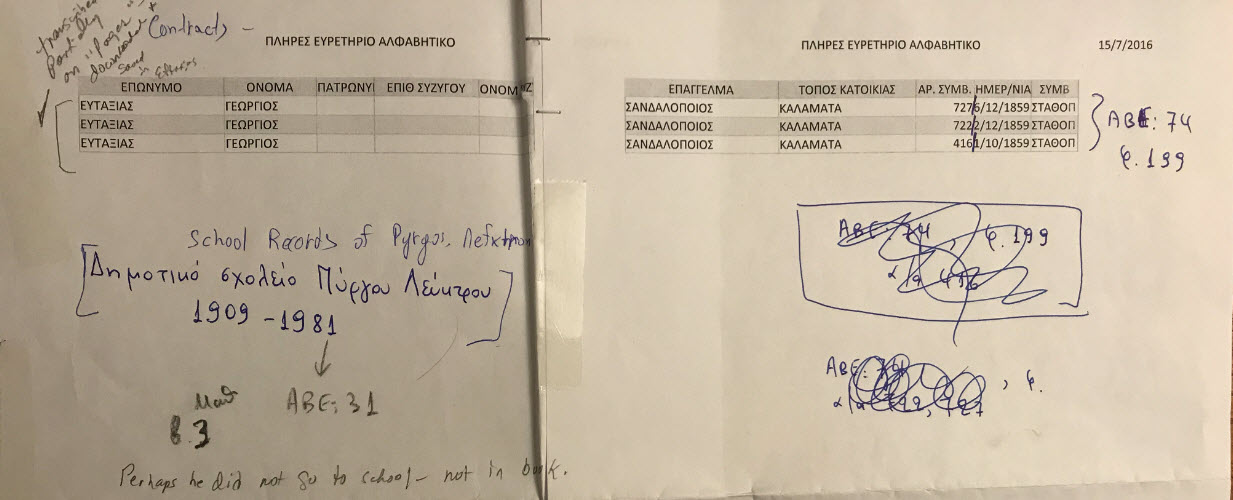
In 2016, Mrs. Milioni had given me a print-out of contracts with the Eftaxias name. There were three for Georgios Eftaxias who was in Kalamata in 1859.

Eftaxias contracts, 1859. General Archives of Greece, Kalamata, Messinia

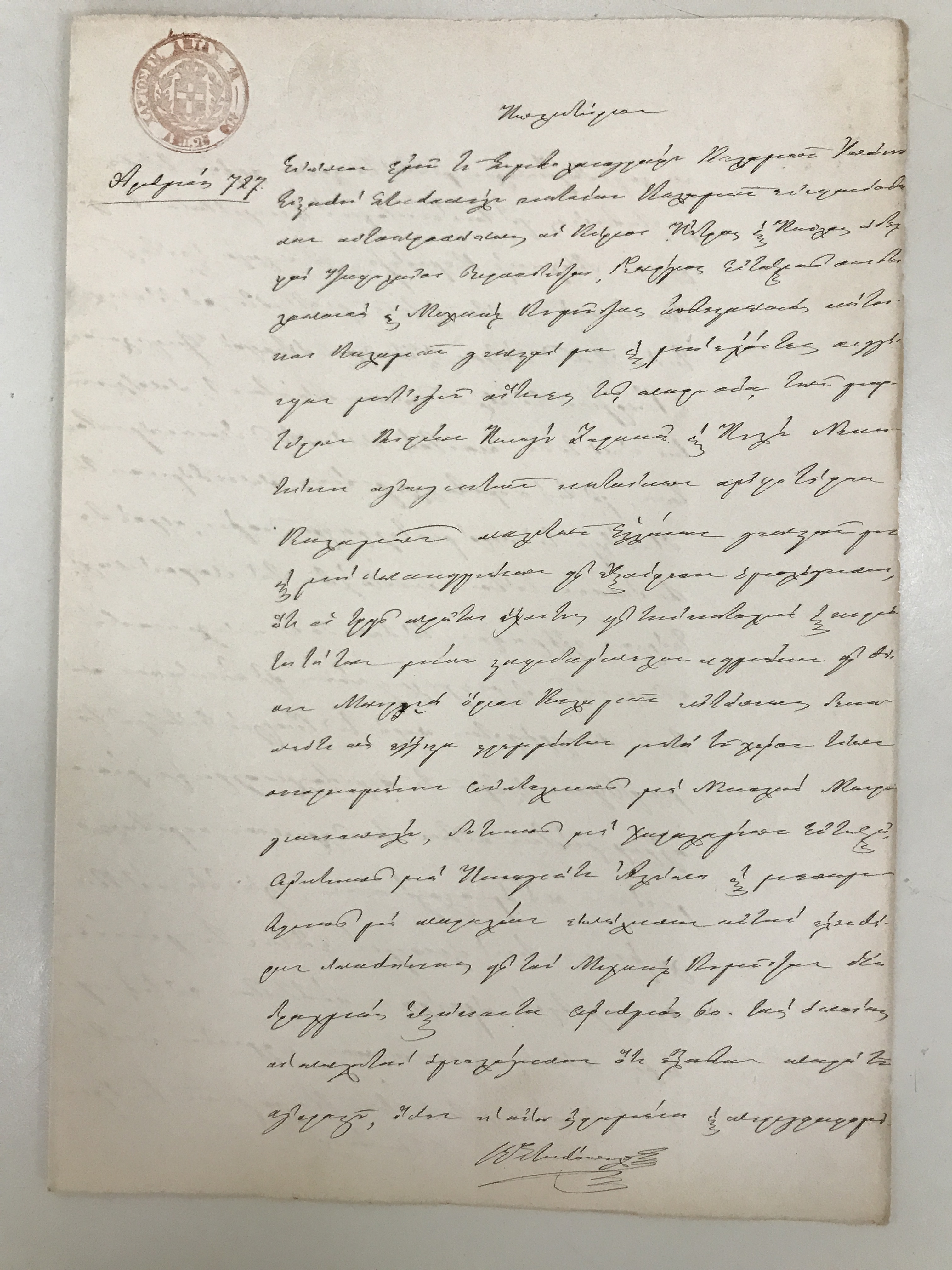
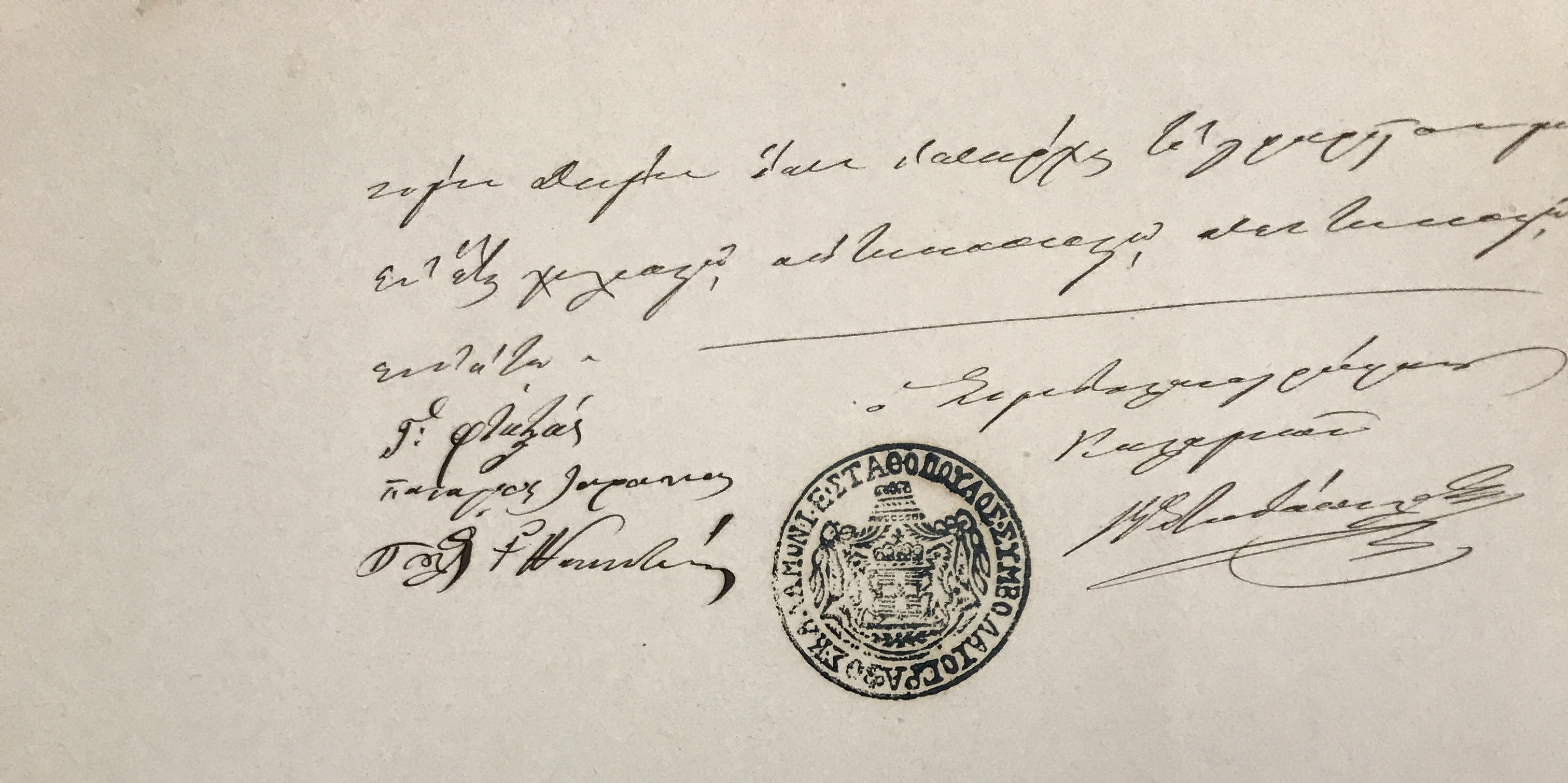
After the contracts were retrieved, Giota amazed me with her ability to read the documents. They were not written in typical old Greek script, but in a specific type of calligraphy used by lawyers and high government officials in the 1800’s.

Below are page one and the signature page of Contract 727 for Georgios Eftaxias, along with a synopsis by Giota.

Eftaxias, Georgios; Contract 727 p.1. Kalamata, Messinia. July 2017

Eftaxias, Georgios; Contract 727 p.3 – signatures.. Kalamata, Messinia. July 2017

Contract 727 Georgios Eftaxias in Kalamata 1859
Final payment on land purchase
Georgios Eftaxias bought a field at Mavria (on the border of Messinia and Laconia). He paid 60 drachmas on the balance due. He bought the land from Michail Koumoutsas who was a lime maker. One of the owners of land bordering his is Haralambos Eftaxias.

With three contracts for Georgios Eftaxias, I now have proof that a family was in Kalamata. But is this my family? Possibly yes, possibly no.

  • I have an Eftaxias “DNA cousin,” Peter, who was born in a village adjacent to Mystras. His father said that their Eftaxias family came from Kalamata. This is definitely his family. Since we have a genetic connection, this is one point on the “yes” side.
  • The very name, Eftaxias, has ecclesiastical connotations. Gregory Kontos sent me this definition: the one that is in charge of the good order of the church:   good=ευ order=τάξη. So, this could be an example of families who had worked in a church and adopted the position title as a surname. This is one point on the “no” side.

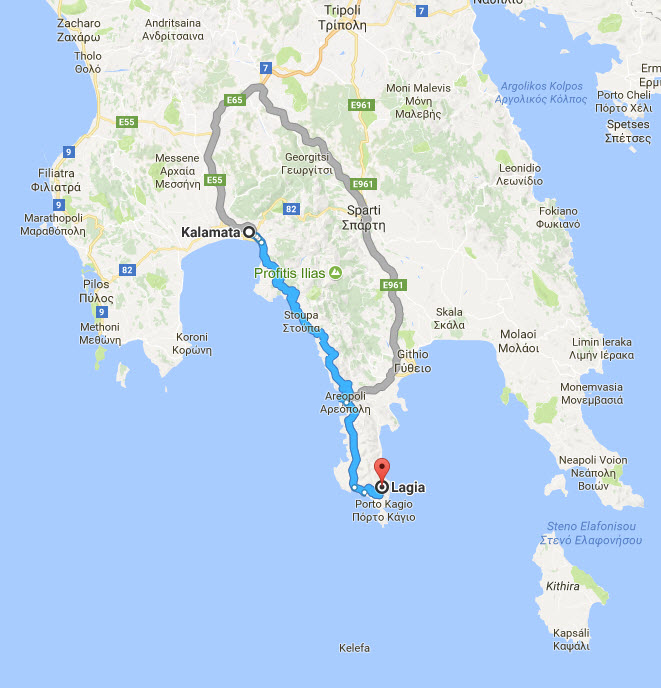
Another twist:  the Election Lists of 1875 show a Michalis Eftaxias who was born around 1800, fought in the Revolution, and lived in Lagia. That is 117 km from Kalamata, a 39-hour walk! Is it possible these two families are related? Not impossible, but perhaps improbable. This could be an example of the second bullet–someone working in a church, taking the ευταξη title as a surname.

So, the definite answer to my question is, “I don’t know.”

Lagia to Kalamata is 117 kilometers

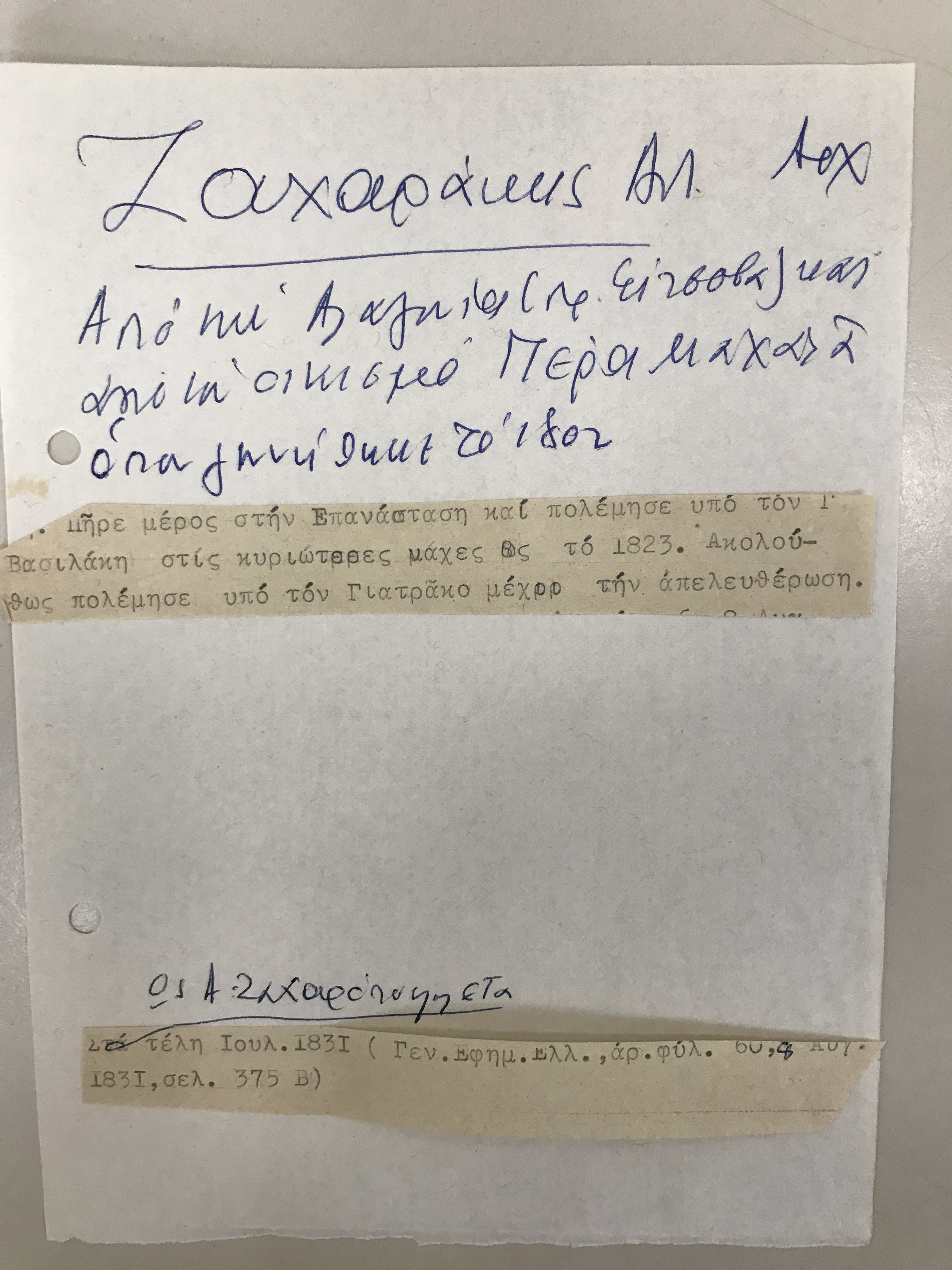
The Archives in Kalamata has a one-of-a-kind collection created by Μίμη Iλ. Φερέτος (Dimitris or Mimi Il. Feretos).  Giannis Michalakakos described Mr. Feretos as a journalist and writer who gathered information on fighters of the 1821 Revolution. In the early 1900’s, he interviewed people who had fought (or whose relatives fought) in the War of Independence. Mr. Feretos created a surname index which include brief notes and reference sources to find the original documentation. The GAK in Kalamata has a bookcase filled with Mr. Feretos’ notebooks. They are arranged in alphabetical order, and Giota easily found the Eftaxias and Zaharakis surnames.

This is a copy of one of the Feretos pages for Zaharakis. I found it fascinating to see how Mr. Feretos compiled and annotated information, long before the computer age.

Zaharakis surname, notes from the files of Mimis Il. Feretos, GAK Kalamata, July 2017

A simple translation of this document, with my thanks to Giannis: M. Zaharakis, born in Sitsova [now known as Alagonia on the border of Messinia and Laconia]. He fought in the Revolution under George Vasilakos, in the main battles until 1823. Afterwards, he fought in the war under the Giatrakos family. In some documents, he is referred to as Zaharopoulos.

This document reveals two important things: first, M. Zaharakis is not my family; he was born in a region far from Theologos at a time when my Zaharakis are found in documents in Theologos. Second, M. Zaharakis was also known as Zaharopoulos. This is a critical piece of information because there is a long-standing (and frustrating!) pattern of Greeks changing their names. Having written proof that Zaharakis and Zaharopoulos in Kalamata are the same family, saves years and tears for the serious researcher.

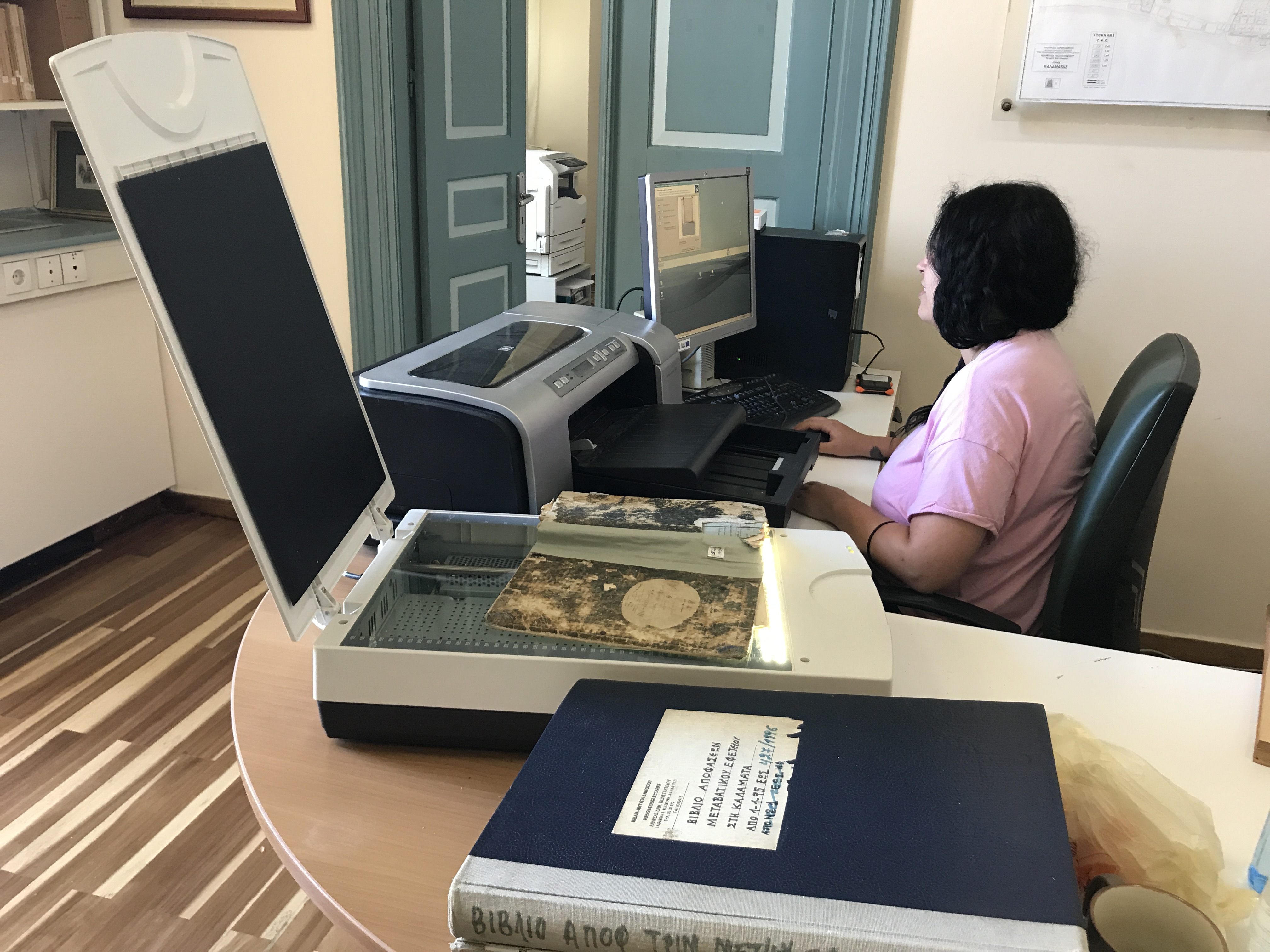
For anyone researching in Messinia, the Archives in Kalamata is an essential repository. The staff is actively digitizing as much of its collection as possible. They are friendly, helpful and supportive in every way.

Digitization underway at the Messinia Archives in Kalamata

Here are links to access the Archives website; its online digital collections; and its YouTube channel.This link is especially helpful, as it shows the collections in the Archives.

Was my research trip to Kalamata a success? Yes! I did not find the definitive information I was seeking to link my families in Laconia to the ones in Kalamata. However, I explored a new Archive, discovered the Feretos collection, found documentation to prove (and disprove) some of my theories. I visited the Kalamata Museum, filled with incredible antiquities and artifacts. Most importantly, I spent a delightful day with Giota, who inspires me with her continual desire to help and teach. Thank you, my friend!


Greece 2017. Part Six: Theologos

This is my maternal great-grandmother, Stathoula Zaharakis, of Theologos. How I wish I could have met her. Her eyes pierce my soul and her look of strength and determination inspire me.

I have written previously in this blog about my search for her and the Zaharakis family of Theologos. One of my biggest research “to do” items this summer was to visit Theologos and learn more about the family. Much to my delight, this has happened in a way that was beyond my wildest dreams.

The seeds for success began with Facebook. I had found a Zaharakis family in the U.S. with roots in Theologos. Georgia Zaharakis of Sparta actively commented on the posts, and I “friended” her. The moment we met in Sparta, there was an instant connection.

Within 48 hours of meeting face-to-face, I was driving with Georgia and her mother to Theologos to celebrate the saint day of Agia Paraskevi. To reach the village, we drove for five kilometers up a narrow one-lane road with hairpin turns until we arrived at the very top of the mountain, a breathtaking sight overlooking the village.

View from the mountain top, overlooking Theologos. July 2017

The church of Agia Paraskevi was built in the late 1800’s at the pinnacle of the mountain. It is very small but the interior is beautiful. Liturgies are chanted there only once a year for the festival of its patron saint, or at the request of a family. The original church bell hangs on a nearby tree. Its clapper is missing and to hear it ring, children hit it with pine cones.

Agia Paraskevi icon and church; church bell. Theologos, Laconia. July 2017

After the liturgy, villagers gathered for coffee and sweets outside the church. As I walked the grounds, my mind wandered back 150 years and I envisioned Stathoula also celebrating this feast day at this very place. At that moment, I felt so very close to her.

Coffee time, Agia Paraskevi Church, Theologos, July 2017

Georgia had told me that there were many members of the Zaharakis family living in Theologos. Imagine my thrill when she began introducing me to new cousins!

l-r: me, Georgia Zaharakis, Kanella Zaharaki Koutrobi, Pavlos Zaharakis

As one cousin introduced me to another, I was embraced with the warmth and affection that permeates Greek families. Georgia proposed having a Zaharakis family reunion, and all agreed to meet at the platea the following Monday evening. I arrived early to visit the cemetery and the Zaharakis gravestones. The sign indicated that the cemetery was dated 1893. It is likely that Stathoula’s parents would have been buried there, but by now, any old graves are long gone.

Cemetery, Theologos, Laconia. July 2017

The Zaharakis family reunion was a joy beyond description. Young and old arrived at the platea, chatting animatedly and excited to be together. I had printed out Family Group Sheets in Greek, and people clustered around Georgia to relate their family information. We have yet to sort out all the information, but for a family historian, this was a thrilling sight to behold.

Capturing the Zaharakis family history, Theologos, July 2017

The family told me that not only was this the first time all the Zaharakis’ met together, but it was also the very first reunion of any family held in the village! A restaurant on the platea provided endless food and drinks, and the festivities lasted into the night.

One of the tables of the Zaharakis family of Theologos, July 2017

Many Greek villages have organizations known as syllogos , which work to preserve the history and culture of the village. A new women’s syllogos for Theologos was recently formed with Georgia as the organizer and president. One of their goals is to convert an old stone schoolhouse, no longer in use, into a museum. As a descendant from this village, I joined immediately and offered to be of help to them. In this day and age, being across the ocean does not hamper collaboration!

l-r: Georgia Dounia, Georgia Zaharakis, me; Women’s Syllogos of Theologos, July 2017

Logo: Syllogos Women, Agios Ioannis Theologos, Love.

All that happened in Theologos was as a dream to me. I am now connected with the descendants of the Zaharakis family and I have many new “sisters” in the Syllogos. Online research has its place, but so many blessings come when we can visit our ancestral homeland.

Greek Microfilms at FamilySearch Now Digitized

Background
FamilySearch.org is the only genealogical website that has records from Greece. During the mid-1980’s, permission was received from the General Archives of Greece to microfilm some records. During that time, Lica Catsakis was working as a volunteer at the Family History Library in Salt Lake City, Utah. She reviewed the microfilms as they arrived and compiled a comprehensive list which can be downloaded as a pdf file here.

Until recently, to access a microfilm of interest, one had to pay a small fee to order the film. It would be sent to the Family History Center (FHC) requested by the patron, where it could be viewed on a microfilm reader for about six weeks before it had to be returned. Alternately, one could travel to the Family History Library in Salt Lake City. As digital technology advanced, FamilySearch embarked on an ambitious project to convert all of its microfilm (2.5 million rolls!) to digital images. This enables a researcher to easily access images online and with mobile devices, free of charge. To accomplish this, FamilySearch has renegotiated every contract with every repository which had previously given permission to microfilm its documents.

New Policy
As of today, the legal review of the new contracts for Greek microfilms has been completed. Permission has been granted for 75% of the films for Greece to be viewed in a digital format. The contractual arrangement made with Greek authorities states that the images are to be viewed at Family History Centers and affiliate libraries only; they are not available for viewing on personal computers or mobile devices. There are 4,900 Family History Centers worldwide; to find one close to you, click here.

The remaining 25% of the films are categorized as “restricted” because of privacy constraints; meaning that there is information on them for people who may still be living. The privacy rule is that records are not made public if they contain information from the current date back 100 years for birth, 75 years for marriages and 0 for death. For example, if a record has information about a person who was born in 1920, that record cannot be made public until 2020–100 years after the person’s birth. Restricted films must remain in microfilm format, and they can be viewed only at the Family History Library in Salt Lake City.

The good news is that researchers no long have to pay to order a microfilm nor is the viewing period limited. The 75% of Greek films digitized are now free of charge and available online permanently.

Yes, one does have to go to a local FHC or affiliate library to access the digital images, but that had to be done previously to view a microfilm that had been ordered.

Does FamilySearch have images for your area of research in Greece and if so, how can they be accessed?

As mentioned in the first paragraph, Lica Catsakis has compiled a comprehensive list: GREEK MICROFILMS, A List of Microfilms by Counties. This 157-page document enumerates and describes every microfilm in the Greek collection, and it is arranged in alphabetical order by Nomos (County). Please download this document here.

The first four pages are the Table of Contents. Scan this to find your county or collection of interest, then go to the page indicated.

Important note: When records were microfilmed in the 1980’s, only limited records in some areas in Greece were captured. If you do not see records from the Nomos you are researching, look at the category, “Greece, All Counties” which are on pages 6-11.

Greek Microfilms, Table of Contents

Let’s look at the collections found in “Greece, all counties” on pages 6-11. On page 8, I see a collection, “Jurors List,” film #1038847. I want to see if this is available in digital format.

  1. Click on this link to go to the FamilySearch catalog
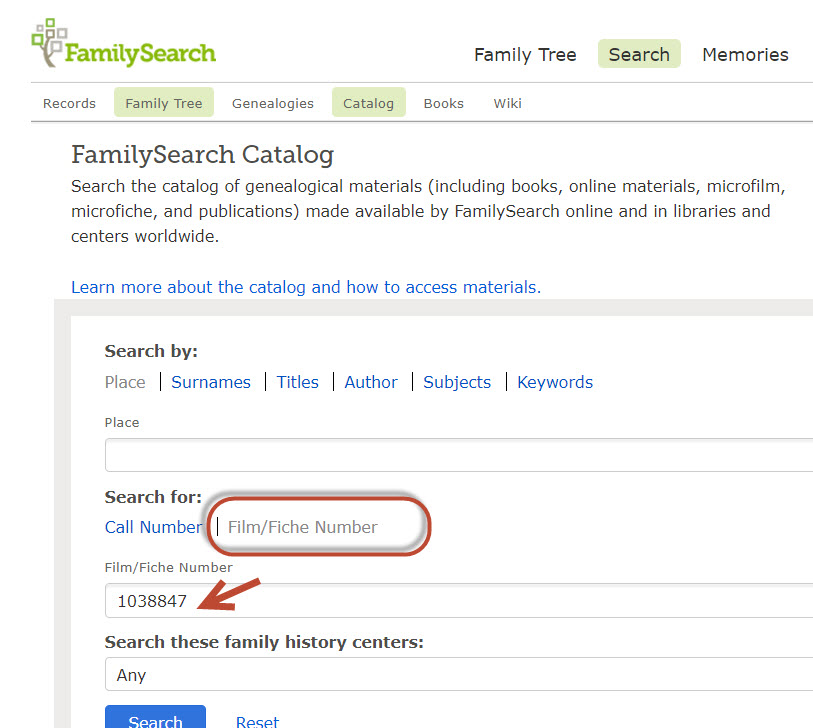
  2. Click on “Search for Film/Fiche”, then type in: 1038847 (the film number)
  3. Click on the blue button, Search.
    1. This is the page that you will see. We will look at Items 6-8, Juror’s Lists.
      This page gives us a more detailed description of the film. Notice the camera icon on the lower right. There is a key above it. The camera indicates that this microfilm is in digital format; and the key indicates that it is only available at a Family History Center or affiliate library.
    2. When you click on the camera image, you will get this message:
    3. Clicking on either of those links will produce a worldwide map where you can search for a Center or Library near you. There are 4,900 Family History Centers worldwide, and many affiliate libraries.
    4. Click on the green tree icon for a pop-up message with location name, address, hours, and contact information.

FamilySearch has a Help Desk which is manned 24/7. Call 1-866-406-1830 to speak with a representative, or you can live chat or send a message from the Contact Page.

Let’s hope that in coming months, Greek authorities will allow genealogy companies to digitize more records, ensuring that they are preserved and made available to the worldwide diaspora. Digitization by large genealogy companies is done at no cost to the repository; the contract expressly states that the work will be done free of charge and the repository receives a hard disk with the digital images. In exchange, the repository gives the company permission to make the digital images available.

It’s a win-win for everyone.

Greece 2017. Part Five: Researching in Greek Cemeteries

Sparta. Siesta. Nothing to do between 3:00-6:00 p.m. in July, when the thermometer hits 40 celsius (104 fahrenheit) and every shop and business is closed. A smart traveler seeks a cool oasis in an air conditioned hotel; but a fanatic researcher will not waste three precious hours. That’s when I visited the cemeteries.

Entrance to Amykles cemetery, 2017

Greek cemeteries are fascinating to explore. In modern times, they have become memorials to the deceased. Photos, flowers, icons, candles and personal items decorate the gravestones, making each unique. They become a sanctuary of mourning for the bereaved.

The first thing a visitor notices is that all of the gravestones are constructed of white marble and sit atop the ground.

Sikaraki, Laconia. July 2017

This gravestone for Panagiotis G. Koniditsiotis in Amykles is unusual, because the marble slab on the top has been replaced with grass. It exudes an oasis-like feel under the hot July sun.

Panagiotis G. Koniditsiotis, 7-7-1938 – 16-6-2013, Amykles, Laconia, July 2017

Invariably, the headstones face east. My research indicates that this is a common Christian tradition, based on the belief that when Jesus returns it will be from the east; thus, the deceased will rise from the grave to face Him.

Lysandros K. Giannakopoulos, Died 20-3-1999; age 87. Theologos, Laconia cemetery, July 2017.

As the photo above shows, these east-facing gravestones posed a serious problem when taking photos in mid-afternoon: shadows. As the sun moved west towards the Taygetos mountains, it shone over the top of the headstones, casting silhouettes on the engravings of the marble slabs. Also, it shone directly into my eyes, making it almost impossible to see the image I was photographing. It was pure luck that I was able to get decent pictures.

Many families have purchased cemetery plots, and the gravestone becomes a memorial for the entire family. Information about parents and their children are inscribed. It is especially helpful to find a married daughter buried with her parents, as her “new” surname will be etched in the marble. When photos are included, one has a visual mini-snapshot of the family structure. In the picture below, notice that Spyridon’s middle name was “Char” (Charalambos),  the name of his father. This takes the researcher back one more generation.

Tsakonas family grave, Agios Ioannis, Sparta. July 2017. Spyridon Char. Tsakonas, born 1884, died 26-2-1965; Sarantos Sp. Tsakonas, born 1934, died 10-10-1943; Aggeliki Sp. Tsakona, born 1907; died 28-7-1995; Lygeri Tsakona Skouli, born 11-14-1937, died 6-10-2010.

The older gravestones are especially poignant. Some are in disrepair and have suffered neglect. Others are empty holes but the names are still inscribed on crosses–an eerie reminder of a Greek custom described below. This grave in Sikaraki, Laconia, especially touched my heart.

Georgia A. Chelioti, Sikaraki, Laconia, July 2017

Georgia A. Chelioti died 21-11-89 , age 85, Christian martyr of Jehovah. The inscription is taken from the New Testament, John 6:40:  And this is the will of him that sent me, that every one which seeth the Son, and believeth on him, may have everlasting life and I will raise him up at the last day.

Georgia A. Chelioti, Sikaraki, Laconia, July 2017

An empty hole is indicative of a long-standing custom in Greece to bury a person for only 3–5 years, after which the remains are exhumed, the bones are cleaned, and then placed in an ossuary box. This is a sacred religious ritual, performed by a priest and attended by family. The ossuary box is placed in a building on the cemetery grounds known as an osteofylakeion. The candles, photos and other memorabilia that had been on the gravestone are transferred to the ossuary box kept in the building. I was hesitant at first to step into an osteofylakeion. I thought I would feel creepy; but to my surprise, I felt like I was standing on holy ground.

Osteofylakeion building, Sikaraki cemetery, July 2017
Interior of osteofylakeion building, Sikaraki cemetery, July 2017

While exploring cemeteries in Agios Ioannis (Sparta), Amykles, Sikaraki, Mystras and Theologos, I took photos of gravestones inscribed with surnames that appear on my family tree. Many tombstones provided information that I had not found in documents procured to date. If I saw that “my people” were memorialized with photos, I felt a surprising and joyful sense of kinship. As I walked the narrow paths separating the gravestones, a sense of peace filled me. Many of these people were related by blood, by marriage, or by collateral relationships such as in-laws or godparents. Now they rested together, facing east, awaiting the resurrection promised them by their Orthodox faith.