Unknown's avatar

About Spartan Roots

I am of Greek ancestry with roots in villages near Sparta. My paternal grandparents and maternal grandfather were born in Agios Ioannis (St. Johns), and my maternal grandmother was born in Mystras. I love family history research and have been tracing my roots for many years. I was born in Brooklyn, New York and was raised in a predominantly Greek neighborhood close to extended family. I live in the Washington D.C. metropolitan area and work as a volunteer Co-Director of the Washington, D.C. Family History Center and a genealogy aide/project aide at the National Archives in Washington, D.C. I am always updating and adding new information. Please contact me - I would love to hear from you!

Greece 2019 – Putting Together the Zacharakis Family Tree

Stathoula Zaharaki Eftaxias

This is my maternal great-grandmother, Stathoula Zacharakis Eftaxias. Her photo sits on my desk and every day, she inspires me to keep going with my research.

Stathoula was born in the village of Theologos, Laconia which is 10 kilometers from Sparta and 6 kilometers up a mountain. Her parents were Dimitrios Zacharakis of Theologos, and Giannoula Zarafonitis of Amykles.

For the past two summers, we have had Zacharakis cousins’ reunions in the platea of Theologos. Last year, they asked me to bring their family tree. This year, I did.
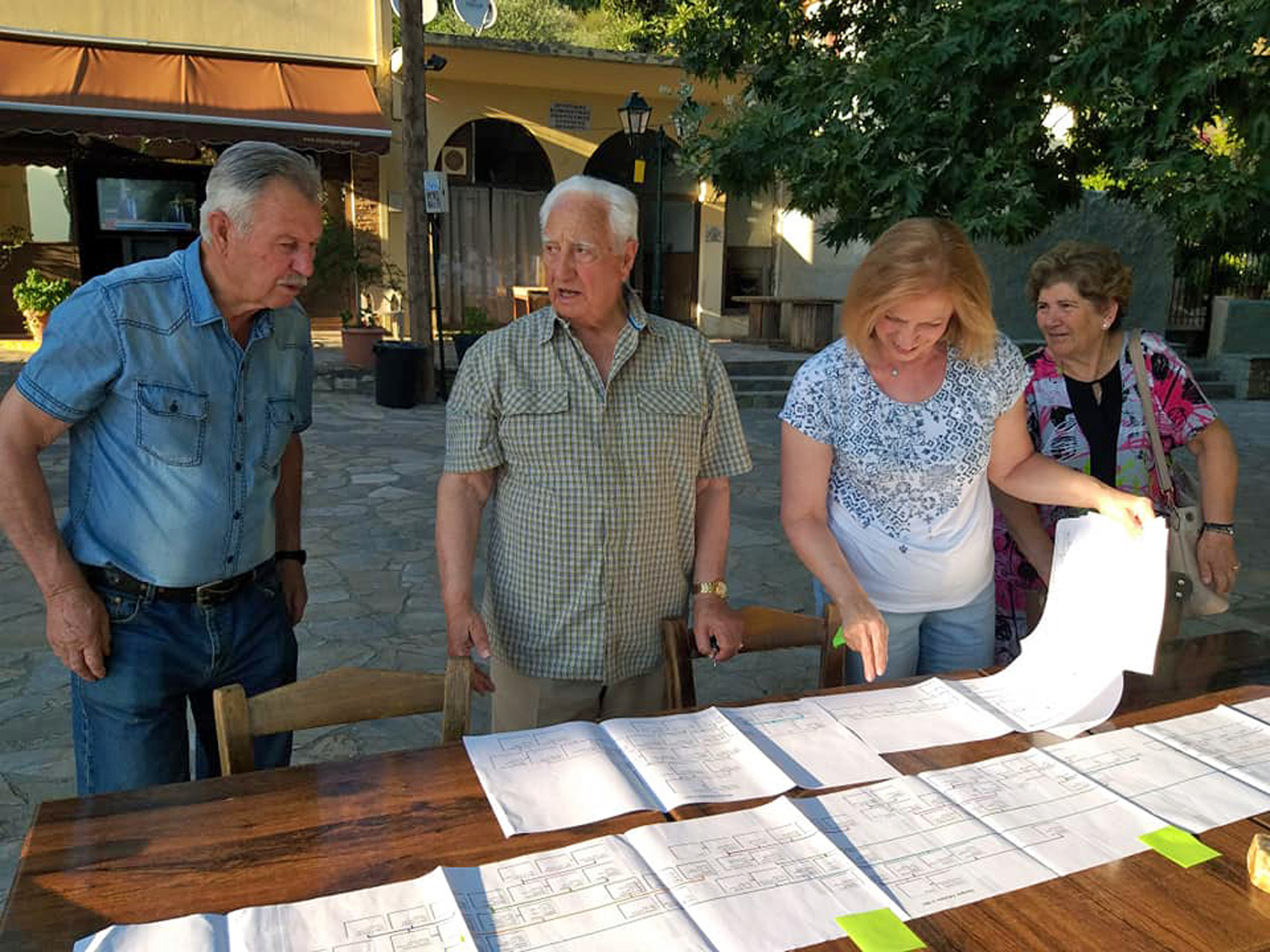
Pavlos, John and Joanna discuss their family tree

Preparing this information sent me hunting for the Zacharakis name in:  Male Registers (Mitroon Arrenon), Town Registers (Dimotologion), Election Lists of 1872, and school, church and marriage records at the village, town hall and metropolis levels. I think I have all the bases covered for vital records from Theologos. What I am missing, though, is a history book of the village. Librarians at the Central Library of Sparta said that one does not exist but I will keep looking.

I maintain all my data in a RootsMagic genealogy database and Excel spreadsheets, and I enter every name that I find, whether or not I can connect him/her to a specific line. For example, the 1872 Election Lists give a man’s name, birth year, father’s name and occupation. But if his father is Theodoros and there are several Theodoros’ in the village, I sometimes can’t determine which one he belongs to.
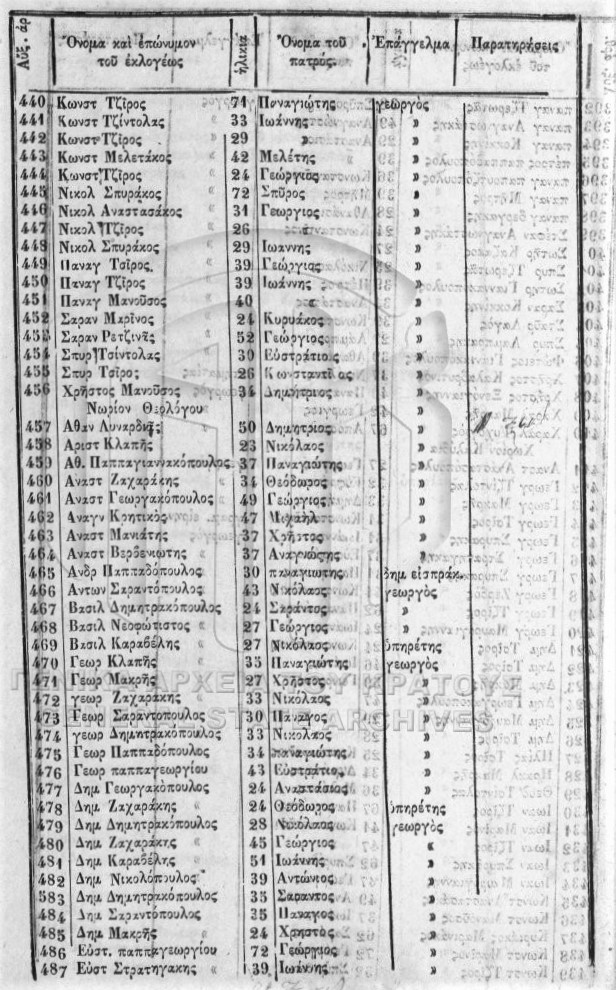
1872 Election List for  Theologos. Zaharakis family:  line 460: Anastasios, age 34, son of Theodoros; line 472: Georgios, age 33, son of Nikolaos; line 480: Dimitrios, age 45, son of Georgios.

I especially ran into problems with the earliest generations. In this Election List, were Theodoros, Nikolaos and Dimitrios brothers or cousins? I spent hours staring at computer screens, flipping between spreadsheets and multiple family group sheets to determine what made sense. When I became utterly confused, I tried a different tactic:  paper.
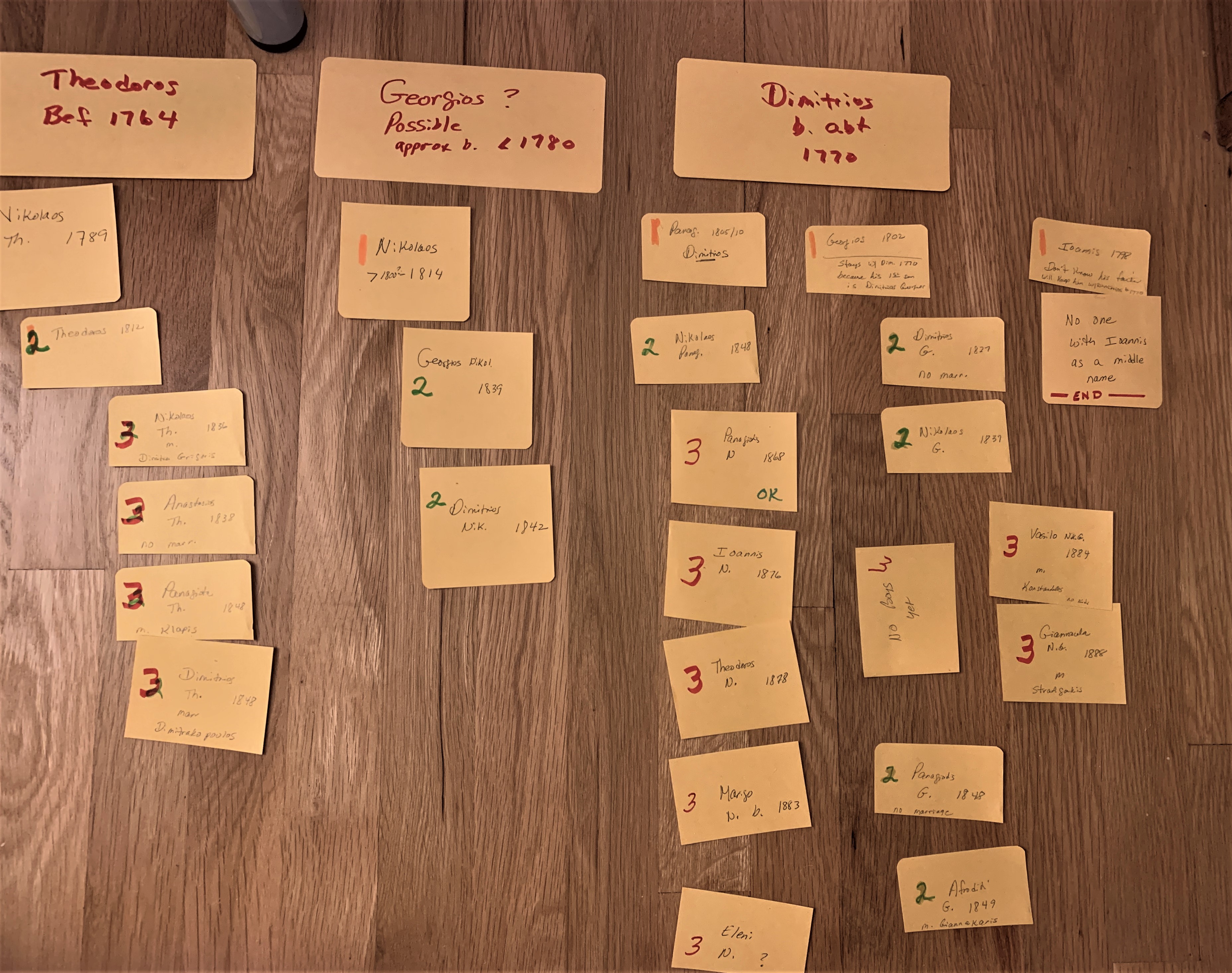
Sorting out the Zaharakis generations–on paper!

I began by writing on paper the men’s first names, fathers’ initials and birth years. Then using birth years, I sorted them into generations moving from youngest to oldest. The tactile experience of holding a pen, writing a name, and moving pieces of paper around until the families made sense helped everything “click” in my brain. After just a few minutes, the descendants were in place.
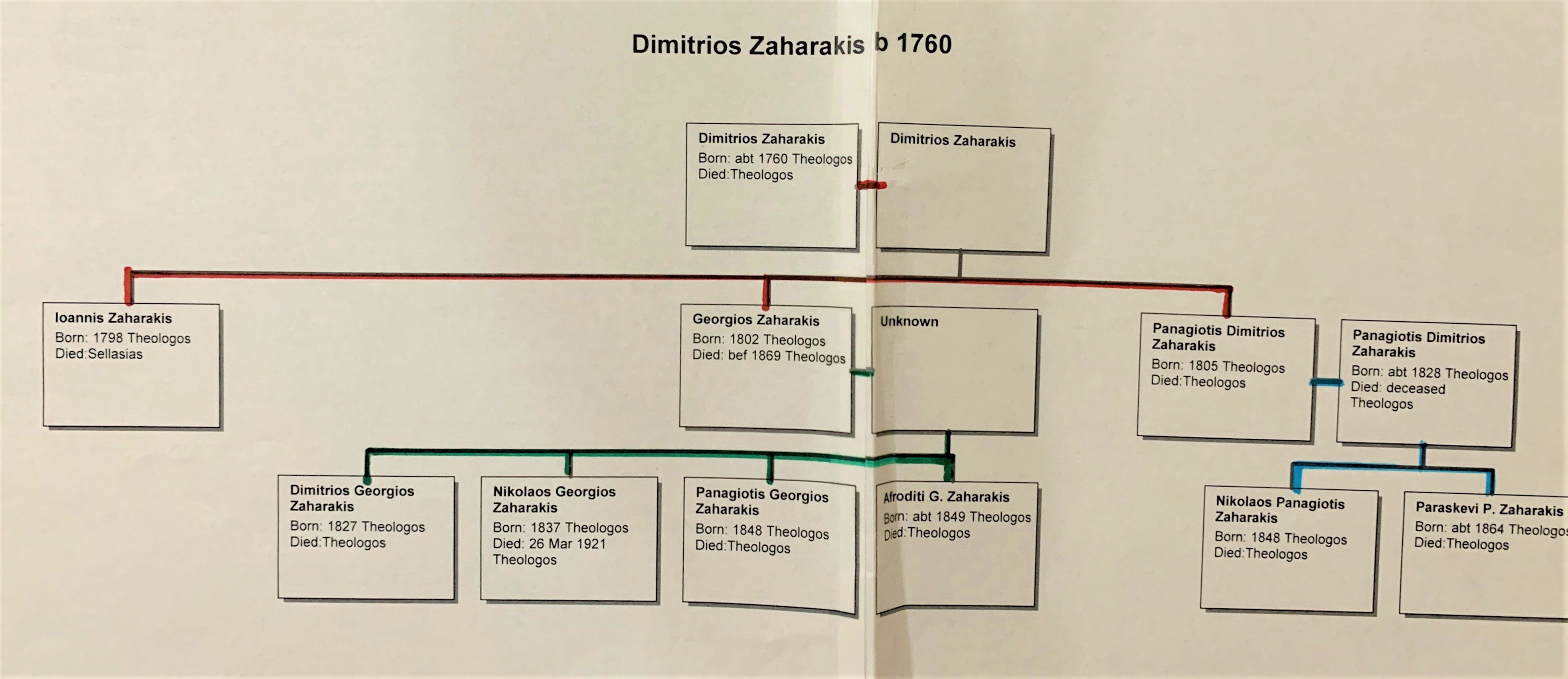
Example of one chart using Dimitrios born c. 1760

Using RootsMagic and lots of tape, I printed and put together the following trees:

  • Dimitrios, born abt. 1760
  • Theodoros, born abt. 1764
  • Ioannis, born abt. 1798 (no known descendants, but he received an Aristeia award for fighting in the 1821 Revolution; blogpost here)
  • Georgios, born abt. 1802
  • Panagiotis, born abt. 1805
  • Nikolaos, born abt. 1814
  • Konstandinos, born abt. 1842
  • Dimitrios, born 1844 (my maternal great-great grandfather)
  • Dimitrios, born c.1848

Certainly the three youngest are sons of the oldest, but who belongs to who? We won’t know in this life; the paper trail has stopped.

As the cousins looked for their names on the trees, I asked them to correct and add information.
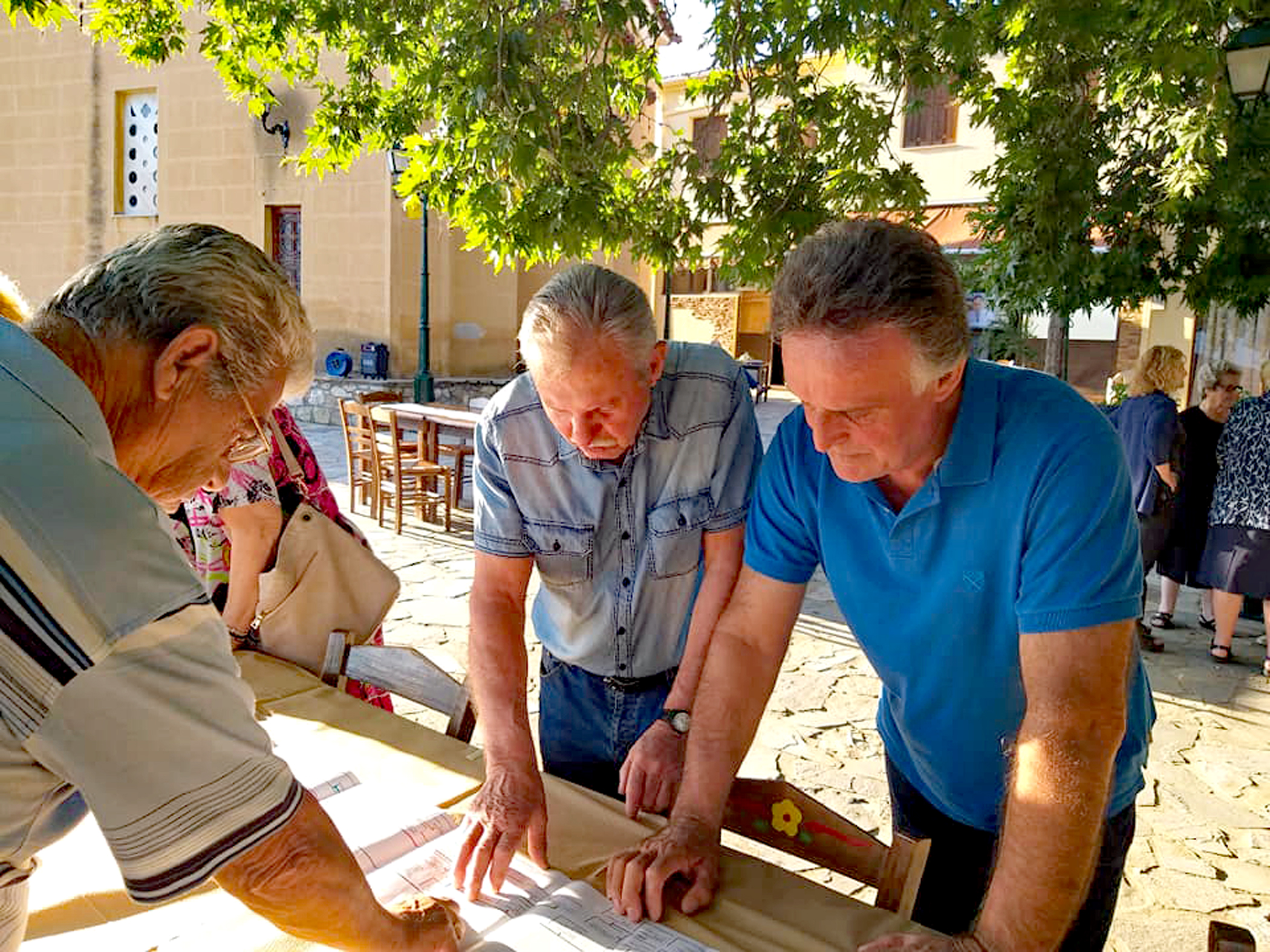
Pavlos and his son, Thanassis, examine their tree

It was interesting to see that everyone there, except three people including me, were descended from Panagiotis born 1805. That tree was on the longest table and had the most activity.
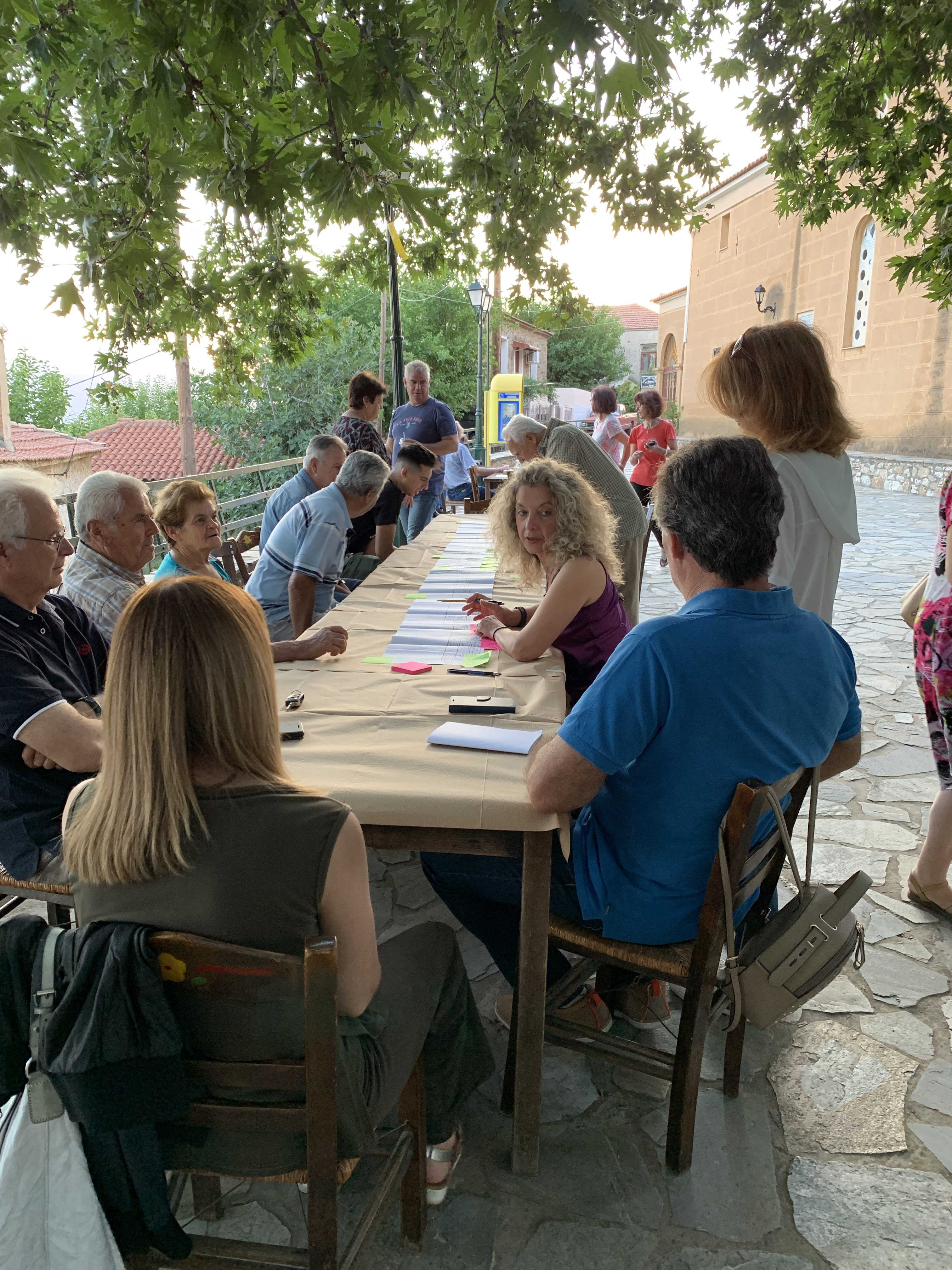
The largest tree was for the descendants of Panagiotis Zaharakis, born abt. 1805

I am very grateful for the support of the village priest, Papa Panagiotis Kotsos, who was the host of the evening. He contacted family, shared information on the church Facebook page, and got people dancing. He is young and fun!
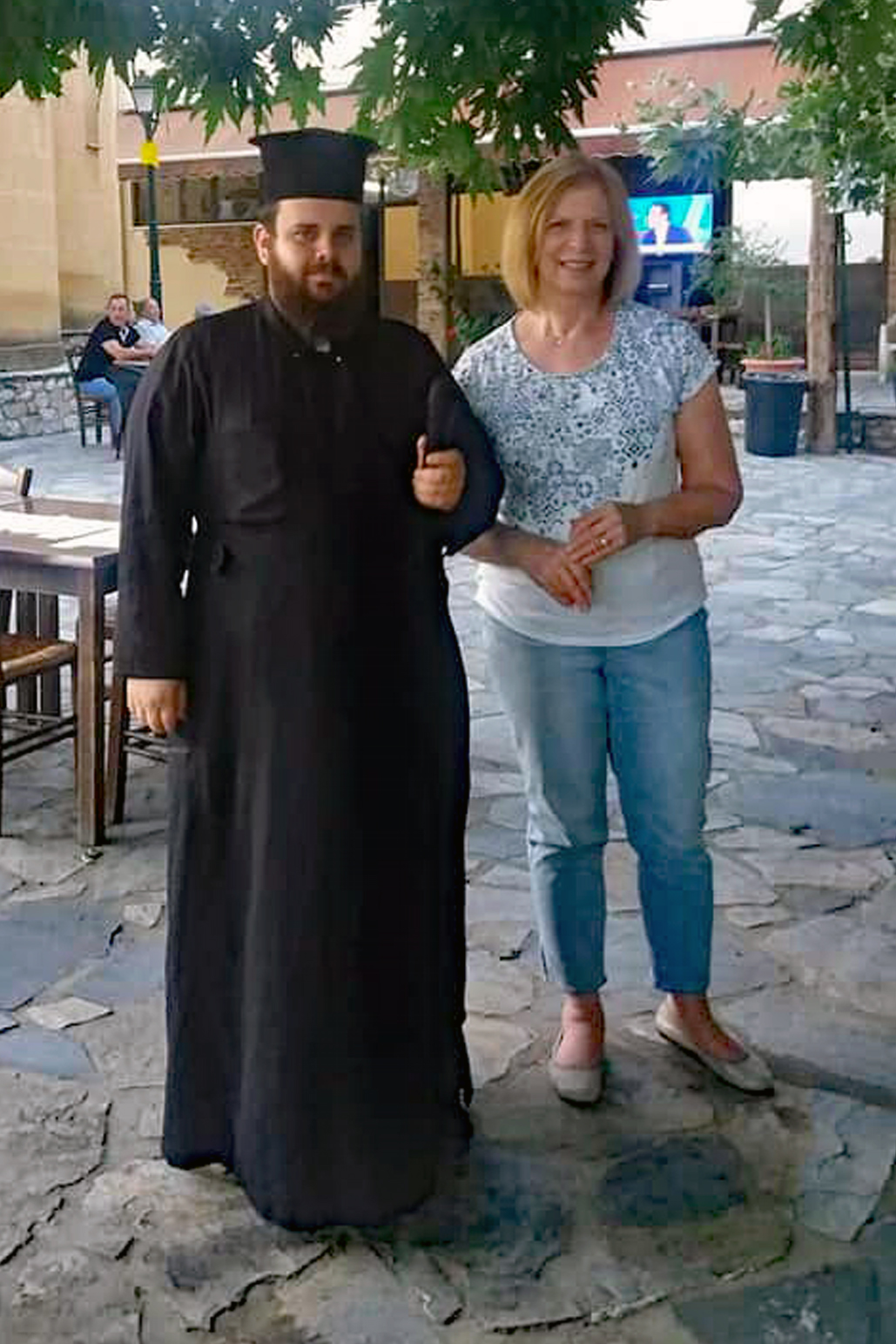
Papa Panagiotis Kotsos, host of the evening
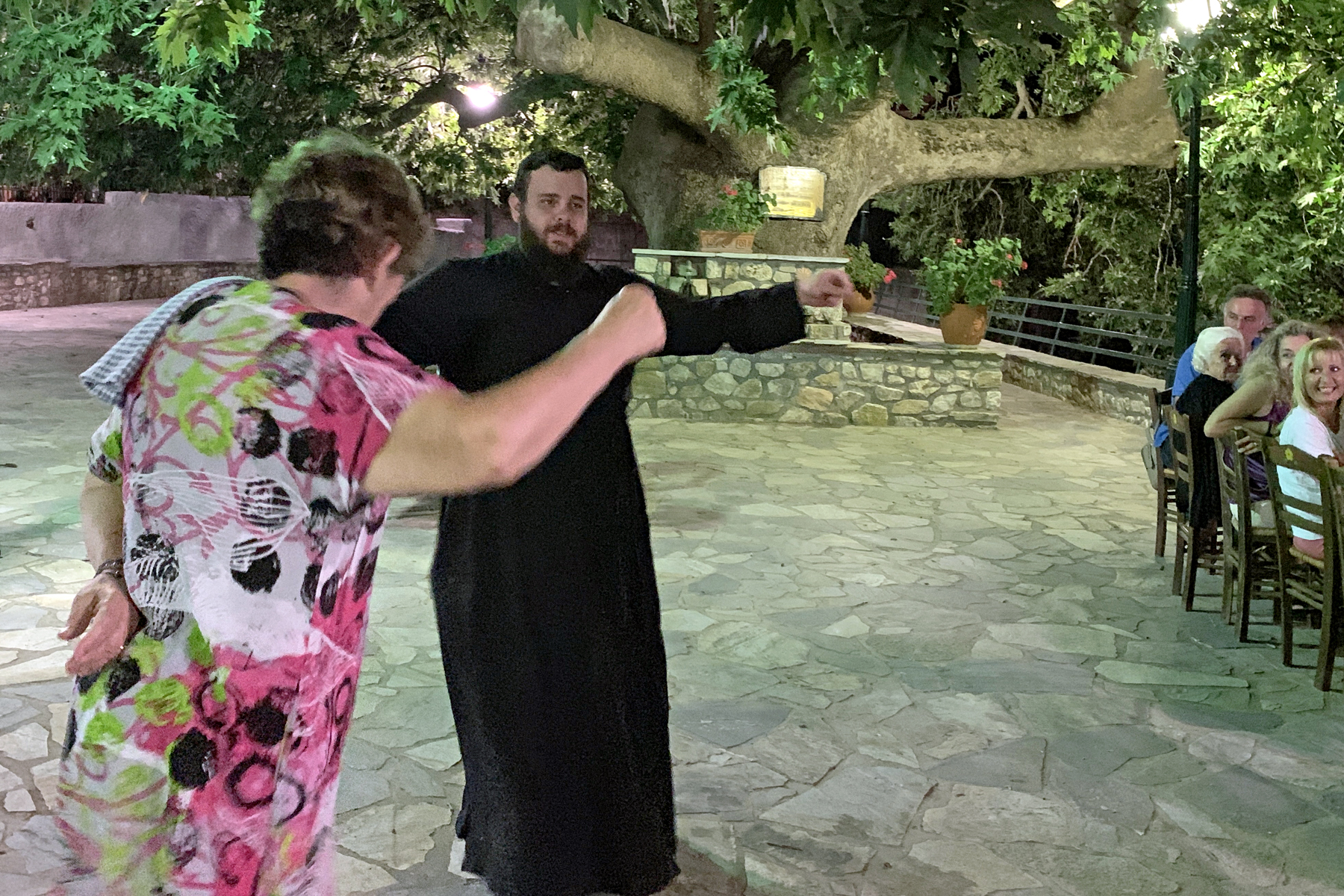
Papa Panagiotis leads the Greek dancing

And of course there is food!
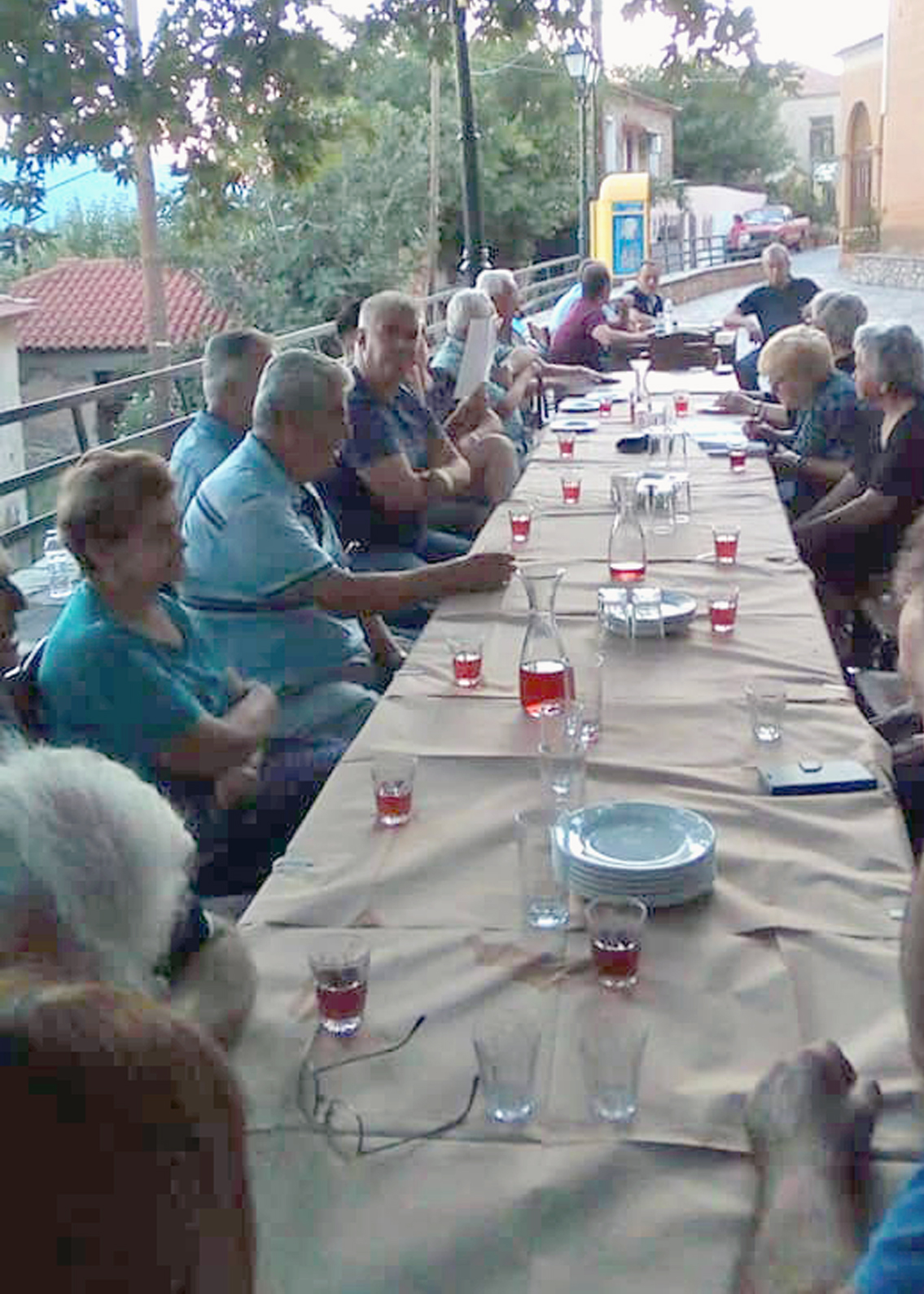
Waiting for dinner

And a group photo 🙂
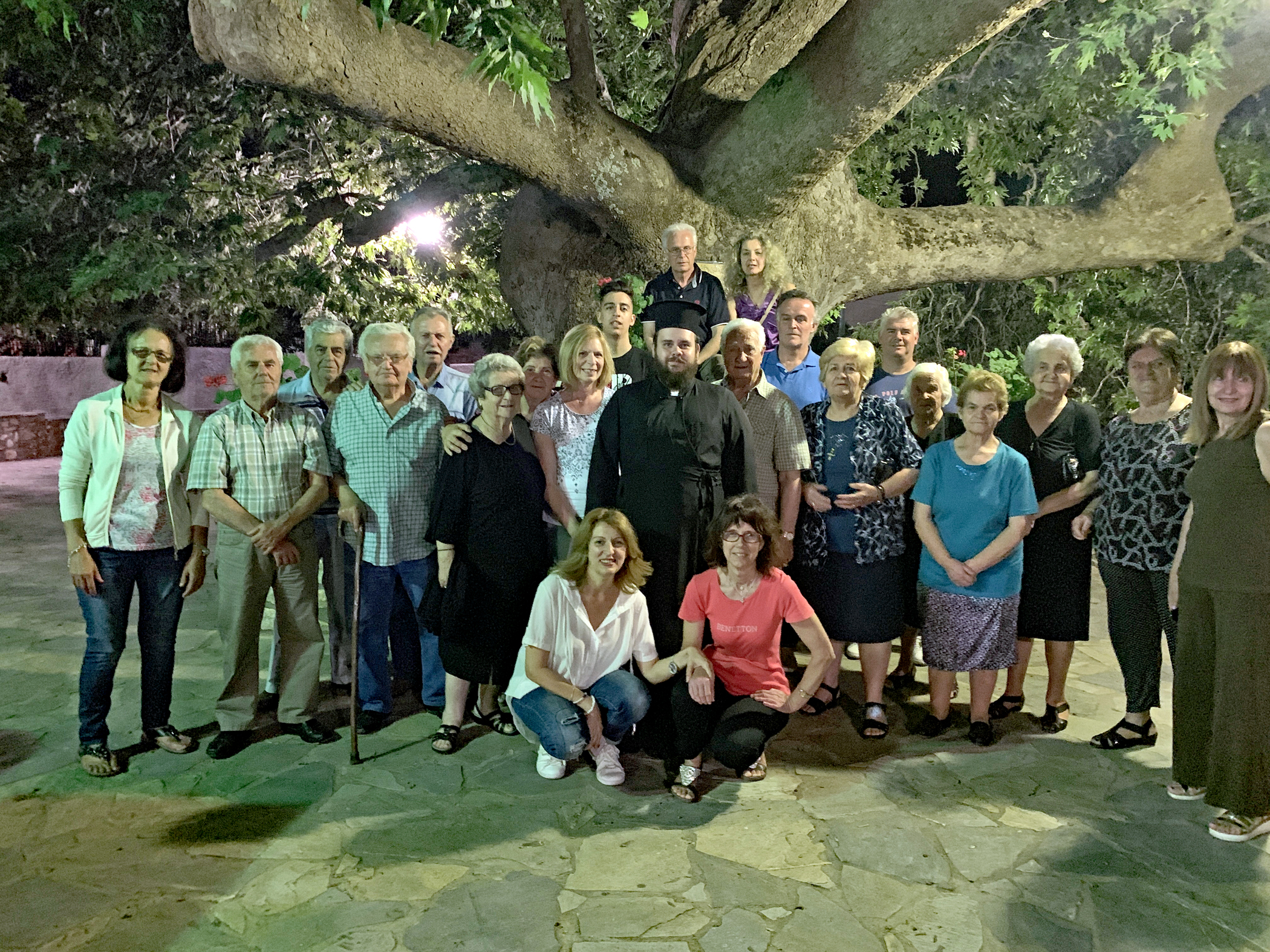
Zacharakis Reunion in Theologos, July 2019

The large tree behind us has a plaque which reads:  “The generation that lived in Theologos during the years 1879-1880 have planted this sycamore tree and watered it but God made it grow.”
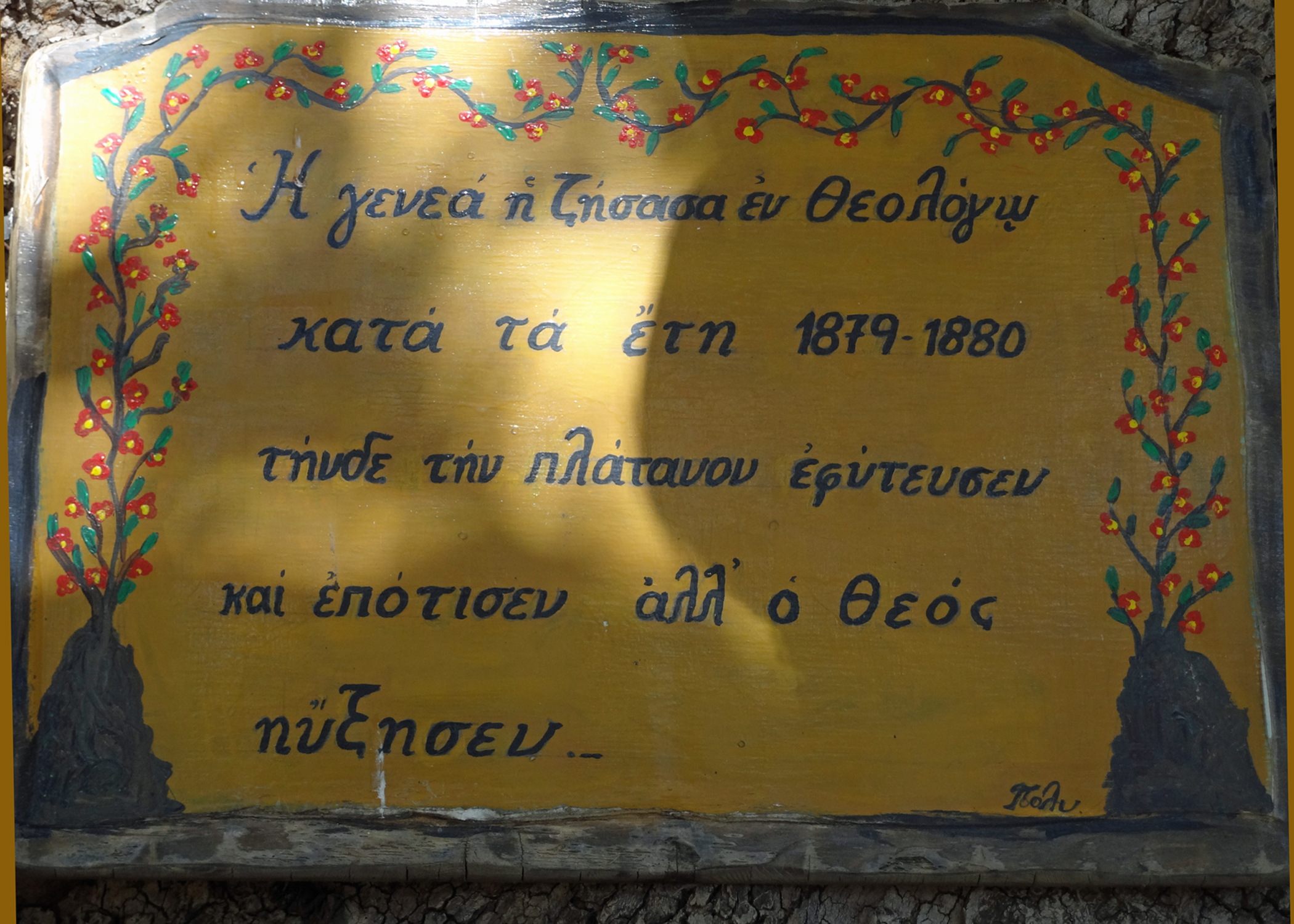
Plaque on the sycamore tree in the platea of Theologos

My great-grandmother, Stathoula, was born in 1870. She was a child when her parents, Dimitrios and Giannoula, helped plant the tree. Now we, the descendants of the earliest Zacharakis’, can gather under it and share the joy of family.

Greece 2019 – The Road to Perganteika

Listen to the locals! Wise counsel, which is leading me down new roads (literally). When I had lunch with friends in Barsinikos, I mentioned to Christos (a native of the area) that I was trying to determine where my great-grandfather, Andreas Kostakos, may have lived before he was in Agios Ioannis in 1844. With waving arms and rapid Greek, he said, Anavryti and Perganteika (these are two villages on top of the Taygetos mountains). I was a bit stunned; my cousins had said Anavryti, but there was never a mention of Perganteika. So I replied in a nice manner, “But how do you know that?” Christos looked at me incredulously (how could I possibly doubt him?) and went into a long and animated explanation about how a man would settle in a certain area, have children, and then those children would populate the area; and, that a small settlement (not a village) would be formed by a couple of families. Therefore, the origin of specific families is known.

During the Ottoman occupation, families fled to the high mountains where they lived in ways that are unimaginable to me. After the Revolution of 1821, they began to descend into the valleys where the land was fertile and flat.  When I told Christos that Andreas Kostakos was listed in the 1844 Election Rolls as living in Agios Ioannis (in the valley), he said that by that time, he had already come down from the mountain.

1844 Election Rolls, LADA Collection; Line 1205: Andreas Kostakos age 35, indigenous; owns property; village Agios Ioannis

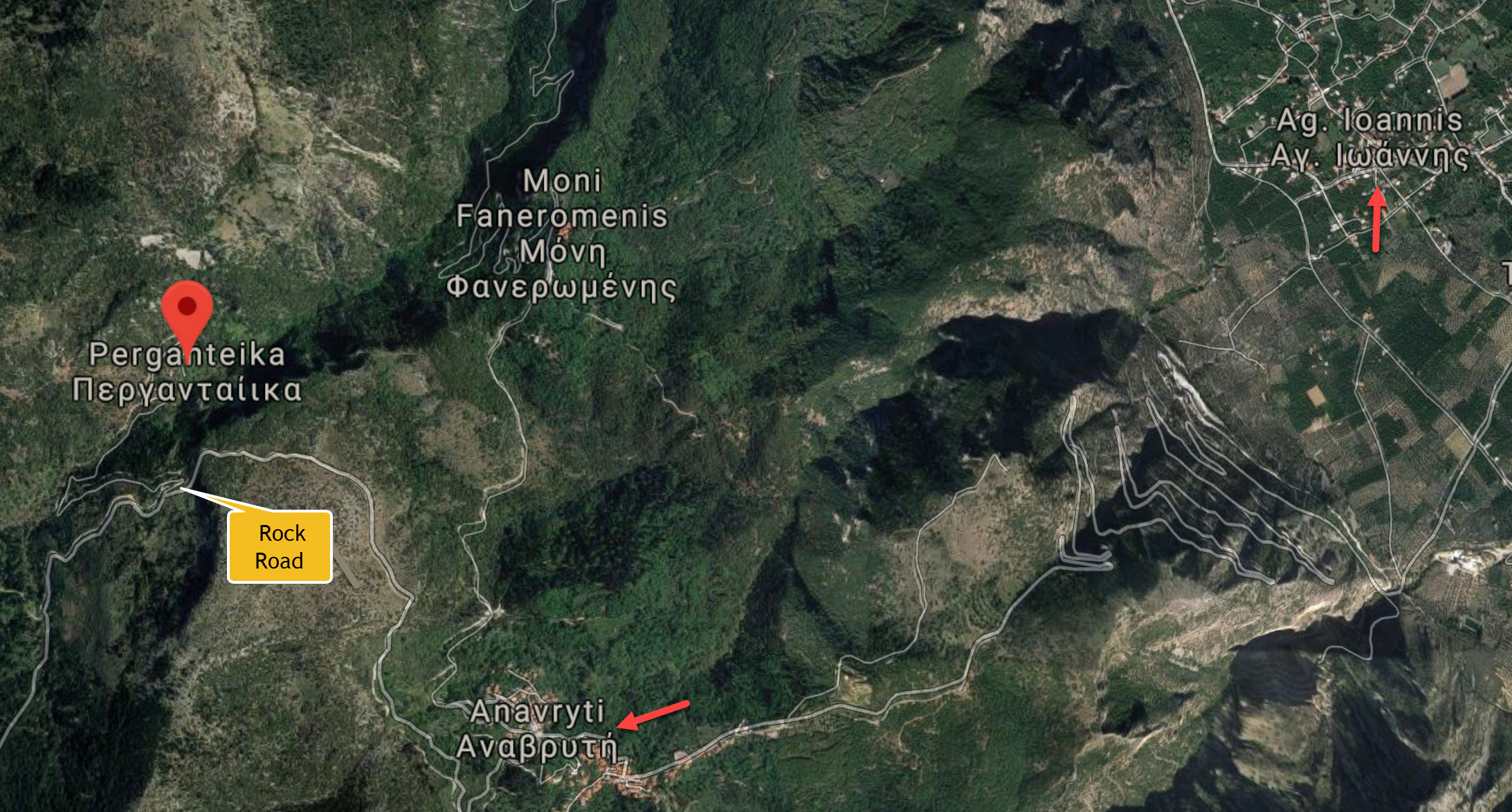
Location of Perganteika:  it is above and over the mountain from Anavryti; Agios Ioannis is in the valley. Seeing it on a topographical map, it is easier to understand how Andreas followed the pattern of descending from the highest to the lowest location after the Revolution.

Perganteika, in relation to Anavryti and Agios Ioannis

Christos’ words have been weighing on me for two weeks, and I resolved to go to the now deserted settlement of Perganteika. How could I not go if my great-grandfather could have been from there? So this afternoon, I left the flat terrain of Agios Ioannis and headed up the mountain.

Anavryti is an historic village situated near the top of one of the Taygetos mountains. Prior to a road constructed in 1980, it could be reached only by foot or donkey. The white spaghetti-looking lines on the map above are the switchback roads, with hairpin turns providing magnificent views of the valley below.

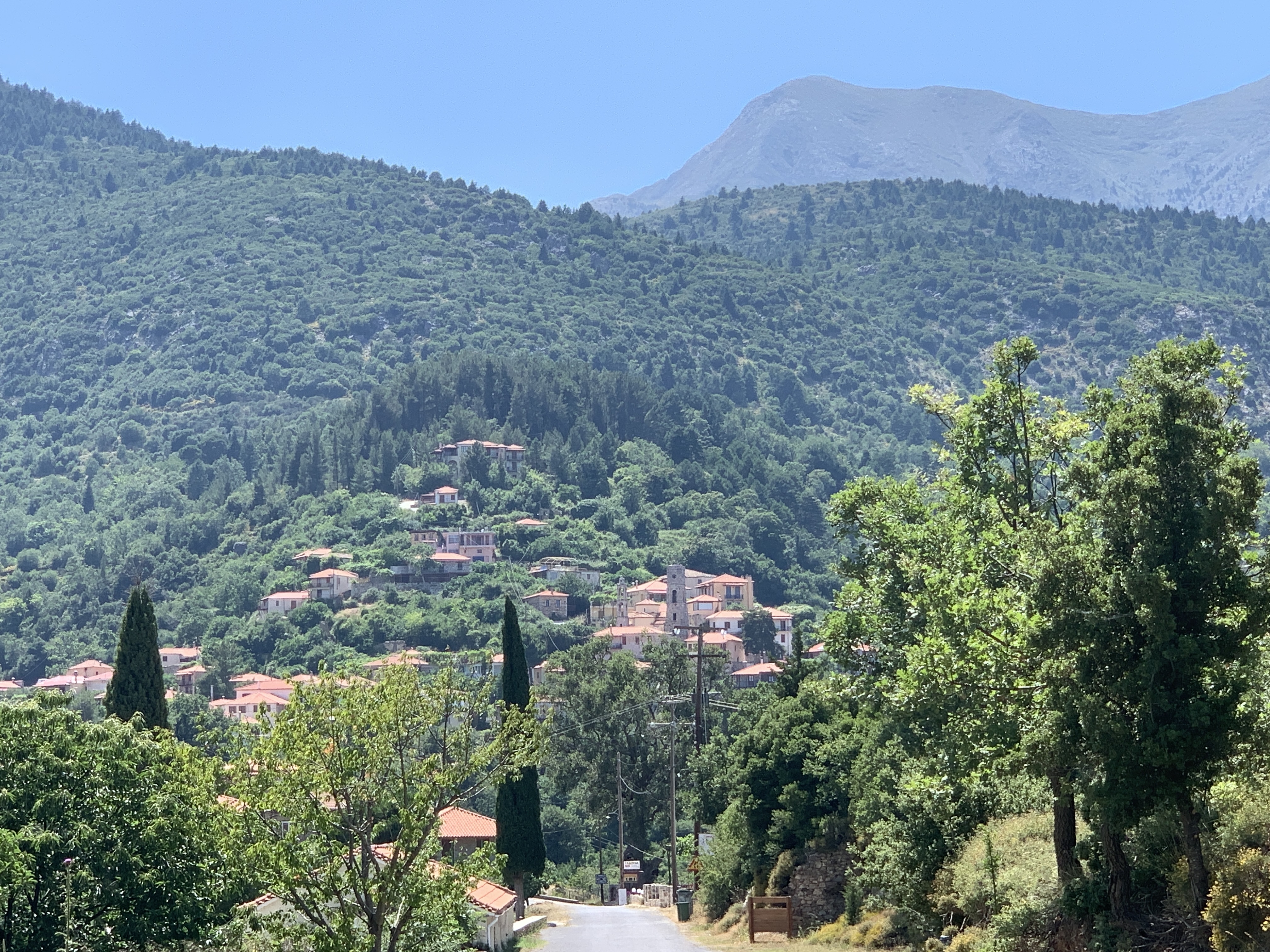
Leaving the valley on the road to Anavryti

Almost to Anavryti; almost to the mountain top

When I entered the village, I stopped to take photos. The owner of a taverna which overlooked the valley came to say hello, and I asked him where I could find the road to Perganteika. He said to go through town and when the road dead ended to turn left, and when I reached a fork in the road with a steep turn, to go right. Then he looked at my Honda Civic, shook his head and said, “not in that car. With a Jeep, maybe.” I had heard that there was a church service in Perganteika the previous Sunday so I completely disregarded his caution, thanked him, and kept going. The road through Anavryti is paved stone; very narrow; with homes so close you can almost touch them from your car window.

The road in the village

Every mountain village has fountains where cold, pure mountain water flows continuously. Villagers and hikers fill their water bottles. This fountain was donated by the Katsichtis family and is at the edge of town.

Fountain of Anavryti.

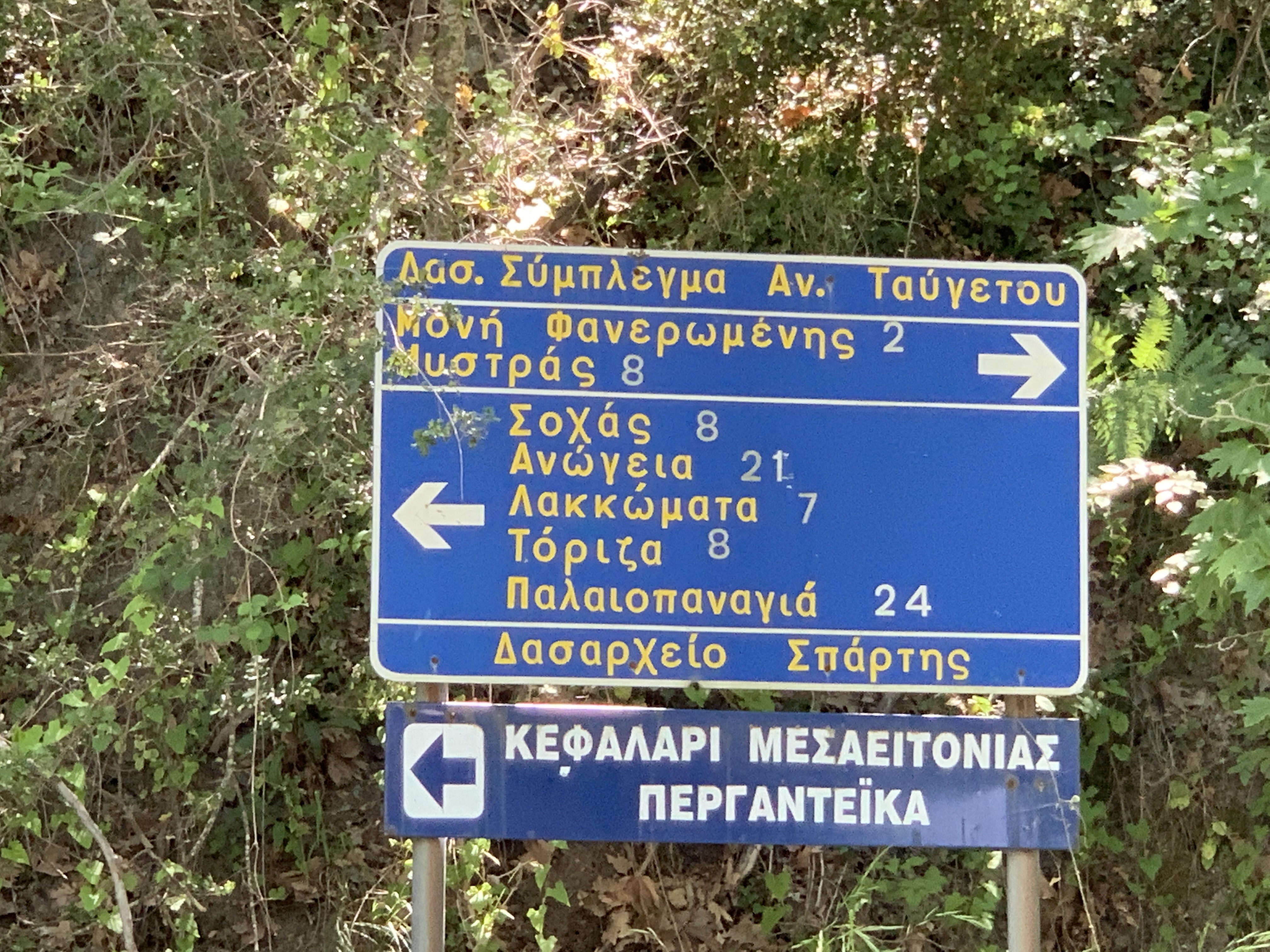
Towards the end of the village, the road changed from stone to asphalt, still narrow, still winding, but easily driveable. It wasn’t long before the road dead-ended and I came to a sign. The dark blue addendum with the left-pointing arrow proved the taverna owner was correct and that I was going the right way.
Immediately, the road changed. It became narrower. The asphalt became rougher and big ruts appeared randomly. There was a steep drop-off so I had to stay far from the edge. Donkey droppings were everywhere; they are still part of life in the high mountains. Here, in the middle of nowhere, a truck appeared. I stopped and asked the men where they were going. I thought that if they were headed to Perganteika I could follow them, but they waved me off and muttered something in Greek which I could not understand.

Drop off

I was doing great! The road was not bad and I was feeling a bit smug about ignoring the taverna owner and forging ahead. Until I got to the fork in the road where I was to turn right. I started on the hairpin turn and stopped. No way could I go any farther in a Honda Civic. The pavement ended and ahead there was nothing but rock.

The rock road to Perganteika

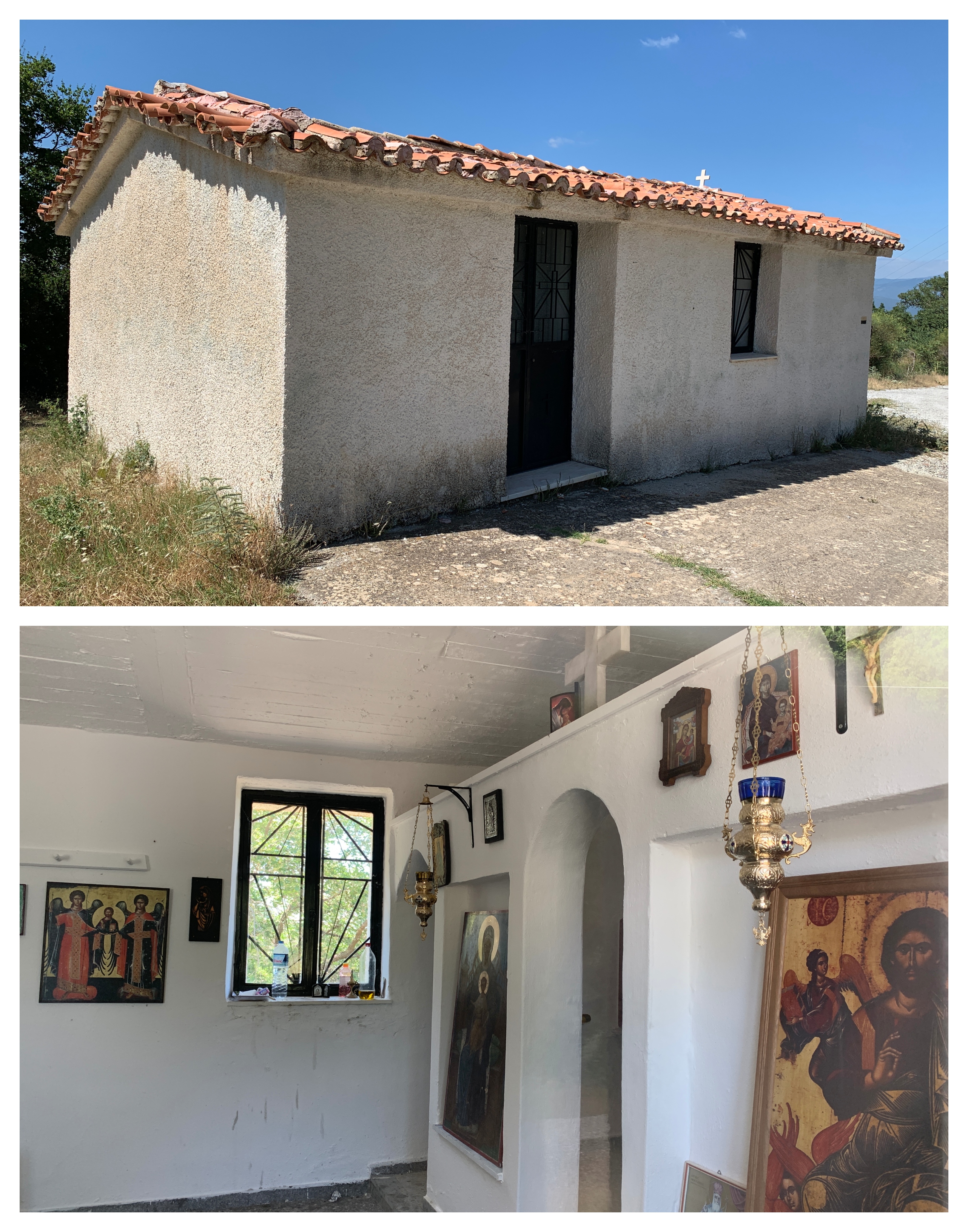
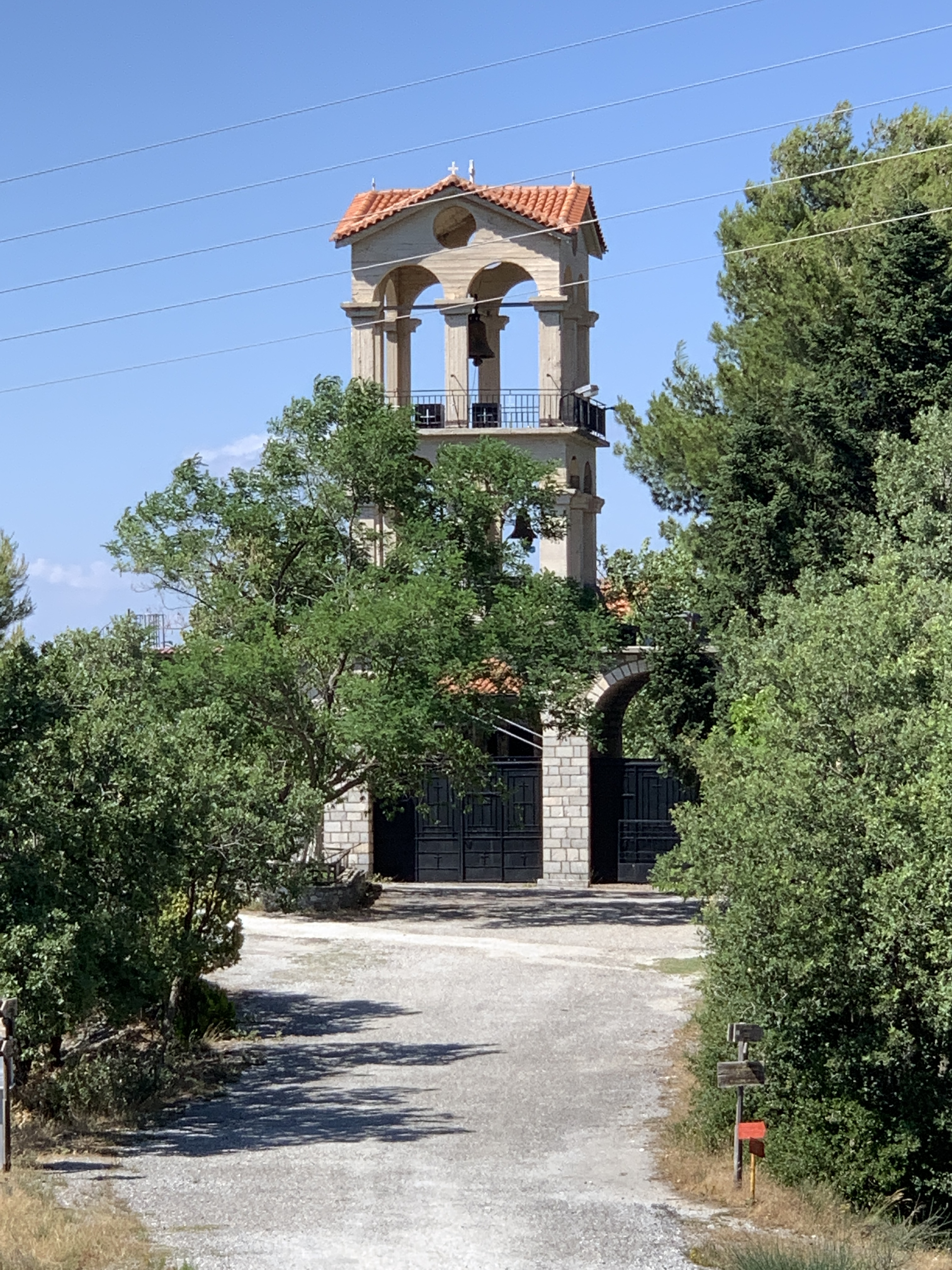
I considered leaving the car and walking, but the map showed Perganteika was 4.2 km and I was wearing sandals. I ventured a bit by foot but the road worsened as it continued. It wasn’t going to happen today. Disappointed, I headed back towards Anavryti. I decided to go to the Faneromenis Monastery, just 2 km from the road into Anavryti. Although there are thousands of churches in remote and uninhabited places, I continue to be amazed whenever I find one. Despite their lonely habitat and disuse, they are decorated with beautiful icons.

Agios Stratigos

Once again, the passable road ended at the monastery. I would have liked to continue towards Mystras, but the road became a steep gravel path descending precipitously down the mountain. Not in a Honda Civic! That’s when I realized that the road was maintained for the monastery. I turned around again and drove back to Anavryti.

Faneromenis Monastery; a lovely but lonely edifice in the wilderness

No village stopover is complete without a visit to the cemetery. Cemeteries in Laconia are lovely memorials to loved ones. White marble crypts are decorated with flowers  and photos. With the mountains as backdrop, they are peaceful and spiritual resting places.

Cemetery in Anavryti

Next summer, I am renting a Jeep and bringing walking shoes. I will get to Perganteika. How can I not go?

Greece 2019 – Enchanting Epidavros

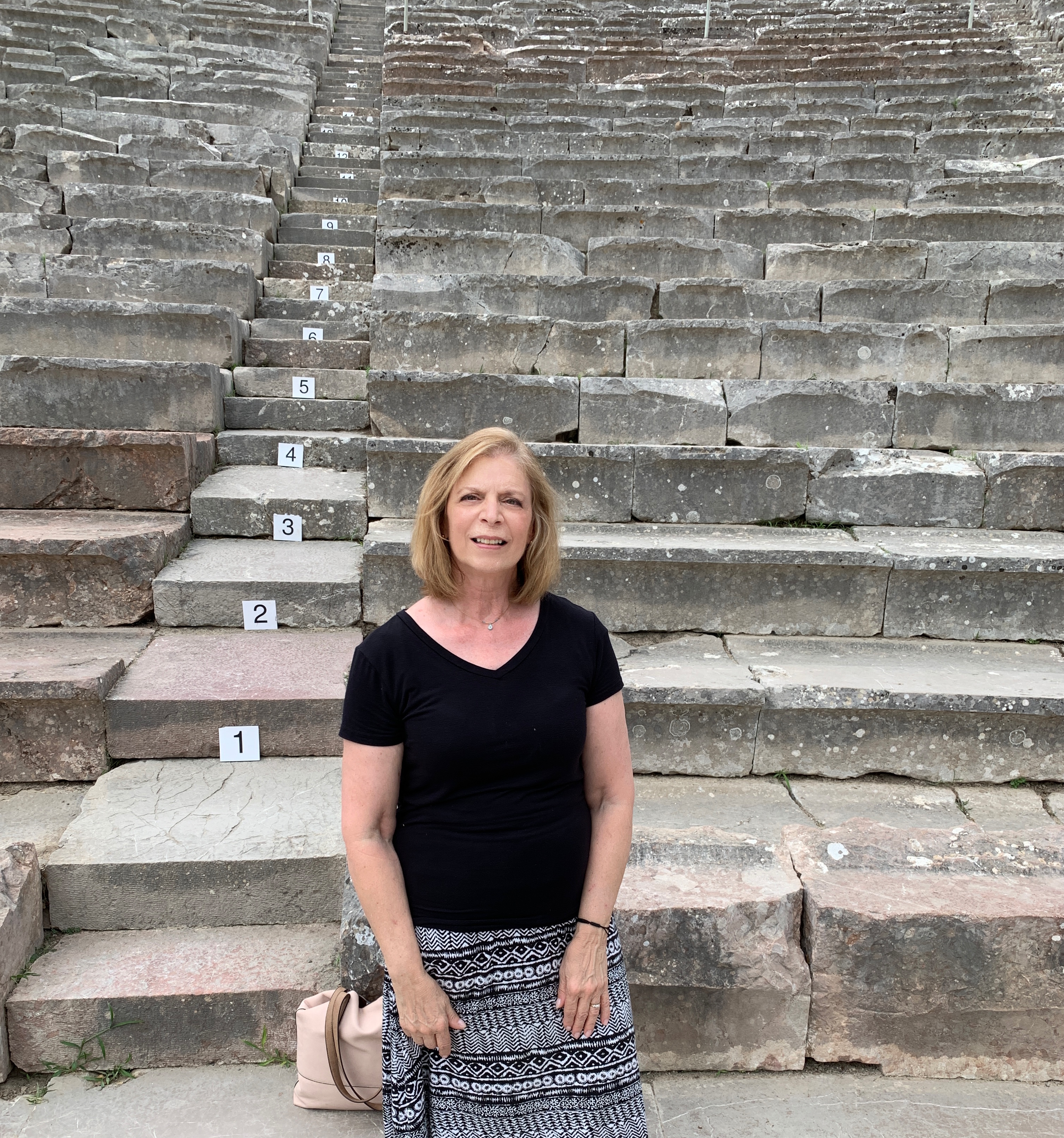
An open-air theater that seats 15,000 people? Where you can sit in the back row and hear a whisper from onstage? This is  Epidavros, built in the 4th century B.C. and still used for live performances in July and August.

Photo Credit: By Rvjansen22 – Own work, CC BY-SA 4.0

Theater stage entrance

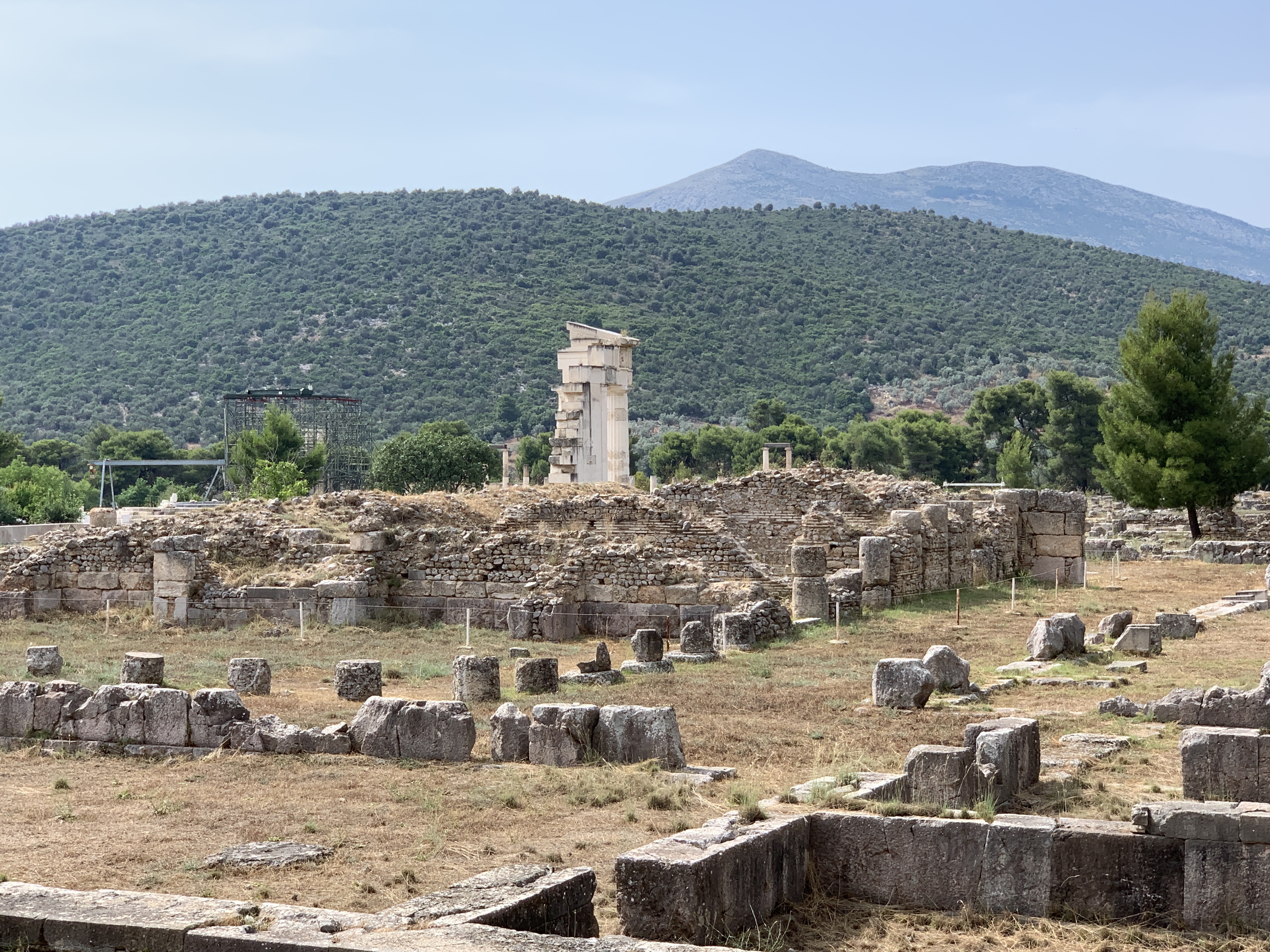
Although the theater is majestic, it is only one aspect of this impressive site. Its origins lie in Greek mythology as the birthplace Asclepius, the son of Apollo. He was a master physician and the god of healing. Ancient Greeks built a comprehensive health complex here, and remnants of its numerous buildings remain.

Diagram of the Asklepieion of Epidavros

One section of the archaeological site, Epidavros

Remnants of the Abaton (incubation hall), where patients were cured by Askelpios

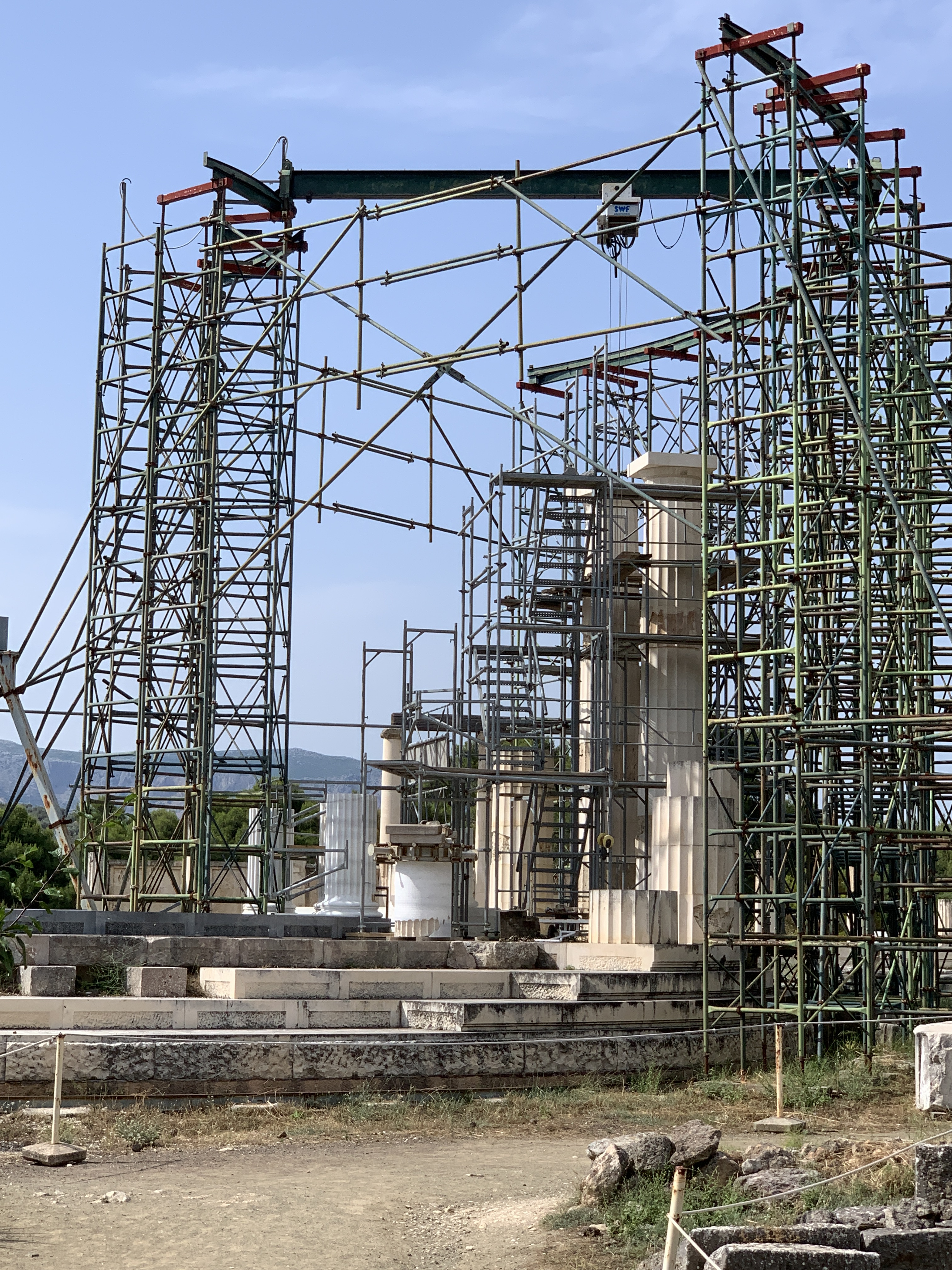
Archaeological excavations and restoration are being actively undertaken at Epidavros. I can only imagine the painstaking work involved.

Restoration continues

Pulley system used to lift tons of stone and marble

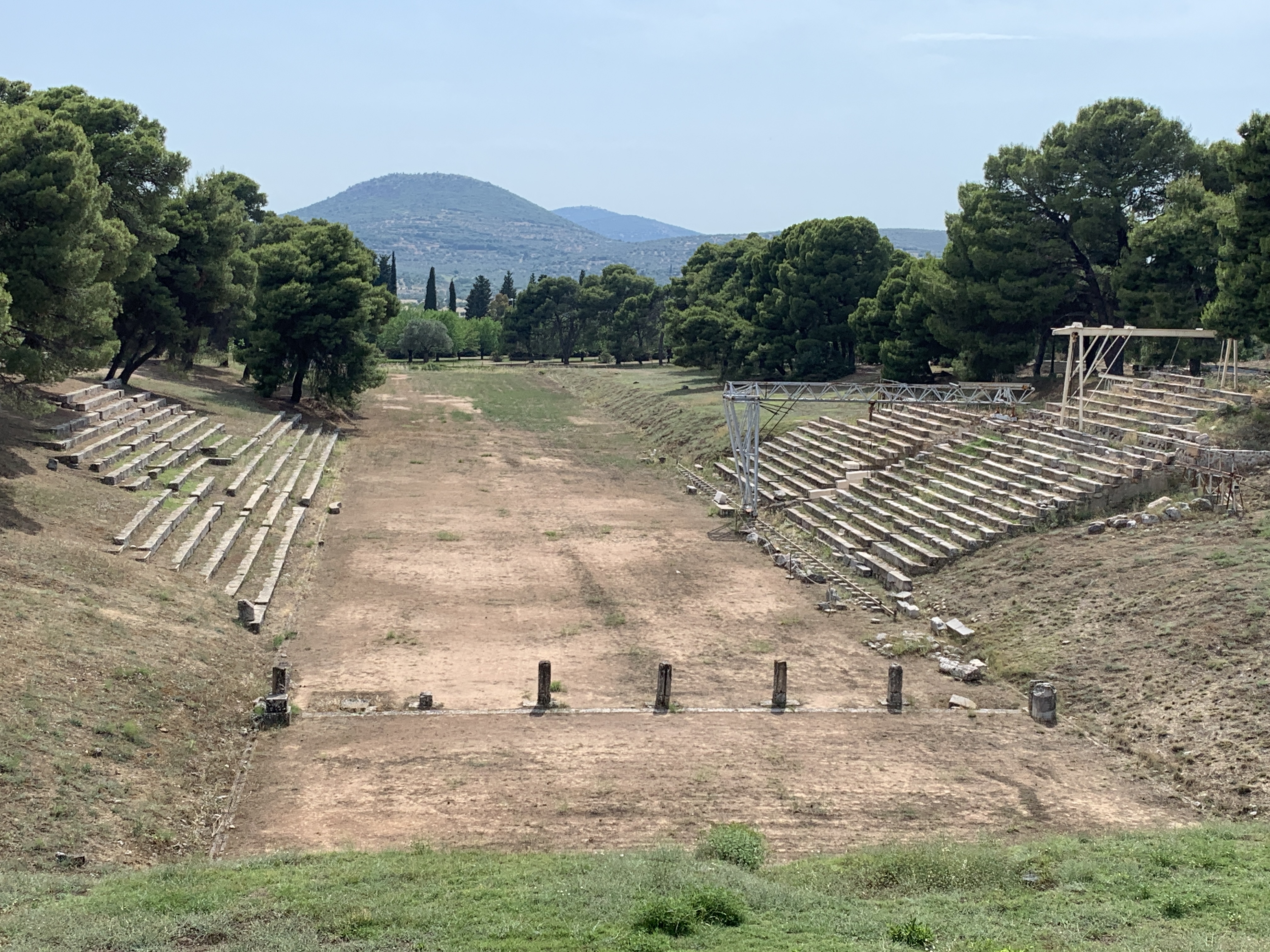
Since this is an ancient Greek site, surely there is a stadium! Athletic contests in Epidavros dating from 5th century B.C. are in the writings of Plato and Pindar. Today, the stadium is used in limited capacity for school track and field activities.

Stadium of Epidavros

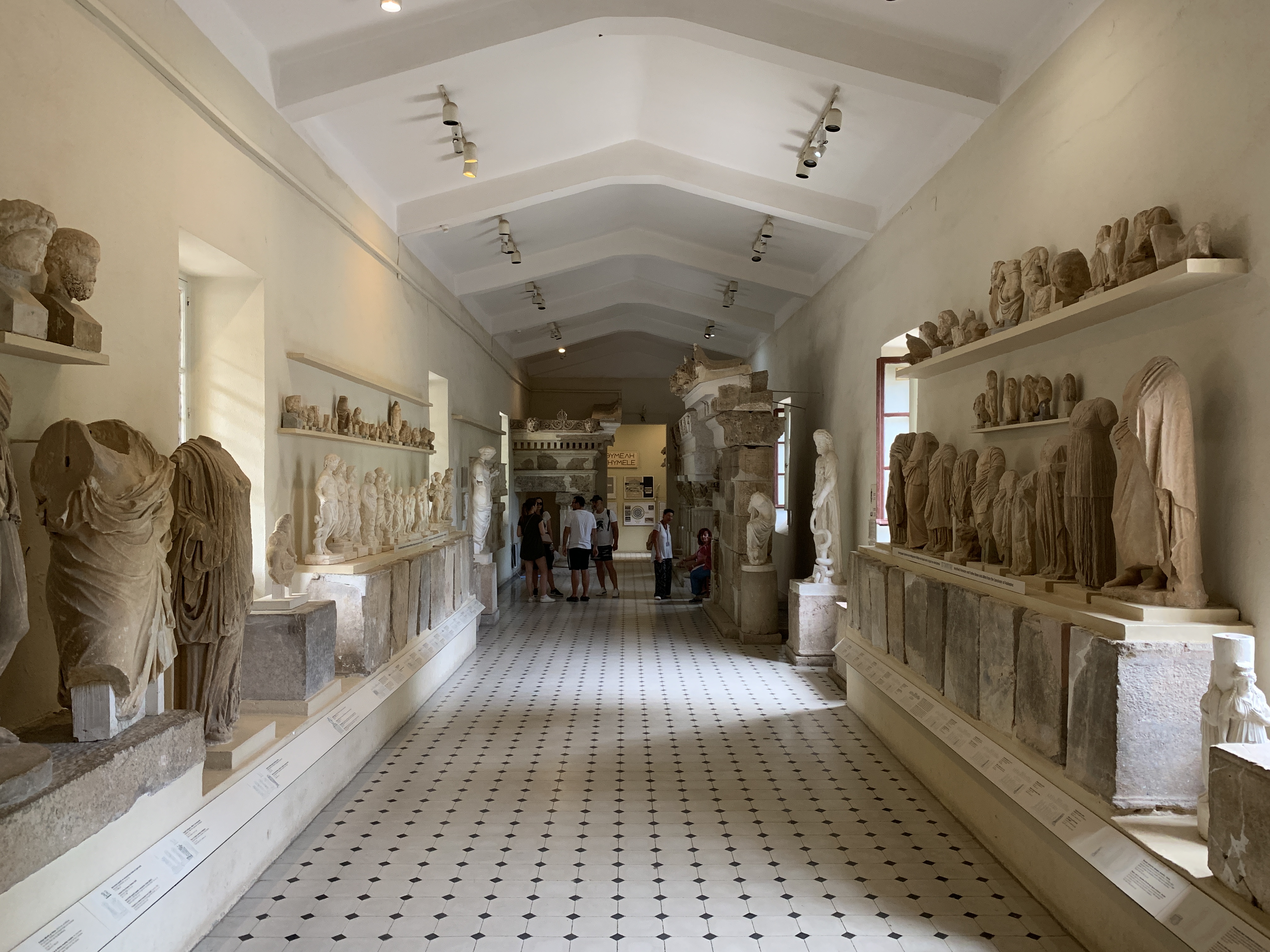
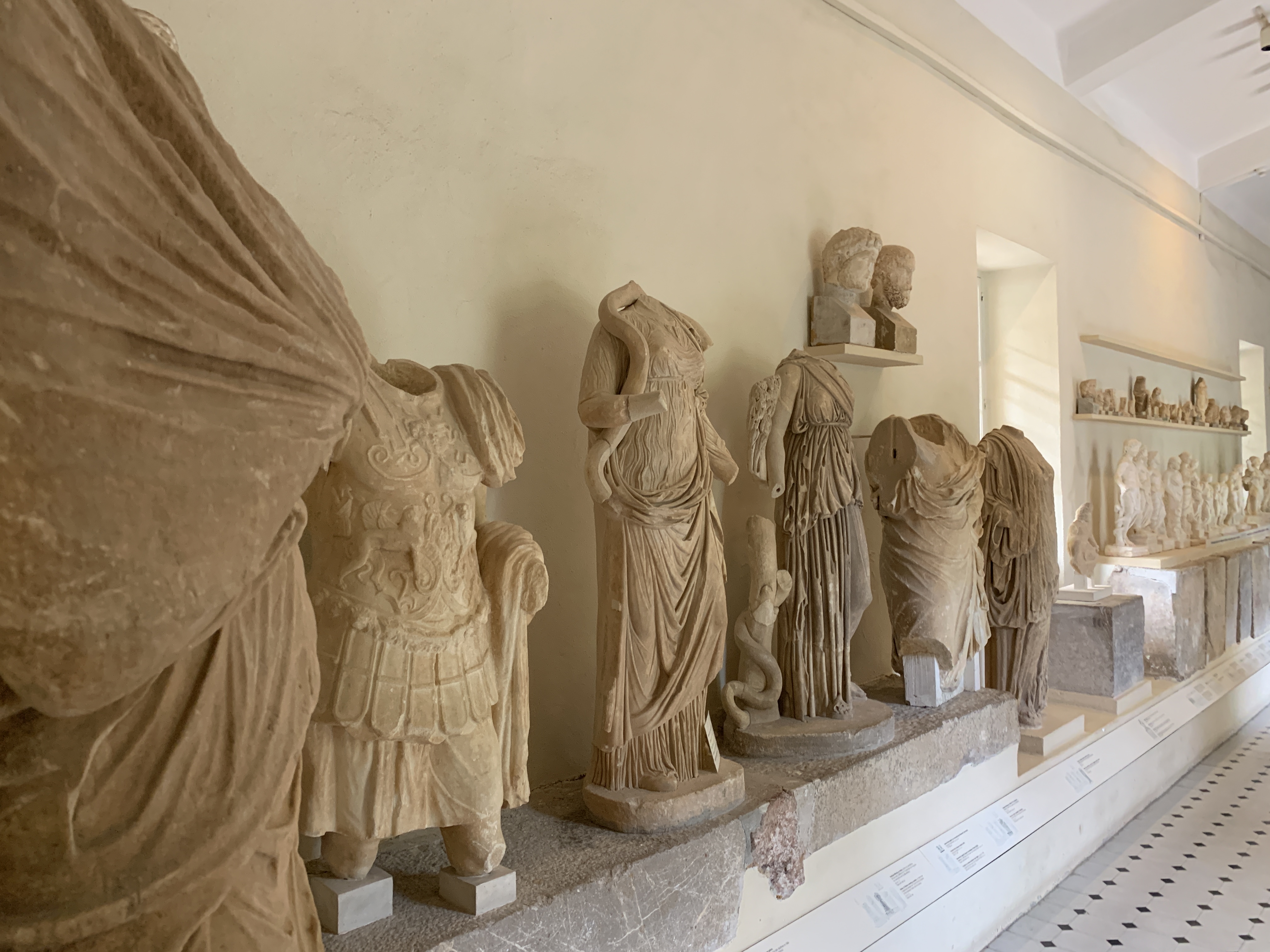
And of course, there is a museum. Although this one is small, its treasures rival those at Delphi, Corinth, and other places. I marvel that statues and artifacts over 2,000 years old are not encased; their beauty can be examined from inches away.

Treasures of the past

Magnificent statues line the walls of the museum

Timeless beauty

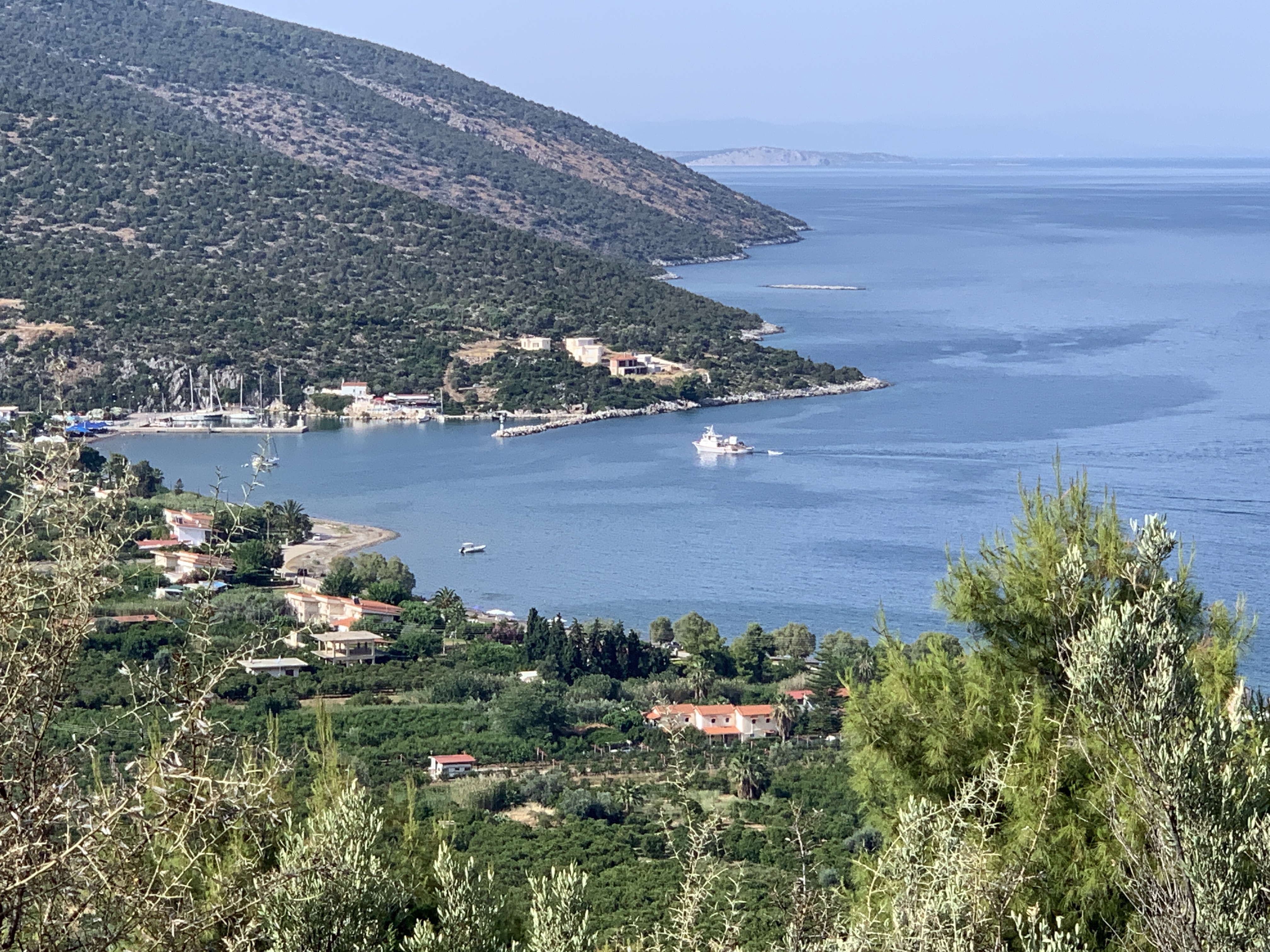
Adding to the enchantment of the Epidavros experience is getting there. The road along the coast and over the mountains is a winding ribbon of scenic overpasses and stunning views. Thankfully there are pull-out places to stop and absorb the beauty, and to take picture-postcard photos.

The road to Epidavros

A

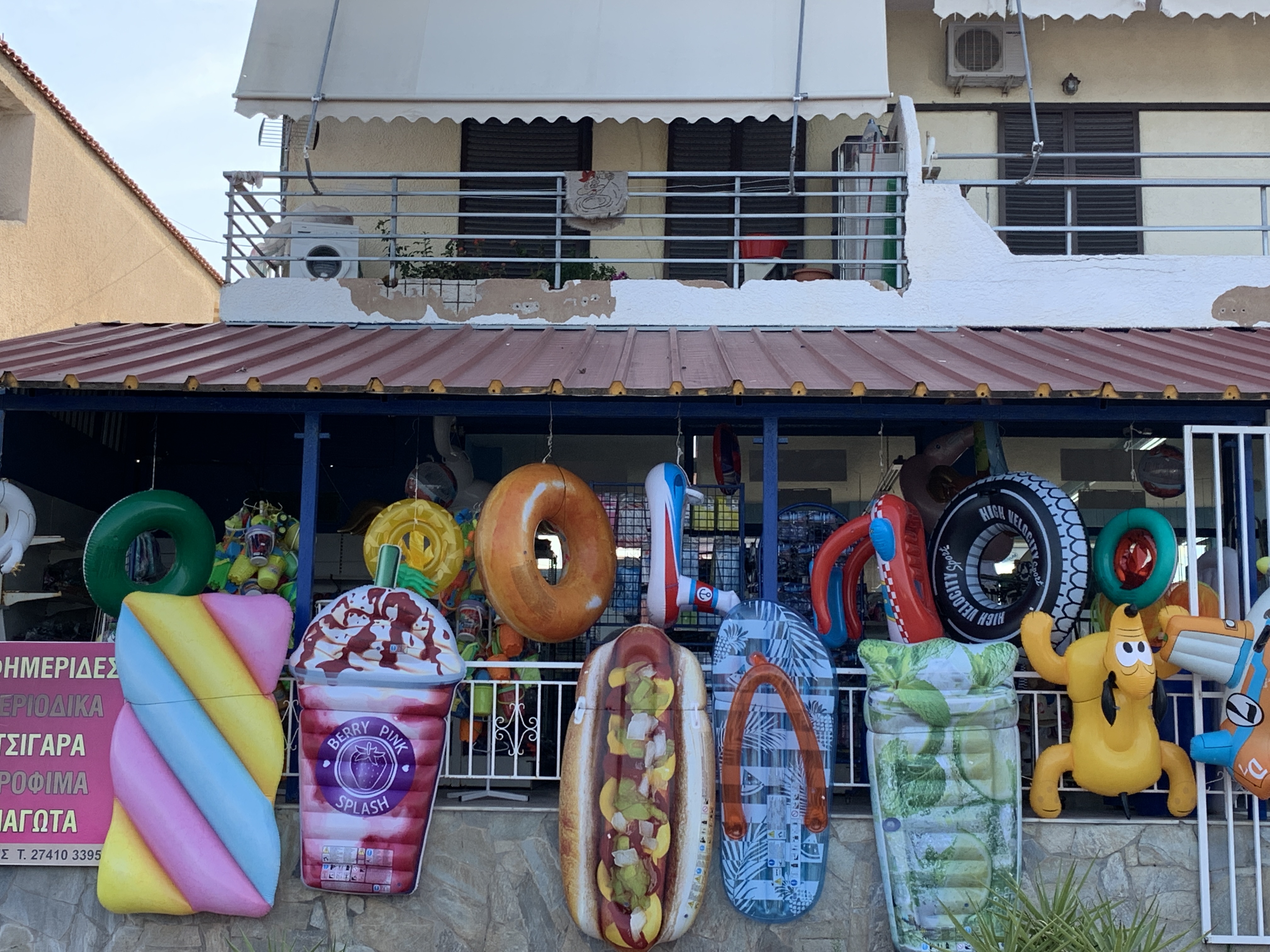
Families flock to the rocky beaches. The water is clear, clean and inviting. Beach shops sell the same wares as the ones in Ocean City, Maryland!

Beach time

Greece or US? It’s the same!

Now that I’ve explored by day, I am ready for a play at night. Whether tomorrow or 2,000 years ago, the experience will be timeless.

Greece 2019 – Greece in Mosaics

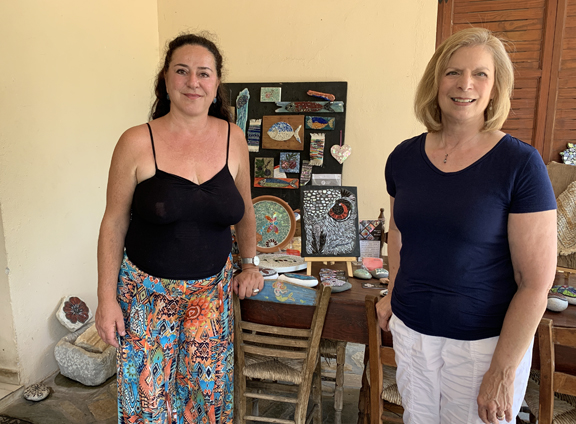
How to capture the uniqueness of this country, in an art form that is timeless and authentic to Greece? Dimitra Columvakou has one answer–mosaic designs. An ancient art stretching back 4,000 years, I have seen masterful pieces in museums throughout Greece. But I never expected to visit a studio, and I was excited to find one in Xirokambi, 10 minutes from Sparta.

With Dimitra Columvakou at her studio in Xirokambi, Laconia.

I first connected with Dimitra through her page on Facebook and have long admired her art. She had begun mosaic design in Canada, but it was not until she returned to Greece in 1996 and settled in Xirokambi that she established a studio. She finds inspiration in art, nature and culture which are reflected in every piece.

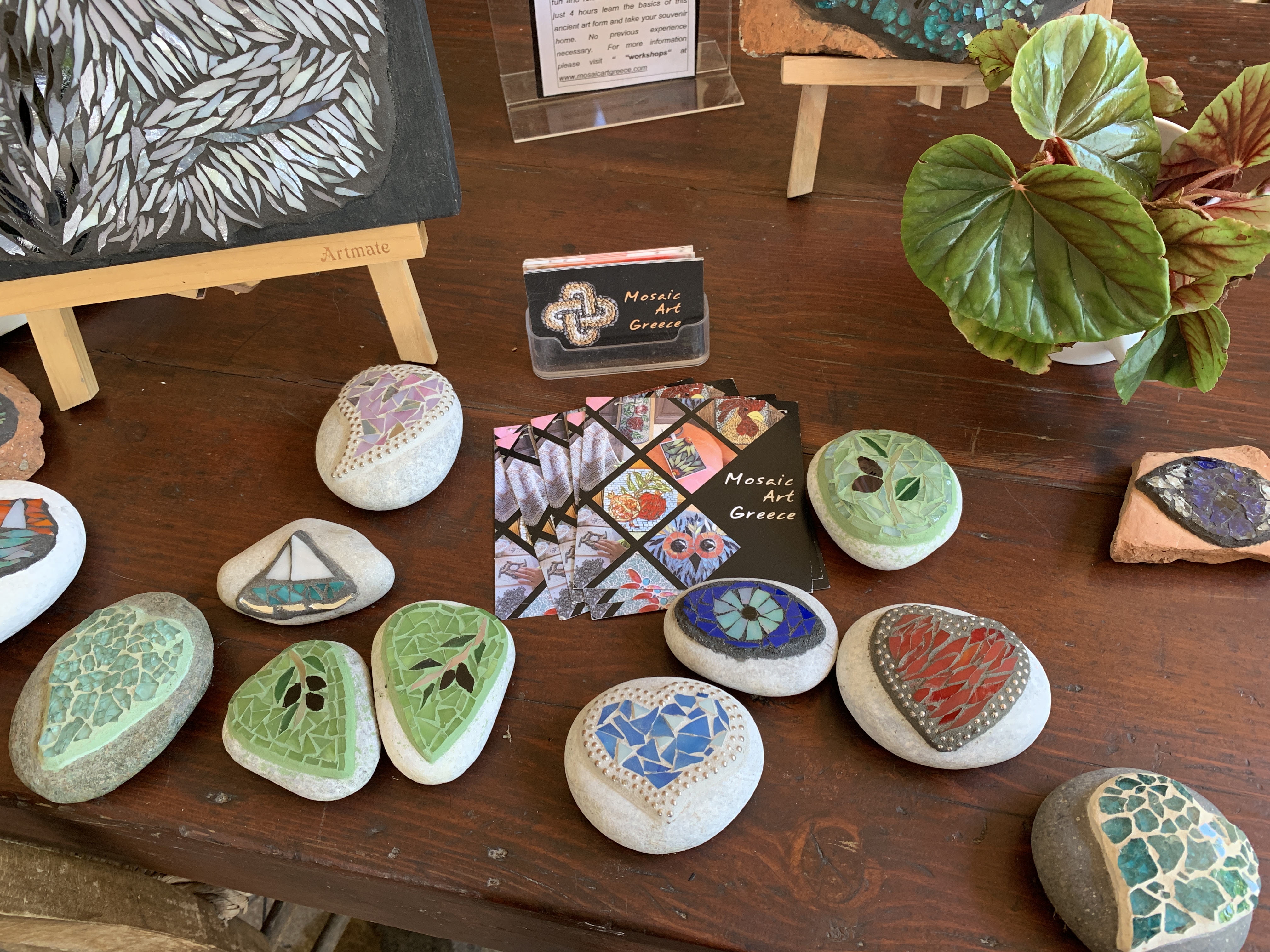
Some of Dimitra’s designs

Dimitra works in pebble  and glass. She creates designs on rocks, tile, wood, pottery, cloth, and even frying pans. No two pieces are alike. Each takes hours to construct. Pebbles and glass are handpicked and meticulously arranged. This is an art form that combines beauty and functionality; mosaics are found not only as art but on floors, walls and footpaths.

Birdbath designed and constructed by Dimitra

Dimitra told me that each stone, tile or other item, “speaks” to her and she creates a design unique to that item’s shape, size and color. As a quilter, I understand exactly what she means. An artist doesn’t force her will upon nature; instead, she allows nature to direct the creative process. And in the end, a unique work of art is formed.

More of Dimitra’s art

Dimitra’s creations extend to jewelry

Every year, my Pappas/Papagiannakos family gathers for a cousins reunion and Dimitra’s work will be there. Unfortunately, stone is heavy and I have twelve items to buy; fortunately, Dimitra has time to create small pieces for me. I can’t wait to give my cousins such unusual and authentic Greek gifts.

Some gift items for my cousins’ reunion. More are being created.

Dimitra’s work is found throughout Greece and abroad. She holds weekly workshops in Xirokambi and Kalamata. I hope that next summer, time will allow me to try my hand at this new form of art and learn from this extraordinarily talented woman.

To find Dimitra:
email: info@votsalota.com
Mosaic Art website
Mosaic Art Greece on Facebook
Mosaic Art Greece on Pinterest 
Read an interview with Dimitra here.

Greece 2019 – Cooking with Eleni

Every summer, I look forward to a cooking lesson with my cousin, Eleni Kostakos. Last year, we made κεφτέδες (keftedes, meatballs). This year, δολμάδες (dolmades, stuffed grape leaves) were on the menu. A google search will bring up dozens of recipes, but none are as good as Eleni’s.

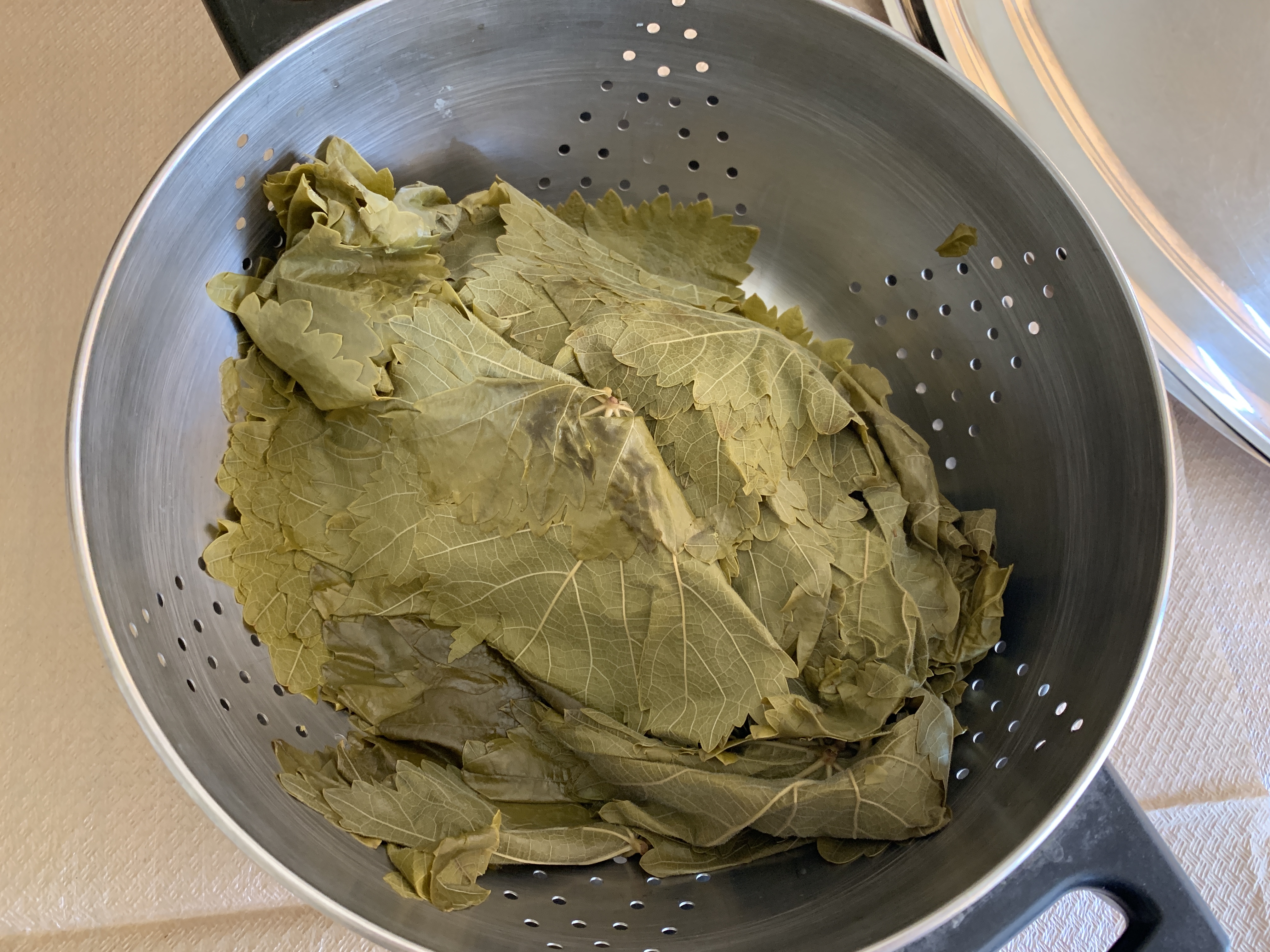
Her grape leaves come from her brother’s vines and are picked when young and tender. She freezes them with no loss of flavor. Fresh, even frozen, leaves are infinitely better than the brined and salted ones which come in jars; but since I have to use jarred leaves, Eleni recommends boiling them to remove the salt and vinegar.

Frozen grape leaves, thawing at room temperature

Our first task is to cover the table with a laminated brown paper, which absorbs fluids and drips. Next, the meat mixture is prepared.

Ingredients 
1 kilo (2 pounds) ground beef
2 very large onions (Eleni used red onions)
3 eggs
1 can tomato paste (6 oz)
1 cup rice, rinsed
salt, pepper (no measurements)
dry mint (a handful, rubbed)
about 1/3-1/2 cup extra virgin olive oil
fresh mint leaves

Fresh mint dot the grape leaves

Directions
1. Soak fresh mint in water.
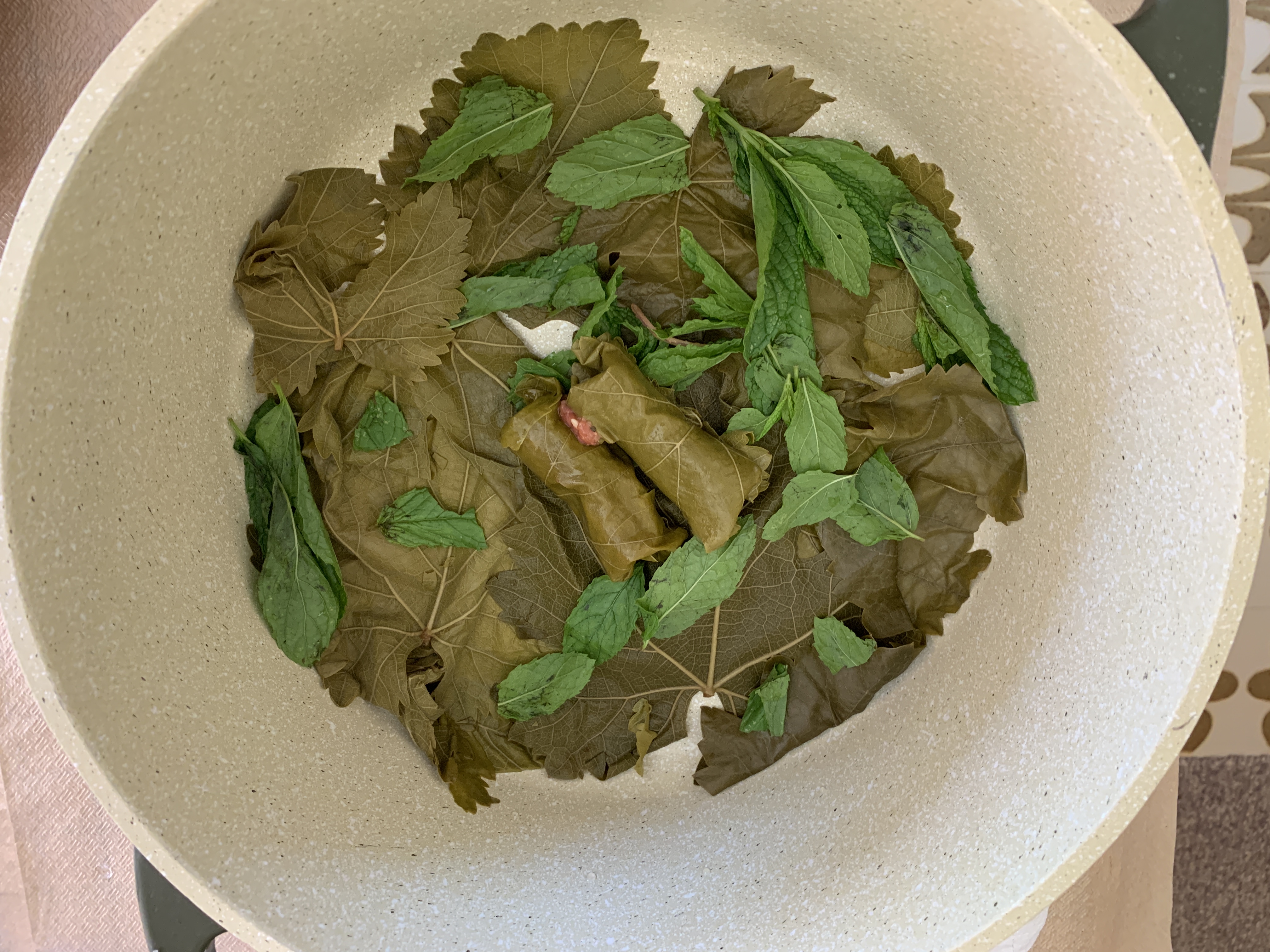
2. Begin to separate grape leaves. Put a layer in the bottom of a casserole, add a few fresh mint leaves, then another layer of grape leaves and mint.
3. Put ground beef in large bowl.
4. Finely chop onions in a food processor. There should be absolutely no chunks! Add to meat along with tomato paste, eggs, oil, salt, pepper, dry mint and rice.
5. Mix, mix, mix by hand until everything is smooth and shiny. The oil acts like glue to hold the ingredients together. DO NOT use bread crumbs or other fillers.

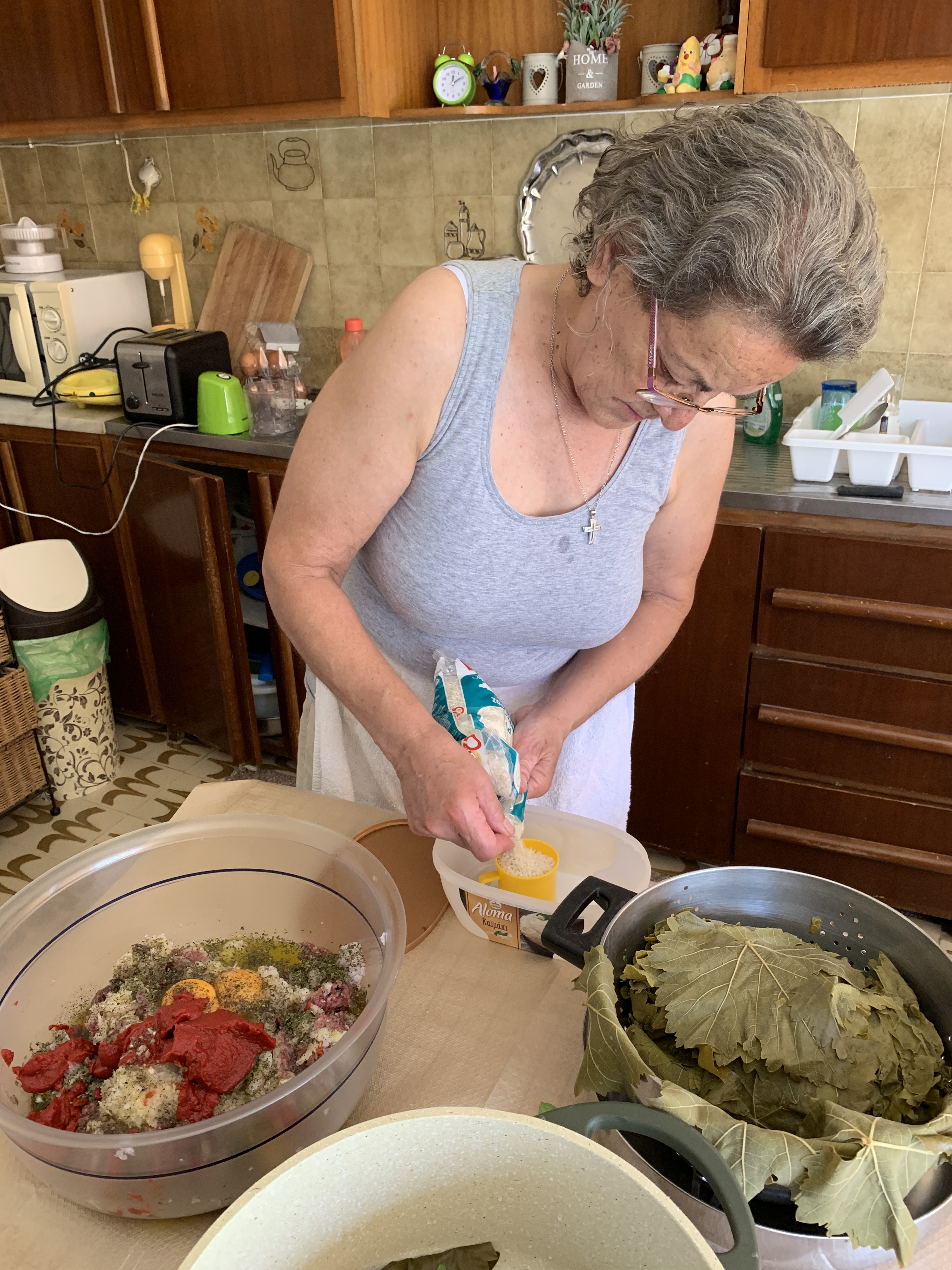
Eleni measures the rice. Note the bowl on the left with meat ingredients, ready to be hand mixed.

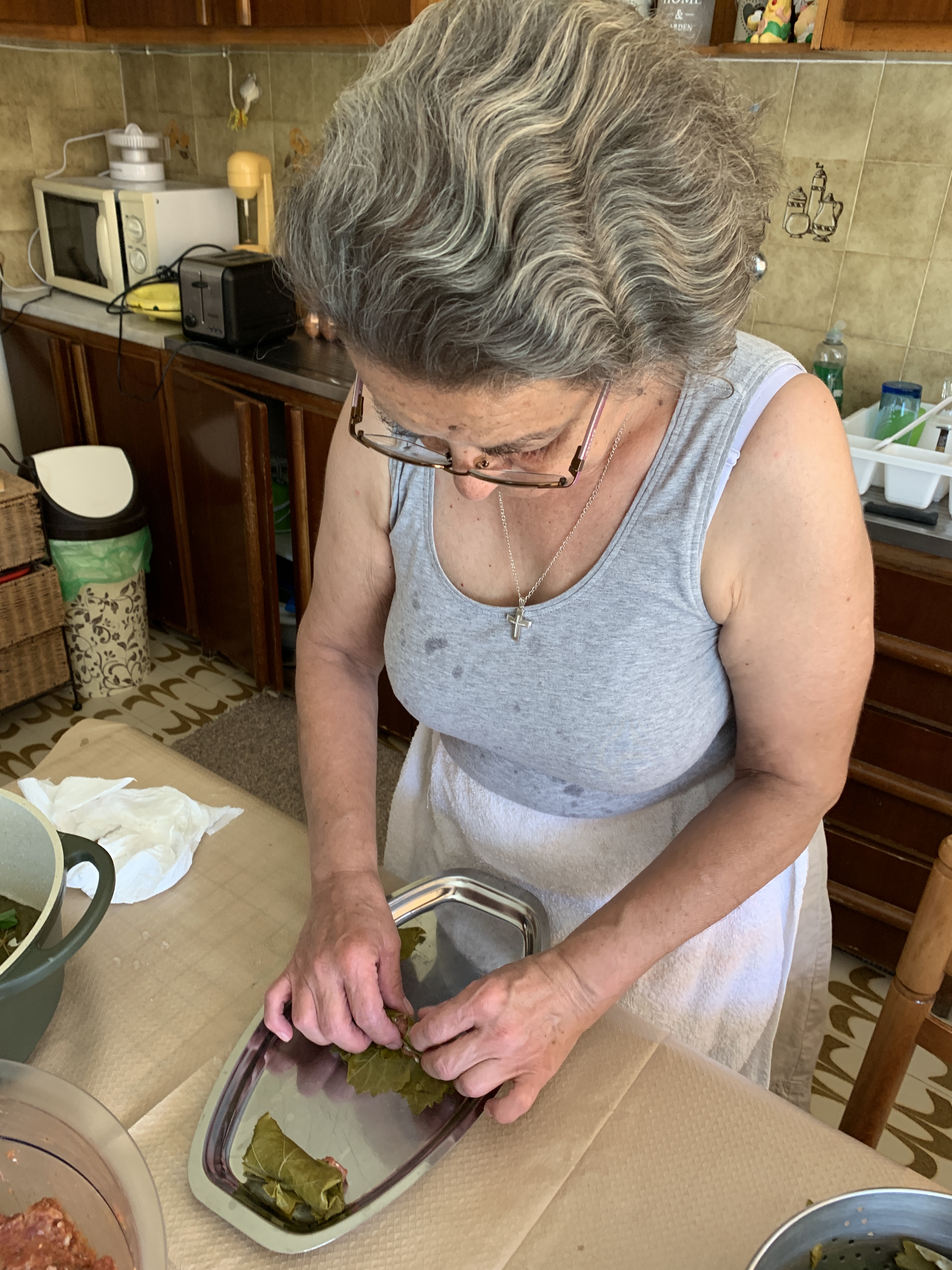
When the meat is ready, the grape leaves are stuffed. This is a tricky process. When Eleni and her husband were owners of a taverna, her dolmades had to be picture-perfect. She showed me her method of folding the grape leaves around the meat and tucking the ends of the vines inside so there is an exact mitered angle. I tried and failed. So we did it the easy way–by putting the meat inside the leaves, folding in both ends, and rolling. I learned that the meat is put on the bottom side of the grape leaves (where you see the veins), so that the shiny and smooth side is visible after rolling.

Eleni rolls the dolmades. You can see that this “easy” method does not yield mitered ends.

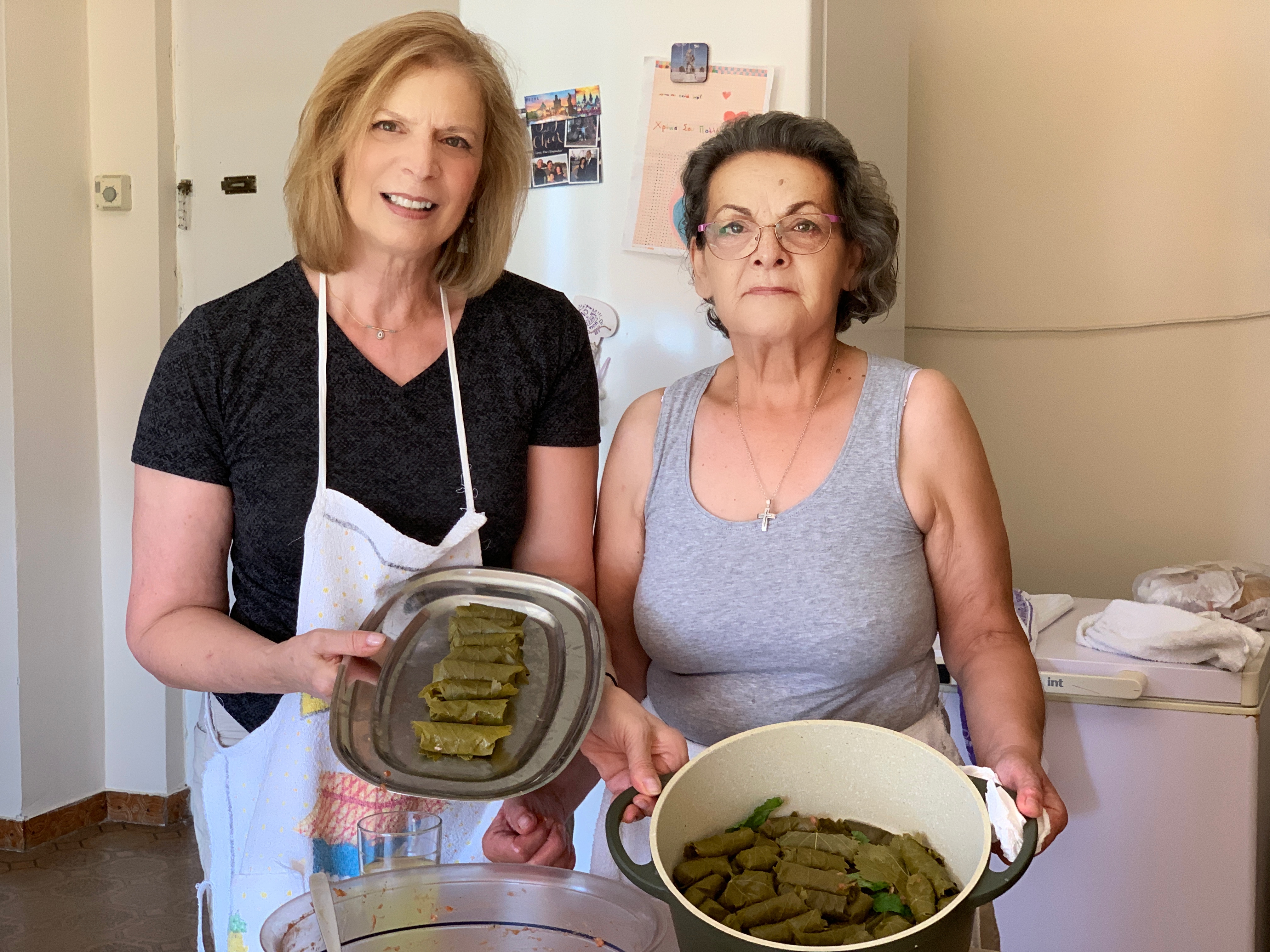
My handiwork!

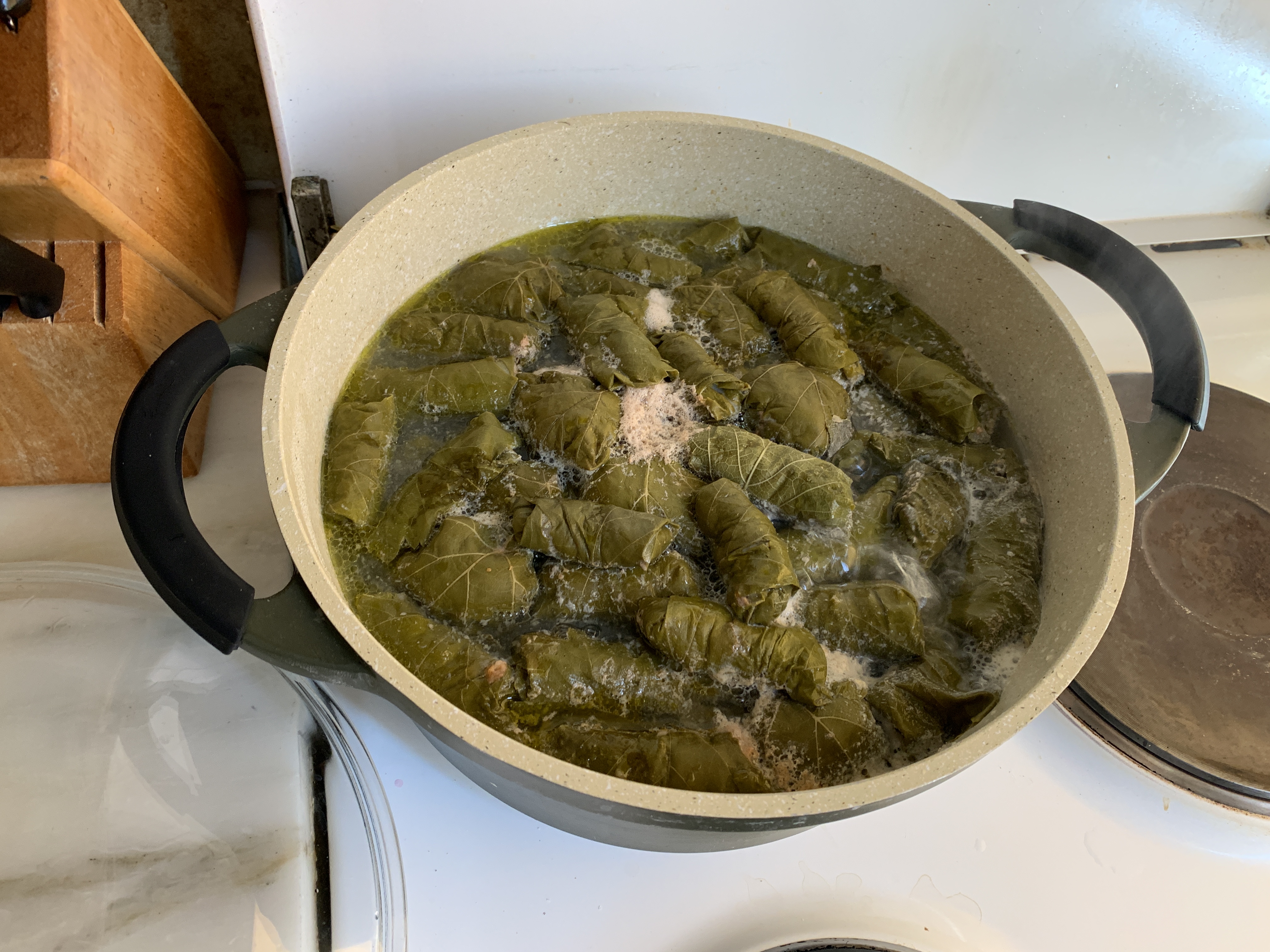
The rolled dolmades are carefully placed in the pot on top of the mint and vine leaves. Boiled water is poured over them, the pot is covered, and the dolmades simmer for one hour. If they start to open, put a plate over them. After one hour, drain the liquid from the pot and reserve.

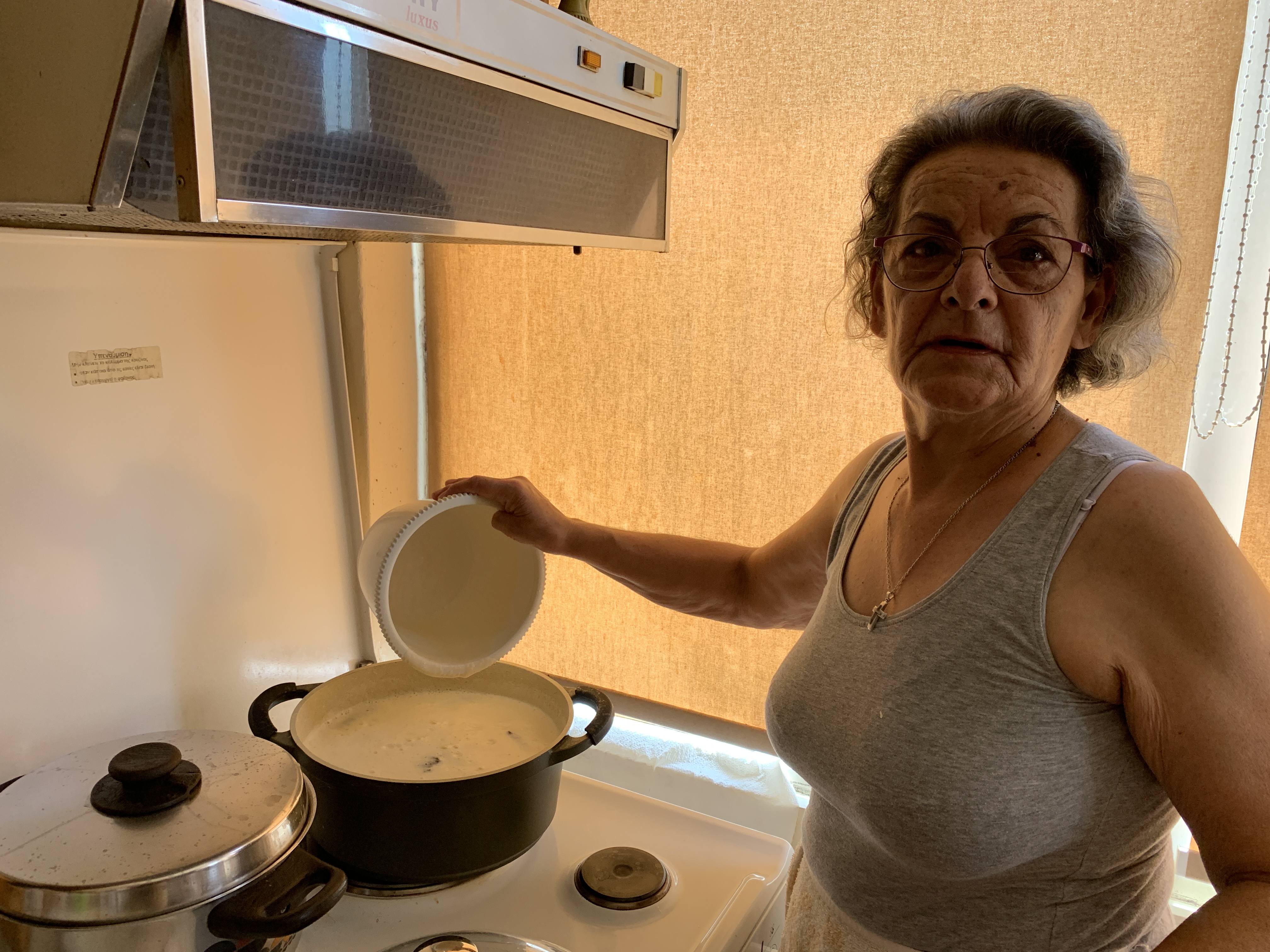
Simmering on the stove

Now comes the lemon-egg sauce — the final touch that gives that unique flavor. Use four eggs and the strained juice of two large lemons. Beat the eggs at least five minutes until they are smooth and creamy. Add the lemon juice one Tablespoon at a time. Finally add about 1/2 cup hot liquid which had been drained from the pot. Pour the lemon-egg mixture over the dolmades and heat thoroughly. Don’t boil or the egg will curdle!

Lemon-egg sauce is added to the pot

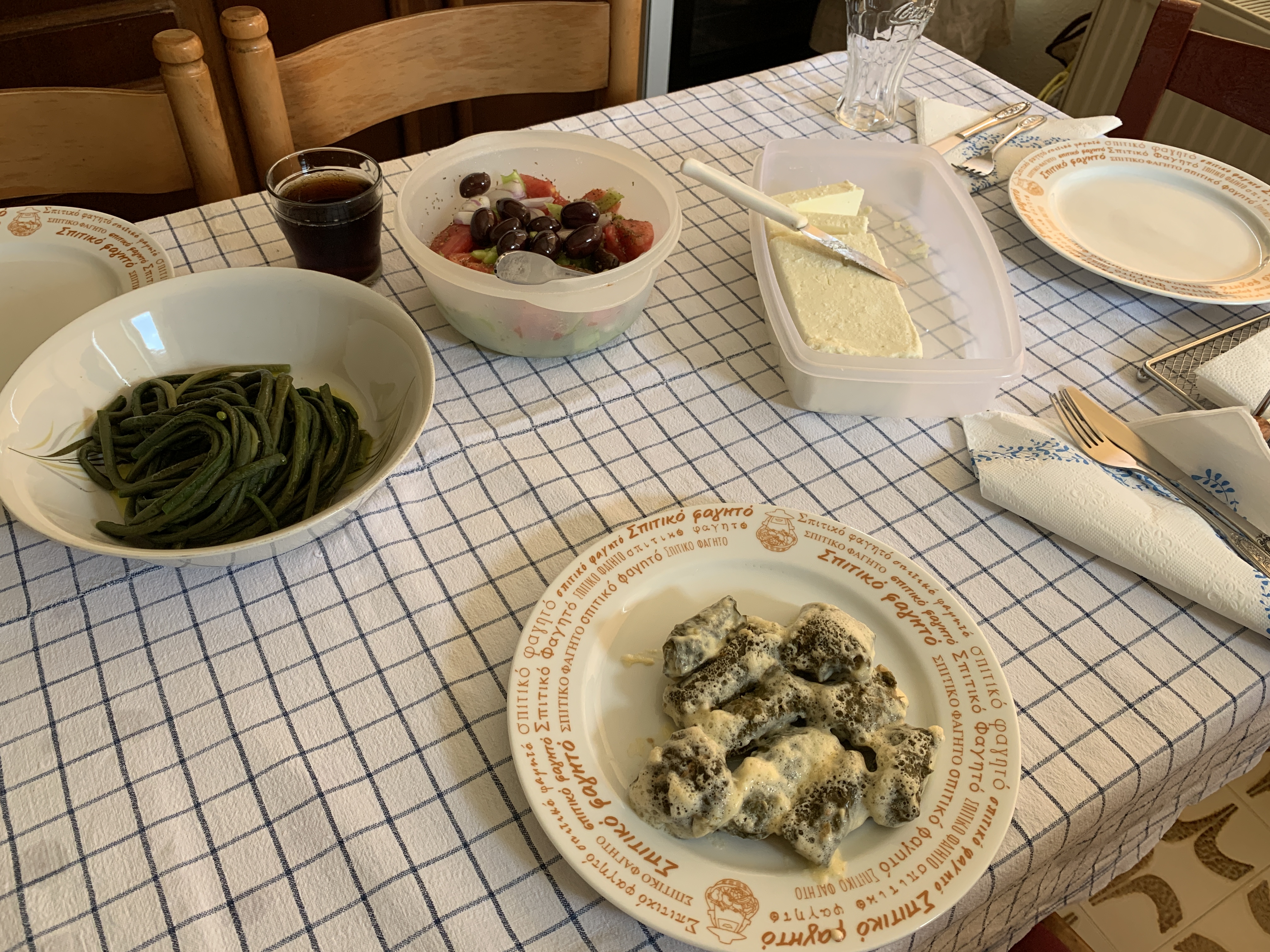
Dolmades can be kept in the refrigerator for one week, and can be successfully frozen. Make a batch and enjoy with traditional Greek salad, olives, feta cheese and crusty bread. You will feel like you are in Sparta!

A perfect meal!

And next summer’s lesson? Γεμιστά, stuffed peppers and tomatoes ❤