Unknown's avatar

About Spartan Roots

I am of Greek ancestry with roots in villages near Sparta. My paternal grandparents and maternal grandfather were born in Agios Ioannis (St. Johns), and my maternal grandmother was born in Mystras. I love family history research and have been tracing my roots for many years. I was born in Brooklyn, New York and was raised in a predominantly Greek neighborhood close to extended family. I live in the Washington D.C. metropolitan area and work as a volunteer Co-Director of the Washington, D.C. Family History Center and a genealogy aide/project aide at the National Archives in Washington, D.C. I am always updating and adding new information. Please contact me - I would love to hear from you!

The First Cart in Kaminia

author: Georgia Politis-Apostolakos
published in The Faris Newsletter, Issue 55, December 2011, pages 19-20

The first wheeled vehicles appeared in our region just 50 to 60 years ago. Before that, in the villages for their travels but also for the transport of things, they mainly used animals. They had mules, donkeys and the more privileged ones, horses.

Horse Cart; photo: https://www.arcadiaportal.gr/news/hani-tis-sellasias-ston-dromo-tripolis-spartis-pics

So, the first wheeled vehicle that made its appearance was a cart. It was two-wheeled and drawn by horses. Its base was in Kaminia. Its original owner was Menis Theofilopoulos who then sold it to Georgios Politis, to whom it remained for many years. For a period of three to four years it was the only one in the area and served not only Kaminia but also all the surrounding villages. Therefore, that period was a good time for the owner, as it was in high demand and had no competition. As mentioned above, it was a two-wheeler and was pulled by one or two horses, which were also owned by the same one. He usually used one of them, depending on the load. If the load was heavy or the road was bumpy, he yoked both of the horses to it. He moved people or carried things, such as wood or olives at a price, which depended on various factors, such as the type of cargo and the distance it covered. To transport people, he charged about 100 drachmas per head and, if the distance increased, the cost varied slightly. Often, as he says, he would put several women together in the cart to take them to the fields to work, and on the way he got teased by everyone he met. From the west, he could go as far as Polovitsa and more rarely to Gorani and from the other side as far as Anogia. Kaminia – Xirocampi was one of the most common routes.

The best period in terms of work was the winter months, during the “olive season”. It was the golden period, as he transported workers to the fields for the harvesting olives, olives from the fields to the factories, and then the barrels with the oil from the factories to the houses. The cart could carry up to 500 kg of load. Exceptionally, when it carried olives, the price was not money, but for each 100 kilos of olives carried, he got 1 kilo of oil. An incident that he himself mentions is that one year, there was such a big quantity of oil, that he was constantly unloading olives of various people at the factory of Stratigis, as he was called. At one point, he saw Stratigis coming towards him in a rage, and cursing and shouting, he kicked him out of the factory, telling him among other things “…you, the way you’re going, you’ll take the factory from me…”, as he was working hard and with so many olives he had brought in, he was entitled to a large amount of oil.

Finally, his contribution to the creation of local roads in Kaminia and the surrounding villages, as well as to the reconstruction of the Kolopanas bridge, was also great. I got the information from the owner of the cart himself, Georgios Politis, son of Evangalos, 87 years old today.


I am honored to receive permission from the Katsoulakos family to translate and share articles from The Faris. Translation verification and corrections have been made by GreekAncestry.net. This is the fifth article of the ongoing series. Previous articles can be viewed here.

Local Childbirth and Puerperium Customs

by Eugenia Io. Konidi
published in The Faris Newsletter, November 1998, page 9

The birth of a child used to occur in the house in the presence of the midwife, a respectable person of the local community. In cases where labor presented difficulties, a doctor intervened and sometimes took the child with “spoons” [known as forceps].

The midwife, the mother-in-law, and the mother burned incense to icons so that God would help with the birth. Primarily, they invoked St. Stylianos, protector of children [paretymologically from stelos, (verb stelono), which is a strong pillar or beam]. They believed that the diet of the mother should be very light. She usually ate chicken soup with angel hair pasta and oregano or boiled greens.

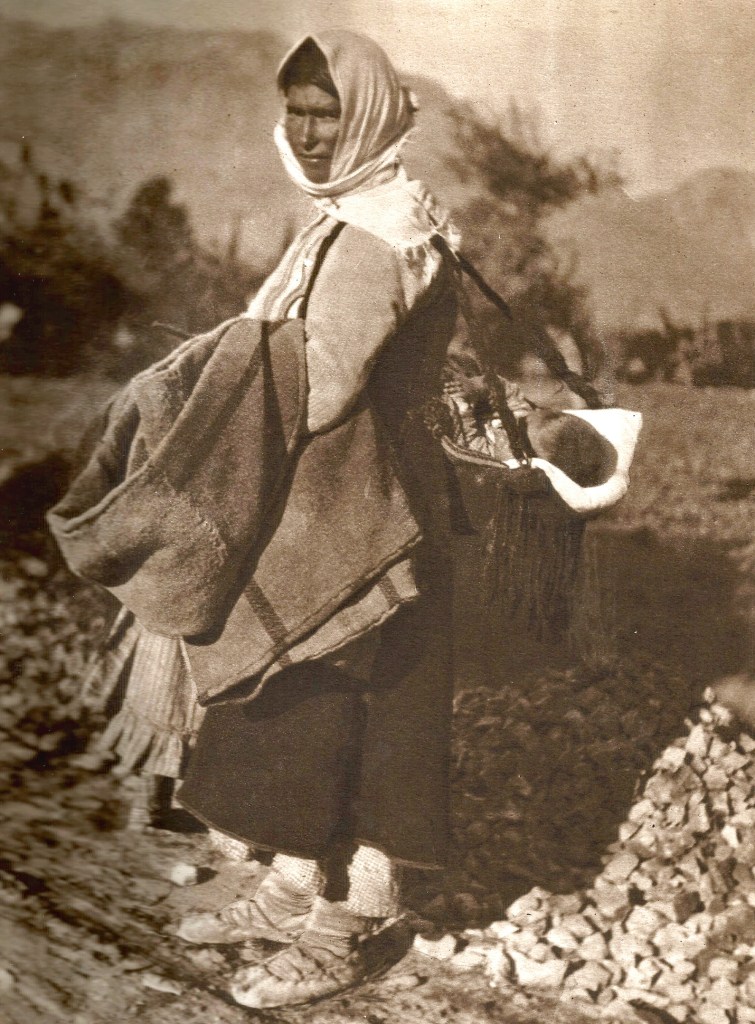
Spartan Woman in Field, 1929 by Francesco Perilla
Wikimedia Commons and Lakoniki Bibliothiki
Χωρική της Σπάρτης 1929. Στον ώμο έχει την νάκα με το μωρό
Από το βιβλίο του Francesco Perilla, Mistra. Histoires franques-byzantines -catalanes en Grèce = notes d’art et de voyages (Athènes 1929)

Immediately after the birth they did not wash the baby, but cleaned it with cotton that was saturated with warm water and put powder on it. For the first bath of the baby, the midwife put salt in the water, so that the child would not become “unsalted”, meaning probably insipid, bland. The new mother was not supposed to left alone in the house, at least for three days, as it was believed that new mothers, because of the impurity of childbirth, were under the influence of demons.

It was believed that on the third day after the birth, the Fates would come to determine the child’s luck. In many places, in order to appease the Fates to predict a fate of good fortune for the child, a plate of bread, honey, nuts and sweets would be placed by the mother’s bedside so that the Fates could take it themselves. If it was necessary for the mother to be left alone, they would place under her pillow incense, bread, an icon, a cross, a holy flower, a bit of holy water or a little kid by her, because of the belief that small children have a deterrent power.

When the baby was forty days old, the midwife would take it together with a small child and they would go to the church to get blessed. If it was a boy, he would be taken to the chancel (the altar area). The baby was usually swaddled so it would not hunch and it could stand upright and strong. For the best wishes, they made sweets, diples if it was a boy, in order to double itself or kouriambiedes and ravani for the girls. Relatives brought sweets or a silver coin.

The couple usually preferred to give birth to boys, so that the family (soi) could continue (male preference). Instead, girls needed a dowry and a lot of attention during their upbringing, so they had to live with limitations so as not to be given a bad name.
Many customs are common in many regions of Greece and some of them have their roots in antiquity.


I am honored to receive permission from the Katsoulakos family to translate and share articles from The Faris. Translation verification and corrections have been made by GreekAncestry.net. This is the fourth article of the ongoing series. Previous articles can be viewed here.

In Family Tree Magazine!

I appreciate the mention of this Spartan Roots blog in the recent issue of Family Tree magaine, an excellent resource for genealogical research. Thank you, Sunny Jane Morton for the endorsement, and to Georgia Stryker Keilman, founder of the Hellenic Genealogy Geek website and Facebook page, for alerting me to this post! The full article, Genealogy Blogs from Around the World (and Why They’re Valuable), can be accessed here.

Is it True? You Decide!

It’s happened to all of us – someone posts information about your surname on a genealogy Facebook page or an online family tree. Your eyes pop and then the adrenaline rush hits. Could this be the clue you’ve been seeking? Everything seems right. The name is the same. The village is close to yours. The dates may be a bit off but we know that’s common in Greek genealogy. Your intense desire to find your ancestors may overcome a speculative thought that creeps in when you see that no source or notation is given. Brushing that pesky thought aside, you happily add the name to your family tree. Success!

But is it? No. You have just succumbed to one of the most dangerous aspects of genealogy research:  accepting someone else’s research conclusions without independent verification.

The Genealogical Proof Standard (GPS) is an established methodology to help us guard against making this mistake. Its 5 components are:

  1. A reasonably exhaustive (thorough) search
  2. Complete and accurate source citations
  3. Analysis and correlation of relevant evidence
  4. Resolution of conflicting evidence
  5. Clear written explanation

When we see posts, comments or articles where the GPS standard is clearly not followed, we must not  accept that author’s conclusions as being accurate. We can take their information and consider it a possible puzzle piece, but one that must fit within the framework of what we have already verified. What others do—or do not do—should not upset us. We alone are responsible for the accuracy of our own research.   

Thomas W. Jones, who has lectured extensively on the GPS and has written the guide, Mastering Genealogical Proof (available here on Amazon), compares a jigsaw puzzle to genealogical proof (see this article): 

  • Just as a picture emerges from assembled puzzle pieces, genealogical proof rests on the sum of evidence.
  • Jigsaw puzzle pieces…may be found partly assembled. Valid genealogical evidence may be similarly easy to obtain and already partially connected…or scattered…then the situation becomes complex, requiring researchers to hunt for pieces…that answer a research question.  
  • Some puzzle pieces may be set aside because they do not belong to the puzzle at hand. Genealogical proof resolves conflicting evidence by discarding information that is unreliable or not applicable to the research question.
  • A clear picture or reliable answer may emerge even when pieces are missing…When the pieces are assembled correctly, pieces found later will augment the picture, not change it.  

In summary, it is incumbent upon us, the researchers, to follow the GPS by carefully reviewing each piece of “evidence” or information, checking its sources, analyzing its meaning in the context of our research, resolving (if possible) conflicting evidence, and writing clearly our analysis and conclusions. When we take these steps, we can confidently share our research with others.

Marriage at the Beginning of the Last Century

by Nicholas Bourazelis, Colonel (retired)
Published in The Faris Newsletter, October 2020, issue 27, page 17

No marriage was made for love, it was made through matchmaking and mediated by a woman, the well-known matchmaker.  Along with the parents of those who were to be married, the symbetheri (parents-in-law) as they were called, arranged all the details, the dowry to be given, etc. When the agreement was finally reached, it was drawn up and signed by the parties concerned. The father of the groom paid the matchmaker, and the work of the matchmaker was over.

A peasant bride, in splendid gold adorned costume, at the annual religious feast, Mandra, near Eleusis, Greece. Library of Congress Prints and Photographs Division, Washington, D.C.

When night fell, two or three shots used to be fired at the groom’s house. This custom was intended to inform the villagers that the match, which they had suspected, had come to a happy end. Engagement ceremonies followed in a short time without any particular formality. They simply exchanged the rings.

Finally, the wedding took place. However, since one of the betrotheds did not come from the same village, the relatives of the groom usually went to the other village to pick up the bride. A convoy of men wearing fustanellas was then formed. All the guests rode on mules and horses. In psyki, as the procession was called, they did not use donkeys. The animals’ bodies were covered with white mandani (blankets), the kilimia (woven blankets). The procession began with songs. As the first wedding song, it was customary to sing: “Let my eyes see, let my eyes see how my love is doing.” With songs, joking and cheerful conversation, they came to the bride’s village.

In front of the village church the bride-to-be and her father were waiting. When the bridegroom arrived, the prospective bride’s father would kiss him and hand over his daughter. The priest would then take the couple and bring them to the middle of the church where the ceremony would take place. During the “Isaiah dance,” the guests showered the newlyweds with rice, flower petals and confections. The atmosphere was joyful and happy. The sacrament was over and the newlyweds received the embraces of those present with the wish: May your life be lucky and happy.

The company then, with the bride on a decorated horse, was on its way back. The singing by men and women continued all the way to the groom’s house. There the bride was welcomed and the dance began, which was started by her, while everyone sang together: “My fortunate bride, may you live, may you grow old, may you live to be a hundred years old and more.” The feast continued with rich food and drinking until the early hours of the morning. That is how the marriage ended.

What happens today? Time has changed a lot. Life goes on with all the changes. This is not a concern, as long as the couple has mutual love. Otherwise, divorce follows with all the consequences. Mutual love leads to a peaceful old age.


I am honored to receive permission from the Katsoulakos family to translate and share articles from The Faris. Translation verification and corrections have been made by GreekAncestry.net. This is the third article of the ongoing series. Previous articles can be viewed here.