I am of Greek ancestry with roots in villages near Sparta. My paternal grandparents and maternal grandfather were born in Agios Ioannis (St. Johns), and my maternal grandmother was born in Mystras. I love family history research and have been tracing my roots for many years. I was born in Brooklyn, New York and was raised in a predominantly Greek neighborhood close to extended family. I live in the Washington D.C. metropolitan area and work as a volunteer Co-Director of the Washington, D.C. Family History Center and a genealogy aide/project aide at the National Archives in Washington, D.C. I am always updating and adding new information. Please contact me - I would love to hear from you!
There’s a scientific principle that any gap that is created in nature is inevitably and typically filled by other elements of inferior quality. We all tend to forget this when old values are abandoned or lost.
The field guard is also one of the old values, who protected the land, the countryside, the outdoors that is now unguarded and where countless outlaws roam freely, terrorizing the elderly, taking their wages, stealing everything, whatever they can find: lambs, chickens, kettles, irrigation valves, with a great risk of killing you or, you killing them and going to jail.
Every village used to have a capable field guard, the protector of nature. Every day, alone but also with other field guards, he roamed the land, a vigilant sentinel, observing everything in his grey uniform with boots and a hat, like a constable.
And although before you saw him passing, in another part of the village you heard him whistling. He was a fickle person, an excellent tracker who could find any trace, even in the mud or dust. He investigated the tracks and acted accordingly. He knew the owner of every field, the flocks, and every estate whether it was sown, fallow or obstructed. He settled the villagers’ disputes and always made a proper assessment of their damages. At night he conducted raids, frequently patrolling and setting up several ambushes, and even staying up all night. So, no one would dare to break the law because the invisible guard would punish fairly. He did his job right and the farmers acknowledged him. Well done, they said to themselves, and they slept peacefully. The field guards guarded the outdoors which is now unguarded and countless outlaws roam freely. They terrorize, burn and loot. This phenomenon is in great need of the government to address it. When you guard yourself from all danger, then you will learn to guard ordinary citizens as well.
Aristotle had said that, when there are law-abiding citizens, there is no need for the state. For this reason, the real power must institute draconian laws to secure order.
I am honored to receive permission from the Katsoulakos family to translate and share articles from The Faris. Translation verification and corrections have been made by GreekAncestry.net. This is the eleventh article of the ongoing series. Previous articles can be viewed here.
(Note: this post, “Telephone” is the third of three parts describing the earliest modern developments in Xirokampi. Part 1: Light, can be read here; Part 2: Water, can be read here.)
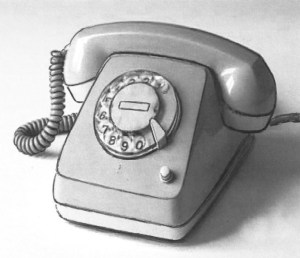
The OTE telephone network entered the houses and shops of the village in the late 1960s and early 1970s. OTE, founded in 1949, succeeding the 3Ts (Post Office [“Tachidromio”] – Telephony – Telegraphy), then began to install telephones connected to automatic dialing systems. The systems for each rural area were operated in the, so-called, Rural Telephone Centers.
In Xirokampi the center was housed for a brief time in the post office that was installed on the ground floor of the house of Dimitris Xanthakos and was to serve the telephones of the inhabitants of the villages of the whole area. The first employee and supervisor was Georgios Evag. Karampelas, who took over all the operations related to telephone and telegraph communications. Then the center was relocated to the ground floor of Ilias Kapetanakos’ house. Panagiotis Il. Komninos and Vassilis Il. Christopoulos also worked at the center temporarily, before Efstratios Ioan. Kritikos was hired as a permanent employee.
In the past, telephones were operated by means of manual systems, whereby the selection of telephone connections was made by means of plugs that operators/answering staff inserted into holes in a panel. They measured with mechanical timers the duration of calls as well, while calls required the turning of a small ‘crank’.
Photo credit: Library of Congress. Kansas City, Missouri. Private branch exchange (PBX) operator at her switchboard in the freight depot, photographer: Jack Delano; created 1943. https://www.loc.gov/item/2017847312/; accessed March 16, 2023
The office of Xirokampi was connected through a telephone line to every neighboring village. Even earlier, communications were made from station to station by telegraph or teletype, which in Xirokampi were originally installed in the house of Sotiris Papadakos (or Kokkinos).
Automation, the expansion of the telephone network and the proliferation of telephones caused (also) in our villages, for some time, an upsurge in pranks among the residents. In Xirokampi, coffee shop waiters would move around with trays throughout the market after telephone orders turned out to be pranks. Also, some people woke up one night after a call from the headquarters – supposedly – of OTE and cut the wires of their phones when they were warned of an imminent explosion of their device (!). However, at the same time they enabled family members who were away – especially abroad – to talk more often and more privately (since the privacy of telephone conversations was not guaranteed by the – very little – soundproofed ‘booths’ in call centers). But they also reduced the frequency of the letters they exchanged, as the postal employees of the time (Dimitris Georgountzos, Georgios Katsaros and Kleomenis Anastasakos) found and claimed.
I am honored to receive permission from the Katsoulakos family to translate and share articles from The Faris. Translation verification and corrections have been made by GreekAncestry.net. This is the tenth article of the ongoing series. Previous articles can be viewed here.
(Note: this post, “Water” is the second of three parts describing the earliest modern developments in Xirokampi. Part 1: Light, can be read here.)
The construction of a complete network of drinking, running water with pipes in the village was attempted and completed in the 1960s or even the early years of the 1970s, during the presidency, initially of Georgios Koumoustiotis and then of Nikolaos Koumoustiotis. It was preceded by the construction of a small stone tank, under the presidency of Ioannis Karambelas and Efstratios Skouriotis, at the highest point of the village, at the exit of the Anakolo gorge. There, the water was collected with metal pipes from many small springs – such as Sotiritsa – that were expropriated by the state.
Initially – in 1953 or 1954 – “public” taps with brass spigots were installed in central points and in the large neighborhoods of the village. The network, made of metal pipes, did not supply these taps with water around the clock, due to its inadequacy. Thus, the sight of long lines of women with buckets, jugs or pitchers and wooden water barrels (. . . ) was a daily occurrence, from dawn. It was there that the women informed each other about the news of the village.
However, the public water fountains made the life of the villagers so much easier, that today’s children cannot imagine. Until then, the transport of drinking water was carried out by springs [“αμπουλάδες”] which gushed with a natural flow in the banks of the Rassina, from a small spring on the right bank of the Anakolo – at the height of the “Komnini” small lake; but also (after the middle of the 19th century) from wells dug in the village, at a depth of 4 or 5 meters, in various places: Iatrideika, Feggareika (of Kalamvokis or Magganiaris), Volteika, Poulakeika, Rassina (of Aivaliotis), Liakeika … All of the wells were communal. Of course, with the operation of the wells, the springs gradually dried up, since the underground water level went down due to constantly increased consumption, especially during the 1960s.
With the completion of the network and the replenishment of the reservoir, water reached every house in 1961 and 1962. But the process was long, arduous and costly. Trenches in the streets had to be opened with a pickax and a shovel. Pipes had to be bought, transported, placed and connected together. Then, the local handymen worked as plumbers in the public network and in the networks inside the houses: Giannis Chatzigeorgiou, Stavros Argyropoulos, Michalis Tsapogas and Elias Christopoulos. To deal with the large expenditure, the community rulers resorted to the then common measure of compulsory (co-)contribution from the inhabitants – alternatively or additionally – of money or oil, personal labor or the labor of their animals for the transport of the pipes and materials. Each family was estimated to bear the cost of 10 meters of the network.
The consequences of the construction of the water supply network were, of course, crucial for the quality of life of the inhabitants, but they also had secondary, controversial results. Horticultural production increased, but it was also necessary to transport water even from Taraila, bypassing the route of centuries and reducing the underground water. Undoubtedly, however, the project was large and innovative for its time, it improved the life of the inhabitants and attracted new residents from the surrounding villages, being one of the strongest incentives for them.
Part 3 of this series, The Telephone, will be published next.
I am honored to receive permission from the Katsoulakos family to translate and share articles from The Faris. Translation verification and corrections have been made by GreekAncestry.net. This is the ninth article of the ongoing series. Previous articles can be viewed here.
(Note: this post, “Light” is the first of three parts describing the earliest modern developments in Xirokampi.)
The “Light-Water-Telephone” of the title of this article refers (as older people will remember) to the -advertised by the radio at that time – conditions that a region of the country in the 1960s and 1970s had to have for the arrival of new settlers. At that time, networks of electricity and water supply did not exist in all areas, let alone their coverage by the telephone network of the national telecommunications organization, OTE.
Of course, this article refers only to Xirokampi and in particular to the first supply of electricity and drinking water to its houses and shops through networks, as well as to the first connection of the houses and shops with the country’s telephone network. Previously, only one public telephone in each village was connected to the telephone network, or even formerly, a teletype or telegraph. It is noteworthy that light and water “arrived” at the houses and shops of our village much earlier than in other areas of our prefecture, thanks to the initiative of the residents and the progressive community leaders.
Electric light, running water in the houses, and the telephone were decisive factors in the development of our village (as well), but also in the improvement of the quality of life of its inhabitants (as well as all the villages in our region).
Part One:The Light
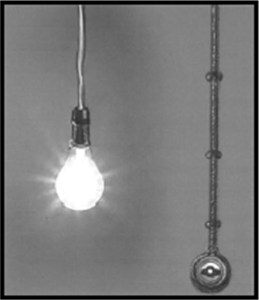
Xirokampi was illuminated for the first time with electric light in 1937. The direct electric current was provided by a 110-volt, diesel-powered electric generator. It was installed by Achilleas Galatis, after a bidding auction held by the community in 1936 during the presidency of Nikolaos Psyllakos, with a predetermined price ‘per Ω x B’ (Hour x Watt).
The generator was initially installed in a building of the sister of Tsigalis (next to the house of Nikolas Mavroidis) and later in a building of Solomos near the church of Agia Triada (where there is now the Hotel Taleton). At that time the operation of the generator was taken care of by the son of Achilles, Takis Galatis.
The “Galatis factory” – as we called it – operated for limited hours around the clock. The limited power of the electric generator as well allowed the lighting of only the square and some streets – mainly at intersections – in the evening hours. It also ensured the electric lighting of shops and houses, but not the operation of devices other than light bulbs. Of course, for several years there were also oil lamps in the shops and houses that were supplied with electricity from the Galatis factory, since the breakdowns of the generator were frequent and the intensity of the light was not constant.
The generator was initially installed in a building of the sister of Tsigalis (next to the house of Nikolas Mavroidis) and later in a building of Solomos near the church of Agia Triada (where there is now the Hotel Taleton). At that time the operation of the generator was taken care of by the son of Achilles, Takis Galatis.
In many shops—like my father’s pharmacy, I remember—there were for several years lux oil lamps with beck and “bubble” from asbestos—which they pumped up from time to time—since they gave off a strong white light and inspired more trust and confidence. On the contrary, many traders who set up their stalls in open spaces or shacks – as at the village “panegyri” – as well as the “karagiozis” puppeteers (καραγκιοζοπαίχτες) used burning acetylene (a flammable gas derived from the combination of water and the common mineral calcium carbonate) which gives a strong white light but also has a “pungent” smell. But for several years, common kerosene lamps and traditional oil lamps would continue to illuminate most homes with their “shimmering” but cozy light.
The time when the electric lights were switched on before dark was a milestone for life in the village. The instruction of mothers to children who played in the streets and “forgot” to return home was typical: “gather when the lights come on” … But also many things had to be finished “before the lights went out” around midnight. There were usually warning continuous and brief power outages. Sometimes not. Galatis, in addition to regulating our lives and our habits in the evening hours, had also created in his “factory” a “gathering place” for people of the neighborhood, with conversation and games until late at night.
It should be noted that diesel-powered electric generators were operating in Xirokampi even before 1937, supplying power to limited business units, such as the oil press and mill of Stratigis Solomos (near Agia Triada) and the Christakos brothers’ carpenter’s shop (in the village market).
The generator of Galatis supplied the village with electricity until the beginning of the 70’s – in 1963 – when Xirokampi joined the PPC network exclusively and the electricity came from far away – from Ladonas (!) as we used to say. Then many local and foreign crews, working for months, changed all the wires in the streets and houses, as imposed by the new voltage of the network (220V instead of 110V). The work was hurried and the laying of the new lines was done on the walls, without digging. Copper wires insulated with waxed cloth were passed through spiral tubes of thin sheets of lead or bakelite that were nailed to the walls. From the local crews who worked on the installation of the new lines, we remember those of Theodosis and Pantelis Giannakas, Christos Hadjigeorgiou (or Fouras) and Konstantinos Papadakos (or Paschalis). On the contrary, the PPC crews who transported and installed the wooden logs to replace the older small “columns” of the network were mainly composed of non-local workers. The porcelain current insulators that some people secured were used as decorations in their homes for many years and were—or still are—used in offices to hold papers with their great weight.
After Xirokambi, the electricity supply from the PPC network was gradually extended to the surrounding villages. The wait and longing for electric light was long, so the joy of the inhabitants was great. An incident told to me by my classmate at Xirokambi High School, Kostas Dim. Plagiannis from Goranοi, is characteristic. When his bedridden elderly grandmother saw the light bulb in her room turn on, she crossed herself and died.
Note: Part 2 of this series, Water, will be published next.
I (Carol Kostakos Petranek) am honored to receive permission from the Katsoulakos family to translate and share articles from The Faris. Translation verification and corrections have been made by GreekAncestry.net. This is the eighth article of the ongoing series. Previous articles can be viewed here.
In its January 2023 newsletter, the General State Archives of Greece (GAK) announced a major digitization project to include “55,000,000 digital downloads from the archives and collections of almost all of the General Archives Services of the State*(Central and Regional) with parallel documentation and development of a thesaurus of items for all the digital material…Upon completion, the project will also utilize the content of the digital portal @ρχειομνημων, of the first major digitization project of the GAS Service which was completed in 2008.”
The implications for researchers, both historical and genealogical, are phenomenal. The announcement below was in the GAK January 2023 newsletter. You can subscribe to the newsletter at this link. The English translation is via Google Translate.
Another article about this initiative can be found here.
*Address: General State Archives · Dafnis 61 · Filothei-Psychiko 154 52 · Greece






 Spartan Roots (Σπαρτιατικές Ρίζες)