Unknown's avatar

About Spartan Roots

I am of Greek ancestry with roots in villages near Sparta. My paternal grandparents and maternal grandfather were born in Agios Ioannis (St. Johns), and my maternal grandmother was born in Mystras. I love family history research and have been tracing my roots for many years. I was born in Brooklyn, New York and was raised in a predominantly Greek neighborhood close to extended family. I live in the Washington D.C. metropolitan area and work as a volunteer Co-Director of the Washington, D.C. Family History Center and a genealogy aide/project aide at the National Archives in Washington, D.C. I am always updating and adding new information. Please contact me - I would love to hear from you!

Visiting the Villages: Vathia

Pirates and invaders. Warring clans. Fortified towers. The legends of Vathia are captivating and plunge you into an era of the past. Vathia was built as a fortress to protect its families from hostile attacks. A sign in the midst of this “ghost village” alludes to its history:

My first introduction to the tower villages of Mani was in 2014 when Giannis Michalakakos took Gregory Kontos and me to Vathia. My fascination has not waned, but accelerated. It’s not only the architecture, but also the stories, myths, customs, and traditions of this land that captivate my imagination.

My ancestors were from Mani, as reflected in their surnames and in family stories. Their genesis in this region and their migration north began before the revolution of 1821, as they are in Agios Ioannis, Sparta in the 1844 Election Registers. Because records prior to the Revolution do not exist in the modern Greek state, I cannot trace where, in Mani, they originated. However, every time I come to this region, I feel a metaphysical connection to this land and to them.
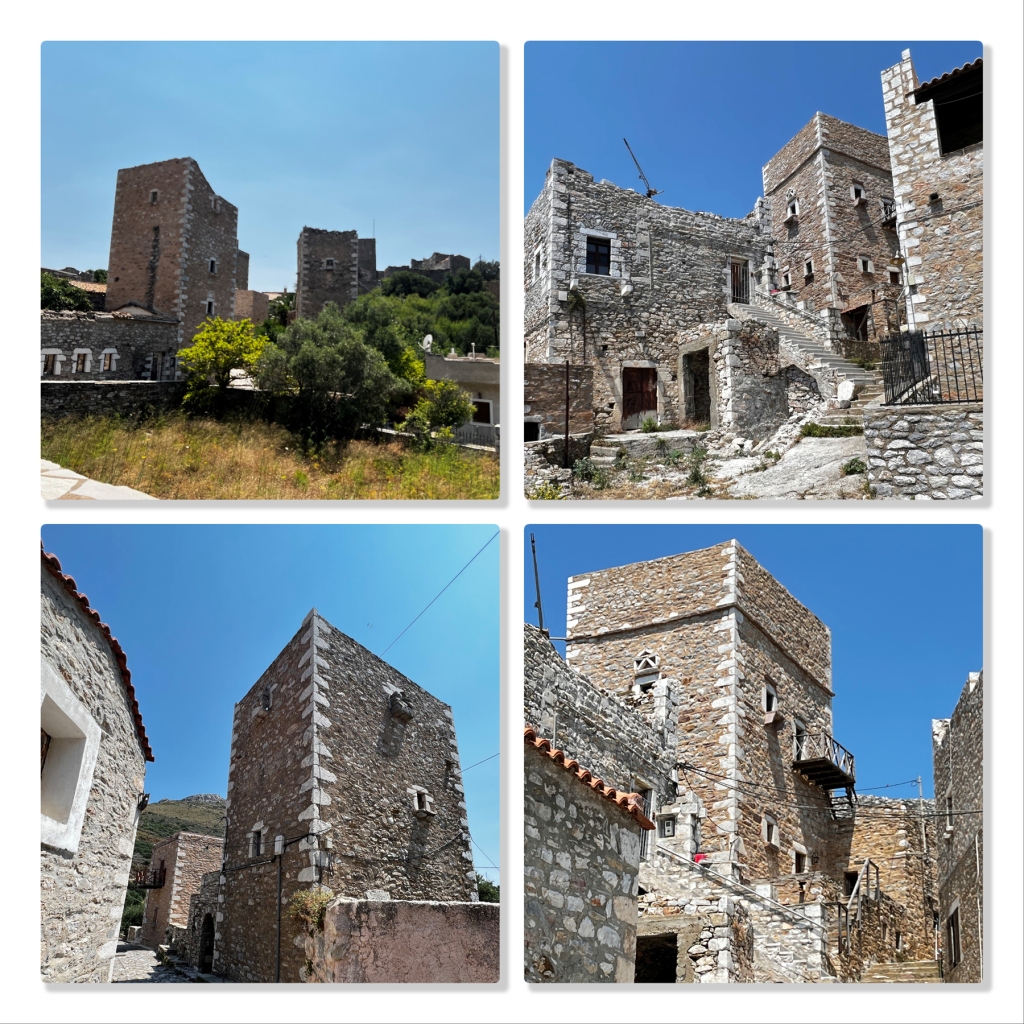
The tower houses of Vathia are classic Maniot fortification architecture

These tower houses are owned by families. The size of the tower demonstrated the family’s wealth and standing in the community. They are built close to each other, with small alleys as separations. Most of them are square with two or three floors. The windows are just large enough for guns and armaments to protrude outwards in times of defense. The inhabitants of Mani are legendary for fiercely resisting foreign invasions. They maintained their independence for centuries.
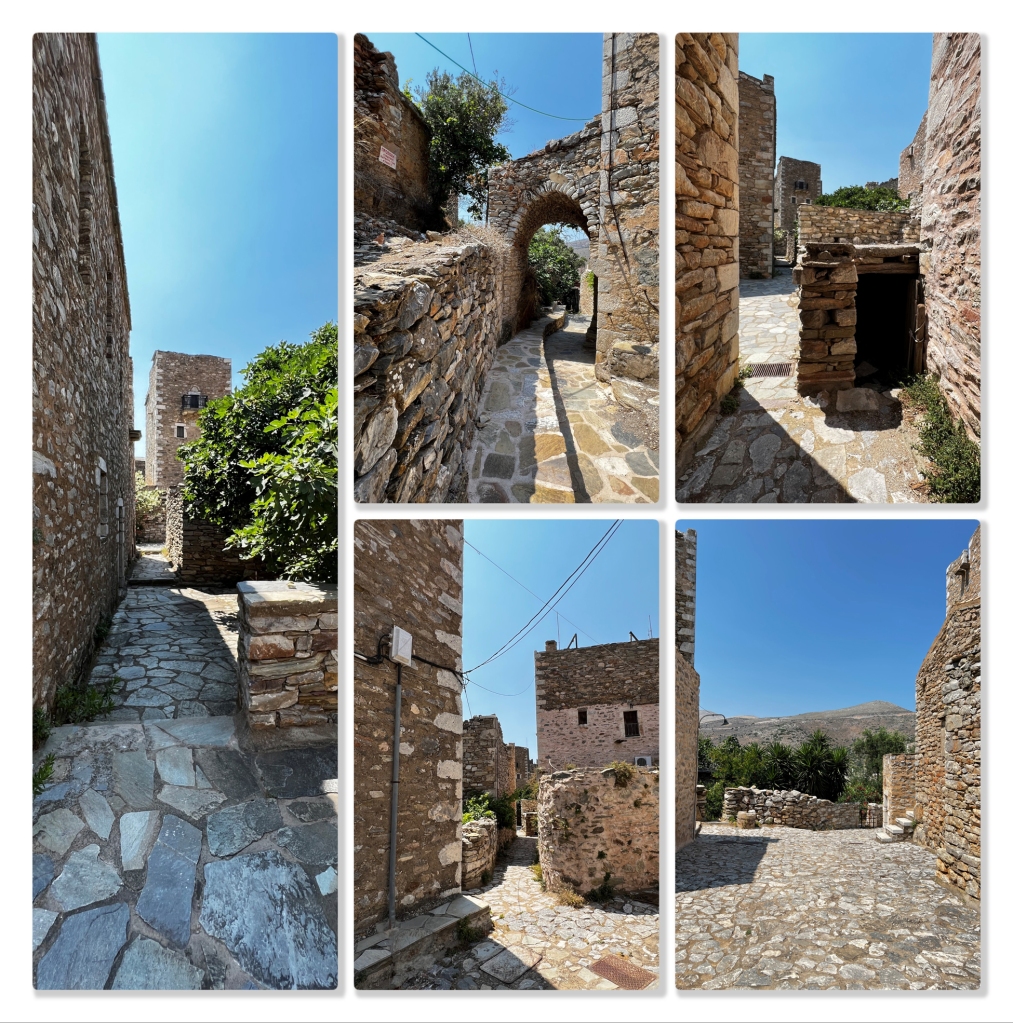
The alleyways of Vathia

During the Ottoman period, Maniots continued to resist Ottoman rule. They preserved a degree of autonomy and the Ottoman beys (rulers) let them be. Maniots were known for their military acumen and martial skills, and their resistance played a significant role in the 1821 War of Independence. As with all Greek villages, monuments to the fallen are found in the plateia, across from the church.

Monument photos courtesy of Nick Santas, whose great-grandfather, Panagiotis Laos, is listed

Names on the War Monument
Top:
Georgakakos, Antonios
Georgakakos, Petros
Exarchakos, Panagiotis
Laos, Panagiotis
Kallidonis, Petros
Lagoudakos, Nikolaos
Feidopiastis, Fotios
Gerakakos, Stavros
Gerakakos, Nikolaos
Lagoudakos, Panagiotis
Syggikos, Petros
Bottom:
Anaroutsakos, Spyros
Mitsakos, Ioannis
Stravokefalos, Michail
Andreakos, Nikolaos
Xypolitos, Michail
Xypolitos, Panagiotis
Kallidonis, Leonidas
Aggelakos, Aristeidis
Xypolitos, Vasileios
Giannakakos, Panagiotis
Koutrigaros, Antonios

Maniot families evolved from clans which controlled various regions. There are many stories written about the loyalty and protection that clans provided for their families. Conflicts between clans were common, and some clan wars continued for years. This article provides historical background and names of the clans of Vathia.
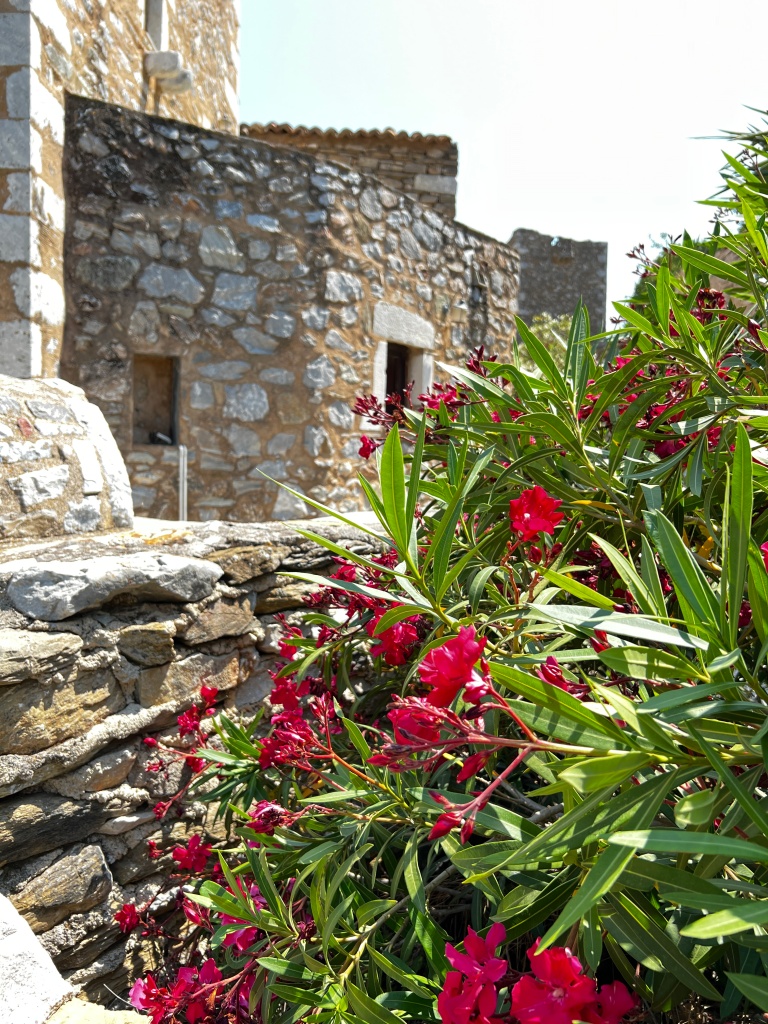
Bright spots of color amidst the stone towers

After Greece gained independence from the Ottomans in 1830, Vathia, like other parts of Mani, experienced a decline in its strategic importance. The tower houses gradually lost their defensive purpose and many fell into disrepair. Around 1950, after World War II and the Greek Civil War, families left rural areas to reestablish themselves in urban areas where economic opportunities existed. People abadoned their tower homes for Kalamata, Sparta, and Piraeus. By 1960-1970, the village was deserted.

I asked my friend, Giannis Michalakakos, local historian and author of the Maniatika blog, if the tower houses would ever be restored, especially with the current surge in tourism that Mani is experiencing. His answers helped me understand both the complexities of this issue and the culture of the society.

Homes are primarily abandoned because of financial considerations:
• It was common for many members of a family (cousins) to have partial ownership in a tower; sometimes as many as 40!
• If many parties had an interest in a house, and one person wanted to be the sole owner, he would have to have enough money to buy out all the other parties.
• If a person wanted to restore an abandoned home, he may have to buy out others who would have to agree to sell it, AND spend a lot of money to refurbish the home. Therefore, if financial matters were a concern, it is easier to just abandon a home than to deal with ownership and renovation issues.
• To sell a house to an outsider of the family, a title is needed. Years ago, oral agreements were made within and among families when buying, selling or partitioning a house. In times past, a man’s word was his honor and official documents were not required, nor were they needed. Such transactions occurred in the local cafenion (coffee house), where witnesses would attest to the validity of the agreement and be called upon if there was ever a conflict.
• There may have been a past agreement, still in full force, that a house would never be sold.
• If a house was renovated strictly for tourism, that season is short and the family would need other sources of income. In the area of Vathia, that does not currently exist.

This explanation made sense, but it also made me sad. Such an area, so rich in history and so incredibly wild and beautiful, should be renovated and preserved. The complications above make this difficult now, but in the future there may be resolutions that are not currently available. It is my hope that this will be.


Visiting the Villages: Koumousta

Going back in my family research always leads to the mountains. The Spartan villages of my four grandparents, Agios Ioannis and Mystras, were nestled in the valley beneath the Taygetos range. This was the agricultural center of the region—fertile plains filled with citrus and olive trees, fruit and vegetable gardens. As I wrote previously, villages in the valleys became repopulated after the Ottomans were expelled in 1830 and people descended from the mountain tops to start a new life. Among them were my grandparents’ ancestors.

Prior to the Revolution of 1821, Koumousta was the populated village; Xirokampi was a small settlement with just a few families. In the book, Koumousta of Lacedaimonos, Theodore Katsoulakos and Panagiotis X. Stoumbos meticulously describe life in Koumousta prior to the residents’ leaving. Among them was the Christakos family, ancestors of my paternal great-grandmother, Politimi Christakos, who married Andreas Kostakos. Her father, Nikolaos, and her grandfather, Dimitrios, are named in this book. Finding this information was an enormous and important breakthrough in my research.

Koumousta of Lakedaimonos, Theodore S. Katsoulakos and Panagiotis X. Stoumbos, published 2012

The book describes the villagers: “Koumousta, from old times and until its desertion, was a very hospitable village. Everyone of Koumousta considered it an honor and pleasure to have someone under his roof. Work was stopped to settle the foreigners. Many people back then came to Koumousta from the plains and from surrounding villages. Relatives and friends were everywhere…Every Koumoustioti’s door was open to any foreigner that would knock on his door. The man who asked for hospitality was considered a “holy” [highly respected] person who should be treated with all arrangements of good relations. This treatment was highly characteristic and very good. Every good thing that there was in the house was offered with love and selflessness, and above all, food: cheese, bread, pork, eggs were the necessary and basic foods. Women put their hands deep into the barrels because there was where the best portions of pork meat lay after it was boiled. But it was not only the visitor that had to be treated well; even his mule had to be treated well. They took care to give the mule water and food, like their own animals.”1

This intrigued me. People would climb a steep mule trail to visit a village at the crest of a mountain? The villagers were known for their hospitality, despite living in an isolated area? I knew that Koumousta was situated on a high peak and that its access road was narrow and treacherous. But my ancestors were those described in the book, and I just had to go!

Leaving Xirokampi on the road to Koumousta

The journey seemed inoccuous at first. The road was paved, and a low stone wall provided a comforting border between the road and the ravine below. I felt reassured. But after a mile, the wall disappeared and the ravine’s treetops lined the side of the road. They were my guardrails throughout the four mile ascent.

The treetops on the left appear to be bushes, indicating the depth of the ravine.
The face of this mountain is particularly scary!

Partway up the mountain, I saw what appeared to be a lake on the right side of the road. But this is a man-made, rectangular basin. There are no structures adjacent to it, and I cannot imagine its purpose.

A pool of some type, constructed mid-mountain
The scenery is lovely, with bright spots of color accenting the rocks and greenery.

The road was extremely steep, and despite my growing fears, I had to keep my foot on the accelerator to keep the car moving upwards. Parts of the pavement were washed out, with evidence of small rockslides.

Seeing an isolated house, I wondered who would construct it mid-way up a mountain? It appeared to be abandoned, but at some point it was a home. How could one live so alone?

This house, although close to the road, was built in an isolated spot

The phrase, “are we there yet?” kept running through my mind. I knew that the closer I got to the top, the worse the road conditions would become. I felt relief when I came across this sign.

Koumousta 500 metres – almost there!

Rounding a curve, my breath stopped when I saw the village: perched on the mountains were beautiful stone houses with red tile roofs. This appeared to be a viable village; I had expected crumbling vestiges of bygone years.

Homes in beautiful condition, cut into the mountain

Driving onto the stone pavement of the plateia, I could not believe the scene before me. Koumousta was not a village in ruins. It was beautifully restored and utterly charming. I parked the car and in the town square; a black and white dog greeted and walked with me. The peace and beauty were almost magical.

The lovely plateia, impeccably clean and perfectly maintained
Pure mountain water gushes from the fountain and is channeled
The houses are traditional and charming. All appear to be renovated and in excellent condition.
One couple lives in Koumousta year-round; others come for holidays and vacations.
The inscription on the plaque mentions the restoration of the plateia in October 2000.

I can understand why my 3rd great-grandfather, Dimitrios, left and resettled in Xirokampi in the mid-1800s. I would bet, however, that if he were alive today, he would find a way to keep his mountain home. Although winter weather would make the road impassible and the cold intolerable (altitude of 2200 feet), this village remains a pristine oasis and a welcomed haven from contemporary life. Today, the village of Koumousta is also known as Pentavli.


1Koumousta of Lacedaimonos, page 213; translation by Giannis Michalakakos.

Sparta Archive Office Has a New Home

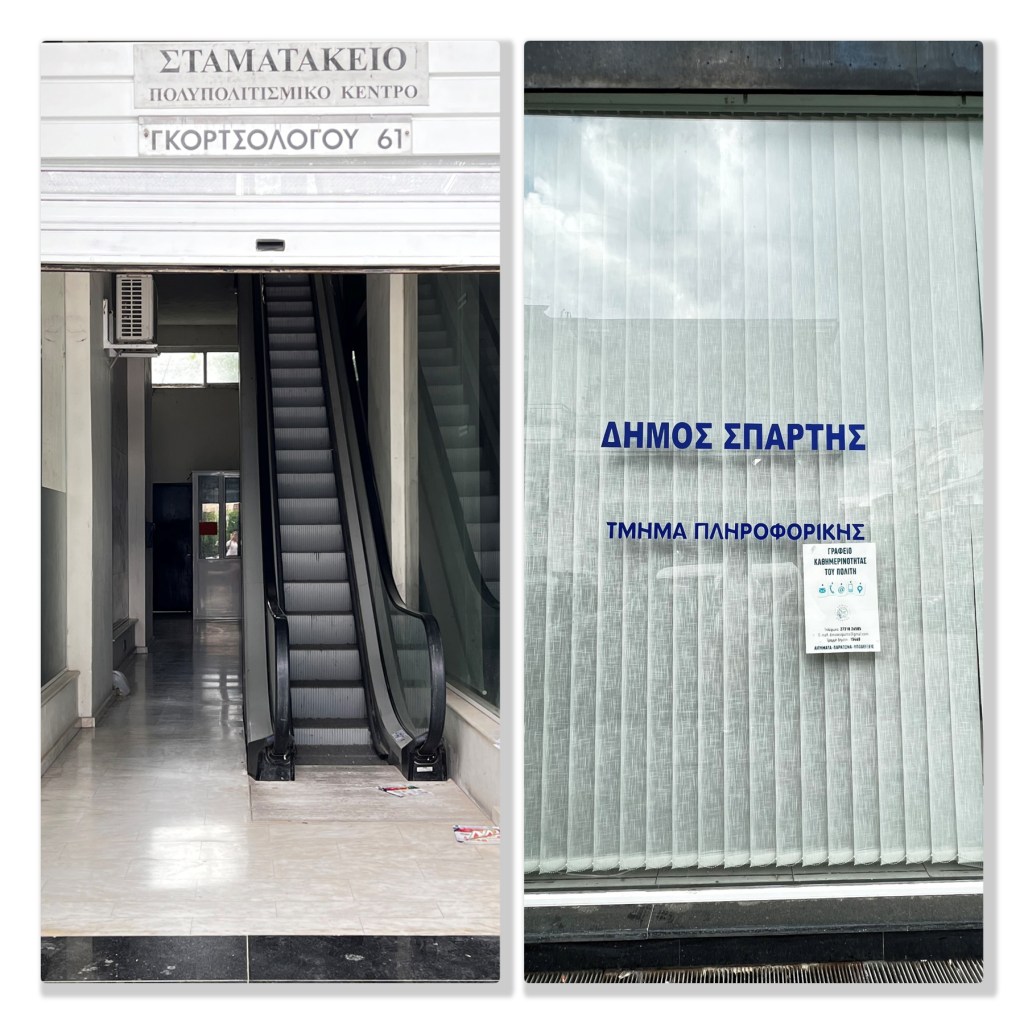
Our friends at the General State Archives of Greece, Sparta office, have a spacious new office. It is located at on the 3rd floor of 61 Gkortsologou, 1/2 block from the Dimarcheion and the plateia, in the same building as the Dimos.

The interior is bright and airy, and there is room for cabinets and storage. One section has a raised platform with a large, flat screen monitor. Visitors can sit at a conference table and have space to work comfortably.

In-person researchers will complete a form to ask for specific information. Those who are distant can send an email to: mail at gak.lak.sch.gr (use the@ sign). Genealogical information can be accessed specifically for direct-line ancestors, due to European privacy laws (GDPR). Please be sure you state your relationship to the family whose information you are requesting. The staff will conduct the research for you, and send you an email with digital images of the information requested. Materials that can be requested include Male Registers, Town Registers, Notary Files and many others. When you ask the staff what you are seeking, they will direct you to the appropriate records.

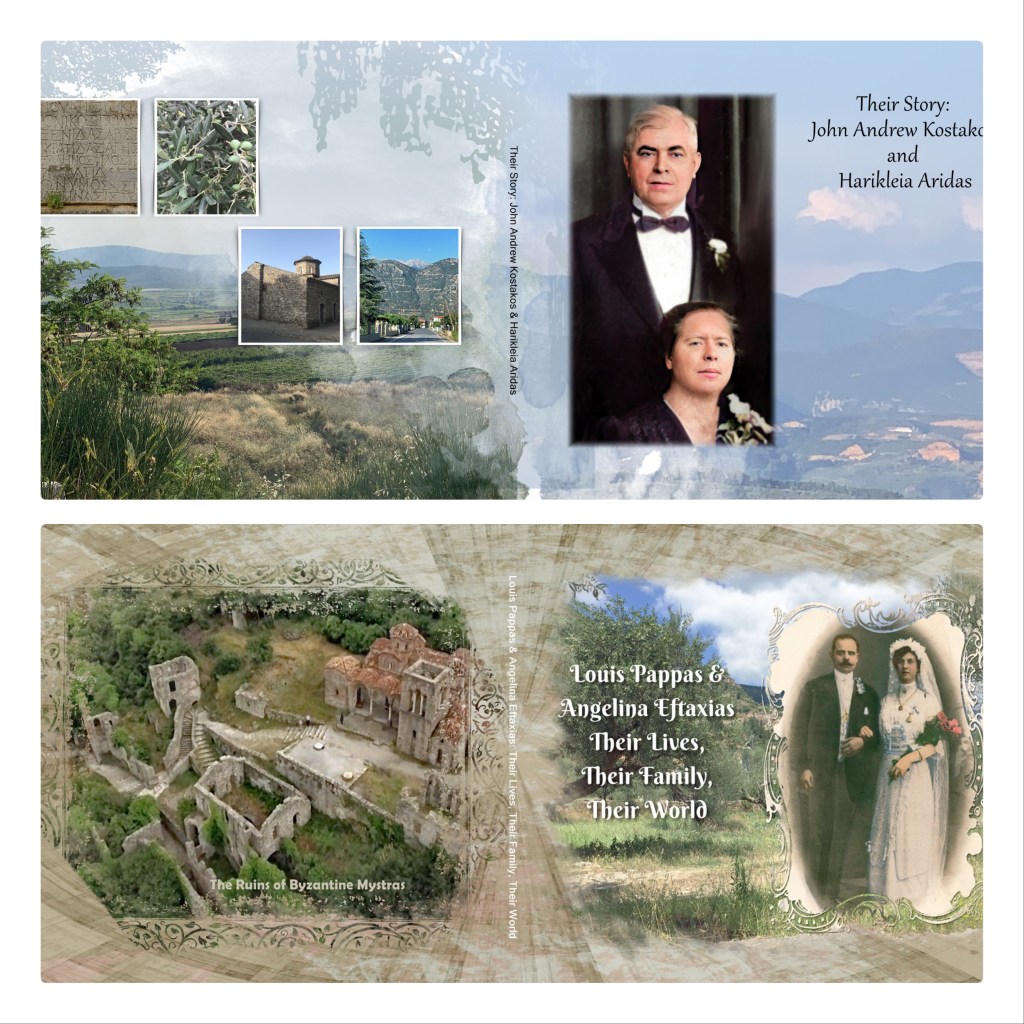
I am extremely grateful to the archivists, Pepi Gavala and Michail Sovolos, and their kind and helpful staff for all the assistance they have given me over the years. Without their help, I would not have been able to write two books about my grandparents and their ancestors. I donated copies to the archive office and hope others will do the same. Having these volumes in the land where my ancestors originated is one way to ensure that their story can be found and studied by future researchers.

I wish the staff much happiness in their new venue, and continued success in the years to come. Συγχαρητήρια και τις καλύτερες ευχές!

Visiting the Villages: Gytheio

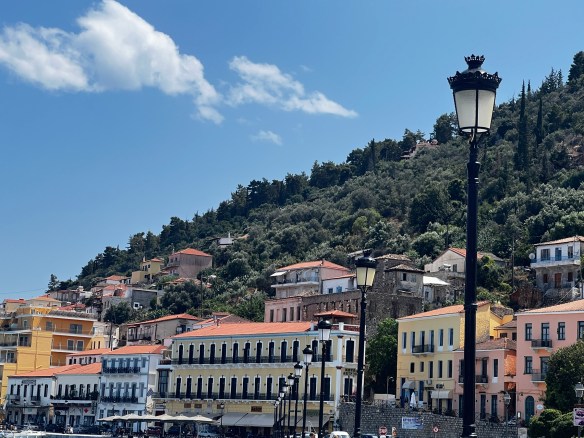
Picturesque Gytheio is much more than just a lovely port village. Considered the port of Sparta (located 47 km south of the city), its location on the southeastern coast of the Peloponnese made it an ideal departure point for emigrants leaving Lakonia in the early 20th century.

Greeks who were seeking opportunities abroad needed to get to major ports in southern Europe: Piraeus, LeHavre, Hamburg, Boulogne-sur-Mer, Cherbourg and others. They would walk or take donkey carts from their homes to a local port. From there, they would board a small boat (caique) which would transport them to one of the transatlantic departure ports. Gytheio was the closest port to those from southeast Lakonia, yet it drew people from all regions of the Peloponnese.

All four of my grandparents left their villages near Sparta and came to America between 1897-1920. Although I have their ship manifests from their major ports of departures, I don’t know how they got from their homes to that port (how wish I knew!). I surmise that at least some of them traveled first to Gytheio.

The name, Gythion (Γύθειον) means “Γη των θεών” (land of gods); γύον (γη) = land (location) and θεός = god (according to an ancient legend, this refers to the gods Herakles and Apollo). A port city from ancient times, it was founded by the Spartans in the 5th century BC and played a crucial role in Sparta’s maritime, commerce and trade activities. Shipbuilding was a major industry. Throughout the eras, the port prospered as it served as a crucial sea route and harbored ships that crossed the Mediterranean. See this reference for further historical information.

Along with the rest of Greece, Gytheio eventually came under Frank, Venetian and Ottoman rule. The Venetians fortified the town and constructed a castle to protect it from pirate raids.

The tower of Tzanetakis, built 1829

Today, Gytheio teems with tourists and natives who seek its beauty and its sea. Nearby beaches such as Mavrovrouni are filled in summer months.

When in Gytheio, I can’t help but wonder what it was like for my grandparents who left their villages. Their journey must have been both exciting and terrifying, and I honor them for their determination and bravery. I come to Gytheio not only to decompress and relax, but also to view the sea that my ancestors may have experienced for the very first time on their journey to a new land.

Mosaic Morning

I have long admired the creativity of Dimitra Colomvakou, mosaic artist and founder of Mosaic Arts Greece. Whenever I am in Sparta, I stop by her studio and purchase unique and beautiful gifts for my family.

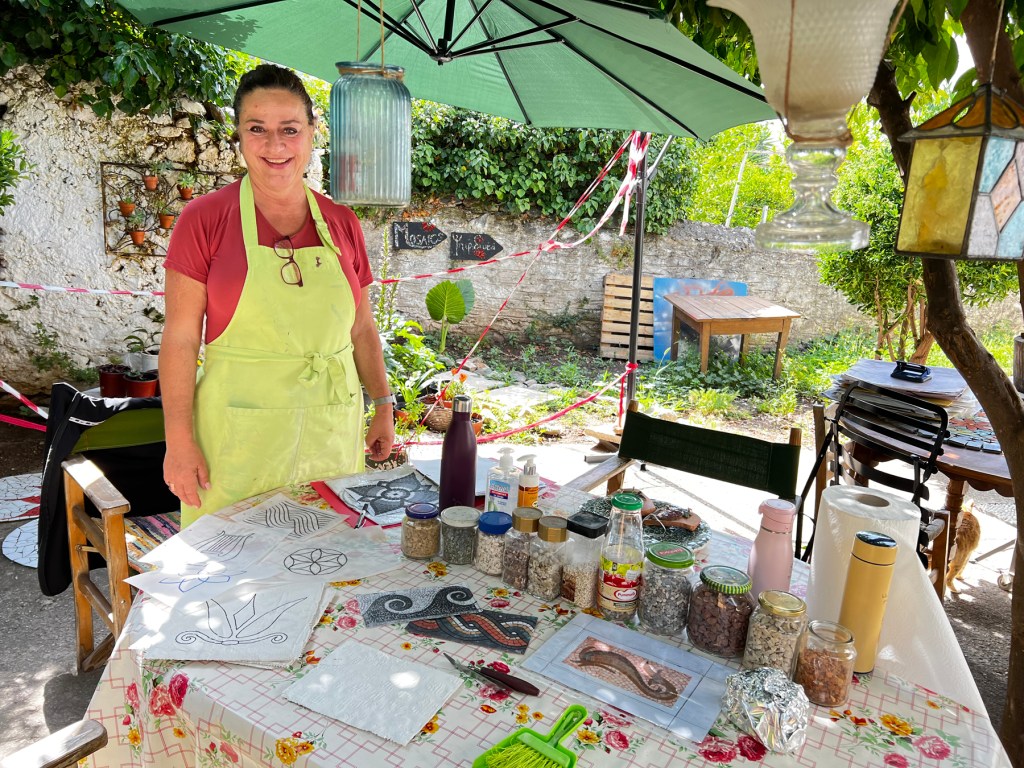
Dimitra’s studio is on Kostantinou Palaiologou 132 in Sparta. It is a delightful outdoor oasis of beauty, nature and peace in the midst of the city. Located in the vicinity of Ancient Sparta and the statue of Leonidas, its cool, leafy canopy and sparkling artifacts beckon both tourists and natives to step inside.

The garden studio draws in people who admire its beauty and peace

In 2019, I wrote a post about Dimitra, her studio and her work. Ever since my first visit, I have wanted to take a workshop. Today, I did. Dimitra had materials ready for me when I arrived. She is a patient and caring person, and she both assisted and instructed me.

Dimitra loves her work!

Although Dimitra teaches and works in many mediums, she recommended that, as a first-timer, I start with a pebble mosaic. After looking at several patterns, I chose one that resembles ocean waves. Dimitra used carbon paper to trace a pattern on a white backdrop composed of fiberglass mesh.

The base, with the pattern drawn

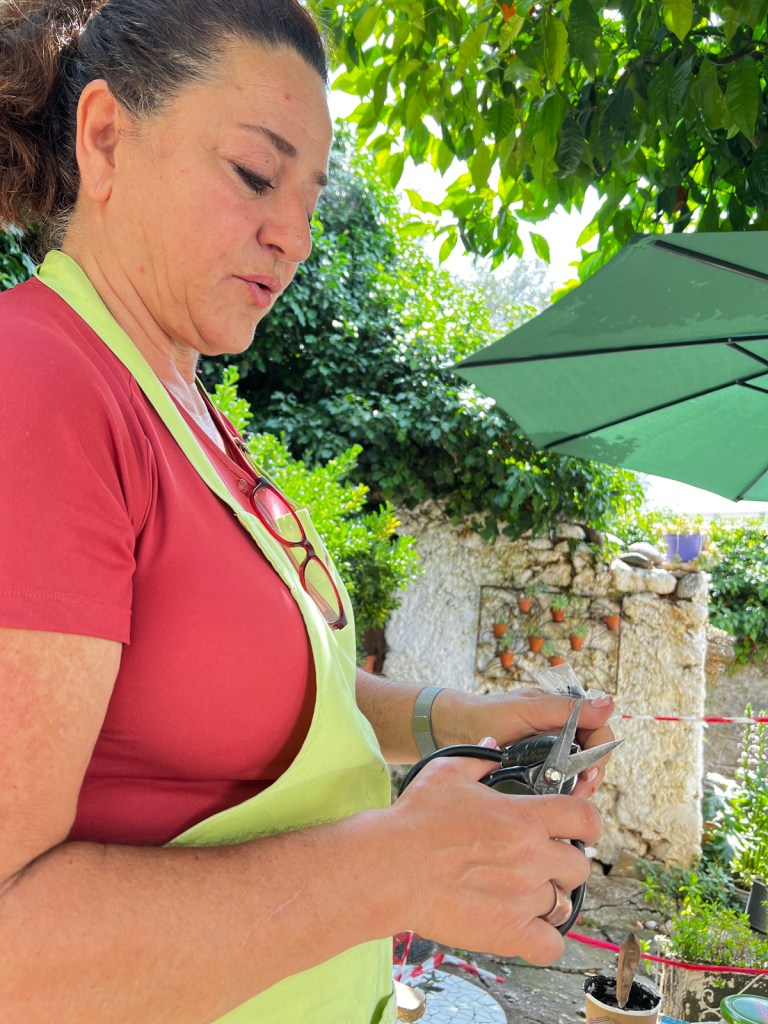
Mosaics can be created on any surface: stone, wood, glass, metal, marble; and she works on them all. Specific glues and adhesives are used on specific surfaces. Because my base was fiberglass, we used “thin set,” a type of mortar-based adhesive used in tile work. Dimitra colored the adhesive to blend with the stones I would use. She started with black, putting the adhesive in a pastic bag and cutting a corner so it could be manipulated, like adding piping to decorate a cake.

Dimitra puts the adhesive into a plastic bag, then cuts the corner.

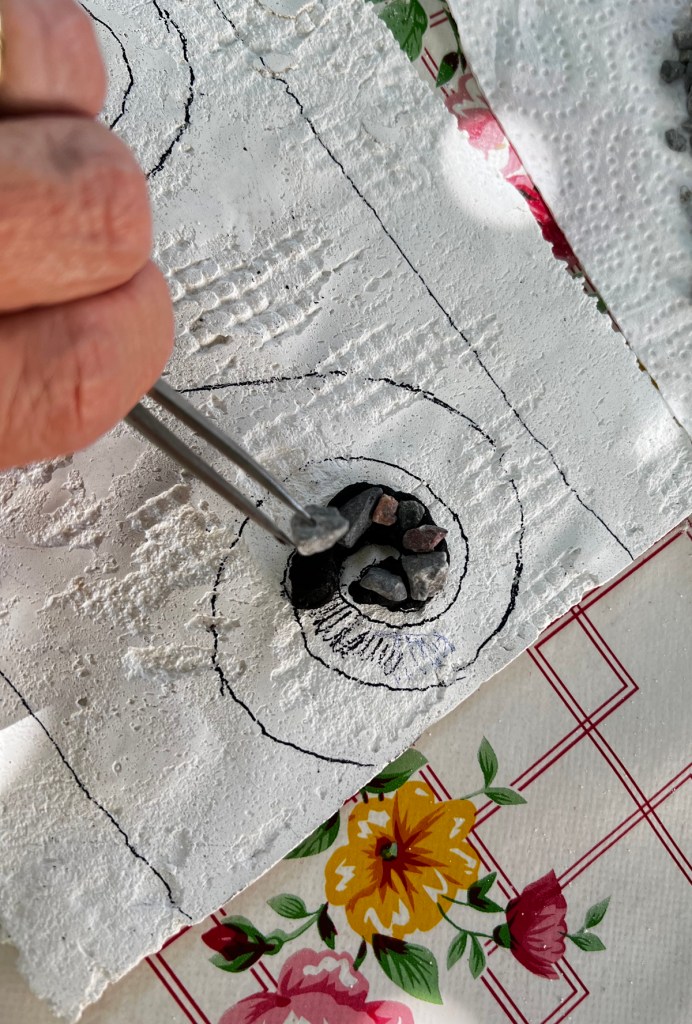
And then the creative process began. Dimitra instructed me on how to “pipe” the adhesive onto the pattern. I then used tweezers to grab pebbles and set them into the adhesive. Yes, every pebble was chosen for its size, shape and color, and carefully placed onto the pattern!

Every single stone is set in place, precisely!

To say I was hyper-focused is not an understatement. As a quilter, I have learned to use shades of color and texture to add interest to projects so I did this pattern a bit differently than others. I added spots of color throughout the wave, rather than making it monochromatic.

Instead of using just one color pebble, I varied the hues.

For three hours, I chose every stone and decided which color and shape to put into the pattern. The time passed so quickly that I didn’t even stop to take a drink of water!

I loved this creative process!

Although seeing a work in progress gives you an idea of how it will look, I was truly surprised to see the finished product. I like it! The tiny pieces of colored stone, which I carefully placed around the dark ones, were picked up by the terra-cotta borders and caused the waves to “pop.”

The finished piece!

Trying something new is one of the joys of life. Every experience adds to our personal mosaic and enhances our creative perspective.

Dimitra’s studio is a must-see, and must-do, for anyone visiting Sparta. The gifts you bring home, and the ones you may make, will be unlike any you would purchase in a tourist shop. Follow her Mosaic Arts Greece website, Facebook page and Instagram which display her products that can be ordered online and shipped anywhere.

Thank you, Dimitra, for a Magical Mosaic Morning!