Unknown's avatar

About Spartan Roots

I am of Greek ancestry with roots in villages near Sparta. My paternal grandparents and maternal grandfather were born in Agios Ioannis (St. Johns), and my maternal grandmother was born in Mystras. I love family history research and have been tracing my roots for many years. I was born in Brooklyn, New York and was raised in a predominantly Greek neighborhood close to extended family. I live in the Washington D.C. metropolitan area and work as a volunteer Co-Director of the Washington, D.C. Family History Center and a genealogy aide/project aide at the National Archives in Washington, D.C. I am always updating and adding new information. Please contact me - I would love to hear from you!

Lakonia Studies 6th Annual Conference

The Society of Lakonia Studies organization fulfills a vital role in documenting and preserving the history of the prefecture of Lakonia. The organization brings together historians, archaeologists, linguists, cultural specialists and other professionals who present their research at the annual conference of the organization. Their research papers are subsequently published in the Journal of Lakonia Studies, which currently consists of twenty-three volumes and numerous supplements.

Lakonia Studies logo

This year, the organization’s annual conference will be held on December 5-7, 2025, at the Cultural Center of the Municipality of Sparta (ground floor of the Library). The theme is “Laconia 330 AD – 1830.”

The presenters are devoted and dedicated researchers.Their goal is to educate and enlighten. Most are native to the region and work with primary source materials which may be unavailable or even unknown to outside scholars. Thus, their works extend beyond basic academics and dive into topics, people and historical elements that are less-studied and even obscure, but historically relevant and important.

This article in Lakonikos.gr outlines (in Greek) the program and speakers. My very rough computer-assisted translation of the program follows:

Friday, December 5
Opening Session (18.00-20.00) | Chair: Socrates Kougeas
18.00-18.30: Arrival
18.30-19.00: Welcome
19.30-19.15: Dimosthenes Stratigopoulos, Nikiphoros Moschopoulos, president of Lacedaemonia (ca. 1288 – ca.1315), and leader in Mystras
19.15-19.30: Dimitrios Th. Katsoulakos, Surnames with Byzantine origin in the villages of Faridos
19.150-19.30: Stavros G. Kapetanakis, Ibrahim’s unsuccessful attempt in 1826 to subjugate the Maniots and its long-term consequences
19.30-20.00: Discussion

Saturday, December 6
First morning session (9.30-11.00) | Chair: Dimitrios Vachaviolos
9.30-9.45: Danae Charalambous, The surviving frescoes of the church of Panagia Krissa in Finiki, Laconia
9.45-10.00: Sofia F. Menenakou, The brushwork of the painters Anagnostis from Lagkada and Nikolaos from Nomitsi in the Church of Saint George in Panitsa (Laconian Mani, 18th century)
10.00-10.15: Leonidas Souchleris, The northern part of the Eurotas valley in the 4th and 5th centuries AD. Residential perspective: urban planning, cemeteries and road network.
10.15-10.30: Georgios P. Kountouris, Monuments of the Early Christian Period in Voies
10.30-10.45: Panagiotis D. Christofilakos, The Byzantine church of Saint Athanasius in Paleochori, Lakedaemon
10.45-11.00: Panagiotis S. Katsafados, Following the traces of icon painters in Mani during the post-Frankish period
11.00-11.30: Break

Second morning session (11.30-13.00) | Chair: Dimosthenis Stratigopoulos
11.30-11.45: Panagiota D. Laskaris, The Laskari clan in Lacedaemon. The biographical stories of Demetrios Laskaris as a starting point for an existential historical investigation
11.45-12.00: Christina Vambouri, Highlighting the history of Byzantine Laconia through the newspaper Embros during the first half of the 20th century
12.00-12.15: Dimitrios S. Georgakopoulos, New information about the founder/donor of Panagia Chrysafistissa
12.15-12.30: Michael Grünbart , An empire vanishes – imperial concepts vs. political reality in late Byzantium
12.30-13.00: Discussion

First afternoon session (17.00-19.00) | Chair: Georgios Kountouris
17.00-17.15: Eleftherios P. Alexakis, Byzantine pronoiai, Venetian captaincies, and the development of the political system of Outer Mani
17.15-17.30: Antonis Mastrapas, Searching for ancient Sparta in the 18th and 19th centuries
17.30-17.45: George V. Nikolaou, Laconia through the work of the English traveler William Leake, envoy of the English government (early 19th century)
17.45-18.00: Kyrillos Nikolaou, Laconia through the second travelogue of the French consul and traveler François Pouqueville (early 19th century)
18.00-18.15: Panagiotis N. Xintaras, Laconian place-names through the pen of French travelers
18.15-18.30: Alexandros Gizelis, Sparta in the political literature of Protestantism during the era of the Religious Wars (16th-17th century)
18.30-19.00: Break

Second afternoon session (19.00-20.30) | Chair: Yannis Tsoulogiannis
19.00-19.15: Yianna Katsougraki, At the end of the thread: from the material to the immaterial. The presence of weaving in Byzantine and modern Laconia
19.15-19.30: Michalis Sovolos, Indexing the first decisions of the Court of First Instance of Sparta: Persons and matters concerning Mani, 1770-1821
19.30-19.45: Georgios A. Tsoutsos, Enlightenment and Ancient Sparta: The case of Gabriel Bonnot de Mably (1709-1785)
19.45-20.00: Dimitrios Galaris, Nikitas Nifakis: the author of the Declaration to the European Courts at the liberation of Kalamata from Ottoman rule
20.00-20.30: Discussion

Sunday, December 7
9.30-10.30: Guided tour of the Archaeological Museum of Sparta
Morning session (11.00-12.30) | Chair: Georgios Nikolaou
11.00-11.15: Marios Athanasopoulos, “In this sacred Struggle, I too, taking up arms in my hands, ran to all the battles of my most beloved homeland…”: The life and deeds of the 1821 fighter, Father Polyzois Koutoumanos
11.15-11.30: Dimitrios Mariolis, Dimitrios Poulikakos. Military leader of 1821 from Vamvaka, Mani
11.30-11.45: Socrates V. Kougeas, Mosaics of the life and actions of the legendary figure Zacharias Barbitsiotis – The actions of the chieftain Sousanis
11.45-12.00: Giannis Michalakakos, Ilias Bispinis, a forgotten fighter of 1821 from Laconia
12.00-12.15: George – Konstantinos K. Piliouras, The Holocaust at the Paleomonastiro of Vrontama
12.15-12.45: Discussion

Afternoon session (17.00-19.00) | Chair: Dimitrios Katsoulakos
17.00-17.15: Pepi Gavala, Court of First Instance of Laconia – Correspondence Register: Transactions and Cases (February-April 1830)
17.15-17.30: Yannis N. Tsoulogiannis, The action of Panagiotis Krevvatas through two letters
17.30-17.45: Dimitrios Th. Vachaviolos – Stylianos D. Dimitropoulos – Dimitrios Ath. Christou, Two unknown documents from the Museum of Ecclesiastical Art of the Holy Monastery of Monemvasia and Sparta concerning Bishop Kyrillos Germos of Karyoupolis († July 1842)
18.00-18.15: Nikos I. Karmoiris, Papa-Kalomoiris, the Levite (cleric) chieftain from Vordonia
18.15-18.30: Katerina Diakoumopoulou – Maria Giatrakou, “ For Giatrakos’ great struggles.’ The monumental speeches in Parliament and the indirect references in the dramaturgy of M. Chourmouzis.
18.30-19.00: Discussion
End of the conference proceedings

These papers will be published in the next issue of the Journal. If there is an essay of interest to you, contact the Lakonia Studies organization at: etlasp@gmail.com. This pdf document lists the Table of Contents for each of the twenty-three volumes of Lakonia Studies, prior to this 2025 conference. Volume(s) can be purchased from the Lakonia Studies organization for 20 euros per book.

The work of this organization and its members is important, and must be accessible to people worldwide. I have written previously about bringing the Journal of Lakonian Studies to the Library of Congress, first in 2024 and this year in 2025. Let’s spread the word together and introduce the world to our modern-day Spartan intelligentsia!

Sparta Municipal Registry Offices (Lixarcheia)

Around 1925 in Greece, Registry Offices for Municipalities were created for the purpose of maintaining civil birth, marriage and death records. These offices are also known as Ληξιαρχεία / Lixarcheia. Village priests retained the responsibility of keeping church books to record baptisms/births, marriages, and deaths in their specific congregations.

I have received requests from people asking where they should write to obtain an ancestor’s birth certificate. The answer is: if you are seeking information for a person born after 1925 and you know the exact village of birth, contact the lixarcheion office for that village.

This post explains how to access contact information for the Lixarcheion offices under the Municipality of Sparta.

  1. Lixarcheia are under the jurisdiction of the Dimos Sparta / Δημος Σπαρτη. The link to the website is: https://www.sparti.gov.gr/.

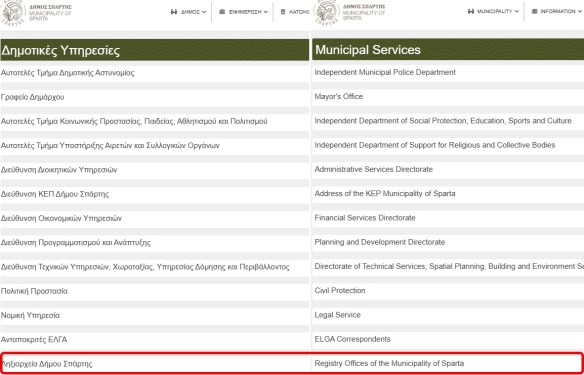
2. Under the tab for Municipality is the category “Municipal Services”. The direct link is: https://www.sparti.gov.gr/dimos/dimotikes-ypiresies

3. Under Municipal Services, at the very bottom, is an entry for “Registry Offices of the Municipality of Sparta”.

Sparta Dimos Municipal Services from Website

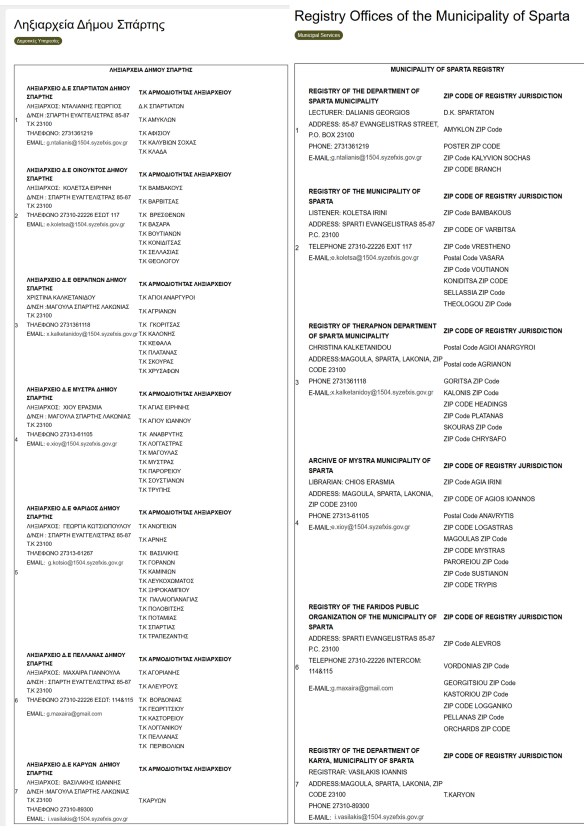
4. Click on the title “Registry Offices of the Municipality of Sparta” to access the chart below with contact information for each Lixarcheio office. The direct link is: https://www.sparti.gov.gr/liksiarxeia-dimou-spartis

Sparta Registry Offices Lixarcheion contact info

A note about the government structure: The Municipality is Sparta; and under it are several Municipal Units. Each Municipal Unit services several villages. The title of the Municipal Unit reflects its government hierarchy. For example, the first entry on the chart is ΛΗΞΙΑΡΧΕΙΟ Δ.Ε ΣΠΑΡΤΙΑΤΩΝ ΔΗΜΟΥ ΣΠΑΡΤΗΣ which translates to Civil Registry Office of the Municipal Unit of Spartiaton, Municipality of Sparta.

The Municipal Unit office information is on the left column of the chart, and the villages it services are on the right. You must know the exact village and be sure to contact the office which serves your village!

My recommendation is to bookmark this last link for direct access: (https://www.sparti.gov.gr/liksiarxeia-dimou-spartis)

When writing an email to a Lixarcheio office, prepare it in both English and Greek (use an online app such as Google Translate). Or, put your English text into ChatGPT or another AI service for translation. If your Greek is limited, it’s a good idea to enter your text into two different translator apps to check for consistency. Including the English version is important because if the Greek is not well-translated, an English-speaking clerk will be able to read your original English message and understand your request.

Lixarchion Office, Magoula
Civil Registry Office of the Municipal Unit of Mystras, Municipality of Sparta

This is the Lixarcheion office for the municipal unit of Mystras, which services my village of Agios Ioannis. It is located in Magoula, outside Sparta. When I visited in person, the clerk was kind and helpful and I left with both both and death records about my family. I wish you success as you contact a Lixarcheio for assistance!


NOTE: Translate the Sparta Dimos website into English using Google Translate or a similar translation app. In the images for this post, I used screenshots to put the Greek and English side by side; the website does not appear like this.

Congratulations to Gregory Kontos of Greek Ancestry!

My dear friend and colleague, Gregory Kontos, founder of GreekAncestry, was honored by Forbes magazine as one of “30 Under 30” entrepreneurs in Greece. This award brings me great joy. I have been friends with Gregory for over ten years and have watched him work with diligence and integrity to create GreekAncestry and guide it to its premier place in the genealogy community.

This is Greg’s announcement of his award:

I was extremely honored to be included in Greece’s Forbes Under 30 List released yesterday morning.

This is not an honor for myself only, but for the entire field of Greek genealogy, which is finally recognized as innovative and influential! We at Greek Ancestry will continue to serve our community and pursue our mission for high-standard genealogy research and access to genealogical data.

The official ceremony is to take place at the Athens Concert Hall on November 25 with Prime Minister Kyriakos Mitsotakis.

Here is an English translation of the text in the article:

DIGITAL GENEALOGY – Greek Ancestry
“Gregory Kontos, with studies in migration history and a passion for Greek heritage, transforms forgotten archival traces of the past into a vibrant, global digital experience of exploring our genealogical history.

He began at the age of 15 by mapping his own family tree and, at 24, founded Greek Ancestry, the first Greek genealogical research platform that reconnects Greeks from every corner of the world with their roots.

Until recently, genealogical research in Greece was nearly impossible, as historical records were fragmented and inaccessible. In just five years, Greek Ancestry has radically changed the landscape: through pioneering collaborations with the General State Archives, the University of Athens, metropolises, and local communities, it digitizes centuries-old genealogical records — from civil registrations and church registers to family archives from across Greece. The result is a constantly growing database of more than 8 million ancestral names, spanning from the 18th century to today, and accessible worldwide.

From uncovering the ancestors of Jennifer Aniston and George Stephanopoulos for American television programs to documenting the history of Asia Minor refugees, Greek Ancestry modernizes and deepens Greek genealogy, revealing small, everyday, yet often astonishing stories of the past.

More than just a service, the platform is a global bridge “with roots”, reconnecting millions of Greeks of the diaspora with their history—using technology to preserve and showcase our cultural heritage for generations to come.”

Congratulations, Greg! Wishing you continued success as you advance the mission of Greek Ancestry, build its database of records, and help people connect with their Greek ancestral history!

The Self-Construction and Self-Use of the Loom and of the Dyeing of Woven Fabrics in Our Villages

by Panagiotas / Tinia Georg. Kalkanis – Argyri
published in The Faris Newsletter Issue 82, July 2025, pages 13-15

In the villages of our region, as in almost all the villages of the non-urban areas of the country, until the end of the previous century, their economy was and remained almost self-sufficient and based on exchange among the households as well as the craftsmen of the area. This meant that almost all the needs of homes and families were covered or met through the exchange of their agricultural and livestock farming products and through the exchange of labor and working hours among the residents.

Even the making and the use of “tools” that required specialized knowledge or skills were carried out within the communities of the villages (or in their neighboring ones) by self-construction and self-use. A most characteristic example was the loom which covered the entire process of design, creation, and making people’s clothing (the woolen garments), as well as the necessary bedding, coverings, and decorations of the houses.

Modern Greece Weaving Loom
Greek History exhibit, Benaki Museum, Athens, Greece.
Complete indexed photo collection at WorldHistoryPics.com.

Here we must refer to our multiskilled ancestors who learned from improvisation, experimentation, applications and improvements, to reach the rationality and the experience of perfection in their self-made constructions (…). Most of them practiced many and different professions (and crafts) at the same time. Giorgis St. Rigakos (or Stylianakos), for example, practiced in Goranoi until his eighty-fourth year, in old age, the professions/crafts of farmer, lumberjack, carpenter, floor-layer, cooper, basketmaker, house roofer, farrier, saddle-maker, tool and loom maker…

We must also mention the women of our villages who had -all of them- exceptional skills and endurance to be wives, mothers, and housekeepers, but also nurses, farmwomen, cooks, seamstresses, bakers, weavers, embroiderers, knitters… with imagination and lateral thinking.

Along with the self-construction and self-use of the loom, we refer in this note to the process of searching, testing, and selecting natural dyes for the threads/yarns from local plants and herbs, completing the making and artistry of the woven fabrics.

We must, of course, remember that up until the end of the previous century there were no such dyes available commercially in a variety of colors. But we must also correct the notion cultivated by many people that every substance (food, medicine, dye, cosmetic, …) that comes from nature is more effective and safer, without side effects, than the corresponding substances that come from chemical laboratories.

Their supposed “purity” (!?) should not be attributed only to their composition—since they consist of the same chemical elements and compounds as the commercial ones—but mainly, their dosage and other characteristics must necessarily be controlled, such as the pesticides, the environment in which they grow (temperature, rainfall, humidity, …), their processing, etc. The artisans of the dyeing industry learned empirically the secrets for achieving beautiful, bright, and -above all- indelible / unalterable colors resistant to light and washing.

Woven wool blanket on the loom.
It was woven and dyed with natural dyes from plants around 1945 by our compatriot Valaso Solomou, daughter of Konstantinos, wife of Fotios Asimakopoulos, son of Ioannis.

The dyeing of the yarns, after they were washed (always in lukewarm water and with the homemade soap that each family made), was done carefully—coordinating the fire with the boiling—then spreading / wringing them in natural air and without strong sunlight, so that the dye would “set” and become uniform, but without the yarns becoming moldy.

First, however, they had to search for, test, experiment in practice, and select roots, leaves, but also barks and fruits of trees and wild herbs, to create the colors of the dyes they desired. All these were pounded, soaked overnight or boiled, strained, cooled, and  afterwards poured into the water where the yarns were, and boiled for four to five hours. They often rinsed them with *alísiva* (lye).

For example, to get the brown color for the yarns (threads), they used husks from green walnuts. To get the dark walnut color or honey color, they added tobacco, while to get the sweet light brown of the ripe apple, they used leaves and soaked dry onion peels. For dark olive or khaki color (and oak color), they used dried acorns. For yellow, they used venetian sumach (Cotinus coggygria) and daffodils; for beige, bark of wild almond trees; while for red, roots and leaves of holly oak and heather. Finally, for dark blue, they bought (!) from the flower shops indigo (a mineral imported from China), which they washed in lukewarm water.

___

NOTE: In 2022, the Stavros Niarchos Foundation initiated a collaboration with the Cultural Society of Geraki to investigate and relate the story of the history of weaving in Geraki. The Geraki Weaving website has photos, videos, and descriptions of the project.

I (Carol Kostakos Petranek) am honored to receive permission from the Katsoulakos family to translate and share articles from The Faris. Translation verification and corrections have been made by GreekAncestry.net. This is the twenty-fourth article of the ongoing series. Previous articles can be viewed here.

Perganteika: Reprise

I can be a pretty determined person, especially when it comes to seeking out ancestral places. In 2019, I wrote a post about my futile attempt to drive to the deserted village of Perganteika: a settlement near the summit of the towering Taygetos mountains. At 5 km above the already-ridiculolusly-high village of Anavryti, Perganteika may have been a temporary residence of my great-grandfather, Andreas Kostakos. After 1840 when Greece was freed from Ottoman rule, it was common for families to leave their mountain homes, descend into the valley, and relocate in villages where the land was fertile and crops could be grown (see this post). Thus, it is highly likely that Andreas also moved from the high villages down to his permanent residence in Agios Ioannis.

The road from Agios Ioannis (red dot) to Anavryti, then to Perganteika.
The red arrow indicates the end of hardpack gravel and beginning of dirt and rock

Last month, I asked my cousin Panos if he would help me get to Perganteika. He was a bit incredulous. Why would I want to do that? It’s a terrible road, and no one lives there. Even when I explained that our Kostakos ancestor may have resided there, he was hesitant. He explained that although remote roads might be cleared after winter snows and spring rains, there is no way of knowing if that was done until one goes in person. It was only after Panos examined satellite maps that showed the road looked fairly clear did he agree to venture forth. Note: isolated mountain roads are not paved. At best, they are packed gravel, at second best they are packed dirt, and at worst they are neither — just a widened donkey path left to nature’s mercy.

Nevertheless, he said yes! On a Sunday evening, Panos and his sister and my daughter and I piled into his car for the great ascent.

Switchbacks wind around the very edge of the road and are the only way to get up the steep mountains

The drive to Anavryti is always breathtaking. The panoramic views into the valley are humbling and always cause me to contemplate my miniscule place in this world.

The plains of Sparta lie far beneath Anavryti
Wilderness view from our car wndow – we are not even halfway up the mountain to Anavryti

As we enter Anavryti, the road guides us through the center of the village. There are no sidewalks, only narrow cobblestone streets. It is a charming place. In the early 1900s, numerous Anavrytians emigrated and settled in Brooklyn, New York, where they formed the Vyrseon Society to support each other in their new homeland. Many of their descendants return each summer to their ancestral village.

The main road in Anavryti

At the end of the village, the road turns left and we traverse the edge of the mountain. It’s not long before a sharp turn to the right takes us off the main road to hardpack gravel. Panos was right–the road had been cleared and it seemed quite navigable. I was excited to realize that we would really get to our destination!

The road to Pergantaika after leaving Anavryti. To the left are the drop-offs over the mountainsides.
The greenery on the left are not bushes, they are the tops of trees above the cliffs.

The remote landscape was green and brown; rugged terrain with a mixture of deciduous and pine trees, scruffy underbrush, and thorny weeds. There is absolute quiet and perfect peace. No people; no cars; no houses; no distractions. It felt almost sacrilegious to break the silence.

As we continued, Panos had to navigate steep terrain and rock-filled gullies. Downshifting and stomping on the gas coaxed the car up the inclines, but there were times it was frightening and dicey. Worried about car damage, I implored him to stop and turn around. But he knew the limits of his vehicle and they had not been breached. When the road eventually flattened and the curves ended, we entered into a clearing were stunned to see an edifice rise before us. It was the village church of Agia Triada. We had arrived!

The church of Perganteika, Agia Triada
Panos quickly grabbed the rope and rang the church bell.
Hearing its echo in the wilderness brought life to the abandoned settlement.

I became emotional as we entered this modest church. It was impeccable and beautiful inside. The altar and icons, the stone floor and wood ceiling, the proskynetarion1 and chandeliers–all were in perfect condition, ready for worshippers. There was even a page of hymns resting on the analogion2, waiting for the baritone voice of the psaltis (cantor) to resonate within the building.

Iconostasis in perfect condition
The proskynetarion (left), an eclectic mix of crystal and candle chandeliers, and the analogion

As I absorbed the spirit of this holy place, this thought came to me: “in their poverty, they spared nothing to build this church.” No matter how miniscule or remote a Greek settlement, an Orthodox church will surely be built there.

A sampling of icons on the wall. I was stunned to see silk flower decorations

The silk flowers, burned candles, and immaculate surroundings indicated that a service had been held recently. One of the priests from either Anavryti or Mystras would have chanted a liturgy to commemorate the church’s patron saint. Descendants of the founding families, among others, would have made the trek up the mountain for this yearly event. My cousin Joanne, who has been at the service, explains: “the service is conducted 50 days after Easter (Tou Agiou Pnevmatos ) and there is a big picnic afterwards at the platiea with boiled goats and whatever everyone brings. It is a fabulous tradition.”

We exited the church, carefully closing the iron gate at its entrance, and began walking the path down the hill. Our footsteps crunched on the gravel. The vegetation was wild and thick. We saw no wildlife, heard no birds. We spoke in low tones as if not to interrupt the silence. It felt as if time had stopped.

I didn’t know what we would find as we followed the path. Imagine our utter surprise when a stone tower jutted out from the treetops to our right! This was the type of tower that is found in Mani, the southern Peloponnese. Who built it here? Maniate settlers who had traveled north?

This is the type of tower found in the Mani region

And houses! We saw two that were standing structures; one was outfitted with beds and sparse furniture. There were many that had crumbled into heaps of rocks, barely visible through the vegetation. The settlement had been populated by several resident families.

Houses: standing, fragmented and rubble

At the bottom of the path in a large clearing was the proof that Perganteika had been a viable community: a plateia with its plane tree in the center, and a fountain gushing frigid but pure mountain water. Large or small, every Greek village had these requisite, distinct features.

The plateia of Perganteika
The fountain
Sign on the fountain reads: this water is for you from the families Moundrouka, Kostea, Koutrou, Mitakea, Dorites

I read the transcription on the stone fountain: This water is for you from the families Moundrouka, Kostea, Koutrou, Mitakea, Dorites. From my genealogy research, I knew every one of these names. Some were in the scant records which exist for Perganteika and others were in the records of Anavryti. This, of course, made sense as official records in Lakonia began in 1840, at the end of the Greek Revolution and simultaneous with the period of downhill migration. I was thrilled to see these surnames–irrefutable proof that these families had lived here.

As we began our drive to the valley, the vista descending from Perganteika was even more spectacular than the one ascending. I cannot spot even a hint of Anavryti when I am in Agios Ioannis, looking up the mountain. Yet here we were, above the village looking down at its rooftops!

Looking down upon Anavryti
Goodbye, Perganteika

Thank you, Panos, for this marvelous experience! It is so very meaningful to me–if Andreas Kostakos did live here, even for a short while, I have walked in his footsteps. My curiosity is satisfied and my heart is happy.


1a wooden structure, holding a framed icon, where worshippers can approach, venerate, and light candles.
2a lecturn or stand specially designed to allow the psaltis to easily read the text.