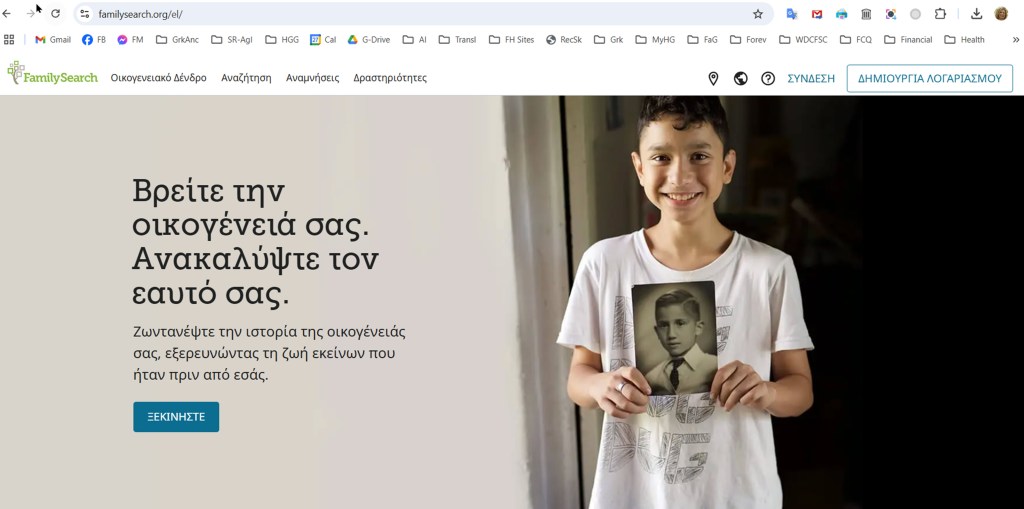
Today, FamilySearch has published its website in the Greek language! For our Greek-speaking friends throughout the world, and especially for those in Greece, this opens doors of discovery for your family history. The url is: familysearch.org/el. Congratulations to the technical specialists and IT engineers who made this possible!
FamilySearch is the largest FREE website in the world. Its collections of digital images from Greece is unsurpassed, and these can be accessed at any of the over 5,000 FamilySearch Centers worldwide.
I especially like using the FamilySearch tree. Each person has his/her own “page” which serves as a personalized memorial site. This is where I upload photos, documents and stories about each ancestor to his or her page. For example, this is the page for my paternal grandfather, John Andew Kostakos (Ιωάννης Ανδρέας Κώστακος). As you scroll through the tabs at the top of the page, you will see the Sources, Notes and Memories that document his life. The “About” page is a synopsis of all the information about him. Everything I have about my grandfather is posted on his page and is accessible to researchers now and in the years to come.
With all of the unrest in the world today, it is critically important that we preserve the work we are doing to document the lives of our ancestors. This preservation should be both personal (i.e., digitizing documents and sharing with family and uploading to a personal online account) as well as universally accessible (uploading to a reputable online genealogy website so that our research can be accessed by others both now and in the future).
I choose to use FamilySearch as my primary online genealogy website for these reasons:
1. FamilySearch International is a non-profit organization. It has always been–and will always remain–free of charge to use.
2. FamilySearch will never go away. Other genealogy websites are owned by investors and thus are subject to being divested, sold or eliminated. FamilySearch is a service provided by The Church of Jesus Christ of Latter-day Saints to everyone, regardless of tradition, culture, or religious affiliation. FamilySearch resources help millions of people around the world discover their heritage and connect with family members.
3. The FamilySearch tree is a collaborative tree, which enables people worldwide to share information about their common ancestor(s). Anyone can upload a photo or document, or share a source of information, to a person’s page in the tree (see example above of my grandfather, John Andrew Kostakos). By sharing data, we can work together to ensure that correct information is always available for an ancestor.
4. FamilySearch has many thousands of digitized images from Archives and repositories in Greece which are not found on any other website. The catalog for Greece can be found here.
5. The FamilySearch Wiki Greece page is an excellent resource to find historical documents in Greece, and to learn methodologies for researching in Greece.
I encourage you to explore FamilySearch as a provider of research documents and as a repository to preserve your family history research.

 Spartan Roots (Σπαρτιατικές Ρίζες)