by George Theoph. Kalkanis
published in The Faris Newsletter, Issue 62, July 2015, pages 3-6
(Note: this post, “Telephone” is the third of three parts describing the earliest modern developments in Xirokampi. Part 1: Light, can be read here; Part 2: Water, can be read here.)
The OTE telephone network entered the houses and shops of the village in the late 1960s and early 1970s. OTE, founded in 1949, succeeding the 3Ts (Post Office [“Tachidromio”] – Telephony – Telegraphy), then began to install telephones connected to automatic dialing systems. The systems for each rural area were operated in the, so-called, Rural Telephone Centers.
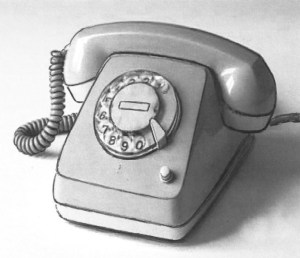
In Xirokampi the center was housed for a brief time in the post office that was installed on the ground floor of the house of Dimitris Xanthakos and was to serve the telephones of the inhabitants of the villages of the whole area. The first employee and supervisor was Georgios Evag. Karampelas, who took over all the operations related to telephone and telegraph communications. Then the center was relocated to the ground floor of Ilias Kapetanakos’ house. Panagiotis Il. Komninos and Vassilis Il. Christopoulos also worked at the center temporarily, before Efstratios Ioan. Kritikos was hired as a permanent employee.
In the past, telephones were operated by means of manual systems, whereby the selection of telephone connections was made by means of plugs that operators/answering staff inserted into holes in a panel. They measured with mechanical timers the duration of calls as well, while calls required the turning of a small ‘crank’.

The office of Xirokampi was connected through a telephone line to every neighboring village. Even earlier, communications were made from station to station by telegraph or teletype, which in Xirokampi were originally installed in the house of Sotiris Papadakos (or Kokkinos).
Automation, the expansion of the telephone network and the proliferation of telephones caused (also) in our villages, for some time, an upsurge in pranks among the residents. In Xirokampi, coffee shop waiters would move around with trays throughout the market after telephone orders turned out to be pranks. Also, some people woke up one night after a call from the headquarters – supposedly – of OTE and cut the wires of their phones when they were warned of an imminent explosion of their device (!). However, at the same time they enabled family members who were away – especially abroad – to talk more often and more privately (since the privacy of telephone conversations was not guaranteed by the – very little – soundproofed ‘booths’ in call centers). But they also reduced the frequency of the letters they exchanged, as the postal employees of the time (Dimitris Georgountzos, Georgios Katsaros and Kleomenis Anastasakos) found and claimed.
I am honored to receive permission from the Katsoulakos family to translate and share articles from The Faris. Translation verification and corrections have been made by GreekAncestry.net. This is the tenth article of the ongoing series. Previous articles can be viewed here.

 Spartan Roots (Σπαρτιατικές Ρίζες)