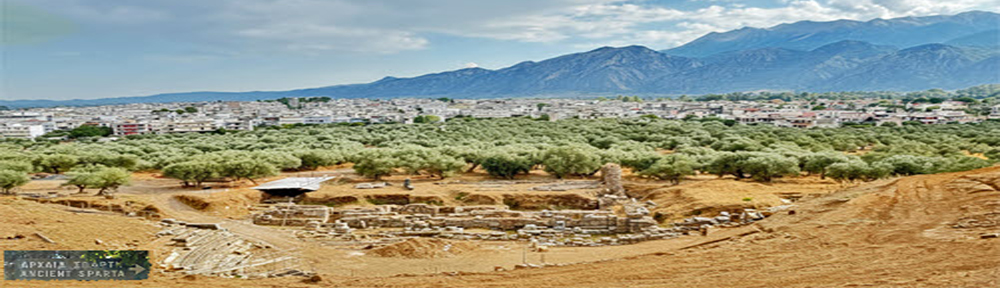
Guest post by Georgia Stryker Keilman, founder, Hellenic Genealogy Geek website and Facebook group
For years, I was focused on proving a family story which prevented me from considering other options and records to understand the history of my maternal great-great grandmother, Marigo Fousketakis (maiden name unknown).

This is the story as told to me by my mother in the 1980s. My great-great grandfather, Ioannis Fousketakis, was from Hania, Crete. He was conscripted into the Ottoman Empire military. During his service, in what is currently Turkey, he met a young woman and fell in love. She sewed gold coins into the hems of her clothing and ran off to be married. They ended up in Sparta, Greece and had four sons.
My mother heard this story for the first time after her mother’s death in 1967 (over 100 years after the event). My grandfather was visiting us and, over a cup of coffee, told my mother the story. Why hadn’t her mother ever told her this? My grandfather supposedly indicated it was because Marigo was “Turkish,” and my grandmother was ashamed to have this “Turkish” intermarriage in the family history. My mother assumed that being Turkish meant that she was Muslim and had converted to Greek Orthodox to marry.
Based on my mother’s assumptions, I made another assumption, that my great-great grandparents had fled from Turkey (Ottoman Empire) and went directly to Sparta. This was based on the fact a Muslim woman could not marry a Greek Orthodox male in the Ottoman Empire. It was against the law, and she would have been executed. I hoped I would be able to find some documentation regarding her conversion to the Greek Orthodox religion and a marriage record. I was unsure of the approximate date.
I reviewed the Mitroon Arrenon (Male Registers) for Crete on the GAK website, looking for a birth record for Ioannis Fousketakis, and then did further research in the archives in Sparta.
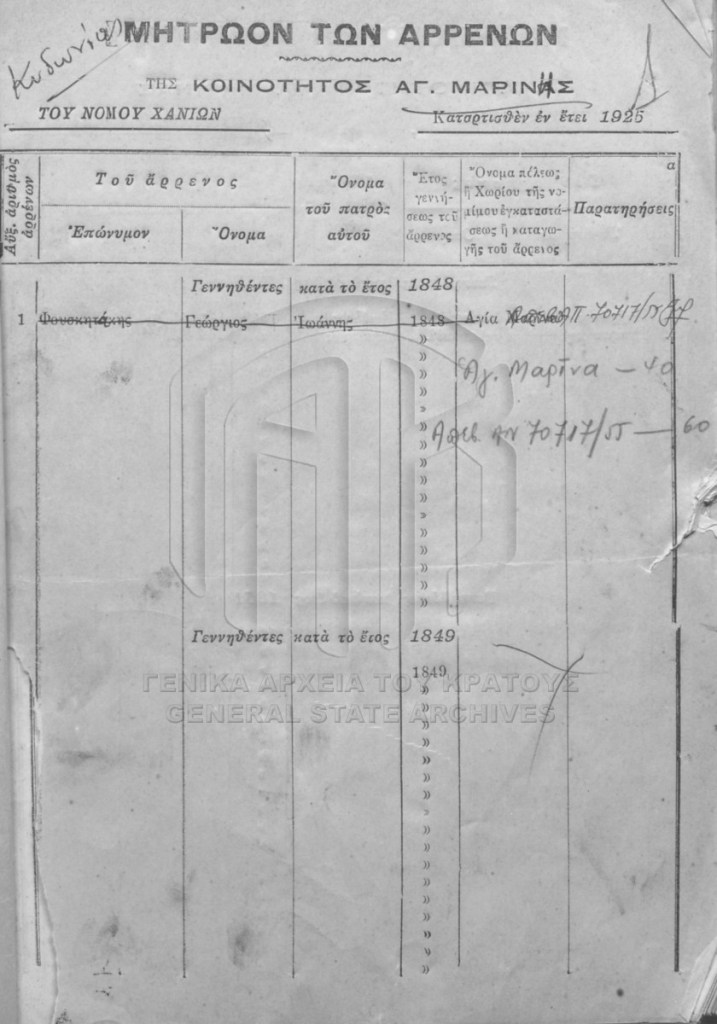
· Did not locate a record for the birth of Ioannis Fousketakis
· Located Mitroon Arrenon for GEORGIOS, son of Ioannis – born 1848 in Agios Marinas, Crete (village near Hania).
· Located Mitroon Arrenon for NIKOLAOS, son of Ioannis – born 1857 in Sparta, Greece
· Located Mitroon Arrenon for my great-grandfather, ANASTASIOS Fousketakis, son of Ioannis – born 1874 in Sparta, Greece.
· I also located the 1897 Sparta marriage record for EMMANOUIL Fousketakis, son of Ioannis – no birth date indicated.
There are 26 years between the births of Anastasios in 1874 and Georgios in 1848.
Based on this age difference I didn’t think that Georgios was in my direct family. Instead, becauseGreek male names can repeat, generation after generation, I assumed these records referred to a different branch of the family. I totally ignored the Crete records that referenced Ioannis Fousketakis from Crete for years as not being “my Ioannis Fousketakis” because a child born in Crete didn’t fit into my family story.
If Ioannis and Marigo had a son born in Crete, that would mean that the family story of the couple running away and going directly to Sparta from Turkey to marry would be incorrect.
Instead, if they came back to Crete, which was part of the Ottoman Empire, Marigo must have been from a family who was Greek Orthodox living in current Turkey which was also part of the Ottoman Empire.
Lessons learned:
- Consider the source of your family story. My source was my mother, who heard the story from her father, who heard the story from his wife who was the granddaughter of Ioannis Fousketakis. On reflection, it is not hard to believe that my grandfather could have embellished the story.
- Follow the records, not the story. I totally dismissed records that didn’t fit the scenario I was trying to prove.
NOTE: This is the second in a three-part series, Follow the Records. Read Part One here.

 Spartan Roots (Σπαρτιατικές Ρίζες)
Happy Canada Day, y’all! I have a family legend, which for obvious reasons was tantalizingly proffered then quickly withdrawn or dismissed: my father’s mother was said to have been abandoned on a mountainside and left to die. Apparently, her family could not afford one more child and her father ordered someone, perhaps an older brother, to wrap her in swaddling and leave her in a spot in the Parnon Mountains. The father, not trusting that his orders had been followed, went to check the work and when he peeled back the swaddling, the baby girl smiled at him and his heart was melted. Darkly charming story, eh, but not one that could be verified. It’s an open secret that infanticide was practiced in Southern Europe as a means of population control, but certainly not discussed. So how did this grisly story survive? There must have been a grain of truth at its core. Kind of like “Jenufa” but set in Lakonia.
Wow! What a family story! Thank you for sharing with us 🙂
Pingback: Friday’s Family History Finds | Empty Branches on the Family Tree
I have different stories that are also connected with Turkey and Crete, and also Kefalonia and Egypt. The people in my grandfather’s family had professional careers (civil engineer, doctor, mechanics, sailor), but I have not been able to find records for any of them, except for my grandfather in Egypt who was born in Kefalonia, went to school in France, worked in Smyrna before moving to Egypt. It appears that they often did hide the real stories for various reasons. I am afraid the Kefalonia records were destroyed by the 1952 earthquake. I am hoping as records are added to the Greek ancestry website I will find some somewhere in Greece. These mysteries are difficult to ignore, and it is very difficult to avoid making assumptions. I have created scenarios, then wrote about the “what ifs” which often lead to viable places to search. Thank you for your story.
Thank you for sharing this with us! Your “what if” concepts are a great approach to considering additional research options. We truly need to think “outside the box” when records are scarce or non-existent. I hope additional information will be forthcoming soon to help you. 😊