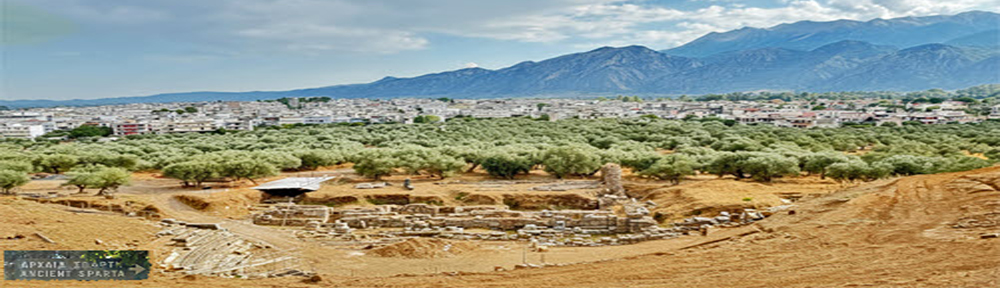
Beware of Translation Tools!

Knowing how important notary contracts are in finding information about our ancestors, I was very excited when Gregory Kontos of Greek Ancestry brought me a book published by Pepi Gavala, Archivist at the General State Archives of Greece, Sparta Office.[1] This book is not just a synopsis, but a full extract, of contracts from the collection of the notary, Georgios Chartoularis, 1833-1835.
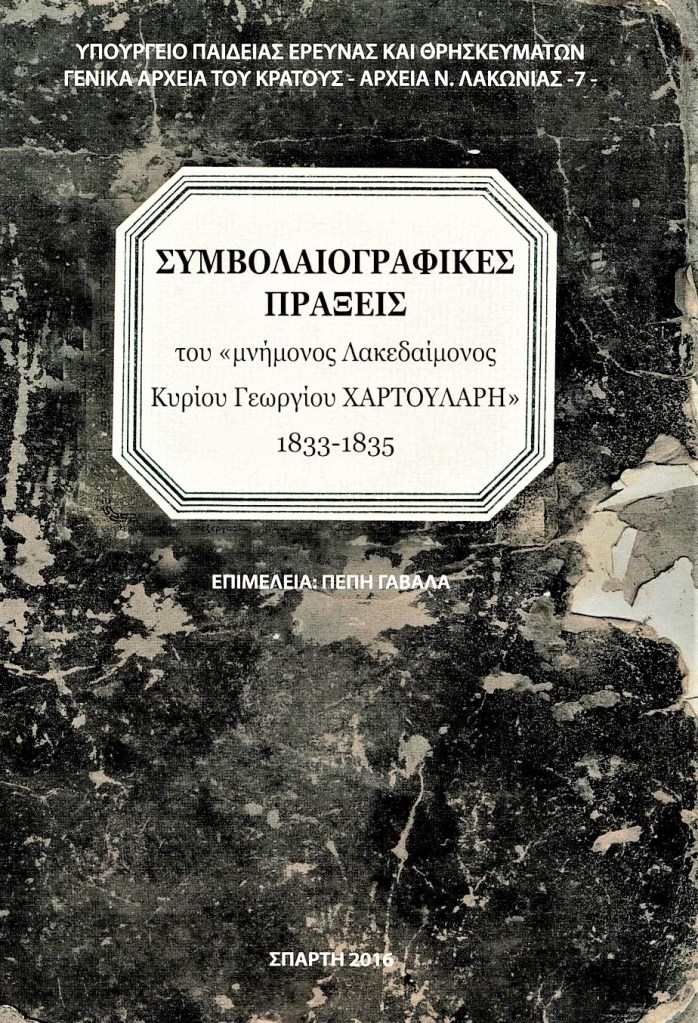
Gavala, Pepi. Notary book of Georgiou Cartoularis of Lakedaimonos, 1833-1835. Sparta, 2016

I used the index to find entries of interest to me, and Gregory provided a synopsis of the contracts.

Here is an example: Contract 388, page 365-366; year 1834.
In the parish of Stavros in Mystras. Martha, daughter of the late Diamantis Dimitrakakis and wife of Anagnostis Dimakos. Martha had property which was part of her dowry. She wanted to sell the property to build a house  in Mystras. Martha’s brothers and her nephew gave permission for her to sell the property to another nephew, Ilias Michalopoulos.  It is unclear whether Martha’s brothers actually owned the property with her, or if they just gave permission for its sale.
Martha’s two brothers were: Theodorakis and Dimitrakis Diamantopoulos, sons of Diamantis [note: they took their father’s first name as their surname!]
Martha’s nephews [sons of her two sisters who are unnamed, but I now have her sisters’ married names]: Diamantis Panopoulos; and Ilias Michalopoulos the one to whom she sold her property.
Permission was given by Martha’s brothers, Theodorakis and Dimitrakis, and her nephew, Diamantis Panopoulos, to sell her property to her nephew, Ilias Michalopoulos.
The contract explains exactly where the property was located in Vitinarias, Mystras.

I was curious to learn some details about the property being sold, so I typed the contract into both Deepl and Google Translate. I was both surprised and confused when the word, αυτάδελφος, (relating to Martha’s brothers) appeared with different translations.

I looked in my Collins Greek-English dictionary and the word was not there.

I checked the dictionary, Λεξικό της ελληνικής ως ξένης γλώσσας, and the word was not there.

Babel Fish gave me the message: “failed translation.”

Microsoft/Bing translated the word as: self-brother (what does THAT mean?)

Systran: translated the word as: colleague

Βικιλεξικό: produced several definitions:  self- brother <ancient greek  αὐτάδελφος <αὐτός + ἀδελφός αυτοδελφος male (female cousin and cousin) brother (from both parents).

By this point, I was truly frustrated. Having the exact relationship is critical in genealogy research and I had many variations. Finally it dawned on me that this word, αυτάδελφος, used in 1833, may be obsolete in modern Greek. Giving it one last try, I went to the Google search bar and typed:  What is the definition of αυτάδελφος? A “new to me” website, WordSense gave this definition: (rare) brother-german, full-brother. And under related words and phrases was: see αδελφός (masc.) (“brother”)

Intrigued, I clicked on brother-german, and found this definition: A full brother: a brother born to the same mother and father, as distinguished from half-brothers, step-brothers, or ‘brothers’ established through relationships such as wardship. 

I went back to Greg and he confirmed that αυτάδελφος is obsolete and no longer used.  He also said that old documents may use the term αθταδέλγη as full sister. Another colleague pointed out that ετεροθαλής is a half-brother.

Now I know why the printed and online dictionaries of MODERN GREEK do not have αυτάδελφος (it’s not a modern word!), and why online translation services mistranslated it.

Important lesson learned:  when translating old documents, do not rely on online translations. They’re okay to get a general idea of the context of the document, but when it comes to important items such as relationships, ask Greek Ancestry for translation help. If Greg had not done the translation and I had relied solely on the translating tools, the relationships in my family tree would have been totally wrong, leading not only to misinformation but to utter confusion when corroborating evidence from various sources.

_______
[1] Gavala, Pepi. Notary book of Georgiou Cartoularis of Lakedaimonos, 1833-1835. Sparta, 2016. Contract #388, page 365

Muslim Converts of Agios Ioannis Sparta in the Year 1689

Although Greece currently is, and has historically been, a Christian Orthodox country, Jewish and Muslim communities have existed within its borders for centuries. Scholars have written extensively about Greek conversions to Islam during the Ottoman occupation, but the same level of study has not been given to Muslims who converted to Christianity. Although not common, it did happen, especially during and after the Revolution of 1821.

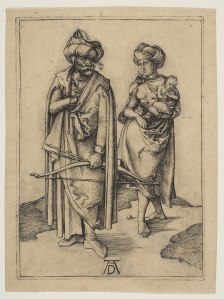
Turkish Family, circa 1500
Metropolitan Museum of Art, New York City

Why would a Muslim, living in a Greek village, voluntarily change religions? “Muslim converts to Christianity were ready to compromise their Islamic faith in exchange for security, social status, and well-being in the changed political and social environment created by Greek nationalism, with a view to advancing their professional opportunities and material interests in the new state.”[1]

Abandoning their faith and adopting a new identity, some converts retained their names; others either took the name, or were given the nickname, of Neofotistos (Νεοφώτιστος), loosely translated as “new light.” Converts, particularly females, who were ostracized by their families found safety through conversion and marriage, and easily assimilated into village life.   

In his essay, Neophotisti and Apostates: Greece and Conversion in the Nineteenth Century,[2] Evdoxios Doxiadis, through his study of notarial and court records, found that “their [Muslim converts] numbers may have been more significant than previously thought.” He writes, “although the evidence presented here is sporadic, it is also indicative of a noteworthy presence of converts, and especially female converts, in the early decades of the modern Greek state and their integration into Greek society as wives and property owners.”

In 2014, historian Giannis Michalakakos gave me a copy of the Periodical Study of the Society of Lakonian Studies, Volume 9. Comprised of essays and documents retrieved from the Venetian Archives (Archivio di Stato), it includes a “list of Turks who became Christians, with their women and children, who are inhabitants of the respective places of the province of Mystras.”[3] The document is dated 1689, and the statistical information was obtained during the Second Venetian rule in the Peloponnese. The villages listed in the document are: Mystras, Agios Ioannis Sparta, Sklavochori, Arkasa, Lopesi, Floka, Kastri and Voaria.

In my ancestral village of Agios Ioannis Sparta, the following converts from Islam to Christianity are named:

Theodoris Bettiafaci, age 40 years
Giannoula, his wife
Panagiota, his daughter
Giannoula, his other daughter

Ilias Papoutsis, age 45 years
Kanella, his wife
Panagiota, his daughter, age 18 years

Ilias Papoutsis, age 45 years
Kanella, his wife
Panagiota, his daughter, age 18 years
Nikolaos, his son, age 11 years

Panagiotis Zalamachera, age 32 years
Panoria, his wife
Baroloni, his son

Ilias Chortatzis, age 20 years
Pagona, his wife
Panagiotis, his son

Giannis Krevelis, age 30 years
Pagona, his wife
Garoufalia, his daughter
Panagiota, his other daughter

Giannis Tsakalis, age 45 years
Maroula, his wife
Kontylo, his daughter

Dimitrios Karas, age 40 years
Panagiota, his wife

Panagiotis Vlachakis, age 28 years
Venetia, his wife

Giannakis Staveris, age 32 years
Paraskevi, his wife
Giorgios, his adopted son

Panagiotis Thereianos, age 39 years
Panoria, his wife
Maria, his daughter
Venetsiana, his sister
Giannis, his son
Dimitrios, his other son
The female, Kanella Achmetitsa
Dominikos, her son
The female, Maroulla Paina
The female, Maroula Koutsevaina
The female, Maria Katanaina

Widow Magio (Maro) Karamenmetaina
Nikolaos, her son

Alexandros Mpanamakis, age 25 years
Chrysafo, his wife

Giorgios Kazakis, age 30 years
Isabeta, his wife

The majority of these surnames are Greek, leading me to wonder if the Muslim convert was the wife who took a Greek given name after marriage. Unfortunately, the document does not provide further details. I find it interesting that none of the names are “Neofotistos;” however, I have found that name many times in the Μιτρόον Αρρένον (Male Register) and Δημοτολόγιον Κοινότητος (Dimotologion Koinotitos) documents from the Archives of Sparta, which were created in the mid-late 1800s.

 “The idea that Greece emerged [from the Revolution] as a solidly homogenous Christian state is rarely challenged,” Doxiadis concludes.[4]  Yet the records prove that a rich kaleidoscope of ethnicities have melded over the centuries to forge the modern Greek people of today.


[1]  Katsikas, Stefanos and Dimitriadis, Sakis, *Muslim Converts to Orthodox Christianity during the Greek War of Independence, 1821–1832,” European History Quarterly, Vol 51, Issue 3, 2021, page(s): 299-323. SAGE Publications: 07/01/2021. https://journals.sagepub.com/doi/full/10.1177/02656914211025378

[2] Doxiadis, E. (2022). Neophotistoi and Apostates: Greece and Conversion in the Nineteenth Century. Historein20(1). https://doi.org/10.12681/historein.24980. paragraphs 16 and 19.

[3] Lakonian Studies, Periodical Study of the Society of Lakonian Studies, Volume 9, page 272. Athens: 1988. Mystras, 20 September 1689, Document Number 21

[4] Doxiadis, paragraph 34.