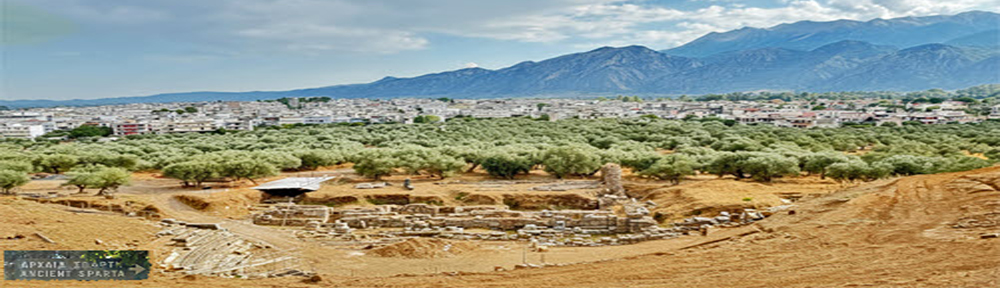
This post and part one examine the everyday life of our Spartan ancestors from the mid-1800’s to mid-1900’s, and draws upon Thomas W. Gallant’s book, Modern Greece From the War of Independence to the Present.
in the years after the 1821 Revolution, the majority of Spartans lived, worked, married and settled within a few kilometers of their place of birth. Marriages occurred among couples living in close proximity–usually within one day’s walk or donkey ride from each other. Women married in their early twenties, and men by their late twenties. Almost all Greek men and women married; they married somewhat younger and lived longer than their forebears; and they produced more children who survived into adulthood.[1]
Households were a mix of nuclear (parents and children), extended (nuclear plus one or more relatives, often a widowed parent) and joint (one or more married siblings, usually brothers, with their families residing together). Sometimes, the family occupation determined which type was most beneficial; for example, “more complex households were better able to pool resources and manage labor in a way better suited to the needs of shepherding, especially where transhumance was involved.”[2]

Herding goats in Vathia, 2014
Newlywed Spartans followed a common pattern found throughout southern Europe: their new household was formed by “combining the land that the husband received as his inheritance with the property that the woman brought through her dowry.”[3] Young girls worked for years preparing their dowries, which consisted of linens, clothing, jewelry, household utensils and often land. (See this post about dowries.) Thus, the contributions of both men and women were equally important in creating a fully and mutually supportive household.
The Men
The σπίτι (literally “house” but used to designate the household) was the primary unit of society and family, and it was the man who was its primary protector. Gallant explains:
A man’s overarching obligation was to protect and further the interests of his household, his σπίτι, and after that, it was to the extended network of men to whom he was related by blood. Should a conflict arise between household and community, between kin and non-kin, the former always took precedence. Household interests come before all others.[4]
Interwoven with responsibility for the σπίτι is the concept of τίμι or honor. This was of paramount importance in the Greek community. A man of τίμι commanded respect by maintaining firm control of his land, property, animals and family. As such, he could deploy any means to defend and protect them. In 19th century peasant society, if a man or his family was insulted, injured or wronged in any way, “he had to respond with aggression or risk seeing his reputation diminished.”[5] The result was often manifested in a vendetta, a form of honor-related violence. Any threat, implied or real, to the σπίτι justified a man’s need to defend his family and thus, his own character. Of the highest priority was protecting the reputation of women. If confronted with “any imputation that the women of his household were anything less than chaste, a man had either to rise to the challenge and fight, or be humiliated. This form of violence was socially sanctioned and accepted.”[6] While many vendettas became feuds ending in death, others were resolved by arbitration sealed with the payment of “blood money” and even marriages between the dueling parties.
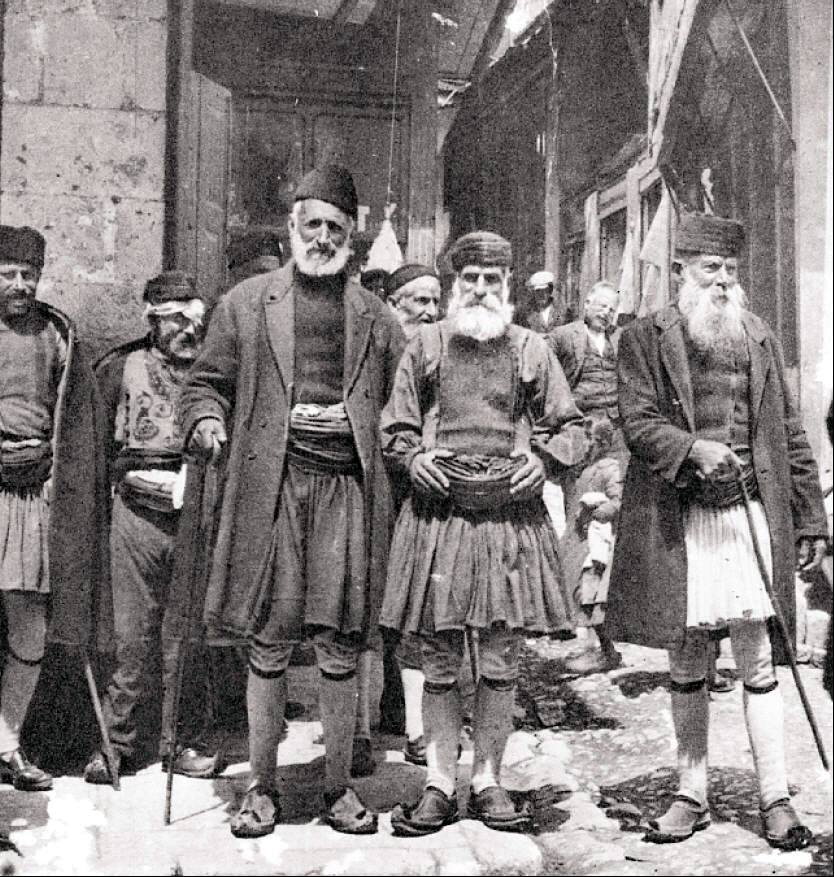
Elder Tripolitsiotis with fusanelles, c. 1900. Archive of N. Grigorakis. From the tribute to Kathimerini on 4/6/1995 “Tripoli the heart of the Peloponnese.” Appreciation is given to Giannis Mihalakakos for sharing this photo.
The strata of Spartan society, even in rural villages, reveals a variety of levels tied to men’s occupations. Some households were larger and wealthier than others, employing laborers to work their fields and shepherds to tend their flocks. Men’s occupations included: shepherds, goatherds, farmers, landowners, laborers, traders, grocers, butchers, bakers, tobacconists. Some learned trades and hand crafts, working with leather, wood or stone; these men became sandal makers, rope makers, cobblers, masons, carpenters. Schooling, if it existed, was rudimentary and most adults were illiterate.
The Women
“In many ways, a woman’s life only began when she got married. Marriage signified not just her transformation from child to woman but it also marked the union between two households and between two sets of kinsmen…Once a wife, a woman had to conform to roles society defined for her.”[7] These roles were paradoxically simple yet complex. The house was her domain; modesty was her virtue. From bread for the stomach to prayers for the soul, a woman provided both physical and spiritual nourishment to those within her σπίτι.
Her life was dominated by food preparation, fetching water, and the care and nurture of children. Women spun and wove cloth, and produced clothing. In the early-mid 1900’s, many Spartan families owned silkworms and it was the women who tended them, spun the silk and created intricate embroidery. They also worked the fields, threshed grain, tended animals and assisted during the harvest.

Cornelia Themistocles, baking bread in her outdoor oven, c. 1930; photo courtesy of Theodore Papaloizos
Like men, women defended their own reputations and that of and their family members. Unlike men, they did not resort to violence, but to words. Gallant wrote:
“There was an ethical code for women similar to men’s honor and, like men, women engaged in contests over reputations…If a woman did not contest malicious gossip about sexual comportment, the cleanliness of her house or her devotion to the church, her sons might have a harder time to find a good match, her daughters might require a much larger dowry to secure a husband, or her spouse might find himself drawing the blade to defend her and his reputation.”[8]
.Although men and women’s lives were segregated by custom and tradition, they were united in one common purpose: to prosper the household and protect those within it. That tradition remains paramount in Greek families through today and throughout the diaspora, and is a hallmark of our Hellenic heritage.
____________
[1] Gallant, Thomas. Modern Greece, New York: Bloomsbury Academic, 2016. p.121.[2] Ibid., p. 122.
[3] Ibid., p. 125.
[4] Ibid, p. 124.
[5] Ibid., p. 143.
[6] Ibid., p. 145.
[7] Ibid., p. 148.
[8] Ibid., p. 150.

 Spartan Roots (Σπαρτιατικές Ρίζες)
Thank you. I have ordered Gallant’s book from Amazon
You will enjoy it! 😊